Audio ›
by Joshua Thomas
Which 10-inch subwoofer actually delivers the low-end punch your system deserves, and which ones are just spec-sheet fiction? After spending serious time evaluating power handling, motor design, and real-world output across seven of the most popular options on the market, we've got a definitive answer — and the Rockford Fosgate P3D4-10 earns the top spot in 2026 with a combination of proven engineering and reference-quality bass that the competition genuinely struggles to match. But depending on your build, your budget, and your enclosure situation, one of the other six picks here might actually be the smarter choice for your specific setup.
The car audio market is absolutely flooded with 10-inch subwoofers making enormous claims, and sorting through 500-watt-RMS workhorses versus 8,000-watt-max competition monsters with wildly inflated numbers requires a framework that actually means something. We looked at cone materials, surround construction, basket rigidity, motor topology, and voice coil cooling systems — because those are the variables that separate a subwoofer that sounds great for three years from one that starts distorting after six months of hard daily use. Whether you're building a clean daily driver system or pushing toward competition-level SPL, this guide covers every tier of the market with honest, spec-backed assessments.
If you're also shopping for full-range sound reproduction upgrades beyond just bass, our guide to the best car speakers of 2026 covers the top coaxial and component options to pair with your new sub. And if you're curious whether a 10-inch is the right diameter for your situation or whether you should consider stepping down, our best 8-inch car subwoofers roundup gives you the direct comparison you need before committing to a purchase.

Contents
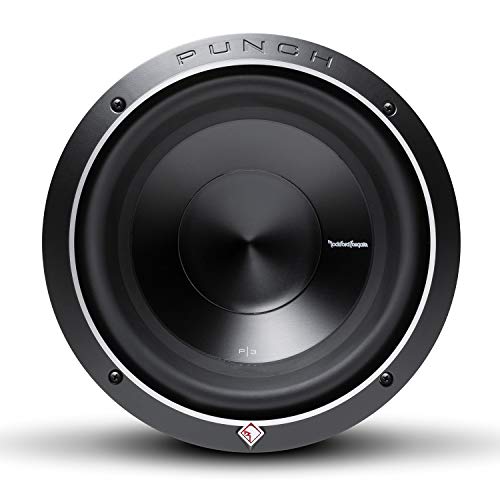









The Rockford Fosgate P3D4-10 is the benchmark that every other 10-inch subwoofer on this list gets measured against, and it earns that position through decades of refinement rather than flashy marketing claims. Rated at 500 watts RMS and 1,000 watts peak through its dual 4-ohm voice coil configuration, this sub delivers what Rockford calls reference-quality bass — and in practice, that means tight, articulate low-end that stays controlled even when you're pushing the woofer hard into complex musical passages. The anodized aluminum cone and dustcap combination gives you a lightweight yet rigid piston that responds quickly to transient signals, reducing the smearing that softer polypropylene cones can introduce at high excursion levels.
The hybrid stamp-cast basket is one of the engineering highlights here, combining the strength advantages of a full cast design with significantly reduced weight and resonance, and you can feel the quality the moment you pick this driver up. Rockford's signature spider venting system channels airflow through the motor assembly to keep voice coil temperatures down during sustained high-power operation, which directly translates to longevity in daily-driver applications. The 10-AWG nickel-plated push terminals are a practical touch that makes wiring clean and secure without the fussiness of some spring-clip designs. If you're building a sealed or ported enclosure for daily use and want a sub that genuinely sounds as good as it performs on paper, this is your driver.
According to Wikipedia's overview of subwoofer technology, effective motor cooling and rigid cone materials are the two primary factors in sustained high-output performance — and the P3D4-10 addresses both with purpose-built solutions rather than afterthoughts. Wiring the dual 4-ohm coils in parallel gives you a 2-ohm final load for most Class D mono amplifiers, while series wiring delivers the full 8-ohm load for amplifiers that prefer a higher impedance — that flexibility alone makes this sub compatible with a wider range of amplifiers than single-voice-coil alternatives.
Pros:
Cons:
KICKER's CompVX line has been refined through multiple generations into one of the most dependable daily-driver subwoofer families in the mid-range market, and the 50CVX104 represents the current peak of that evolution for the 10-inch format. The thick polypropylene cone is the right material choice for this application — it handles temperature swings better than composite cones, provides a warmer, fuller bass character that works exceptionally well with hip-hop, EDM, and modern pop, and it's inherently resistant to moisture damage from condensation inside enclosures. KICKER's signature double blue surround stitching isn't just aesthetic; it indicates a reinforced surround attachment that prevents the common failure point where the surround separates from the cone or basket under high-excursion stress.
The dual 4-ohm voice coil configuration gives you the same wiring flexibility you get on the Rockford, letting you run 2-ohm parallel for maximum power transfer or 8-ohm series for amplifiers with broader impedance ranges, and KICKER's voice coil engineering on the CompVX line is built specifically for the sustained thermal loads that come with daily listening at moderate-to-high volume levels. The overall build quality on the 50CVX104 has a satisfying solidity to it — the basket is rigid without feeling unnecessarily heavy, the spider feels appropriately progressive in its compliance, and the cone pistoning action is smooth and linear across its travel range. This is a sub that rewards proper enclosure tuning and delivers consistent, satisfying bass week after week without requiring babysitting.
Pros:
Cons:
The Alpine RS-W10D4 solves the most frustrating problem in car audio — how do you get genuinely powerful, low-distortion bass when your vehicle simply doesn't have the depth to accommodate a conventional 10-inch driver and its required enclosure? Alpine's answer is the Gen2 DD-Linear Magnetic Circuit, a compact dual-gap voice coil structure that achieves better motor control in a shallower profile than traditional single-gap designs, and the result is a shallow-mount sub that doesn't sound like a compromise — it sounds like a properly engineered driver that happens to fit where others won't. The ultra-shallow design opens up installation locations in trucks, SUVs, and sedans with minimal trunk intrusion while still delivering the kind of precise bass control that justifies the R-Series price point.
The lightweight aluminum dustcap is the key to how this sub maintains clean transient response despite the physical constraints of its shallow mounting depth — aluminum's stiffness-to-mass ratio keeps the piston behavior linear across the driver's excursion range, minimizing the breakup modes that degrade imaging and definition in cheaper shallow-mount designs. Alpine's dual 4-ohm voice coils wire down to a 2-ohm parallel load for maximum power delivery, and the DD-Linear topology specifically reduces distortion at the upper end of the bass range where articulation matters most. If you're in a scenario where conventional depth isn't available but you refuse to sacrifice output quality, this is the sub that eliminates the trade-off — it's also worth comparing against our picks in the best shallow mount car subwoofers guide for the full competitive landscape.
Pros:
Cons:
Skar Audio has built a loyal following by engineering subwoofers that deliver competitive performance at price points that established brands have consistently underserved, and the EVL-10 D4 is the clearest example of that philosophy working exactly as intended. At 1,000 watts RMS and 2,000 watts peak through its dual 4-ohm configuration, this sub handles real-world amplifier power that many drivers in its price class would struggle with, and the 3-inch high-temperature voice coil with its black coating is the engineering detail that makes those numbers credible rather than marketing fiction. A 3-inch coil has roughly 50% more surface area than the 2-inch coils found in entry-level 10-inch drivers, which directly translates to better heat dissipation and the ability to sustain high power levels without thermal compression degrading your output.
The competition-grade paper cone with high roll foam surround is a pairing that Skar has refined across multiple EVL generations, and the combination produces bass that's noticeably punchy and impactful in ported enclosures while maintaining adequate control in sealed applications — the paper cone's natural warmth complements Skar's motor tuning in a way that sounds more musical than you'd expect at this price point. The dual 4-ohm coils give you standard parallel wiring to 2 ohms or series wiring to 8 ohms for maximum compatibility with your existing amplifier, and Skar's documented Thiele-Small parameters make enclosure design straightforward whether you're using a calculator or WinISD. For the buyer who wants legitimate high-output performance without paying premium-brand prices, the EVL-10 D4 is the clear answer in 2026.
Pros:
Cons:
The ORION HCCA102 exists in a completely different category than the other subs on this list — this is a dedicated competition-grade SPL driver rated at 2,000 watts RMS and 8,000 watts max peak power, built specifically for the kind of sustained extreme-power operation that destroys conventional drivers within minutes. The custom cast aluminum frame is the foundation of the build, providing the absolute rigidity required to maintain motor geometry alignment when a massive triple-stack magnet is generating the flux levels necessary to move a cone at competition output levels. Orion's triple-stack magnet isn't marketing hyperbole — each additional magnet plate adds gap flux density, which directly increases the BL product and the motor's ability to control the cone throughout its excursion range at extreme power levels.
The 3-inch aluminum voice coil is the other critical component here, because aluminum dissipates heat faster than copper-clad aluminum alternatives, and the enhanced vented coil cooling system ensures that the thermal energy from sustained high-power operation actually exits the motor assembly rather than building up inside the gap. Dual 2-ohm impedance means your final parallel load is 1 ohm — demanding territory that requires a serious amplifier with stable 1-ohm output capability, so this sub is genuinely not appropriate for casual daily-driver builds. The moisture and UV-resistant cone treatment is a practical detail for vehicles that see significant temperature variation. If you're competing in SPL classes or building a dedicated demo vehicle in 2026 where outright acoustic output is the only metric that matters, the HCCA102 delivers it without compromise.
Pros:
Cons:
Arc Audio occupies a specific niche in the car audio market — they engineer their products in the USA with a level of SQ-focused attention to motor linearity and transient accuracy that most volume-market brands simply don't prioritize, and the ARC-10D4 is the most direct expression of that philosophy in a 10-inch format. The high-temperature black anodized voice coil is built for both thermal performance and linear behavior throughout its operating range, and Arc's stated design goal of linear dynamics at both low and high volume levels is what separates this sub from competitors that measure well on a bench at modest power but start compressing and distorting under real-world listening conditions. The ARC-10D4 is the driver you choose when accuracy and musicality matter as much as peak output numbers.
Arc's SPL and dynamics performance are genuinely impressive given the sub's SQ-tuned motor design — this isn't a driver that sacrifices impact for refinement, it delivers both by getting the linear design fundamentals right rather than chasing peak power figures with oversized motors that compromise excursion control. The dual 4-ohm voice coil configuration matches the standard wiring options available on most modern mono amplifiers, and Arc's engineering team has clearly thought carefully about how the motor, suspension, and cone system interact across the full operating range. For buyers who care about reproducing bass accurately rather than just loudly, and who want to support USA-engineered audio products in 2026, the ARC-10D4 earns its premium positioning with substantive engineering rather than brand mythology.
Pros:
Cons:
The NVX VCW104v3 is the third generation of a subwoofer platform that NVX has refined based on real-world customer feedback, and the Version 3 designation isn't cosmetic — this sub incorporates specific structural improvements that address the durability and output weaknesses identified in its predecessors. The carbon fiber enhanced non-pressed paper cone is the standout material choice here, because carbon fiber reinforcement gives the cone the rigidity advantages of composite materials while preserving the natural damping characteristics of paper that contribute to warm, musical bass reproduction. The custom high roll foam surround with black nylon stitching is both a quality indicator and a practical reinforcement, and the die-cast aluminum vented basket provides the structural foundation that prevents resonance artifacts from contaminating the bass output.
At 1,000 watts RMS and 2,000 watts max through its dual 4-ohm voice coils, the VCW104v3 handles serious amplifier power in a package that undercuts most competing subs at equivalent specifications, making it the obvious choice for builders who want maximum performance-per-dollar rather than maximum performance regardless of budget. The vented basket design aids voice coil cooling during sustained high-power operation, and the dual 4-ohm configuration gives you the standard parallel-to-2-ohm or series-to-8-ohm wiring flexibility that makes this sub compatible with the vast majority of mono amplifiers on the market today. NVX doesn't have the marketing budget of KICKER or Rockford, but the VCW104v3 competes on substance — and for buyers who do the spec comparison work rather than buying brand names, this sub represents genuinely exceptional value in 2026. You might also want to pair it with quality full-range sound — our best 6x9-inch car speakers roundup covers the top options for completing your system upgrade.
Pros:
Cons:
Shopping for a 10-inch subwoofer in 2026 means navigating an enormous range of price points, power ratings, and construction approaches, and the difference between a satisfying purchase and a disappointing one almost always comes down to matching the driver's actual specifications and design intent to your specific system requirements. These four criteria separate the important variables from the marketing noise.
Every subwoofer listing prominently features two power numbers — RMS and peak (or maximum) — and the only one you should use for amplifier matching is RMS. Peak power ratings represent brief, instantaneous capability that doesn't reflect sustained operation, and amplifiers deliver continuous RMS power rather than intermittent peaks, so matching on peak numbers almost always means you're either underpowering the driver (wasting its capability) or the peak rating is inflated beyond physical plausibility and tells you nothing useful. Your amplifier's RMS output at your subwoofer's impedance should fall between 75% and 125% of the driver's RMS rating — a 500W RMS sub pairs ideally with an amplifier delivering 400–625W RMS at the wiring impedance you're running. Voice coil cooling technology, whether spider venting (Rockford), enhanced venting (Orion), or basket venting (NVX), directly affects how long a driver sustains its rated RMS handling before thermal compression sets in.
Dual voice coil subwoofers give you wiring flexibility that single voice coil drivers can't match — wiring the coils in parallel halves the impedance (two 4-ohm coils become 2 ohms, two 2-ohm coils become 1 ohm), while wiring them in series doubles it (two 4-ohm coils become 8 ohms). Most modern Class D mono amplifiers deliver their rated power at 1 or 2 ohms, so a DVC 4-ohm subwoofer wired in parallel to 2 ohms is typically the sweet spot for maximum power transfer without pushing your amplifier into unstable territory. The ORION HCCA102's dual 2-ohm coils wiring to 1 ohm parallel is the exception — that configuration requires explicitly 1-ohm-stable amplification, and not all mono amps meet that requirement safely. Always verify your amplifier's minimum stable impedance before selecting a dual 2-ohm driver.
The enclosure you build or buy for your 10-inch subwoofer has as much influence on the final sound as the driver itself, and the optimal enclosure type depends entirely on your listening priorities rather than on universal preference. Sealed enclosures deliver tighter, more accurate bass with a gradual rolloff below the tuning frequency — they're smaller, easier to design, and they generally sound more musical with acoustic genres, jazz, and anything where low-frequency accuracy matters more than maximum output. Ported enclosures trade some control for significantly higher output efficiency in the tuning range, making them ideal for hip-hop, EDM, and any application where impact and loudness are the primary objectives. The Thiele-Small parameters (Fs, Qts, Vas, Xmax) published by manufacturers like Skar and NVX let you use software like WinISD to model your specific driver in a proposed enclosure before building anything — this step alone prevents the most common and expensive subwoofer installation mistakes.
The cone material determines both the acoustic character of the bass and the driver's resistance to environmental stressors, and each material involves genuine trade-offs rather than universal superiority. Aluminum cones — as used on the Rockford P3 and Alpine RS-W10D4 — provide exceptional stiffness-to-mass ratios that produce fast, articulate transient response, but they can sound slightly analytical or bright compared to softer materials in some musical contexts. Polypropylene cones (KICKER CompVX) handle moisture and temperature cycling better than any alternative and deliver the warm, full bass that suits most popular music genres, but they're heavier and slower in transient response than aluminum or carbon-fiber composites. Paper-based cones (Skar EVL-10, NVX VCW104v3) occupy the middle ground — warm and musical with naturally good damping characteristics, but requiring more attention to moisture exposure in wet climates or vehicles with poor insulation. Surround construction quality directly affects longevity: double-stitched surrounds (KICKER) and foam surrounds with reinforced attachment points (NVX) outlast simple single-stitched rubber surrounds in sustained high-excursion applications.
Match your amplifier's RMS output at the wiring impedance to between 75% and 125% of your subwoofer's RMS rating. For a 500W RMS sub like the Rockford P3D4-10, you want an amplifier delivering 400–625W RMS at your final wiring impedance — underpowering risks distortion-induced damage from a clipped signal, while overpowering by more than 25% risks exceeding the driver's thermal and mechanical limits during sustained peaks.
A dual voice coil (DVC) subwoofer has two independent voice coils wound on the same former, giving you wiring flexibility unavailable in single voice coil designs. Wiring DVC coils in parallel halves the impedance for maximum power transfer to most Class D amplifiers, while wiring in series doubles the impedance for amplifiers that prefer higher loads. DVC drivers also allow you to bridge multiple subwoofers to a single amplifier channel in configurations that single voice coil drivers can't support. Every subwoofer on this list is a DVC design.
Neither enclosure type is universally better — the right choice depends on your listening priorities and the specific driver's Thiele-Small parameters. Sealed enclosures produce tighter, more accurate bass with a natural rolloff below tuning, making them ideal for music-focused builds where low-frequency accuracy matters. Ported enclosures deliver significantly higher output efficiency around the port tuning frequency, producing the loud, impactful bass that hip-hop and EDM listeners prioritize. Use the manufacturer's published Thiele-Small parameters and free tools like WinISD to model both options for your specific driver before committing to a box build.
You can physically connect a subwoofer to a head unit's speaker outputs, but the result is inadequate power delivery that produces distorted, weak bass rather than the clean, impactful output these drivers are designed to produce. Head units typically deliver 15–20 watts RMS per channel, while even budget-tier 10-inch subwoofers require 200–500 watts RMS to operate properly. A dedicated mono subwoofer amplifier is a non-negotiable component of any properly functioning subwoofer installation — without it, you're also exposing the driver to the distorted clipped signal that head units produce when pushed toward their power limits, which is the leading cause of voice coil failures.
Xmax (maximum linear excursion) is the maximum distance the voice coil can travel in either direction while remaining within the linear portion of the motor's magnetic gap — beyond Xmax, distortion increases rapidly as the motor force becomes nonlinear. A higher Xmax allows a driver to move more air at lower frequencies before distorting, which directly translates to cleaner, louder deep bass output, especially in ported enclosures where the port unloads the driver below its tuning frequency. When comparing subwoofers for a ported or bandpass application where maximum output and deep extension are priorities, Xmax is one of the most important published specifications to evaluate alongside RMS power handling.
With two DVC 4-ohm subwoofers, your most common option is wiring all four voice coils in parallel for a 1-ohm final load — efficient and powerful, but only appropriate if your amplifier is explicitly rated stable at 1 ohm. Alternatively, wire each sub's coils in series (giving each sub 8 ohms), then wire the two subs in parallel for a 4-ohm final load that's stable with virtually any mono amplifier. The right configuration depends on your amplifier's minimum stable impedance and rated power output at each impedance level — check your amplifier's specification sheet before committing to a wiring configuration.
 |
 |
 |
 |

About Joshua Thomas
Joshua Thomas holds a Bachelor of Science in Mechanical Engineering from San Diego State University and has spent years applying that technical foundation to hands-on automotive work — from routine maintenance to full mechanical repairs. He founded CarCareTotal in 2017 to give car owners the kind of clear, practical guidance that helps them understand what is happening under the hood and make smarter decisions about upkeep and repairs. At CarCareTotal, he oversees editorial direction and covers automotive fundamentals, maintenance guides, and troubleshooting resources for everyday drivers.
Get some FREE car parts & gear.. Or check out the latest free automotive manuals and build guides here.
Disable your ad blocker to unlock all the hidden deals. Hit the button below 🚗
| | | |
