Audio ›
by Rachel Park
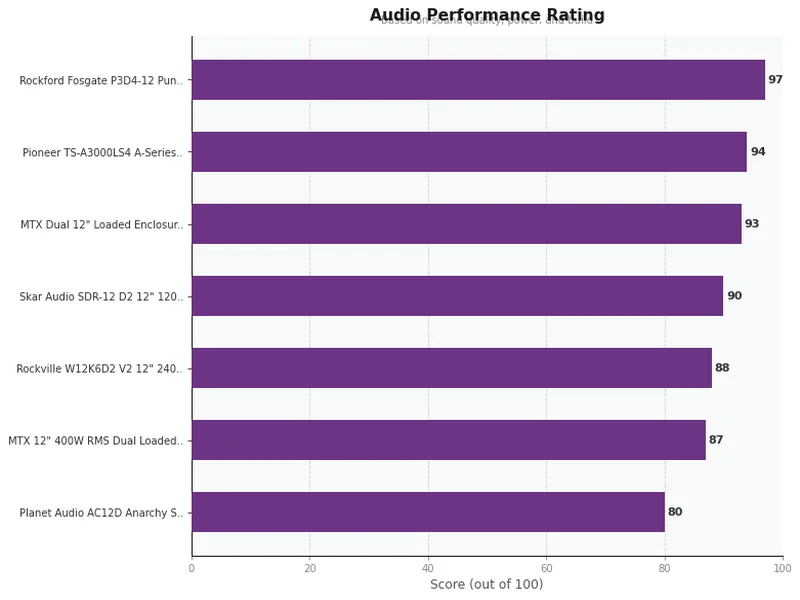
The Rockford Fosgate P3D4-12 earns the top spot in 2026 — its anodized aluminum cone, hybrid stamp-cast basket, and 600W RMS rating deliver reference-quality bass that justifies its price premium over every competitor in this class. Choosing the right 12-inch subwoofer is one of the most impactful upgrades in any car audio build, and the 12-inch format remains the sweet spot between output capability and enclosure flexibility. A well-matched 12 produces the kind of deep, room-filling low end that smaller drivers simply cannot replicate, without demanding the massive box volumes that 15-inch subs require.
The car audio market in 2026 is packed with options across every price tier, from budget-friendly polypropylene-cone designs to full competition-grade monsters with triple-stacked ceramic magnets and 4-inch voice coils. Whether the goal is daily driver SPL, audiophile-grade sound quality, marine-rated durability, or maximum excursion in a ported enclosure, there is a 12-inch subwoofer built for that exact application. The seven picks below were evaluated across power handling accuracy, build construction, thermal management, and real-world bass response to give buyers a clear path to the right driver. Pairing a quality subwoofer with a proper amp wiring kit and a dedicated car audio battery makes the difference between a clean, stable system and one that clips and sags under load.
According to Wikipedia's overview of subwoofer design, the voice coil diameter, Xmax (linear excursion), and enclosure type are the three primary factors determining real-world output and fidelity — specs that separate genuinely capable drivers from inflated peak-power marketing. This guide cuts through the noise and focuses on exactly those parameters.
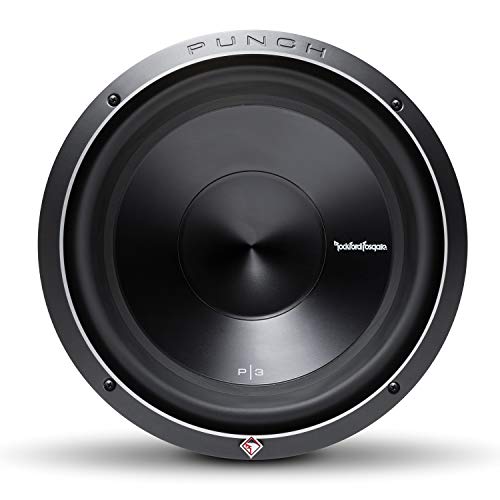







The Rockford Fosgate P3D4-12 is the benchmark against which most enthusiasts measure other 12-inch subwoofers, and in 2026 it still earns that position. The anodized aluminum cone and matching aluminum dustcap deliver a rigid, low-mass piston that maintains linear excursion up to the driver's mechanical limits — which translates directly to bass that stays clean even at high output levels. The hybrid stamp-cast basket balances structural rigidity against resonance suppression better than a pure stamped-steel design, and the spider venting system keeps motor temperature in check during extended high-power sessions.
With 600 watts RMS and 1,200 watts peak, the P3D4-12 hits its rated numbers without the exaggeration common in budget subwoofers. The dual 4-ohm voice coils wire to a 2-ohm load for most amplifier pairings, or a parallel 8-ohm load for tube-amp builds — a flexibility that adds real-world value. The 10-AWG nickel-plated push terminals accept thick wire cleanly without the cheap spring clips that plague entry-level drivers. Installation is straightforward, enclosure compatibility is broad (sealed or ported), and the P3 simply sounds authoritative whether playing hip-hop kicks or low orchestral rumble.
This is the driver buyers reach for when they want a proven performer with manufacturer backing, clear specifications, and a sound signature that leans toward musical accuracy rather than raw SPL output. It competes directly with drivers costing significantly more and wins more often than not.
Pros:
Cons:
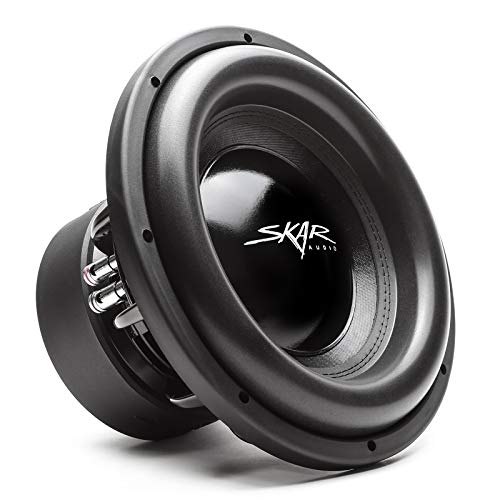
Skar Audio built the EVL-12 D2 specifically for buyers who need serious power handling without the four-figure price tag of boutique competition drivers. The 1,250W RMS rating is legitimate — validated by the 3-inch high-temperature dual 2-ohm voice coil with black coating that handles sustained thermal stress without the coil separation failures common in budget sub designs. The competition-grade paper cone with high-roll foam surround provides a balance of mass and compliance that works well in both sealed and ported enclosures, giving the EVL-12 genuine versatility across build types.
The dual 2-ohm configuration wires to a final 1-ohm load for maximizing output with mono amplifiers that support it, or a stable 4-ohm parallel load for more conservative builds. Either way, the EVL-12 D2 extracts deep, punchy bass that punches well above its price point. The motor structure, while not as exotic as the Sundown or Orion options in this list, is engineered well enough to handle real-world abuse without premature failure. For daily-driver builds that demand legitimate high-power handling at a sane budget, this is one of the most competitive drivers in the 12-inch format.
Ported enclosure builds benefit most from the EVL-12 D2 — the foam surround compliance allows good excursion at tuning frequencies below 35Hz, producing output that feels as much as it sounds. Skar's reputation for accurate power ratings rather than inflated peak figures adds confidence to the purchase.
Pros:
Cons:
Sundown Audio's SA-12 V.3 D4 is the pick for builds where raw SPL and accurate sound quality both matter. The 22mm Xmax is the standout specification here — that linear excursion figure means the cone travels farther without leaving its linear range than most competitors in this power class, producing deep bass extension with significantly less distortion at high output levels. The 1,500W RMS and 3,000W peak power handling are matched to the motor construction, not inflated to win a spec sheet battle. The new V.3 surround with linear geometry further reduces harmonic distortion in the mid-bass range where most subwoofers reveal their character.
The low-distortion motor construction is engineered around sonic purity, using a design that minimizes inductance variation across the voice coil's travel range — a detail that matters in competitive SQ listening and daily SPL builds alike. The dual 4-ohm voice coils configure to 2 ohms or 8 ohms final impedance, covering the majority of modern mono amplifier compatibility ranges. The 8.4-inch mounting depth is a consideration for smaller vehicles, but the performance payoff justifies the enclosure planning required.
Both sealed and ported enclosures work well with the SA-12 V.3 D4. Sealed boxes reward the low-distortion motor with tight, articulate bass that audiophile listeners appreciate. Ported enclosures unlock the full Xmax advantage, producing output levels that rival drivers rated significantly higher in peak power. This is a driver that rewards a well-engineered system rather than a quick box-and-amp combination.
Pros:
Cons:
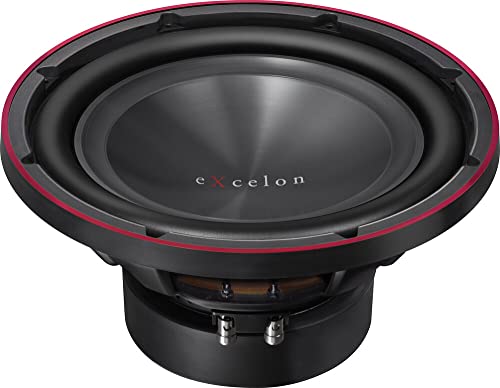
The Kenwood KFC-XW1221HP fills an important role in the 2026 market — a 12-inch subwoofer with a credible brand name, honest specifications, and a price that makes entry into real bass reproduction accessible. The 2-piece polypropylene cone with rubber surround is a proven material combination that delivers consistent performance over years of use without the cone fatigue that foam surrounds eventually develop. The 500W RMS power handling is conservative but honest, and the rubber surround allows a longer usable lifespan than foam alternatives in the same price tier.
The 5-11/16 inch mounting depth is notably shallow for a 12-inch driver, making the KFC-XW1221HP a practical choice for vehicles where enclosure depth is restricted. Sedan trunks with limited vertical space benefit directly from this characteristic. The 2-ohm single voice coil design simplifies amplifier matching — most entry and mid-level mono amplifiers deliver rated power into a 2-ohm load, so buyers avoid the impedance calculation required for dual-coil drivers.
The 2,000-watt peak power figure follows Kenwood's usual conservative naming, meaning the 500W RMS ceiling is the number that actually matters for amplifier matching. Budget-minded buyers pairing this with a mid-range mono amplifier and a properly tuned sealed box get genuine, impactful bass performance without the complexity of high-power builds. For first-time subwoofer buyers who also want to upgrade their source unit, it pairs naturally with a quality single din head unit to complete the system.
Pros:
Cons:
The Polk Audio DB1242 DVC stands out in this list as the only IP56-certified marine-rated 12-inch subwoofer, and it delivers on the promise of that certification. The coated steel basket, moisture-resistant polypropylene cone, and Santoprene surround are engineered to survive salt-fog exposure, UV degradation, and the humidity cycles that destroy uncertified drivers in marine, ATV, and motorcycle applications. For automotive builds, the same construction translates to exceptional longevity in vehicles where condensation, heat, and humidity stress components over time.
Dynamic Balance Technology is Polk's proprietary laser-imaging process that identifies the optimal material combination for the cone and surround, minimizing resonance modes that create distortion in the mid-bass range. The result is measurably cleaner output than drivers designed through conventional trial-and-error prototyping. The 1,110-watt peak rating with dual 4-ohm voice coils works well for daily-driver builds — the dual coil configuration allows the same 2-ohm or 8-ohm wiring flexibility available in premium DVC designs.
The shallow mounting profile is genuinely useful for truck doors, motorcycle saddlebag installs, marine enclosures built into limited hull spaces, and any vehicle where a full-depth 12-inch driver simply cannot fit. The 26Hz–200Hz frequency response range is wide enough for standalone subwoofer use without a dedicated passive crossover, relying instead on the head unit or amplifier's active filtering. The DB1242 DVC proves that marine certification and daily-driver performance are not mutually exclusive.
Pros:
Cons:
The Orion HCCA122 exists for one purpose: maximum output in competition environments. The 10,000-watt max power and 2,500W RMS figures are delivered through a motor structure built to handle them — a triple-stacked 445-ounce ceramic magnet, double spider suspension, and a massive 4-inch high-temperature aluminum voice coil with Orion's signature black coil design. The cast aluminum frame eliminates basket flex under extreme excursion, and the vented cooling system prevents the thermal runaway that destroys lesser drivers during sustained competition-level output. This is not a driver for casual listeners.
The dual 2-ohm impedance wires to a 1-ohm final load for mono amplifiers that support it, enabling maximum current delivery from high-powered competition amplifiers. The NBR foam surround and moisture-resistant paper cone handle the mechanical stresses of extreme excursion without separation failure — a real concern at competition SPL levels where cone displacement reaches values that destroy standard suspension components. The HCCA122 is engineered for builds where output is measured in decibels at a microphone, not perceived quality in a listening session.
Daily-driver use is technically possible with careful amplifier matching and crossover settings, but the HCCA122 rewards the kind of dedicated system build that includes a high-capacity alternator, lithium or AGM secondary battery, and carefully tuned ported enclosure. Buyers investing in this driver should also plan a comprehensive electrical upgrade — a proper car audio battery upgrade is essential for the sustained power draw at competition output levels.
Pros:
Cons:
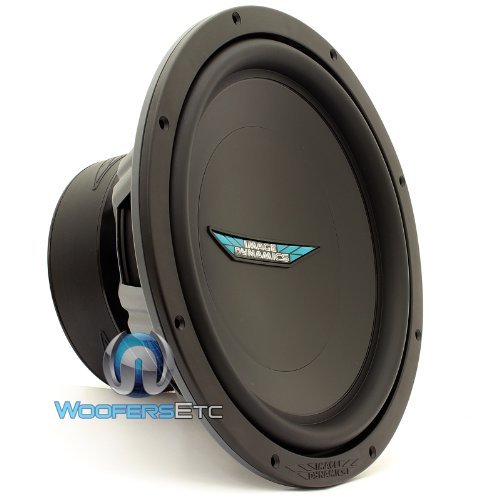
Image Dynamics designed the IDQ12 V.4 D4 for SQ-focused builds where tonal accuracy and low distortion matter more than raw decibel output. The mica-reinforced polypropylene cone provides the mass-to-stiffness ratio that audiophile-oriented subwoofer designs require — rigid enough to minimize cone breakup at high excursion, with enough mass to naturally extend bass response into the low frequencies where music has its foundation. The parabolic roll surround controls cone motion with greater linearity than a flat or half-roll surround, directly reducing harmonic distortion across the excursion range.
The V.4 metal basket is a meaningful upgrade over the fiberglass composite basket used in earlier IDQ versions — rigidity improvements translate directly into reduced basket resonance, which is audible as a cleaner, more defined bass note in critical listening. The Conex spider with integrated tinsel leads maintains consistent voice coil alignment across the full excursion range, eliminating the rubbing artifacts that plague imprecise suspension designs. High-temperature aluminum voice coil and the proprietary voice coil attachment design round out an engineering package that prioritizes precision over maximum power handling.
The 750W RMS (50–750W recommended range) sits in a moderate power tier that suits quality class-D mono amplifiers without demanding dedicated electrical upgrades. The ability to custom match the basket color to specific installation aesthetics is a small detail that demonstrates Image Dynamics' orientation toward the discerning buyer who cares about how a build looks as much as how it sounds. The IDQ12 V.4 D4 is the pick for music listeners who want subwoofer extension that disappears into the soundstage rather than announcing itself as a separate element.
Pros:
Cons:
Peak power figures are marketing — the RMS (continuous) power rating is the specification that determines real-world amplifier matching. A subwoofer rated at 600W RMS should be paired with an amplifier capable of delivering 450–750W RMS into the driver's impedance load. Underpowering a subwoofer is a common mistake: a clipping, underpowered amplifier sends distorted square-wave output that destroys voice coils faster than clean power at twice the rated wattage. Overpowering is only dangerous at extreme levels sustained over time. Match the amplifier's clean RMS output to the subwoofer's RMS rating, and the system runs safely at maximum performance.
Dual voice coil (DVC) subwoofers offer impedance wiring flexibility that single voice coil designs cannot match. A DVC 4-ohm driver can wire to a 2-ohm parallel load or an 8-ohm series load, depending on the amplifier's stable impedance range. A DVC 2-ohm driver wires to 1 ohm (for compatible amplifiers) or 4 ohms. This flexibility allows buyers to optimize power delivery from the amplifier rather than accepting whatever load the driver presents. Single voice coil drivers are simpler but limit the system design options significantly.
The Xmax (linear excursion) specification determines how far the cone travels while remaining within its linear range — and this directly informs enclosure selection. High-Xmax drivers like the Sundown SA-12 V.3 (22mm) extract maximum performance from ported enclosures where cone displacement reaches its peak. Lower-Xmax SQ-oriented drivers like the IDQ12 V.4 D4 shine in sealed enclosures where cone travel is mechanically limited by the sealed air volume, resulting in tighter, more accurate bass reproduction. Choosing a high-Xmax driver for a sealed box or a low-Xmax driver for a ported box wastes the driver's engineering advantages. The enclosure type should drive the driver selection, not the other way around.
Basket material, spider quality, and voice coil diameter are the three build characteristics that separate drivers that perform consistently over years from those that degrade quickly under sustained use. Cast aluminum or hybrid stamp-cast baskets outperform pure stamped steel in resonance suppression. A larger voice coil diameter — 3 inches or 4 inches versus the 2-inch coils found in budget drivers — dissipates heat more effectively and sustains rated power for longer periods. Double spider designs maintain voice coil alignment under extreme excursion, preventing the coil-rubbing artifacts that signal impending driver failure. Vented pole pieces and spider venting designs extend thermal headroom significantly during extended high-power sessions. These are the specifications worth reading carefully before committing to any 12-inch driver purchase in 2026.
Most 12-inch subwoofers perform well in sealed enclosures between 1.0 and 2.0 cubic feet, or ported enclosures between 2.0 and 3.5 cubic feet. The exact target depends on the driver's Vas (compliance volume) and Qts parameters — specifications available in the manufacturer's datasheet. Sealed boxes produce tighter, more accurate bass; ported boxes produce louder, more extended low-frequency output at the cost of transient precision. Drivers with high Xmax like the Sundown SA-12 V.3 benefit most from ported enclosures, while SQ-focused drivers like the IDQ12 V.4 D4 perform optimally in sealed designs.
The final impedance determines how much power the amplifier delivers to the driver. Most mono amplifiers produce maximum rated power at 1 or 2 ohms and progressively less at 4 ohms. The goal is to match the amplifier's rated output impedance to the subwoofer's wiring configuration so the amplifier delivers its stable rated power cleanly. Wiring to a lower impedance than the amplifier supports causes oscillation, overheating, and failure. Always consult the amplifier's specification sheet for its minimum stable impedance before wiring a dual voice coil driver.
A subwoofer performs best when the amplifier delivers between 75% and 150% of the driver's RMS rating. For the Rockford Fosgate P3D4-12 (600W RMS), a 500W–750W mono amplifier is optimal. For the Skar EVL-12 D2 (1,250W RMS), a 1,000W–1,500W mono amplifier delivers maximum performance without stressing the driver's thermal limits. Underpowering causes amplifier clipping at high volume — far more damaging than a modest overpower situation from a clean amplifier source.
Sealed boxes are generally the better choice for music accuracy in daily listening builds. The sealed air volume acts as a mechanical spring that controls cone motion, producing tight, well-defined bass with good transient response. Bass guitar lines, kick drum attacks, and low piano notes sound defined and distinct. Ported boxes maximize output volume and extend low-frequency response, which some listeners prefer for hip-hop, electronic music, and content with sustained sub-bass content. The choice depends on the listening priority — accuracy or maximum output.
Standard automotive subwoofers are not rated for moisture or UV exposure and will fail prematurely in marine, ATV, or motorcycle environments. The Polk Audio DB1242 DVC is the only driver in this list with IP56 marine certification — meaning it is tested for salt-fog, UV, and humidity resistance. For any outdoor, watercraft, or off-road application, the IP rating is a non-negotiable specification. Coated baskets, sealed motor systems, and moisture-resistant cone and surround materials are the indicators of genuine marine suitability.
Competition subwoofers like the Orion HCCA122 are engineered for maximum SPL at competition scoring frequencies — typically 40–80Hz — using massive motor structures, extreme excursion capability, and thermal headroom for sustained high-power runs. They require substantial enclosure volume, high-current amplification, and electrical upgrades to perform as designed. Daily-driver subwoofers prioritize balanced frequency response, musical accuracy, thermal management for long listening sessions, and compatibility with moderate amplifier power levels. A competition driver used as a daily driver typically underperforms because it is optimized for measurement conditions rather than music reproduction.
The Rockford Fosgate P3D4-12 is the strongest all-around choice for most builds in 2026, but buyers who need competition power, marine durability, maximum excursion, or SQ precision have purpose-built options in the Orion HCCA122, Polk DB1242 DVC, Sundown SA-12 V.3, and IDQ12 V.4 D4 respectively — match the driver's engineering to the actual system goals, pair it with an appropriately rated amplifier, build the right enclosure, and the result is bass performance that transforms any vehicle's audio system.
 |
 |
 |
 |

About Rachel Park
Rachel Park specializes in the interior and exterior upgrades that meaningfully change how a car looks, sounds, and feels on a daily basis. She has hands-on experience with head unit installations and audio system builds, LED and HID lighting conversions, interior refresh projects, and cosmetic exterior work — evaluated from both a DIY accessibility and quality-of-result perspective. At CarCareTotal, she covers car audio and electronics, lighting upgrades, and interior and exterior styling accessories.
Get some FREE car parts & gear.. Or check out the latest free automotive manuals and build guides here.
Disable your ad blocker to unlock all the hidden deals. Hit the button below 🚗
| | | |
