Audio ›
by Rachel Park
Picture this: you've spent weeks researching head units and speakers, only to realize the moment you crank the volume that your car's bass response is flat and lifeless. An 8-inch subwoofer sits in that practical sweet spot — compact enough for smaller vehicles and enclosures, yet powerful enough to deliver the low-frequency impact that transforms your listening experience. Whether you drive a compact sedan, an SUV with limited cargo space, or a truck cab where every cubic inch counts, the right 8-inch sub can redefine how you experience music on the road.
In 2026, the market for 8-inch car subwoofers is more competitive than ever, with options ranging from budget-friendly stamped basket designs to premium dual voice coil units built for serious sound pressure levels. Understanding the difference between shallow-mount designs ideal for tight enclosures and full-depth drivers engineered for ported boxes is critical before you buy. This guide covers seven of the strongest performers across a range of price points, power ratings, and installation requirements, giving you the data you need to make a confident decision.
Before diving into the individual reviews, it's worth noting that subwoofer performance is determined by the interaction between the driver, your amplifier, and your enclosure — no single component operates in isolation. According to Wikipedia's overview of subwoofer design, Thiele/Small parameters govern how a woofer behaves in a given box volume, which is why matching the driver to the recommended enclosure type is as important as the wattage rating. If you're building a complete audio system from scratch, also consider our roundup of the best 6x9-inch car speakers of 2026 to find full-range drivers that pair well with any of the subwoofers reviewed here. And for a broader look at the subwoofer category, our best car subwoofers guide covers 10-inch through 15-inch options as well.
Contents
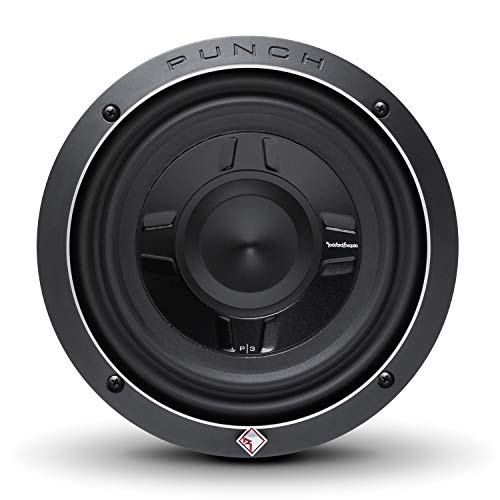




The Rockford Fosgate P3SD4-8 is the gold standard for shallow-mount 8-inch subwoofers in 2026, engineered specifically for installations where mounting depth is the primary constraint. It delivers 150 watts RMS with a 300-watt peak rating, which is modest on paper but entirely appropriate for a driver designed to fit into door panels, under-seat enclosures, and thin ported boxes where a full-depth sub simply cannot go. Rockford's engineers paired an anodized aluminum cone and dustcap with a hybrid stamp-cast basket — a construction choice that reduces resonance while keeping overall weight low, two priorities that directly translate to cleaner, faster bass transient response.
The dual voice coil configuration at 4 ohms per coil gives you wiring flexibility that a single voice coil cannot match. Wire the coils in parallel for a 2-ohm load and extract maximum current from your amplifier, or wire them in series for an 8-ohm configuration if your head unit's internal amplifier is the only power source available. The unique spider venting design actively circulates air around the motor assembly during high-excursion playback, reducing thermal buildup during extended sessions — a detail that separates the P3S from cheaper shallow-mount alternatives that sacrifice longevity for cost savings. The custom 10-AWG nickel-plated push terminals accept large-gauge wire without complaint, which matters when you're running serious amplifier current.
For anyone building a stealth install or working within the confines of a sedan trunk with a small sealed enclosure, the P3SD4-8 is the most technically competent choice in this roundup. It isn't the loudest driver here, and it won't satisfy listeners who prioritize sheer output over installation versatility, but its build quality and brand reliability make it a dependable long-term investment. If you specifically need a shallow-mount design with proven performance, also review our dedicated best shallow mount car subwoofers guide for additional options at various price points.
Pros:
Cons:
Pioneer's TS-A2000LD2 arrives as part of the A-series lineup, a family of components designed to work in acoustic harmony with Pioneer's full-range speakers and head units. Its 700-watt maximum power handling — backed by 250 watts nominal RMS — gives it considerably more headroom than the Rockford Fosgate shallow-mount above, making it the right choice when you want shallow-mount convenience without sacrificing the ability to push higher amplifier output during demanding listening sessions. The glass-fiber and mica-reinforced IMPP (Injected Molded Polypropylene) cone is the defining engineering decision here: mica stiffens the cone, while glass fiber reinforcement prevents flex at high excursion levels, resulting in a driver that maintains pistonic accuracy across a wide frequency range.
As a passive subwoofer, the TS-A2000LD2 depends entirely on an external amplifier for its power delivery, which means the quality of your bass output is directly proportional to the amplifier you pair it with. Pioneer explicitly designed this driver to match their A-series speaker tuning, so if your door panels already carry Pioneer TS-A-series components, the tonal consistency between the subwoofer and your midrange speakers will be noticeably better than mixing brands. The shallow-mount design broadens installation options considerably, accommodating enclosures in trunk walls, beneath rear seats, and in custom fiberglass builds where depth restrictions would eliminate a standard-depth subwoofer from consideration.
Pioneer's long-standing reputation in the car audio segment — the brand has been a consistent presence in the category for decades — provides a level of after-sale support and replacement parts availability that smaller boutique brands cannot always match. If you're building a cohesive Pioneer-branded audio system and want a subwoofer that was engineered to complement those components rather than simply sharing a price point, the TS-A2000LD2 earns its place at the top of this segment. Pair it with a quality head unit for maximum system synergy — our guide to the best Android Auto head units of 2026 covers compatible options across multiple price points.
Pros:
Cons:
The Skar Audio EVL-8 D2 is the most powerful driver in this roundup by a significant margin, rated for 600 watts RMS and 1,200 watts peak power in an 8-inch form factor — a specification that competes directly with what many 10-inch subwoofers offered just a few years ago. The motor system responsible for that output is built around a 122-ounce double-stack ferrite magnet assembly with a Bl (force factor) of 20.27 N/A, a measurement that quantifies how effectively the magnet converts electrical current into cone movement. Higher Bl values directly correlate to tighter, more controlled bass, and the EVL-8's figure places it well above typical consumer-grade 8-inch drivers in this category.
The 2.5-inch dual 2-ohm voice coil is wound with four layers of copper wire and coated for high-temperature resistance, addressing one of the most common failure modes in high-power subwoofers: thermal breakdown during extended full-power playback. At 81.8 dB sensitivity, the EVL-8 requires a capable amplifier to fully realize its potential — plan your system around a minimum of 600 watts RMS from your amplifier, wired to a 1-ohm load by connecting the dual 2-ohm coils in parallel. This is a driver that demands a purpose-built system rather than a casual add-on, and it rewards that commitment with output levels that 8-inch competitors simply cannot match under equivalent amplifier conditions.
Skar Audio has built a loyal following among enthusiasts who want competitive performance at prices that undercut established premium brands by a meaningful margin. The EVL-8 D2 fits squarely in that positioning: it delivers engineering specifications that justify serious amplifier investment without the premium pricing of equivalent Rockford Fosgate or JL Audio designs. If raw output is your primary criterion and you're willing to invest in the amplifier and enclosure infrastructure to support it, the Skar EVL-8 D2 is the clear choice in this field.
Pros:
Cons:
Sundown Audio occupies a distinctive position in the car audio market — a brand with roots in competition SPL (Sound Pressure Level) events that has translated its engineering expertise into consumer-grade drivers built to withstand punishment that typical aftermarket subwoofers cannot tolerate. The SA-8 V.3 D4 carries a 500-watt RMS rating with dual 4-ohm voice coils, giving you the flexibility to wire to either 2 ohms (parallel) or 8 ohms (series) depending on your amplifier's optimal output impedance. The Bl value of 22.06 N/A is the highest in this roundup, indicating an unusually strong force factor that produces controlled, authoritative bass movement even at elevated playback levels.
The Thiele/Small parameters for the SA-8 V.3 reveal a driver optimized specifically for ported enclosures — Sundown explicitly does not recommend sealed box use. The resonance frequency (Fs) of 40.0 Hz, combined with a moving mass (Mms) of 126.6 grams, produces a driver tuned for deep, extended low-frequency output rather than the punchy, quick bass character of lighter-cone designs. The recommended ported enclosure volume of 0.5 to 0.75 cubic feet is manageable in most trunk installations, though it does require more enclosure engineering attention than a drop-in sealed-box solution. The total Q factor (Qts) of 0.360 confirms the ported-only recommendation — this value is well below the 0.5 threshold where sealed enclosures begin to perform predictably.
For listeners who attend SPL competitions, participate in car audio events, or simply want to experience what an 8-inch driver can produce at its absolute physical limits, the SA-8 V.3 is the most technically serious option in this guide. Its specifications are the product of competition-oriented engineering priorities rather than mass-market compromises, which means it demands more from its installation — but it also delivers more in return when those installation requirements are properly met.
Pros:
Cons:
The BOSS Audio CXX8 occupies the most accessible price position in this roundup, offering a 600-watt maximum power rating in a single 4-ohm configuration that simplifies amplifier matching for first-time builders. Its polypropylene cone is the most common cone material in budget subwoofer designs — lightweight, moisture-resistant, and capable of producing acceptable bass response when paired with a modest amplifier in a simple sealed enclosure. The rubber surround adds durability at the cone perimeter, providing consistent restoring force throughout the driver's excursion range without the cracking and dry-rot risk associated with foam surrounds in older designs.
The stamped steel basket represents the expected manufacturing approach at this price point, delivering adequate structural rigidity for normal listening applications while keeping production costs low. BOSS rates the CXX8 at 600 watts maximum, though the RMS continuous power handling is considerably lower — a distinction that matters when you're selecting an amplifier. Matching a 600-watt maximum-rated subwoofer with a 600-watt RMS amplifier will result in distortion and eventual driver failure; a more appropriate amplifier pairing sits in the 150-to-250-watt RMS range for sustained listening at responsible volume levels. For casual listeners upgrading from a factory audio system for the first time, the CXX8 delivers a meaningful bass improvement without requiring a large upfront investment in either the driver or the supporting infrastructure.
The CXX8 is not the right choice for listeners who demand competitive sound pressure levels, precise transient response, or long-term reliability under high-power conditions. It is, however, a competent entry point that allows you to experience the benefit of a dedicated subwoofer channel before committing to higher-performance components. If your primary criteria are lowest total system cost and straightforward installation, this driver fills that role clearly.
Pros:
Cons:
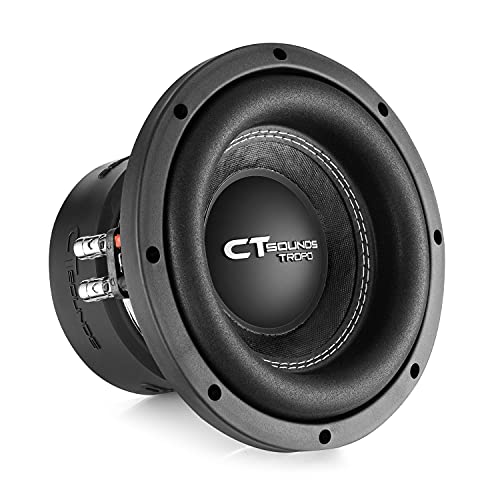
CT Sounds engineered the TROPO-8-D2 to occupy the middle ground between budget-tier drivers and the competition-oriented designs from Skar and Sundown — a position that makes it one of the most practically useful subwoofers for everyday listeners who want genuine performance without the complexity of a high-power SPL-focused build. The 400-watt RMS rating, supported by an 800-watt peak ceiling, pairs efficiently with mid-range Class D amplifiers in the 300-to-500-watt RMS range, making system matching straightforward for builders without extensive car audio experience.
The 3 percent carbon fiber-reinforced cone is the defining construction feature at this price point — carbon fiber additions stiffen the cone without adding significant mass, producing faster transient response and lower distortion at the upper end of the subwoofer's frequency range compared to pure polypropylene designs. The 2-inch, four-layer copper voice coil wound for high-temperature resistance mirrors the thermal management approach found in the Skar EVL-8, providing heat dissipation capacity that exceeds what the driver's 400-watt RMS rating strictly requires — a margin that extends long-term reliability during extended playback sessions. The dual 2-ohm configuration allows a 1-ohm parallel wiring load, unlocking maximum output from bridged mono amplifier configurations.
The double-slug Y30-grade optimized motor assembly and high-foam surround round out a specification sheet that represents genuinely strong engineering value for the price. CT Sounds occupies a niche similar to Skar Audio — a direct-to-consumer brand that avoids distributor markups to offer better specifications per dollar than traditional retail-channel competitors. If your budget falls in the mid-range and you're unwilling to accept the performance limitations of budget-tier alternatives, the TROPO-8-D2 is the most balanced option in this guide. You can also explore car audio upgrades across our full car audio section for complementary components to pair with this driver.
Pros:
Cons:
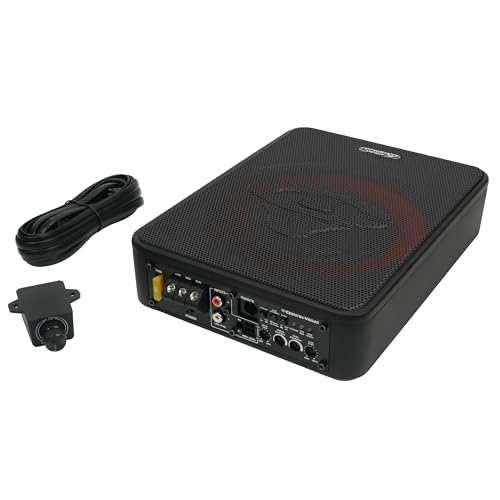
The Cerwin Vega VPASV8 takes a fundamentally different approach from every other driver in this guide — it is an active, powered subwoofer system that includes the amplifier, enclosure, and driver in a single under-seat unit rated at 250 watts. For buyers who want meaningful bass improvement without designing a custom enclosure, sourcing a separate amplifier, or running new power cables through the vehicle, the VPASV8 removes every installation obstacle simultaneously. The die-cast aluminum chassis and enclosure construction distinguishes it immediately from plastic-bodied powered subwoofers in the same category, providing structural rigidity and heat dissipation that directly extends the operational lifespan of the integrated amplifier.
The thermal protection circuit is the most practically important feature for an under-seat installation, where airflow is limited and ambient temperatures can rise significantly during summer driving. Rather than failing suddenly under thermal stress, the VPASV8 reduces output when the internal temperature approaches dangerous levels and resumes normal operation once the unit cools — a behavior that protects the hardware during the sustained low-speed urban driving conditions where heat accumulation is most severe. The short and overload protection circuits provide a secondary layer of protection against wiring errors or unexpected impedance mismatches, safeguarding both the amplifier and the downstream audio system components connected to it.
Cerwin Vega is one of the longest-established names in loudspeaker manufacturing, with a history in both home and car audio that predates most of the brands in this guide. The VPASV8's 250-watt output is modest compared to the passive drivers in this roundup, but it delivers that output from a system that requires no separate amplifier purchase, no enclosure construction, and no complex wiring — advantages that represent genuine time and cost savings for everyday listeners who prioritize installation simplicity. The integrated control knob allows real-time bass level adjustment from the driver's seat, adding the kind of day-to-day usability that passive subwoofer setups require a separate bass remote to achieve.
Pros:
Cons:

The single most misunderstood specification in car audio is the relationship between RMS power handling and peak power ratings. RMS — Root Mean Square — measures the continuous power a subwoofer can accept indefinitely without damage, while peak power describes the brief transient spikes the driver can tolerate for fractions of a second. When you match your subwoofer to an amplifier, the RMS figures are the only numbers that matter: pair a 400-watt RMS-capable driver with a 400-watt RMS amplifier, and leave the peak figures as marketing context rather than engineering guidance. Drivers in this roundup range from 150 watts RMS (Rockford Fosgate P3SD4-8) to 600 watts RMS (Skar EVL-8 D2), a fourfold difference that carries equally significant implications for amplifier requirements and enclosure volume.
The voice coil configuration — single voice coil (SVC) versus dual voice coil (DVC) — determines how many wiring options you have when connecting your subwoofer to your amplifier. Single voice coil drivers like the BOSS CXX8 present one impedance option, typically 4 ohms, which keeps wiring simple but eliminates flexibility. Dual voice coil drivers like the Rockford Fosgate P3SD4-8, Skar EVL-8 D2, and CT Sounds TROPO-8-D2 allow parallel or series wiring combinations, effectively halving or doubling the impedance presented to your amplifier. Most Class D mono amplifiers produce their rated output at 1 or 2 ohms, making a dual 2-ohm subwoofer wired in parallel the most efficient configuration for extracting maximum power from a bridged amplifier channel.
Every subwoofer performs differently depending on whether it is mounted in a sealed enclosure, a ported (vented) box, or a bandpass design, and the driver's Thiele/Small parameters determine which configuration produces the best results. Sealed enclosures are compact, produce tight and accurate bass, and are tolerant of volume variations — the right choice for music genres that demand precision over raw output. Ported enclosures require more careful tuning but deliver higher output efficiency and deeper extension at lower frequencies, making them the preferred choice for listeners who want maximum bass impact. The Sundown SA-8 V.3 explicitly prohibits sealed enclosure use, while shallow-mount designs like the Rockford Fosgate P3SD4-8 and Pioneer TS-A2000LD2 are designed for the sealed configurations that fit under-seat and in-door installations.
Mounting depth is the dimension most often overlooked until the subwoofer is in your hands and the enclosure is already built. Full-depth 8-inch drivers typically require 4.5 to 5.5 inches of mounting depth behind the basket, which rules them out of trunk builds with limited clearance between the floor and the vehicle's structural elements. Shallow-mount designs like the Rockford Fosgate P3SD4-8 reduce this requirement to 2.5 to 3.5 inches, enabling installations in locations that a conventional driver simply cannot occupy. Measure your available mounting depth before purchasing, accounting for terminal clearance behind the basket and any structural obstructions in the enclosure mounting location — a specification mismatch discovered after purchase is a costly and time-consuming error to correct.
A shallow-mount subwoofer uses a shorter voice coil former and a redesigned motor topology to reduce the physical depth behind the basket — typically by 30 to 50 percent compared to a standard-depth driver of equivalent diameter. This reduction in mounting depth enables installation in locations where standard drivers cannot fit, including under seats, inside door panels, and in thin custom enclosures. The engineering trade-off is typically a reduction in maximum excursion capability and total output, which is why shallow-mount designs like the Rockford Fosgate P3SD4-8 carry lower RMS ratings than full-depth drivers with similar cone diameters.
Every passive subwoofer in this guide — including the Rockford Fosgate, Pioneer, Skar Audio, Sundown Audio, BOSS Audio, and CT Sounds models — requires a separate external amplifier to function. Your factory head unit's internal amplifier does not produce sufficient power to drive any of these drivers at adequate volume levels. The only driver in this roundup that includes its own amplifier is the Cerwin Vega VPASV8, which is an active powered unit with an integrated amp. When selecting an external amplifier for a passive subwoofer, match the amplifier's RMS output rating to the driver's RMS power handling at the wired impedance you plan to use.
Enclosure volume requirements vary by driver and enclosure type. Sealed enclosures for 8-inch subwoofers typically range from 0.3 to 0.75 cubic feet, while ported enclosures require 0.5 to 1.25 cubic feet depending on the tuning frequency and the specific driver's Thiele/Small parameters. The Sundown SA-8 V.3 specifies a ported volume of 0.5 to 0.75 cubic feet and explicitly prohibits sealed use. Always consult the manufacturer's published enclosure recommendations before building or purchasing an enclosure — using the wrong box type or volume degrades performance measurably and can damage the driver's suspension over time through uncontrolled excursion.
A dual voice coil subwoofer is not inherently better in acoustic terms — it provides additional wiring flexibility that a single voice coil design cannot offer. With two separate voice coils, you can wire the driver to multiple impedance loads: a dual 2-ohm sub can present 1 ohm (parallel) or 4 ohms (series) to your amplifier, while a dual 4-ohm sub can present 2 ohms (parallel) or 8 ohms (series). This flexibility is particularly valuable when you need to match a specific amplifier's rated output impedance. If your amplifier produces its maximum rated output at 1 ohm and you own a dual 2-ohm subwoofer, wiring in parallel extracts maximum power — a wiring option that a single 2-ohm driver cannot provide without using two drivers.
The 8-inch driver is the practical choice when available enclosure volume or mounting depth prevents the use of a larger driver, but you still want a dedicated low-frequency channel rather than relying on your full-range speakers for bass reproduction. Compact sedans, hatchbacks, and vehicles with under-seat installation requirements are the natural target applications. If you have a larger available trunk volume and your vehicle's structure accommodates a deeper enclosure, a 10-inch or 12-inch driver will generally produce higher output at equivalent power levels — the additional cone area increases air displacement, which directly translates to louder and deeper bass without requiring proportionally more amplifier power.
The Cerwin Vega VPASV8 is the definitive answer for listeners who prioritize installation simplicity over maximum output. Its active powered design integrates the amplifier, enclosure, and driver into a single under-seat unit that connects to your existing audio system with minimal wiring — typically just a signal input, a remote turn-on lead, and a power connection. No custom enclosure, no separate amplifier rack space, and no complex impedance calculations are required. For listeners who want more output and are willing to invest modest effort in a separate amplifier and sealed box, the Rockford Fosgate P3SD4-8 offers the best combination of installation flexibility and brand-proven reliability among the passive drivers reviewed here.
The right 8-inch subwoofer for your vehicle in 2026 depends on three specific factors — your available installation space, your amplifier budget, and the output level you expect from the finished system. Choose the Rockford Fosgate P3SD4-8 for proven shallow-mount installations, the Skar Audio EVL-8 D2 when maximum output is the priority, the CT Sounds TROPO-8-D2 when you need balanced performance without a premium brand price, or the Cerwin Vega VPASV8 when a single-unit powered solution fits your vehicle and installation goals. Select your driver, match it to the correct enclosure and amplifier, and you'll have a bass foundation that transforms how you experience every track you play on the road.
 |
 |
 |
 |

About Rachel Park
Rachel Park specializes in the interior and exterior upgrades that meaningfully change how a car looks, sounds, and feels on a daily basis. She has hands-on experience with head unit installations and audio system builds, LED and HID lighting conversions, interior refresh projects, and cosmetic exterior work — evaluated from both a DIY accessibility and quality-of-result perspective. At CarCareTotal, she covers car audio and electronics, lighting upgrades, and interior and exterior styling accessories.
Get some FREE car parts & gear.. Or check out the latest free automotive manuals and build guides here.
Disable your ad blocker to unlock all the hidden deals. Hit the button below 🚗
| | | |
