Audio ›
by Rachel Park
The Alpine S2-S68 earns the top spot in our 2026 roundup of 6x8-inch car speakers because its Hi-Res Audio certification and HAMR surround technology deliver a level of frequency accuracy that most factory systems simply cannot match. If you are ready to eliminate the muddy, rolled-off sound that came standard in your vehicle, upgrading to a quality pair of 6x8 coaxials is one of the most cost-effective improvements you can make to your car audio setup without touching the head unit or adding a subwoofer.
The 6x8-inch format occupies a specific niche in automotive audio, fitting natively into Ford, Chrysler, and Mazda door panels as well as rear deck positions on dozens of sedans and coupes. Because the cone surface area is larger than a standard 6.5-inch speaker, a well-designed 6x8 driver can move more air and reproduce bass frequencies with greater authority, which reduces your dependence on a dedicated subwoofer for everyday listening. The challenge lies in distinguishing genuine performance upgrades from budget units that offer little improvement over stock hardware, and that is precisely the problem this guide addresses for 2026.
After evaluating specifications, construction materials, user data, and real-world installation feedback across seven highly rated models, the following reviews give you a clear, factual picture of what each speaker delivers. Whether you prioritize raw wattage, nuanced high-frequency detail, or straightforward plug-and-play installation, the options below cover every realistic use case. If you are also evaluating a complete system overhaul, our Android Auto head unit guide and 6x9-inch speaker roundup cover the components most likely to complement your new 6x8 drivers.
Contents







JBL built its reputation in professional audio for decades before turning its engineering focus toward the automotive market, and the 6x8 coaxial reflects that institutional knowledge in a speaker priced for the mass market. The driver delivers a peak power handling of 180 watts with a 60-watt RMS rating, positioning it comfortably above stock levels while remaining compatible with factory head units that output between 15 and 25 watts per channel. The 2-way configuration keeps the crossover network simple and the installation straightforward, with no additional tuning required once the unit seats into the factory mounting location.
Build quality on the JBL is consistent with what you would expect from a brand that supplies original equipment to major automakers. The cone material handles thermal cycling across extreme temperatures without warping, and the surround maintains its compliance across the audible bass range without the stiffening that plagues lower-cost rubber compounds over time. Reviewers consistently report that the midrange reproduction is the standout characteristic of this unit, with vocals and instrument separation that outpace the factory speaker by a meaningful margin even when driven by an unmodified head unit.
The omission of grilles in the package is a deliberate design choice rather than a cost-cutting measure, as JBL intends these speakers to install beneath factory grille covers that remain in place. If your vehicle does not retain OEM grille hardware, you will need to source aftermarket covers separately, which is a minor but notable consideration during your planning process. Overall, the JBL 6x8 represents the most practical entry point into branded speaker performance for vehicles that accept the 6x8 mounting footprint natively.
Pros:
Cons:
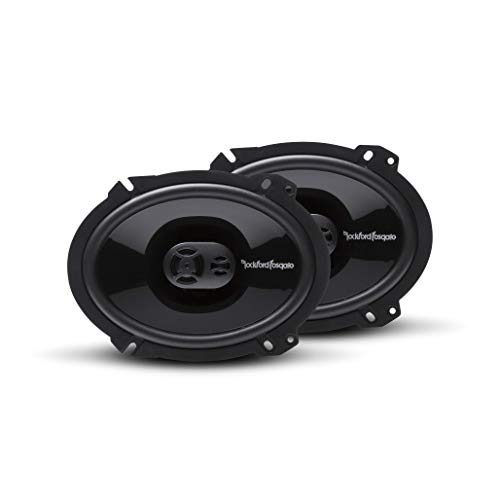
Rockford Fosgate positioned the P1683 Punch as a serious performance replacement for enthusiasts who refuse to accept the compromises that define most factory speaker systems, and the specification sheet supports that marketing claim with considerable rigor. The 3-way full-range design incorporates a dedicated PEI dome tweeter supported by an integrated crossover network, which routes high frequencies away from the woofer cone and reduces the intermodulation distortion that consistently undermines clarity on 2-way designs at elevated listening levels. Power handling sits at 65 watts RMS and 130 watts maximum, numbers that allow this speaker to perform cleanly with a modest aftermarket amplifier delivering 50 to 80 watts per channel.
The cone material is an injection-molded mineral-filled polypropylene compound, a formulation that Rockford Fosgate uses across its Punch line to achieve the rigidity-to-mass ratio necessary for accurate bass reproduction without the breakup resonances that affect standard polypropylene at higher frequencies. The butyl rubber surround complements this cone material by providing consistent damping through temperature extremes, and the OEM adapter plate included in the package simplifies installation into factory mounting locations that use non-standard hole patterns. The mounting hardware package removes the need for additional trips to a hardware store before installation.
Critically, the P1683 arrives with a 4-ohm impedance rating that maintains compatibility with the full range of factory and aftermarket head units currently in production. Users who invest time in proper baffle sealing and door deadening consistently report that the Punch delivers bass output and midrange clarity that legitimately challenges speakers sold at significantly higher price points. For the performance-oriented buyer who wants a demonstrable upgrade over stock without paying premium-tier prices, the Rockford Fosgate P1683 is a well-validated choice in 2026.
Pros:
Cons:
Pioneer's TS-A6881F uses a 4-way driver configuration to separate the audio spectrum into four distinct frequency bands, assigning each range to a dedicated driver element optimized for that portion of the spectrum, which produces a more balanced and accurate presentation than 2-way designs at equivalent drive levels. The maximum power handling of 350 watts and continuous rating of 80 watts RMS place this speaker at the upper end of what you would pair with an entry-level external amplifier, and the frequency response specification of 30 Hz to 32 kHz is among the widest in this product category. That low-end extension to 30 Hz is a particularly aggressive claim for a coaxial speaker, and in practice the Pioneer does reproduce bass with more authority than most comparably priced 6x8 units when installed with adequate baffle support.
The Pioneer A-Series design philosophy prioritizes smoothness across the crossover transition points, which is the engineering challenge that separates excellent multi-way speakers from mediocre ones. A poorly designed 4-way crossover introduces phase shifts and amplitude irregularities at each transition frequency, resulting in a presentation that sounds congested or tonally uneven despite the theoretical advantages of driver separation. Pioneer's implementation in the TS-A6881F manages these transitions with sufficient precision that the speaker presents as cohesive rather than fragmented across its operating range, which is a meaningful achievement at its price tier.
The speaker ships as a pair with all necessary mounting hardware, and the installation process follows the same procedure as most OEM replacements in the 6x8 format. The mounting depth is compatible with the majority of door cavities that accept this speaker size natively, though you should verify clearance dimensions before ordering if your vehicle has unusually constrained interior door panel depth. For buyers who want the broadest possible frequency coverage from a single coaxial driver without stepping into premium-tier pricing, the Pioneer TS-A6881F delivers a compelling value proposition in 2026.
Pros:
Cons:
The Alpine S2-S68 is the only speaker in this roundup carrying Hi-Res Audio certification, a designation that confirms the driver can reproduce frequencies up to 40 kHz — well above the 20 kHz ceiling of human hearing — which translates to greater phase and transient accuracy within the audible spectrum rather than literal perceptibility above it. Alpine achieved this certification by combining a cone built from a hybrid of polypropylene, glass fiber, and mica, a composite that delivers the stiffness necessary to prevent cone breakup at high frequencies while keeping mass low enough to maintain transient speed. The result is a speaker that resolves fine detail in recordings — the decay of a piano note, the breath before a vocal phrase — with a precision that coaxials at lower price points consistently fail to match.
Alpine's proprietary HAMR (High Amplitude Multi-Roll) surround technology is the other defining engineering achievement in the S2-S68 design. Traditional speaker surrounds constrain cone travel as a physical byproduct of their geometry, which limits bass extension and dynamic range. The HAMR design incorporates multiple roll profiles into a single surround structure, allowing significantly greater cone excursion without the loss of centering accuracy that typically accompanies increased travel. In practical terms, this means the S2-S68 reproduces bass frequencies with more impact and depth than competing coaxials of equivalent cone area, a characteristic that experienced listeners consistently identify during comparative listening sessions.
Installation follows the standard 6x8 procedure, and Alpine includes adequate hardware to complete the job without supplementary purchases. The speaker's sensitivity rating supports operation from factory head units, though the S2-S68 genuinely rewards the addition of a modest external amplifier, which unlocks the dynamic range potential that the HAMR surround and composite cone were engineered to provide. If your budget accommodates the premium price point, the Alpine S2-S68 is the definitive answer to what a 6x8 coaxial speaker can achieve in 2026.

Pros:
Cons:
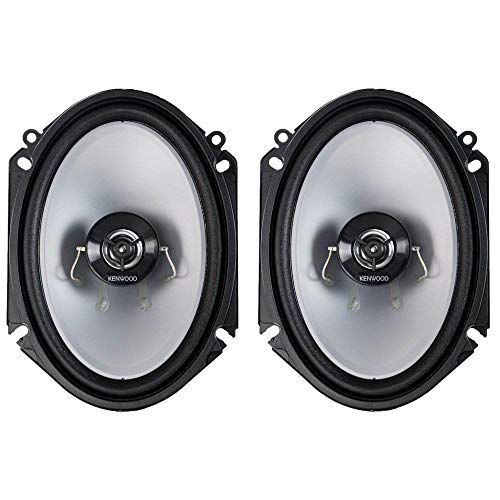
Kenwood positioned the KFC-C6866S as a high-value entry point in the 6x8 category, pairing a 250-watt peak power rating with a 30-watt RMS specification that honestly communicates how the speaker performs under sustained real-world conditions rather than the brief transients that peak figures measure. The 2-way coaxial configuration uses a paper cone woofer paired with a dedicated tweeter, and the 4-ohm impedance ensures compatibility across the full range of factory and aftermarket head units currently in production. Paper cone construction is frequently dismissed in favor of synthetic materials, but Kenwood's implementation uses a well-damped formulation that produces a warm, musical midrange that many listeners prefer over the harder, brighter character of polypropylene alternatives.
The KFC-C6866S installs without modification into vehicles that accept the standard 6x8 mounting footprint, and Kenwood's reputation for consistent manufacturing tolerances means the fit is reliably accurate across production batches. The 30-watt RMS rating is the honest performance ceiling for this speaker, and buyers who respect that boundary by avoiding aggressive amplification will find a driver that performs with commendable naturalness within its operating envelope. Pairing this speaker with a head unit that delivers 15 to 25 watts per channel — the typical output range for modern factory and entry-level aftermarket units — produces a noticeable improvement over standard OEM hardware at a price that keeps the total upgrade cost accessible.
The limitation of the KFC-C6866S is its ceiling rather than its floor. Once you push the driver beyond its rated power range, distortion onset arrives quickly and the paper cone begins to show its constraints in the upper midrange frequencies. For budget-conscious buyers who are upgrading from genuinely poor stock speakers and operating within normal head unit power levels, however, the Kenwood delivers a rewarding improvement at one of the lowest price points in this category.
Pros:
Cons:
Sony engineered the XS-680GS around a fundamental tension in coaxial speaker design: the woofer cone must be stiff enough to reproduce bass accurately while remaining compliant enough to integrate smoothly with the tweeter's radiation pattern across the crossover frequency. Sony's solution uses a durable polypropylene diaphragm formulated to suppress the peaks and dips in the midrange and upper-midrange frequencies that cause tonal colorations, paired with a foam rubber surround that provides the damping characteristics necessary for responsive bass without the excessive stiffness that hard rubber surrounds introduce at low temperatures. The result is a driver that transitions from bass through midrange through treble with unusual smoothness for a 2-way coaxial at this price.
The soft-dome tweeter is the component that most clearly justifies the XS-680GS's positioning in this roundup. Sony specified a flat frequency response and wide dispersion pattern for this tweeter, characteristics that reduce the harshness associated with hard-dome designs and produce more even high-frequency coverage across a wide listening area. In a vehicle interior where listeners sit at inconsistent angles relative to the speaker axis, wide tweeter dispersion is a genuine acoustic advantage rather than a marketing abstraction. At 45 watts RMS and 250 watts maximum, the power handling accommodates both factory head units and modest external amplification without thermal stress on the voice coil.
The XS-680GS occupies a price tier slightly above the Kenwood while delivering measurably superior high-frequency behavior that justifies the difference, particularly for listeners whose music libraries include acoustic instruments, vocal-forward material, or high-resolution audio files. The speaker installs cleanly into standard 6x8 locations, and Sony's build quality control produces consistent performance across the production run. For buyers who prioritize treble smoothness and imaging accuracy over raw bass output, the Sony XS-680GS is a compelling and well-engineered choice in 2026.
Pros:
Cons:
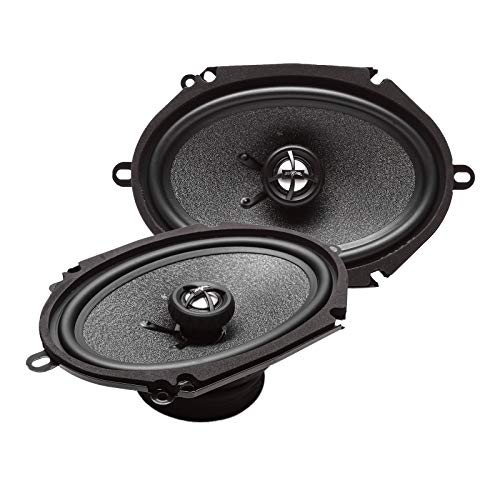
Skar Audio built the RPX68 around a microfiber paper cone and 20mm soft-dome silk tweeter combination that targets a specific listener: the budget-conscious buyer who wants silk-dome tweeter performance without paying the price premium that brands like Sony and Alpine charge for their high-frequency driver technologies. The microfiber paper cone construction delivers the warm, natural midrange character associated with paper while adding the rigidity of microfiber reinforcement, which pushes the breakup point higher in the frequency range and reduces the upper-midrange harshness that standard paper cones exhibit at moderate listening levels. Peak power handling is rated at 210 watts per pair — 105 watts each — with a butyl rubber surround maintaining compliance and damping across the operating range.
The 20mm silk dome tweeter is the RPX68's most differentiating component relative to competitors at comparable price points. Silk dome tweeters are preferred by many audiophiles over metal or plastic alternatives because the natural damping of the silk material absorbs resonance energy rather than reflecting it back through the acoustic output, producing a smoother and less fatiguing high-frequency presentation. At 20mm, the tweeter's radiating area is modest, but the silk dome material compensates for the limited size by maintaining dispersion consistency across a wider off-axis angle than rigid dome alternatives of the same diameter. The butyl rubber surround on the woofer complements the tweeter's character by keeping bass transients controlled and natural rather than exaggerated.
The RPX68 competes directly with the Kenwood on price while offering a tweeter technology argument that resonates with listeners who have previous experience with silk-dome designs. Installation is uncomplicated, and the speaker fits standard 6x8 mounting locations without modification. For buyers entering the aftermarket speaker category for the first time and seeking a noticeable improvement over factory equipment at minimal cost, the Skar Audio RPX68 presents a valid and often underrated option in 2026. If your system needs a subwoofer complement, our shallow mount subwoofer guide covers space-efficient bass solutions that pair naturally with upgraded coaxials like these.
Pros:
Cons:
When evaluating 6x8-inch car speakers, the continuous RMS power rating is the specification that determines real-world performance compatibility, not the peak or maximum figures that dominate marketing materials. Peak power ratings describe the brief energy burst a speaker can absorb before permanent damage occurs, while RMS reflects the sustained power level the driver reproduces without thermal stress to the voice coil. Matching your head unit or amplifier's output to the speaker's RMS range — ideally driving the speaker at 75 to 100 percent of its rated RMS — produces clean output at high listening levels without the clipping distortion that destroys tweeters and degrades voice coil integrity over time. Factory head units typically deliver 15 to 25 watts RMS per channel, which means speakers rated at 45 to 80 watts RMS will perform comfortably without requiring an external amplifier.
The physical materials used in the woofer cone and surround determine both the tonal character of the speaker and its long-term reliability in the challenging thermal and humidity environment of a vehicle interior. Polypropylene cones offer durability and a bright, detailed character that reproduces electronic music and percussion with sharpness and definition, while paper and microfiber paper cones deliver a warmer, more natural midrange that complements acoustic instruments and vocal-forward recordings. Surround materials divide between butyl rubber — which maintains consistent compliance from −20°C to 80°C and provides excellent damping — and foam, which offers natural sound at moderate temperatures but degrades over long periods in extreme heat exposure. For vehicles parked regularly in direct sunlight, butyl rubber surrounds provide meaningfully better longevity than foam alternatives.
The number of driver elements in a coaxial speaker determines how the audio spectrum is divided and assigned to dedicated components, with more ways theoretically producing more accurate reproduction by matching each driver to the frequencies it handles most efficiently. A 2-way design assigns bass and midrange to the woofer cone with a tweeter handling high frequencies, which keeps the crossover simple and the phase response manageable. A 3-way or 4-way design further divides the midrange and introduces additional crossover transition points that can improve clarity when engineered correctly but introduce phase and amplitude irregularities when implemented with insufficient precision. For most listeners replacing factory equipment, a high-quality 2-way or 3-way speaker from a reputable manufacturer produces a more satisfying result than a budget 4-way unit with a poorly tuned crossover network.
The 6x8-inch designation describes the nominal mounting footprint but does not guarantee identical physical dimensions across all speakers carrying that label. Mounting depth — the distance from the front of the speaker to the back of the magnet structure — varies significantly between models and determines whether a particular speaker fits within the door cavity or rear deck without contacting window mechanisms, structural bracing, or interior trim. Before ordering, measure the available mounting depth in your specific vehicle and compare it against the speaker's listed specifications. Additionally, confirm the cutout diameter and bolt-circle dimensions match your vehicle's mounting location or that a compatible adapter plate is available for your application. Installing a speaker with insufficient depth clearance causes mechanical interference that damages the cone, the tweeter, or the vehicle's window regulator hardware.
In vehicles designed with 6x8-inch factory speaker locations — which includes many Ford, Chrysler, Dodge, and Mazda models — yes, aftermarket 6x8 speakers install directly into the OEM mounting location using the existing hardware or a supplied adapter plate. You should verify mounting depth clearance and bolt-circle dimensions for your specific vehicle and model year before ordering, as minor variations exist between production runs even within the same manufacturer's lineup.
No. All of the speakers reviewed in this guide are rated at 4-ohm impedance and carry RMS specifications that fall within the output range of modern factory and aftermarket head units. An external amplifier improves dynamic headroom and reduces distortion at higher listening levels, but speakers rated at 45 to 80 watts RMS perform with full tonal quality when driven by a head unit delivering 20 to 25 watts per channel. If you decide to add an amplifier later, ensure the amplifier's per-channel RMS output matches the speaker's RMS rating rather than the peak figure.
A 2-way coaxial uses a woofer cone for bass and midrange frequencies with a single tweeter handling high frequencies, kept separate by a simple crossover network. A 4-way design adds two additional driver elements — typically a midrange cone and a super-tweeter — to further subdivide the frequency spectrum and assign each range to a more specialized driver. When engineered well, the 4-way design produces more accurate and detailed reproduction; when the crossover is poorly implemented, the additional transition points introduce phase problems that reduce clarity despite the theoretical advantages of driver separation.
Hi-Res Audio certification, as carried by the Alpine S2-S68, requires a speaker to reproduce frequencies up to at least 40 kHz — well above the approximately 20 kHz ceiling of human hearing. The practical benefit is not the extension itself but the engineering precision required to achieve it: a driver capable of operating cleanly at 40 kHz handles the upper registers of the audible spectrum with greater phase accuracy and lower distortion, which produces more natural transient reproduction and finer detail resolution in recordings. Listeners consistently describe Hi-Res certified speakers as more open and spacious sounding than similarly priced non-certified units.
Adapter plates exist for this conversion and are widely available for specific vehicle makes and model years. A 6x9-inch speaker offers a larger cone surface area and greater potential bass output than a 6x8, which makes the conversion worthwhile if your vehicle's mounting depth and cavity geometry accommodate the larger basket. The adapter plate covers the difference in cutout diameter and repositions the bolt holes, but you must verify that the larger speaker's basket depth does not contact window mechanisms or structural components before committing to the conversion.
Proper baffle sealing is the single most effective technique for improving bass output from any door-mounted speaker, because factory door panels have large open cavities that allow sound pressure from the back of the speaker cone to cancel the output from the front. Applying closed-cell foam tape to the door panel baffle where it contacts the speaker mounting gasket seals this path and produces a measurable improvement in bass output without any change in hardware. Adding mass-loaded vinyl or constrained-layer damping material to the door skin further reduces resonance and allows the speaker to pressurize the cavity behind the cone more effectively, extending perceived bass depth by a full octave in some installations.
 |
 |
 |
 |

About Rachel Park
Rachel Park specializes in the interior and exterior upgrades that meaningfully change how a car looks, sounds, and feels on a daily basis. She has hands-on experience with head unit installations and audio system builds, LED and HID lighting conversions, interior refresh projects, and cosmetic exterior work — evaluated from both a DIY accessibility and quality-of-result perspective. At CarCareTotal, she covers car audio and electronics, lighting upgrades, and interior and exterior styling accessories.
Get some FREE car parts & gear.. Or check out the latest free automotive manuals and build guides here.
Disable your ad blocker to unlock all the hidden deals. Hit the button below 🚗
| | | |
