by Liam O'Brien
The Jabra Drive Bluetooth in-Car Speakerphone earns the top spot in this roundup because it delivers crystal-clear hands-free audio with DSP-powered echo cancellation that actually works at highway speeds. Distracted driving remains one of the leading causes of road fatalities, and pairing your phone wirelessly while keeping both hands on the wheel is one of the simplest, most effective upgrades you can make to your daily commute in 2026. Whether your car predates factory Bluetooth by a decade or you just want a dedicated speakerphone that doesn't rely on your aging head unit, the right Bluetooth car kit transforms your vehicle into a safer, more connected driving environment without a costly stereo replacement.
The market for Bluetooth car kits has matured considerably, and the 2026 lineup reflects serious engineering improvements — Bluetooth 5.3 connections that auto-pair before you've buckled your seatbelt, noise-cancellation algorithms borrowed from premium headset technology, and FM transmitter hybrids that work with virtually any car audio system regardless of age. We tested seven of the most popular options across a range of vehicle types, connection methods, and use cases to give you a definitive picture of which kit belongs in your car. If you're also upgrading other cabin accessories, check out our guide to the 6 Best Car Neck Pillows of 2026 and the 6 Best Portable Jump Starters of 2026 while you're outfitting your ride.
Understanding the differences between speakerphone clip kits, AUX Bluetooth receivers, and FM transmitter combos is critical before you buy, because the wrong connection method will leave you frustrated regardless of audio quality. This guide covers every major connection type, walks through seven hands-on product reviews, and closes with a buying guide that cuts through the marketing jargon so you can make a confident decision. You'll find all the tools and accessories your car needs at our automotive tools resource hub.
Contents








The Jabra Drive has been a category benchmark for years, and its staying power in 2026 comes down to one thing: it simply works better than almost everything else in this price tier for hands-free calling. The Digital Signal Processing engine does the heavy lifting — canceling road noise, HVAC rumble, and wind interference so the person on the other end actually hears you clearly rather than a muffled jumble from your dashboard. Sun visor mounting keeps the microphone close to your mouth, which is a critical advantage over dash-mounted units that pick up every rattle in your cabin.
One feature that sets the Jabra Drive apart from single-device competitors is its ability to connect to two Bluetooth devices simultaneously, letting you swap between your personal phone and a work device without any manual re-pairing ritual. Music streaming and GPS audio redirect through the Drive's speaker with enough volume to be audible in highway conditions, and the controls are large enough to operate by feel without looking away from the road. This is the kit you hand to someone who doesn't want to think about their Bluetooth setup — they pair it once, and it handles the rest automatically every time they start the car.
The unit charges via micro-USB and delivers strong battery performance for standard commuter use, though heavy multi-hour talkers may find themselves recharging every couple of days. Call quality is noticeably better than budget AUX adapter alternatives because the speaker sits closer to driver ear level, and Jabra's DSP tuning has been refined across multiple hardware generations to prioritize voice intelligibility over music reproduction fidelity.
Pros:
Cons:
If your car has a 3.5mm AUX input and you want the cleanest possible wireless audio path, the BESIGN BK01 is the adapter to buy in 2026. Running Bluetooth 5.3 — the most current specification available — it delivers lower power draw and broader device compatibility than the 5.0 chips still populating most competitors in this price range. The connection is rock-solid across the full range of a vehicle interior, and the auto-connect behavior means the kit pairs with your phone before you've adjusted your mirrors, provided your phone's Bluetooth is active when you start the car.
The included ground loop noise isolator is a standout inclusion that budget AUX adapters routinely omit to their buyers' regret, because alternator whine through the AUX input is an infuriating problem in many vehicles. BESIGN includes the isolator in the box, and it eliminates that high-pitched electrical interference completely in most vehicles. Hands-free calling routes through a built-in microphone, and while the mic positioning at the AUX port location is less ideal than a visor-mounted unit, call clarity is more than acceptable for daily commuting use.
Auto-on with ignition start is handled correctly here — the unit wakes with your car's accessory power rather than requiring a separate button press, which is the behavior that separates a polished product from an annoying one. The Bluetooth 5.3 chipset also means faster initial pairing and more stable connections when moving through areas with RF interference, making this a reliable daily driver for anyone whose car has an accessible AUX port.
Pros:
Cons:
The Avantree CK11 is engineered specifically for drivers who want a dedicated speakerphone solution that keeps them compliant with hands-free driving laws while minimizing distraction at every interaction point. The Motion Wake function is the headline feature — vibration from your car door opening wakes the device automatically, so you never fumble with a power button before pulling out of your driveway. It powers down intelligently after your Bluetooth disconnects and a period of inactivity passes, so battery management happens without any input from you.
The 3W speaker is tuned for voice clarity rather than music reproduction, which is the correct priority for a device of this form factor. Siri integration works consistently, letting you compose texts, place calls, and get navigation directions entirely by voice without touching your phone at all. The volume knob is a thoughtful hardware decision in a market where too many competitors bury volume adjustment in phone software menus — you can adjust call loudness without navigating any interface while driving, which is exactly how it should work. The titanium colorway looks professional rather than plasticky, and the build quality matches the premium aesthetic.
Bluetooth 5.0 connection is stable and pairs quickly with iOS and Android devices, and the visor clip mechanism is robust enough to hold the unit in place even on vehicles with thin visor profiles. For safety-focused drivers who want the simplest, most distraction-free hands-free experience in 2026 without touching their stereo system at all, the CK11 is the most thoughtfully designed option in the visor-clip category.
Pros:
Cons:
The Kinivo BTC450 is the kit for drivers who refuse to compromise on music streaming quality in the name of wireless convenience, and aptX codec support is the reason it earns that distinction. While standard Bluetooth audio uses SBC compression that audibly degrades high-frequency detail and stereo imaging, aptX delivers CD-quality audio over the wireless connection when paired with an aptX-capable phone — a difference you'll notice immediately on any car audio system that has been properly set up. If you've invested in a quality head unit or aftermarket speakers, the BTC450 is the adapter that won't bottleneck your system's potential.
The unit connects to any car stereo via the 3.5mm AUX input and ships with a built-in microphone for hands-free calling alongside dedicated music control buttons that let you play, pause, skip, and adjust volume without picking up your phone. The ground loop noise isolator is integrated into the design, addressing the alternator whine issue that plagues cheaper AUX adapters in most vehicles. Compatibility with the full range of Bluetooth smartphones — iPhone, Android, and legacy devices — means you won't encounter pairing failures regardless of which device you're connecting.
Installation is genuinely plug-and-play: connect the AUX cable, plug into your 12V cigarette lighter socket for power, pair once, and you're done. The BTC450 remembers your device and reconnects automatically on subsequent drives, and the control layout is intuitive enough that you'll have memorized button positions within your first commute. For drivers who use their car audio system seriously and want to maintain audio fidelity while adding Bluetooth convenience, this is the definitive choice in the AUX adapter segment for 2026.
Pros:
Cons:
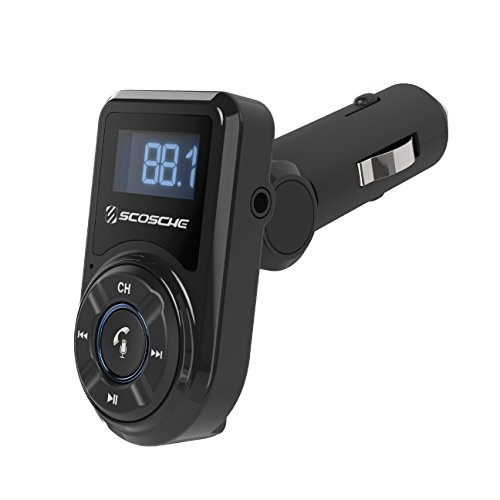
The Scosche BTFM3 solves the oldest problem in the Bluetooth car kit category: what do you do when your car has neither an AUX port nor a working cassette deck? FM transmission is the answer for vehicles without any direct audio input, and the BTFM3 executes this approach competently while adding genuine 10-watt USB fast charging that's actually useful rather than the underpowered afterthought most FM transmitter competitors ship. Streaming audio from your phone to your car's FM radio through this adapter gives you clean audio on any frequency you select, with remote control for frequency switching without reaching for the unit itself.
Hands-free calling functionality works through the built-in microphone, and the 2.1-amp USB port delivers enough power to charge modern smartphones at a meaningful rate even while running GPS navigation and streaming audio simultaneously — a combination that notoriously kills battery on most phones faster than standard car chargers can recover it. Voice control compatibility maintains your ability to make calls and issue commands without button presses, keeping driver distraction at minimum throughout the journey.
FM transmitter performance is inherently limited by your local FM broadcast environment, and in dense urban areas with crowded FM spectrums you'll need to experiment with frequencies to find a clean channel. In suburban and rural environments, the BTFM3 delivers reliable FM audio that's noticeably better than the white-noise-heavy experience of budget transmitters. The combination of wireless audio, fast charging, and hands-free calling in a single 12V adapter makes this the most versatile option for older vehicles in the 2026 roundup. If you're equipping a vehicle for longer road trips, you might also want to pair this with one of the 6 Best Car Escape Tools of 2026 for comprehensive safety preparedness.
Pros:
Cons:
The COMSOON Bluetooth Receiver earns its place in the 2026 lineup primarily because of its 16-hour battery life, which makes it uniquely useful across multiple use cases — in the car, at a home stereo, or paired with wired headphones — without the tethered-power dependency that characterizes most car-focused adapters. The CVC 8.0 noise cancellation combined with DSP processing represents serious audio engineering for this price point, and the call clarity improvement over basic Bluetooth adapters is audible immediately during back-to-back comparisons in highway driving conditions.
The 3.5mm AUX output connects to your car stereo, home audio system, or any wired headphone with the same hardware, making this the most versatile receiver in the roundup from a multi-environment use perspective. USB-C fast charging with a 2.5-hour full charge cycle means that even if you drain the battery completely over a long drive, a lunch break will restore full capacity before your return trip. The Bluetooth 5.0 chipset provides stable connection with clean handoff behavior when switching between paired devices, and the compact form factor in black and silver fits unobtrusively in a cupholder or on a center console without drawing attention.
The noise cancellation performance during calls is genuinely impressive — CVC 8.0 is the same generation of noise processing used in premium wireless earbuds, and it makes a material difference when you're calling from a freeway at 70 mph with windows cracked. For drivers who want a single Bluetooth receiver that works equally well in their car, at home, and potentially at the office with a desktop speaker, the COMSOON delivers flexibility that none of the other devices in this roundup can match.
Pros:
Cons:
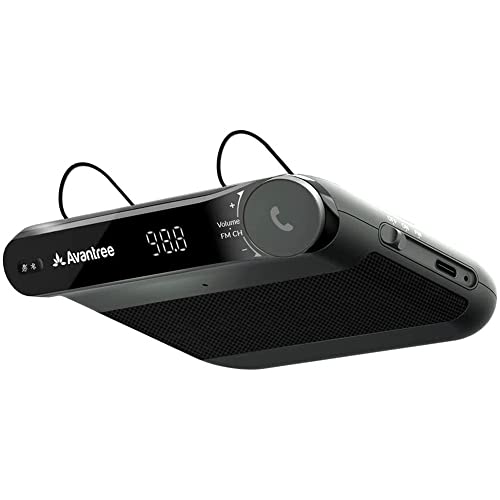
The Avantree Roadtrip occupies its own category within this roundup because it's the only device here that meaningfully functions as both a standalone Bluetooth speaker for calls and a wireless FM transmitter for streaming music through your car's stereo simultaneously, with a 22-hour battery life that outlasts every competitor in the review by a wide margin. That runtime figure isn't marketing fiction — dual 3W speakers and an efficient wireless chipset combine to deliver genuine all-day operation that makes the Roadtrip viable for rideshare drivers, long-haul commuters, and anyone whose driving day extends past what a single charge of most car adapters can sustain.
The 2-in-1 functionality is executed intelligently rather than as a compromise between two mediocre modes. Using it as a Bluetooth speaker for calls and voice assistant interactions delivers strong audio quality through the dual 3W speaker array with the built-in noise-reducing microphone handling voice pickup clearly. Switching to FM transmitter mode for music streaming routes your phone's audio through whatever FM frequency your car stereo is tuned to, giving you full-range stereo reproduction through your factory speakers without any cable. For vehicles without AUX ports, this is the most complete wireless audio solution in the 2026 market.
The noise-reducing microphone performs well enough in city traffic conditions, though the distance between a dash-positioned unit and the driver's mouth is a physics limitation that no amount of noise processing fully overcomes. For calls in genuinely noisy freeway conditions, the Jabra Drive's visor placement remains the technical leader, but the Roadtrip's 22-hour battery and FM transmitter functionality make it the more capable overall device for drivers whose needs extend beyond hands-free calling alone.
Pros:
Cons:

The single most important decision you'll make when choosing a Bluetooth car kit is selecting the right connection type for your vehicle's existing audio system, because each approach carries different audio quality ceilings and installation constraints. Understanding your car's capabilities before you buy prevents the frustration of receiving a product that physically cannot work in your specific vehicle.
The quality of the microphone and its associated noise-cancellation processing determines whether the person you're calling can actually hear you clearly, which is ultimately the core value proposition of any hands-free kit. Budget adapters with basic microphones perform acceptably at low speeds in quiet conditions and deteriorate rapidly as road noise, HVAC, and wind enter the equation at highway speeds.
The daily-use friction of a Bluetooth car kit is determined almost entirely by how much conscious attention it requires from you to function — a device that auto-pairs, auto-powers, and auto-connects is categorically more useful than one that requires manual intervention every time you start your car, regardless of its audio quality specs.
If you're choosing a battery-powered portable unit rather than a 12V-powered adapter, battery life directly determines whether the device is a reliable daily tool or an intermittently available inconvenience. The variance across products in this category is dramatic — from the 16 hours of the COMSOON to the 22 hours of the Avantree Roadtrip — and the right choice depends on how many hours of active use your typical driving day accumulates.
All seven kits reviewed here use standard Bluetooth protocols (A2DP for audio streaming, HFP for hands-free calling) that are universally supported by iOS and Android devices. Any smartphone released in the past decade with Bluetooth capability pairs with these adapters without requiring any special apps or drivers. aptX audio quality requires both the adapter and the phone to support aptX — check your phone's specifications if this matters to your use case, as not all Android phones support aptX and iOS devices use AAC instead.
No — FM transmission is inherently inferior to direct AUX connection for music quality because the audio is converted from digital to analog, modulated onto an FM carrier frequency, broadcast, received by your car radio, and demodulated back to audio. Each conversion step introduces some quality loss, and FM's limited bandwidth (around 15 kHz) can't reproduce the full frequency range of high-quality audio files. For calls and spoken-word content, FM transmission quality is perfectly acceptable. For serious music listening, a direct AUX connection with an aptX adapter like the Kinivo BTC450 is noticeably superior.
Modern Bluetooth car kits operate in the 2.4 GHz ISM band using frequency-hopping spread spectrum technology, which is specifically designed to coexist with other wireless systems without interference. Ground loop noise — a whining sound caused by the car's alternator — is the most common audio problem users encounter, and it's not interference from the kit but rather an electrical grounding issue between the adapter and the stereo. The BESIGN BK01 and Kinivo BTC450 include ground loop noise isolators in the box that eliminate this problem completely in most vehicles.
Not simultaneously — active phone calls take priority over music streaming, so your music pauses when a call connects and resumes automatically when the call ends. This is standard behavior across all Bluetooth HFP/A2DP implementations. What some kits like the Jabra Drive do enable is maintaining paired connections to two devices at once, so you can receive a call from your work phone while your personal phone handles the music streaming without any manual re-pairing between the two functions.
Echo on calls is caused by the speaker's audio being picked up by the microphone and transmitted back to your caller — the same problem DSP echo cancellation is specifically designed to solve. If you're experiencing echo, first ensure you're using a kit with DSP or CVC noise cancellation (all seven reviewed here have some form of this). If echo persists, reduce the speaker volume slightly, as high volume levels can overwhelm even well-implemented echo cancellation algorithms. Visor-mounted kits with the speaker facing the driver rather than an open cabin generally handle echo better than dash-mounted units.
This is precisely the scenario Bluetooth car kits are designed for — they add wireless connectivity to any vehicle regardless of model year or factory technology. AUX adapter kits like the BESIGN BK01 and Kinivo BTC450 work in vehicles from any era that have a 3.5mm input jack on the stereo (common on vehicles from 2005 onward). FM transmitter kits like the Scosche BTFM3 and Avantree Roadtrip work in any vehicle with an AM/FM radio — effectively every car ever mass-produced. For vehicles that lack both, a standalone speakerphone like the Jabra Drive or Avantree CK11 operates completely independently of the car's audio hardware.
Every driver in 2026 should have a Bluetooth car kit that matches their vehicle's connection options and their personal driving priorities — whether that's the Jabra Drive's unmatched call clarity for the hands-free-first commuter, the Kinivo BTC450's aptX audio fidelity for the music-focused driver, or the Avantree Roadtrip's 22-hour battery and FM transmitter versatility for the driver who needs everything in one device. Pick the connection type that works with your car first, then optimize for the features that matter most to your daily routine, and you'll have a safe, connected driving experience that makes every commute more productive and every road trip more enjoyable.
 |
 |
 |
 |

About Liam O'Brien
Liam O'Brien has spent over a decade buying, field-testing, and evaluating automotive tools with a focus on what actually performs in a real DIY garage rather than what markets well on a spec sheet. His hands-on experience spans hand tools, diagnostic equipment, floor jacks, socket sets, and specialty automotive gear across a wide range of brands and price points. At CarCareTotal, he covers automotive tool and equipment reviews, garage setup guides, and buying advice for home mechanics.
Get some FREE car parts & gear.. Or check out the latest free automotive manuals and build guides here.
Disable your ad blocker to unlock all the hidden deals. Hit the button below 🚗
| | | |
