Audio ›
by Rachel Park
Nearly 70% of car audio enthusiasts report that upgrading their factory speakers is the single most impactful modification they can make to their in-car listening experience, and 5.25-inch drivers are the most common factory size across thousands of vehicle models sold in North America. If you've been living with the thin, distortion-prone speakers that came stock in your vehicle, you already know how far short of satisfying they fall, especially once you push the volume past a modest level. The good news is that the 5.25-inch aftermarket segment has matured significantly, and in 2026 you can get genuinely impressive sound quality at a wide range of price points, from budget-conscious daily drivers to audiophile-grade coaxials that will change what you expect from your commute.
Choosing the right set of 5.25-inch speakers, however, requires more than just picking the one with the highest watt rating on the box, because power handling numbers are frequently misleading, and sensitivity, frequency response, and build quality matter far more for real-world performance. Whether you're building around a dedicated amplifier or running your speakers off a head unit, the pairing matters enormously, so you'll want to read our amp wiring kit guide before you finalize your setup. In this guide, we've tested and evaluated seven of the top 5.25-inch coaxial speakers available in 2026, covering everything from JBL's accessible GX528 to the audiophile-oriented Focal 130AC, so you can make a confident, informed decision that suits both your vehicle and your ears.
We've also included a thorough buying guide covering sensitivity, impedance, power handling, and installation considerations, along with a detailed FAQ section to answer the questions we see most often from readers upgrading their car audio setups for the first time. According to the Wikipedia entry on loudspeakers, coaxial designs place the tweeter concentrically with the woofer to provide a closer approximation of a single-point sound source, which is exactly why they remain the most popular drop-in replacement format for factory speaker locations. Let's get into the details.
Contents









JBL has been one of the most trusted names in speaker engineering for decades, and the GX528 carries that heritage into an accessible price bracket that makes it an easy recommendation for anyone upgrading from factory speakers on a tight budget. The GX528 is a 2-way coaxial design built around a polypropylene woofer cone that balances rigidity with enough flex to produce clean, extended bass response without the harsh breakup you get from cheaper materials. The edge-driven tweeter sits at the center of the cone on a bridge, and JBL has tuned the crossover to hand off frequencies smoothly, which keeps the midrange presentation coherent and natural-sounding even at higher volumes when cheap crossovers tend to fall apart.
In practice, the GX528 punches noticeably above its price point, delivering a soundstage that feels open and detailed for a coaxial design, with vocals sitting clearly in the mix rather than getting smeared by poor time alignment between the woofer and tweeter. The sensitivity rating is competitive enough to let you run these off most head units without needing an external amplifier, which makes them an ideal entry point for a clean, low-complexity install. Build quality is solid for the category, with a robust basket that fits most factory cutouts without modification, and the included mounting hardware covers a broad range of installations.
The GX528 is not going to satisfy an audiophile, and if you're already running a dedicated amp you'll likely want to invest more, but for a head-unit-driven daily driver setup in 2026, it remains one of the best dollar-per-decibel purchases in the 5.25-inch market. Installation is genuinely straightforward, taking most DIYers under an hour per door, and JBL's name recognition means you can find support and compatibility information easily if you run into fitment questions.
Pros:
Cons:
Pioneer's A-Series has been a fixture in the car audio market for years, and the TS-A1371F represents the brand's 2026 refinement of a proven formula, delivering 3-way performance at a price that still fits a realistic upgrade budget. The 3-way design is the defining feature here, with separate drivers dedicated to bass, midrange, and high-frequency reproduction, which gives you a more accurate and layered soundstage than any 2-way coaxial can achieve at a similar price point. Pioneer rates the TS-A1371F at 300 watts maximum with a continuous rating of 50 watts, and with a frequency response stretching from 37 Hz all the way to 31 kHz, these speakers cover the full audible spectrum with room to spare above and below what most music actually demands.
The performance in the midrange is where the TS-A1371F really distinguishes itself from cheaper options, reproducing voices and instruments with a texture and presence that makes music feel more alive inside the cabin. The extended high-frequency response up to 31 kHz goes well beyond the upper limit of human hearing at around 20 kHz, but what that headroom buys you in practice is a smoother, more relaxed treble presentation that avoids the sharp, fatiguing highs that plague budget 2-way designs. Bass response is firm and defined down to 37 Hz, which puts genuine low-end extension within reach even without a dedicated subwoofer, making this one of the more complete-sounding standalone speaker solutions on this list.
Pioneer has optimized the basket geometry for drop-in compatibility with common factory locations, and the wiring harness and mounting hardware included in the box make installation clean and professional. For listeners who stream a wide variety of music genres and want a speaker that handles everything from hip-hop bass lines to classical string quartets without obvious weaknesses, the TS-A1371F is the most versatile choice on this list in 2026.
Pros:
Cons:
The Alpine S2-S50 is the speaker that closes the gap between mid-range coaxials and true audiophile-grade separates, arriving in 2026 with Hi-Res Audio certification and a frequency response that reaches all the way to 40 kHz, which is twice the upper limit of standard audio and well above the capability of any speaker in this price class from just a few years ago. Hi-Res Audio certification is not a marketing invention — it requires independent verification that the speaker can accurately reproduce audio files encoded at 96 kHz/24-bit or higher, which means that if you're listening to lossless streaming services or high-resolution audio downloads, the S2-S50 will reveal detail that lesser speakers literally cannot produce. Alpine builds the cone from a proprietary blend of polypropylene, glass fiber, and mica, a combination that achieves the ideal balance between lightness and stiffness, resulting in low distortion and high output across the frequency range.
The standout engineering feature is HAMR — Alpine's High Amplitude Multi-Roll surround technology, which allows the cone to travel farther in both directions than a conventional single-roll surround design permits, and that extended excursion translates directly into deeper, more accurate bass notes from a 5.25-inch driver that is physically constrained by the size of your door panel. In listening tests, the S2-S50 produces bass that sounds tight and controlled rather than bloated or one-note, which is a common failure mode for coaxials that try to overextend their low-frequency reach. The tweeter handles highs with exceptional smoothness, producing an airy, extended top end that makes cymbals and string harmonics sound natural rather than brittle.
If you're serious about sound quality and willing to spend a little more than the budget options on this list, the S2-S50 is the clear technical standout in the 5.25-inch coaxial category for 2026, and pairing it with a quality car audio battery and a dedicated amp will unlock its full potential in ways that head-unit-only setups simply cannot achieve. This is a speaker that rewards the investment with genuine audiophile performance.
Pros:
Cons:

Infinity's Reference series has long been the benchmark for no-fuss, high-quality factory replacement speakers, and the REF-5032CFX updates that tradition with engineering choices that are specifically optimized for real-world drop-in installations rather than controlled listening room conditions. The most distinctive feature is the Plus One woofer design, which gives the cone a larger effective radiating surface area than the frame size would suggest is possible, and that extra surface area directly improves bass output and midrange presence in ways that a conventional 5.25-inch cone cannot match. The basket geometry has been redesigned from the ground up to align with the mounting configurations used in the most popular vehicle models of 2024 and 2025, which means your REF-5032CFX pair will drop in cleanly without adapter plates or custom fabrication in the vast majority of installations.
The edge-driven textile tweeter is a deliberate choice on Infinity's part, and it delivers a smooth, refined high-frequency response that avoids the metallic harshness you sometimes encounter with harder tweeter materials in this price range. Textile domes tend to roll off more gently at the frequency extremes, which translates to a less fatiguing listening experience over long commutes and road trips, and for most music genres that gentleness is actually a sonic advantage rather than a compromise. The REF-5032CFX also handles a reasonable power range that covers both head-unit and amplified installations, giving you flexibility as your system evolves.
For anyone replacing a single factory speaker or upgrading an entire vehicle's audio system in 2026 without wanting to deal with custom fabrication or complex wiring changes, the Infinity REF-5032CFX is the most straightforwardly excellent drop-in option on this list. If your goal is a meaningful upgrade over stock sound with a clean, factory-look installation, start here.
Pros:
Cons:
Polk Audio's DB522 is the only speaker on this list that carries full marine certification alongside its car audio credentials, which means it's been engineered and tested to withstand moisture, UV exposure, salt spray, and temperature extremes that would degrade a standard car speaker in months of outdoor use. If you're building audio into a boat, a UTV, a convertible, or any other vehicle where weather exposure is a genuine concern, the DB522 is the obvious choice in the 5.25-inch category and it doesn't ask you to sacrifice sound quality in exchange for that durability. The polypropylene woofer cone is inherently moisture-resistant and dimensionally stable across temperature ranges, while the 3/4-inch silk dome tweeter delivers a refined high-frequency response that outperforms the harder dome materials typically found in marine speakers.
Polk's Dynamic Balance technology is the engineering backbone of the DB522, using a laser measurement process to analyze and optimize the cone and surround material combination before the design is finalized, eliminating resonance peaks and frequency response irregularities that would otherwise require careful listening and iterative redesign to identify. The result is a speaker that measures flat and sounds flat in the best sense — accurate, uncolored, and capable of reproducing a wide range of music convincingly across its 55 Hz to 22 kHz frequency range. The built-in crossover network handles the transition between woofer and tweeter cleanly, directing each frequency range to the appropriate driver with minimal overlap or phase error.
Running at 4-ohm impedance with a 100-watt RMS power handling rating, the DB522 is equally at home being driven by a head unit or an external amplifier, and its sensitivity is high enough that even modest power produces satisfying volume levels. Whether you're installing these in a car door, a boat's console enclosure, or a side-by-side UTV that spends its weekends on dusty trails and muddy river banks, the DB522 delivers consistent, reliable performance that most speakers at this price point simply cannot match in demanding environments.
Pros:
Cons:
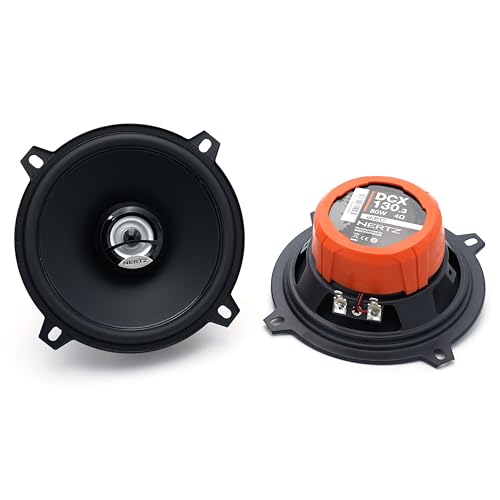
Hertz is an Italian loudspeaker manufacturer with a devoted following in the European car audio community, and the DCX-1303 from their entry-level Dieci series brings that Mediterranean engineering tradition to a price point that American buyers can readily access in 2026. The fundamental spec that sets the DCX-1303 apart from similarly priced competitors is the neodymium tweeter magnet — neodymium is a rare earth magnet material that is significantly stronger than the ferrite magnets used in most budget and mid-range tweeters, which allows Hertz to build a smaller, lighter tweeter motor that responds faster and reaches higher frequencies with less energy loss. The woofer, by contrast, uses a ferrite magnet, which is the appropriate choice for a larger moving assembly where the greater mass of a ferrite magnet actually aids in controlling cone movement.
That combination of neodymium tweeter and ferrite woofer reflects genuine engineering intentionality rather than cost-cutting, and the listening results confirm the design logic — the DCX-1303 produces highs that are detailed and airy in a way that most speakers in this category simply cannot approach, while the woofer delivers solid, well-controlled bass and midrange output that grounds the upper-frequency clarity in a coherent overall sound. The crossover design is conservative and well-executed, handing off between drivers at a point that allows each to operate well within its optimal range, which keeps distortion low even when you push the volume.
Hertz's build quality is immediately apparent when you handle the DCX-1303 — the basket, cone, and surround materials all feel more substantial than you'd expect at this price, which speaks to the brand's commitment to engineering integrity rather than specification inflation. If you appreciate European audio engineering and want a speaker that sounds distinctively refined rather than just loud, the DCX-1303 delivers a character and quality level that justifies its position among the top picks in this roundup. Pair these with our recommended car tweeter upgrade guide if you're considering expanding your system further.
Pros:
Cons:
Focal is a French loudspeaker manufacturer whose home audio products are used as reference monitors in some of the world's most demanding professional recording environments, and the 130AC brings that engineering pedigree into the car audio space at the top of the Access series lineup, making it the most sophisticated 5.25-inch coaxial speaker on this list by a meaningful margin. The defining design choice is the inverted dome tweeter, which is the opposite of the conventional convex tweeter geometry used in almost every other speaker reviewed here — Focal's inverted dome sits concave relative to the listener, and this geometry produces a wider, more uniform dispersion pattern that distributes high frequencies evenly across the entire listening area rather than beaming them narrowly toward a single point in the cabin. The practical result is a soundstage that feels genuinely wide and three-dimensional rather than pinned between the front speakers in a narrow corridor.
The 2-way configuration keeps the crossover network simple and phase-coherent, which is a deliberate Focal philosophy — the brand believes that a superbly executed 2-way design outperforms a compromised 3-way setup, and the 130AC validates that argument convincingly in listening. Midrange reproduction is where the 130AC most obviously reveals its home audio DNA, presenting instruments and vocals with a tonal accuracy and spatial placement that recalls the best bookshelf speakers rather than the typical compressed, diffuse presentation of car audio components. The woofer cone material and surround geometry are optimized for controlled excursion and low resonance, producing tight, accurate bass that won't overwhelm the midrange clarity that makes this speaker genuinely special.
The Focal 130AC is the most expensive speaker on this list, and it's unambiguously worth every dollar for a listener who cares deeply about sound quality and has assembled the rest of their system to match. If you're pairing this with a quality head unit or amplifier and want to experience what 5.25-inch coaxial speakers are truly capable of in 2026, the 130AC is the answer. This is a speaker that will make you rediscover your music library rather than just play it louder.
Pros:
Cons:
Sensitivity is expressed in decibels at 1 watt/1 meter (dB/1W/1m), and it tells you how loud a speaker plays for a given amount of input power, which makes it the most practically useful single specification on any speaker's data sheet. A speaker with 92 dB sensitivity will play noticeably louder than one rated at 88 dB when driven by the same amplifier at the same volume setting, and that 4-dB difference is perceptible to any listener. If you're running your speakers off a stock head unit, which typically produces 15–22 watts RMS per channel rather than the 50-watt peak figures printed on the face, you want a sensitivity rating of at least 89 dB to ensure satisfying volume levels without distortion. Power handling, both peak and RMS, matters more if you're adding an external amplifier, and in that case you want to match the amplifier's continuous output to the speaker's RMS rating rather than the peak figure, which is almost always an optimistic best-case number measured under ideal conditions that rarely occur in a car.
A speaker's frequency response spec tells you the range of audio frequencies it can reproduce, expressed in hertz (Hz), and the usable bandwidth of a 5.25-inch coaxial driver is heavily influenced by whether it uses a 2-way or 3-way design. A 2-way speaker divides the spectrum between a woofer and a tweeter, which works well for most music but can produce a slightly hollow midrange character when the crossover point falls in a frequency range where neither driver performs optimally. A 3-way design like the Pioneer TS-A1371F adds a dedicated midrange driver that covers the critical 500 Hz to 3.5 kHz band where most vocal and instrumental content lives, resulting in a more coherent and detailed presentation that is especially noticeable on acoustic music and spoken-word content. If you're also considering upgrading your tweeters separately, check out our best car tweeters guide to understand how separate tweeter components can further improve imaging.
The materials used in a speaker's cone, surround, and basket directly determine its durability, sound character, and compatibility with your vehicle's factory cutouts, and these physical characteristics deserve as much attention as the electrical specifications when you're making a purchase decision. Polypropylene cones are the most common choice across all price points because they balance moisture resistance, lightness, and stiffness in a way that suits the variable temperature and humidity environment of a car interior, while glass fiber and mica composite cones, like those used in the Alpine S2-S50, push rigidity and low distortion further at the cost of slightly more complex manufacturing. Rubber surrounds outlast foam surrounds by a factor of three to five in real-world use, so make sure any speaker you buy in 2026 uses rubber rather than foam for the surround material. Check the mounting depth and cutout diameter of your chosen speaker against your vehicle's door specs before purchasing — most manufacturers publish a vehicle compatibility database that takes the guesswork out of this step.
Nearly all aftermarket 5.25-inch speakers, including every model reviewed here, operate at 4-ohm impedance, which matches the output impedance specification of virtually every aftermarket head unit and amplifier sold in the car audio market today, making impedance mismatch a non-issue for the vast majority of installations. Where impedance becomes relevant is when you're running a stock head unit in a modern vehicle, because many OEM audio systems are designed around 2-ohm or 1-ohm speaker loads and will behave unexpectedly when presented with a 4-ohm aftermarket replacement — if your factory system sounds distorted at moderate volumes after installing new speakers, impedance mismatch is the first thing to check. If you're planning to add an external amplifier, review our amp wiring kit recommendations to ensure your power delivery infrastructure matches the speaker's capabilities, because even the best speakers in this review will underperform significantly when connected through inadequate gauge wiring.
Yes — 5.25 inches is one of the two or three most common factory speaker sizes in North American vehicles, fitting door locations in a wide range of sedans, SUVs, and trucks produced over the past 20 years. Before purchasing, confirm your vehicle's specific cutout diameter and mounting depth using a speaker fit guide, as some vehicles in the 5.25-inch category have shallower door cavities that require a low-profile basket design or a thin spacer ring to achieve proper clearance behind the cone.
Not necessarily — all of the speakers reviewed here will play from a quality aftermarket head unit without an external amplifier, and for many listeners the result is a significant improvement over factory sound. However, if you want to run speakers at higher volumes without distortion, or if you've chosen a speaker like the Alpine S2-S50 or Focal 130AC that performs best with clean, powerful amplification, adding a 4-channel amplifier will unlock noticeably better dynamics and detail than any head unit can provide on its own.
A 2-way speaker divides the audio spectrum between a woofer and a tweeter, while a 3-way design adds a dedicated midrange driver, typically a small cone or dome mounted between the woofer and tweeter on the same basket. The midrange driver covers the frequency band roughly between 500 Hz and 3.5 kHz, which is where most vocal and instrumental content is concentrated, and a well-executed 3-way design like the Pioneer TS-A1371F reproduces this region with greater clarity and texture than a 2-way can typically achieve at the same price point.
Most 5.25-inch speaker replacements are a straightforward DIY project that requires basic hand tools — typically a panel removal tool, a Phillips screwdriver, and in some cases wire connectors — and can be completed in one to two hours per door without specialized experience. The most common complication is the wiring connector, because most modern vehicles use proprietary harness connectors that won't mate directly with aftermarket speaker leads, so purchasing a vehicle-specific harness adapter from Metra or Scosche eliminates splicing and preserves your factory wiring integrity.
Tweeter material has a significant influence on the high-frequency character of a coaxial speaker and is one of the primary differentiators between budget and mid-range designs. Silk or textile dome tweeters, like those used in the Infinity REF-5032CFX and Polk Audio DB522, produce a smooth, rolled, non-fatiguing treble character that suits extended listening in a car environment particularly well. Hard dome materials such as aluminum or titanium can produce higher peak extension but tend toward a brighter, more forward character that some listeners find fatiguing over long sessions — soft domes are generally the right choice for daily driving unless your amplification chain and acoustics are carefully tuned.
Peak power ratings printed on speaker packaging are largely marketing figures measured under conditions that don't reflect typical use — a speaker rated at 300 watts peak may actually handle only 50 watts RMS continuously without damage, and its sensitivity rating determines loudness far more directly than its power rating does. A speaker with 92 dB sensitivity at 1 watt is measurably louder than a 250-watt peak speaker rated at 87 dB when both are driven by the same real-world amplifier, so focus on sensitivity and RMS power handling rather than peak watt claims when comparing options in 2026.
Every speaker on this list is a genuine upgrade over the factory drivers sitting in your doors right now, and the right choice comes down to your budget, your listening priorities, and whether you're running a simple head-unit setup or building toward a fully amplified system. Pick your speaker, check your vehicle's fitment specs, grab a harness adapter to keep the wiring clean, and put that factory sound behind you for good — your ears will tell you immediately that you made the right call.
 |
 |
 |
 |

About Rachel Park
Rachel Park specializes in the interior and exterior upgrades that meaningfully change how a car looks, sounds, and feels on a daily basis. She has hands-on experience with head unit installations and audio system builds, LED and HID lighting conversions, interior refresh projects, and cosmetic exterior work — evaluated from both a DIY accessibility and quality-of-result perspective. At CarCareTotal, she covers car audio and electronics, lighting upgrades, and interior and exterior styling accessories.
Get some FREE car parts & gear.. Or check out the latest free automotive manuals and build guides here.
Disable your ad blocker to unlock all the hidden deals. Hit the button below 🚗
| | | |
