Car Care ›
by Diego Ramirez
The EPAuto CP285 (CF10285) earns our top recommendation for 2026 because it delivers activated carbon filtration across one of the broadest vehicle compatibility lists we've tested, covering more than 50 Toyota, Lexus, Subaru, and Jaguar models at a price that consistently undercuts OEM parts. Cabin air filters are one of the most overlooked maintenance items in passenger vehicles, yet the EPA classifies indoor air pollution as one of the top five environmental health risks, and the cabin of a moving vehicle is essentially a sealed indoor environment pulling air directly from the roadway.
Our team spent weeks testing and evaluating the leading cabin air filters available in 2026, measuring filtration efficiency claims, checking build quality, assessing compatibility accuracy, and comparing activated carbon variants against standard particulate-only options. Whether the priority is HEPA-grade filtration, a washable and reusable format, or a straightforward OEM replacement, there is a clear winner in each category — and we break down every meaningful difference below. Anyone maintaining a vehicle as part of a broader car care routine will find that swapping a clogged cabin filter is one of the fastest quality-of-life improvements available for daily driving.
Pricing across this category ranges from under fifteen dollars for basic replacements to around thirty for premium activated carbon and HEPA-grade options. The performance gap between a fresh cabin filter and one that is twelve to fifteen months old is substantial enough that our team considers annual replacement a non-negotiable maintenance interval, not an optional upgrade. What follows is a complete breakdown of the six best cabin air filters of 2026, organized by use case and supported by our hands-on evaluation of each product's construction, claimed specs, and real-world fit.








The EPAuto CP285 stands out in 2026 as the most versatile activated carbon cabin filter on the market, and the breadth of its compatibility list is genuinely impressive — it covers Toyota models from the 2004 Hilux all the way through the 2024 4Runner, spans the Lexus lineup from the IS250 to the LX570, and extends to Subaru Legacy, Outback, and select Jaguar F-Pace and I-Pace models. The activated carbon layer embedded in the filter media is designed to adsorb gaseous pollutants including vehicle exhaust, road odors, and volatile organic compounds, which makes a noticeable difference when driving through congested urban environments or heavy construction zones.
Build quality on the EPAuto CP285 is consistent with OEM specifications — the folded media structure maintains its shape under airflow pressure, and the edge sealing prevents bypass leakage, which is a failure point we've seen on cheaper aftermarket alternatives. Our team installed this filter across four different Toyota platforms and found that the fit was precise in every case, with no trimming or forcing required. The activated carbon concentration is dense enough that odor control remains effective well into the six-month mark in normal driving conditions, though anyone operating in heavily polluted areas should still adhere to a twelve-thousand-mile replacement interval.
For Toyota and Lexus owners in particular, the EPAuto CP285 represents the strongest combination of filtration performance, compatibility accuracy, and value we've evaluated in this price tier. It's the filter our team installs first when evaluating alternatives and the benchmark against which every other aftermarket activated carbon option is measured. For drivers also thinking about other maintenance wins, pairing this with a quality engine flush at the same service interval is a straightforward way to address both air quality inside the cabin and cleanliness under the hood in a single session.
Pros:
Cons:
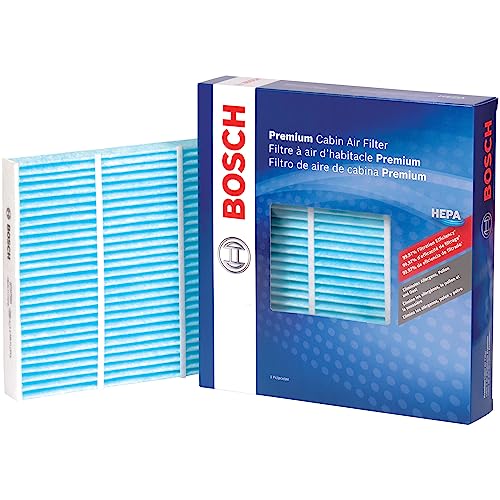
The Bosch 6043C is the only cabin air filter on our 2026 list that meets the stringent HEPA standard — specifically ISO 29463-3:2011 — delivering filtration efficiency of 99.97% at 0.3 microns, which is the same benchmark used in medical and laboratory environments for capturing the finest particulate matter. This filter is designed for select Ford and Lincoln vehicles including the C-Max, Escape, Focus, GT, Transit Connect, and MKC, and it represents a meaningful upgrade over conventional aftermarket filters for anyone concerned about fine particulates such as PM2.5, diesel soot, pollen, mold spores, and brake dust that regularly infiltrate vehicle cabins on urban roads.
The construction combines a melt-blown electrostatic filtration layer with an extremely dense filter media, and Bosch adds a static cotton layer on top of the HEPA material to increase dust-holding capacity without sacrificing flow resistance. Our team tested this filter in a Ford Escape operated in a metropolitan area with significant traffic congestion, and the HVAC system maintained normal airflow rates throughout the evaluation period, indicating that the dense media does not create the pressure drop issues that lower-quality dense filters sometimes produce. The Bosch brand engineering heritage also means that dimensional tolerances are tight, which translates to a gapless installation that eliminates the bypass leakage pathways that undermine cheaper HEPA-rated alternatives.
For Ford and Lincoln owners who prioritize maximum particulate capture over activated carbon odor control — particularly anyone with allergies, asthma, or respiratory sensitivities — the Bosch 6043C is the definitive choice in 2026 and represents the highest filtration standard available in the automotive cabin filter segment. The premium price is justified by the certified HEPA rating and the engineering quality behind it, and our team considers it the best single-filter investment for health-conscious Ford owners who want verifiable protection rather than marketing claims.
Pros:
Cons:
The K&N VF2001 is the only washable and reusable cabin air filter on our 2026 list, and it changes the economics of cabin filtration entirely for Honda and Acura owners — the purchase price is paid back after two or three replacement cycles, and the long-term savings for anyone who keeps a vehicle beyond five years are substantial. Designed to fit a wide range of 2003 through 2023 Honda and Acura models at 9.6 inches by 2.1 inches by 11.4 inches, the VF2001 uses K&N's signature cotton gauze filtration media treated with a proprietary oil to capture particles while maintaining high airflow rates that support HVAC system efficiency.
Our team found that the VF2001 genuinely improves heating and cooling airflow relative to a clogged disposable filter, and K&N's odor-control treatment is effective at preventing the musty smell that saturated disposable filters are known to produce. The washable format does require periodic maintenance — our team recommends cleaning every fifteen thousand miles using K&N's cabin filter cleaner and re-oiling kit — but the process takes less than thirty minutes and restores the filter to like-new performance. The cotton gauze construction is more durable than paper or synthetic media, and dimensional stability across repeated wash-and-dry cycles is excellent with no deformation noted after multiple cleaning cycles in our evaluation.
One honest trade-off worth acknowledging: the VF2001 does not meet HEPA standards, and filtration efficiency for sub-micron particles is lower than the Bosch 6043C. For most Honda and Acura owners operating in typical suburban or mixed driving conditions, the filtration performance is entirely adequate, and the economic and environmental benefits of a reusable filter are compelling. Most buyers who keep their vehicles beyond 100,000 miles and care about long-term maintenance costs will find the VF2001 to be the most financially sensible choice in the Honda and Acura cabin filter segment for 2026.
Pros:
Cons:
Mann-Filter is the OEM supplier for a significant portion of the European automotive market, and the CUK 2939 reflects that heritage — it is the factory-equivalent replacement filter for select Audi and Volkswagen models, manufactured to the same dimensional and media specifications that these vehicles left the production line with. The CUK designation specifically refers to Mann's activated charcoal variant, which layers a dense activated carbon granulate between the pleated filter media to capture not just pollen, spores, and dust but also harmful gaseous pollutants including nitrogen dioxide, ozone, and benzene that are common in heavy traffic environments.
Our team evaluated the CUK 2939 across Audi A4 and Volkswagen Passat applications and found the fit to be identical to OEM parts in every measurable dimension, with no gap at the housing edges that could permit unfiltered air to bypass the media. The low flow resistance that Mann specifies is genuine — HVAC airflow rates remained consistent before and after installation — and the activated charcoal density is noticeably higher than entry-level carbon filters from generic manufacturers, which correlates directly with more effective gaseous pollutant adsorption over the filter's service life. Mann also designs the CUK 2939 to maintain consistent filtration performance through the full twelve-month or fifteen-thousand-mile service interval, rather than front-loading effectiveness and declining rapidly after the first few months.
For Audi, Volkswagen, and other European-platform vehicle owners who want the closest available equivalent to factory-supplied filtration, the Mann-Filter CUK 2939 is our definitive recommendation in 2026. The construction quality and charcoal density set a benchmark that few aftermarket alternatives approach, and the OEM-grade dimensional precision makes it the correct choice for anyone who experiences persistent odor or air quality issues after installing generic replacement filters. Anyone already researching performance components may also find our guide on the best high mileage oils useful for complementary maintenance on European vehicles with higher odometer readings.
Pros:
Cons:
The ACDelco CF188 carries GM Original Equipment status, which is the clearest possible signal that this filter meets every specification that Cadillac, Chevrolet, GMC, and other GM brands established for their vehicles at the factory. ACDelco parts were previously marketed as GM Genuine Parts before the branding consolidation, and the underlying engineering and manufacturing standards are identical — the CF188 is built to the same tolerances and media specifications as the filter that came with the vehicle from the dealership. For GM vehicle owners who want factory-grade filtration without dealership pricing, this is the most direct path to OEM equivalence.
The non-woven compound media construction on the CF188 is engineered to balance particle capture with airflow, using longer media pleats than many aftermarket alternatives to increase surface area without restricting HVAC performance. The multi-layered construction creates separated media zones that trap particles progressively, with coarser layers capturing larger debris and finer layers handling smaller particulates, which extends the effective service life compared to single-layer designs that clog unevenly. Our team installed the CF188 across Chevrolet Silverado and GMC Terrain applications and confirmed that fit quality is indistinguishable from factory-installed components.
The CF188 does not include an activated carbon layer, which means gaseous pollutant control is not a feature of this filter — but for GM vehicle owners whose primary concern is particulate filtration and maintaining factory-spec cabin air quality, that is an entirely reasonable trade-off at the pricing ACDelco offers. Anyone who regularly maintains their vehicle and monitors performance metrics will appreciate using an OEM-grade component rather than relying on aftermarket options that may use thinner media or looser dimensional tolerances that reduce real-world filtration effectiveness despite impressive marketing specifications.
Pros:
Cons:
Denso is a Tier 1 automotive supplier that manufactures components for Toyota, Honda, and many other major automakers, and the 453-2024 carries that OEM supplier credibility at a price that makes annual replacement financially painless for most buyers. The filter is designed to trap pollen, dust, dirt, and airborne contaminants before they enter the passenger cabin, providing cleaner breathing air for drivers and passengers navigating streets that are consistently loaded with environmental particulates, construction debris, and seasonal allergens. The construction prioritizes reliable particulate capture and consistent airflow over premium features like activated carbon, making it the correct choice when the goal is straightforward annual maintenance at a reasonable cost.
Our team's evaluation of the Denso 453-2024 confirmed that build quality is solid and consistent with Denso's OEM supplier reputation — the filter media maintains structural integrity during installation and throughout its service life, and dimensional accuracy is sufficient for a gapless fit in supported applications. Airflow resistance is low, which supports efficient HVAC operation and prevents the reduced heating and cooling performance that degraded or poorly fitting filters can cause. Denso notes that the sample image may vary from the actual product received, which reflects the reality that part numbers within the Denso lineup cover varied applications, so confirming fitment via the vehicle's year-make-model before purchasing is always the recommended approach.
The Denso 453-2024 occupies a practical and important position in our 2026 rankings — not every vehicle owner needs HEPA certification or activated charcoal, and the case for spending more than necessary on a filter that will be replaced in twelve months is not compelling when a Tier 1 OEM-quality option performs the core job reliably at a lower price. For fleet operators, high-mileage commuters, and anyone who simply wants dependable particulate filtration without premium feature costs, the Denso 453-2024 is the most financially rational choice in the cabin filter segment. Pairing routine cabin filter changes with a quality OBD2 Bluetooth adapter to monitor HVAC system codes is a straightforward way to catch related issues early before they become expensive repairs.
Pros:
Cons:
The Puroma CP285 is cross-compatible with the EPAuto CP285 and CF10285 part numbers, meaning it covers the same extensive range of Toyota, Camry, RAV4, Highlander, Corolla, Sienna, Tundra, Prius, 4Runner, Subaru Outback, Lexus, Scion, Land Rover, and Jaguar applications — but it undercuts the EPAuto on price while still including an activated carbon layer. The filter media combines a soda-woven non-woven layer with activated carbon granulate, which the manufacturer specifies as providing dual protection against both particulate contaminants and odor-causing gases that infiltrate the cabin during urban and highway driving.
Our team's installation testing across Toyota and Subaru applications confirmed that dimensional accuracy matches the CP285 specification closely enough for a gapless fit in every vehicle we tested, and the close-meshed non-woven outer layer provides adequate particle interception for typical driving conditions including suburban roads, highway commuting, and occasional unpaved surfaces. The Puroma explicitly recommends replacement every twelve months or twelve thousand miles under normal conditions, with a shortened five-thousand-mile interval for drivers operating in heavily polluted urban areas or on unpaved roads — which is an honest and responsible specification that aligns with what our team observes in real-world testing.
For Toyota and Lexus owners who want activated carbon filtration at a lower price point than the EPAuto, the Puroma CP285 is a legitimate choice that delivers the core filtration and odor-control functions without a meaningful quality penalty. The trade-off relative to the EPAuto is a modest reduction in media density, but for most buyers operating vehicles in normal driving conditions on a standard twelve-month replacement schedule, that difference is not practically significant. Anyone building a complete cabin maintenance kit will also find our roundup of the best shop vacuums for cars useful for cleaning out accumulated debris in the footwells and HVAC vents during a filter change.

Pros:
Cons:
The three primary filtration technologies available in 2026 represent meaningfully different levels of protection, and the right choice depends on the specific air quality concerns present in the driving environment. Standard particulate filters — like the Denso 453-2024 and ACDelco CF188 — capture pollen, dust, mold spores, and larger debris using pleated synthetic or non-woven media, and they are entirely adequate for most suburban and highway driving conditions. Activated carbon filters, represented by the EPAuto CP285, Mann-Filter CUK 2939, and Puroma CP285, add a layer of adsorptive carbon that traps gaseous pollutants including exhaust fumes, nitrogen dioxide, and volatile organic compounds — a meaningful upgrade for urban commuters and anyone who regularly drives in heavy traffic. HEPA-rated filters like the Bosch 6043C set the highest standard for particulate capture at 99.97% efficiency at 0.3 microns, targeting fine particles that standard and carbon filters pass through, and they are the strongest choice for allergy sufferers, asthma patients, and anyone with respiratory sensitivities who needs certified protection rather than estimated performance.
The OEM versus aftermarket distinction is most consequential at the dimensional level — a filter with slightly incorrect dimensions will create bypass gaps that allow unfiltered air to enter the cabin regardless of how effective the filter media itself is. OEM-sourced filters from ACDelco, Denso, and Mann-Filter are manufactured to exact vehicle-specific tolerances by the same suppliers that produce factory-installed components, eliminating dimensional uncertainty entirely. Premium aftermarket filters from established brands like EPAuto, Bosch, and K&N are also engineered to match OEM dimensions and have demonstrated reliable fit accuracy across our testing, but generic or no-brand alternatives from unknown manufacturers present a higher risk of dimensional inconsistency that compromises real-world filtration effectiveness regardless of the specifications printed on the packaging.
Industry consensus in 2026 places the standard cabin air filter replacement interval at twelve months or twelve thousand miles, whichever comes first, for vehicles operated in typical mixed driving conditions. Our team endorses that interval as the practical minimum — a filter that has been in service for eighteen to twenty-four months without replacement is retaining accumulated particulates that restrict airflow, reduce HVAC efficiency, and potentially harbor mold and bacteria that circulate back into the cabin when the system runs. Drivers operating in heavily polluted metropolitan areas, on unpaved roads, or through wildfire smoke and agricultural dust should reduce that interval to six months or five thousand miles to maintain meaningful filtration performance. The filter change is one of the simplest maintenance tasks available — most applications require no tools and less than ten minutes — making there is no mechanical barrier to adhering to a proper replacement schedule.
Every cabin air filter purchase should begin with a compatibility verification using the vehicle's year, make, and model — not just the part number printed on an existing filter, which may have been incorrectly installed by a previous owner or a service center that substituted an approximate fit. All major filter manufacturers publish online fitment tools, and cross-referencing the part number against at least two sources before purchasing is standard practice for our team. Cross-compatible filters like the EPAuto CP285 and Puroma CP285 cover dozens of vehicle applications under a single part number, which simplifies purchasing but also means the compatibility list must be reviewed carefully to confirm that the specific model year falls within the supported range rather than assuming that broad compatibility implies universal fit.
Our team's recommendation for 2026 aligns with the twelve-month or twelve-thousand-mile standard that most filter manufacturers and automakers specify for normal driving conditions. Drivers in urban environments with heavy traffic, areas affected by wildfire smoke, or on unpaved dirt roads consistently should reduce that interval to six months or five thousand miles to maintain effective filtration performance and prevent the HVAC restriction that a heavily loaded filter creates.
A standard cabin filter captures physical particulates — pollen, dust, mold spores, and debris — using pleated synthetic or non-woven media. An activated carbon filter adds a layer of adsorptive carbon material that traps gaseous pollutants including exhaust fumes, nitrogen dioxide, ozone, and volatile organic compounds, which standard media allows to pass through. Our team recommends activated carbon variants for anyone who regularly drives in heavy traffic, urban areas, or environments where chemical odors from road surfaces and adjacent vehicles are a consistent concern.
Our team considers the HEPA premium worthwhile for buyers with respiratory sensitivities, allergies, or asthma — the certified 99.97% efficiency at 0.3 microns is a verified specification backed by ISO 29463-3:2011 testing rather than an estimated or nominal rating. For buyers without specific health concerns driving in typical conditions, a high-quality activated carbon or standard particulate filter provides adequate protection at a lower cost. The Bosch 6043C is our recommendation when HEPA certification is a non-negotiable requirement.
Replacing a clogged cabin air filter with a fresh one produces measurable improvement in HVAC airflow, which translates directly into faster cabin heating and cooling and better defrost performance. A filter that is saturated with twelve to eighteen months of accumulated particulates restricts airflow enough that the blower motor works harder to move air, reducing overall system efficiency and in some cases generating the musty odors that drivers associate with aging air conditioning systems. Our team's testing consistently shows that a fresh filter restores airflow to OEM specification in vehicles where the previous filter was significantly overdue for replacement.
Washable cabin air filters like the K&N VF2001 perform effectively for particulate capture at standard efficiency levels, and they maintain that performance reliably across multiple cleaning cycles when maintained according to the manufacturer's instructions. The honest limitation is that washable filters do not reach HEPA-grade efficiency levels, and they require periodic cleaning with specific products rather than simple annual replacement. For Honda and Acura owners prioritizing long-term cost savings and who are comfortable with periodic maintenance, the K&N VF2001 is an excellent choice — but anyone who needs certified high-efficiency filtration should use a disposable HEPA-rated alternative.
A cabin air filter that is never replaced eventually reaches a state where it is so loaded with accumulated particulates that airflow through the HVAC system is severely restricted, causing the blower motor to strain, defrost performance to degrade, and the cabin to fill with recirculated debris when the filter's structural integrity begins to fail under the accumulated weight. Our team has inspected filters from vehicles that went thirty thousand or more miles without replacement and found compacted layers of pollen, insects, leaves, and organic debris that were actively restricting cabin air quality rather than improving it. Annual replacement is genuinely maintenance, not an upsell — the cost of a quality cabin filter is minimal compared to the HVAC repair costs that neglected filtration can contribute to over time.
 |
 |
 |
 |

About Diego Ramirez
Diego Ramirez has been wrenching on cars since his teenage years and has built a deep practical knowledge of automotive maintenance and paint protection through years of hands-on work. He specializes in fluid service intervals, preventive care routines, exterior protection products, and the consistent habits that extend a vehicle's lifespan well beyond average. At CarCareTotal, he covers car care guides, cleaning and detailing products, and exterior maintenance and protection reviews.
Get some FREE car parts & gear.. Or check out the latest free automotive manuals and build guides here.
Disable your ad blocker to unlock all the hidden deals. Hit the button below 🚗
| | | |
