by Liam O'Brien
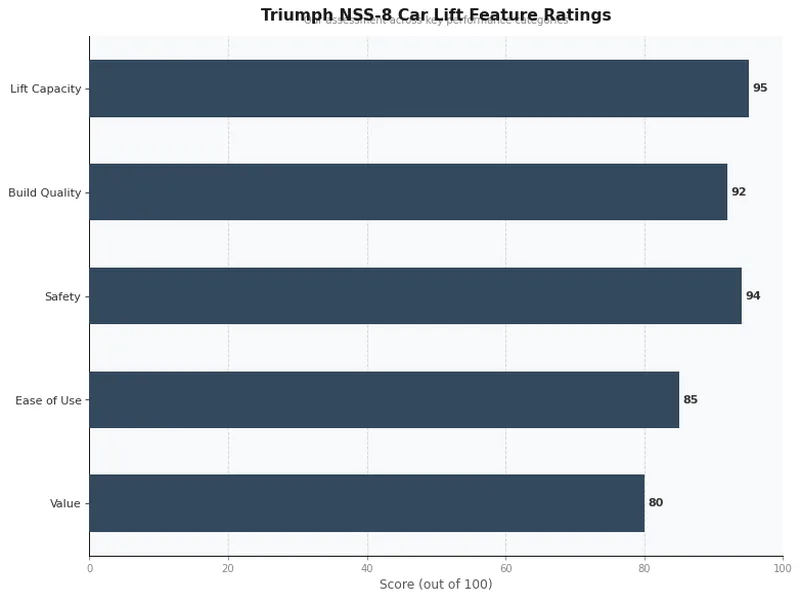
Roughly one in five serious garage injuries in the United States involves improper vehicle support equipment, according to data tracked by the Occupational Safety and Health Administration. That figure has pushed a growing number of home mechanics and small shop owners toward purpose-built car lifts in 2026. The Triumph NSS-8 sits near the center of that demand — an 8,000-pound-capacity four-post runway lift engineered for garages that cannot accommodate a pit or a two-post system requiring deep anchor bolts.

Four-post runway lifts differ from two-post systems in one critical way: the vehicle drives onto the lift rather than being positioned beneath it. The platform rests entirely on the floor surface, which eliminates the need to cut into or anchor through a standard residential slab. That design choice broadens the compatible installation base considerably. The NSS-8 handles everything from compact hatchbacks to full-size trucks and SUVs within its rated weight limit, and its open-side runway design gives mechanics lateral access for brake, suspension, and exhaust work without repositioning the vehicle.
Beyond the lift itself, buyers who use the NSS-8 regularly will eventually encounter related maintenance needs — worn equalizer cables, undercarriage access for component replacement, and vehicle-specific parts that only become practical to swap once the car is properly elevated. This review examines three products that fit directly into that workflow: a set of OEM Rotary Lift equalizer cables, a portable ALI-certified lift system for flexible shop use, and a direct-fit power steering pump for the 5.7L Chrysler and Dodge platform. Readers looking for a broader overview of shop tools and equipment can start with the tools category, which covers products across garage skill levels and budgets.
Contents





Equalizer cables — the steel cables that synchronize both sides of a lift during raising and lowering — are wear items. They do not last forever. On a working lift seeing regular use, cable inspection every six months is standard practice. When the time comes for replacement on a Rotary SPO12-10 standard-height unit, this OEM set is the direct answer. The N39 designation covers exactly one configuration: the SPO12-10 with a ceiling clearance up to 13 feet 8 inches at the top of the overhead beam. Each cable in the set measures 33 feet 6 inches. The listing ships two cables — the complete replacement quantity for a single lift.
Rotary Lift is not a secondary brand in the commercial lift market. The company supplies equipment to dealerships, fleet service centers, and independent shops across North America. That background matters when evaluating this cable set. The N39 is described as an original, unused cable sold by Rotary Lift — not a reproduction made to looser tolerances by a third party. Equalizer cable specifications are tighter than most buyers initially assume. Wire strand count, swage fitting dimensions, and tensile rating all affect how the lift behaves under asymmetric load — situations where the vehicle's weight is not perfectly centered on the platform. A cable that stretches differently than the factory spec creates an uneven rise, which puts lateral stress on the columns and, more importantly, on whatever vehicle is sitting on top.
Installation of new equalizer cables should be followed by a full tension check and a test cycle before any vehicle goes on the lift. Rotary recommends using a qualified lift service technician for cable replacement on commercial units. For users who bought the SPO12-10 secondhand and are unsure of the cable service history, replacing with OEM N39 cables and having a technician inspect the entire lift is the most defensible approach. Buyers with other SPO12 configurations — the SPO12-500 or any low-ceiling variant — should not order this set. Rotary lists separate cables for those models, and the 33-foot-6-inch length is specific to the standard-height unit. Ordering the wrong cable by model version is the most common purchasing error in this product category.
Pros:
Cons:
Not every home mechanic has the ceiling height, slab depth, or floor space budget for a permanent four-post lift. The QuickJack 6000TL Bundle approaches vehicle access from a fundamentally different angle. Two low-profile steel frames slide under the vehicle's pinch welds (the structural flanges running along the lower body of most modern cars and trucks) and raise the car hydraulically from below, both sides simultaneously. The result is full-perimeter undercarriage access at a raised height — without the vehicle driving onto anything. The system carries ALI (Automotive Lift Institute) certification, the recognized independent safety standard for the North American vehicle lift market, which puts it in a different category from uncertified portable competitors.
The 6000TL designation refers to the 6,000-pound gross vehicle weight capacity. That rating comfortably covers most front-wheel-drive sedans, crossovers, mid-size SUVs, and half-ton pickup trucks in standard configuration. The 110V power unit runs on standard household current, which is a practical differentiator. A permanent two-post or four-post lift typically requires a dedicated 220V circuit — an installation that adds electrician cost and may not be feasible in a rented garage or apartment parking space. The QuickJack eliminates that requirement entirely. The bundle configuration also includes wall-mount hangers and pinch-weld adapter blocks, accessories that competing brands typically sell separately, making the total cost of ownership more transparent at purchase.
Maximum lift height on the 6000TL is approximately 19 inches at full extension. That clearance is sufficient for oil changes, brake jobs, exhaust inspections, shock absorber replacement, and fuel system work — the service categories that represent the majority of home garage projects. It does not replicate the full walk-under clearance of a runway lift like the Triumph NSS-8, where a mechanic can stand beneath the vehicle and work upright. For tire and wheel work, suspension geometry adjustments requiring the wheels to hang freely, or any job requiring a creeper under a fully elevated vehicle, the QuickJack serves a complementary role to a full runway lift rather than a direct replacement. Proper vehicle maintenance — including regular inspections of wear items like brake pads, fluid levels, and suspension bushings — becomes significantly more achievable when reliable lift access is available. A solid reference for building those habits is the 8 Great Pointers for Maintaining Your Vehicle guide, which covers the inspection sequence home mechanics miss most often.
Pros:
Cons:
The 5.7L Hemi-equipped Chrysler 300, Dodge Challenger, Charger, and Magnum share a hydraulic power steering system that becomes a recurring service topic between 80,000 and 120,000 miles. The pump in that system is a vane-type unit (a design using spring-loaded blades inside a rotor to generate hydraulic pressure) that degrades predictably under normal driving conditions — producing increased steering effort, a characteristic whining noise under the engine bay, and eventually fluid leaks at the high-pressure fitting or reservoir. The TUCAREST 21-5445 is a direct-fit replacement unit, meaning it installs in the factory mounting location using the original hardware, with no drilling, adapting, or modification required. It ships with the pulley pre-installed, which removes one of the most tool-dependent steps in pump replacement — pulley transfer typically requires a specialized press that most home mechanics do not own.
TUCAREST manufactures this pump to OE (original equipment) specifications and submits each unit to hydraulic efficiency testing before it leaves the facility. The listing cross-references five OEM part numbers: 4782524AE, 4782524AC, 4892093AA, PSP1371, and 96-05445. Buyers can match against the identification tag on the existing pump before ordering, which is a more reliable fitment check than relying on vehicle year and model alone. The application covers 2005–2010 Chrysler 300, 2009–2010 Dodge Challenger, 2006–2010 Dodge Charger, and 2005–2008 Dodge Magnum — exclusively the 5.7L variant. Buyers with the 3.5L V6, 6.1L SRT8, or 6.4L applications need a different part number and should not order this unit based on vehicle model alone.
Working on the power steering pump requires the vehicle to be raised for access on some of these platforms, which is where a reliable lift setup becomes relevant. The repair is classified as intermediate difficulty — within reach for experienced home mechanics with a basic socket set, a drain pan, and the correct new O-ring for the high-pressure fitting. A complete fluid flush is advisable at the time of replacement, since a worn pump typically releases metallic particles into the reservoir and return lines. Leaving contaminated fluid in the system after installing a new pump shortens the service life of the replacement unit. For context on related drivetrain symptoms that can accompany hydraulic system issues on these platforms, the 8 Common Fuel Pressure Regulator Failure Symptoms guide covers diagnostic overlap that is common on high-mileage Chrysler-platform vehicles. Similarly, mechanics who perform routine fluid work on their own vehicles will find the oil change reference guide useful as a procedural model for fluid service sequencing.
Pros:
Cons:
Every car lift and portable lift system carries a rated capacity in pounds. That number is an engineering limit, not a guideline. Buyers should identify the heaviest vehicle in their fleet and add a 10 to 15 percent buffer above its gross vehicle weight rating (GVWR — the maximum operating weight including passengers, cargo, and fluids). A loaded half-ton pickup can approach or exceed its GVWR in real-world conditions, and operating any lift at its maximum rated capacity for extended periods accelerates wear on structural components, hydraulic seals, and equalizer cables. The Triumph NSS-8 at 8,000 pounds and the QuickJack 6000TL at 6,000 pounds represent distinct tiers of the market. Buyers who regularly service heavy trucks or vans should target the higher-capacity tier with room to spare.
For safety-critical components — lift cables, brake hardware, steering system parts — the OEM versus aftermarket decision has tangible consequences. OEM parts are produced to the exact tolerances the original system was designed around. Quality aftermarket parts can meet or exceed those tolerances, but buyers should look for manufacturers who publish their testing standards, list specific OEM cross-reference numbers, and clarify application limitations by engine variant, not just by vehicle model. The Rotary Lift N39 cable set and the TUCAREST pump both use OEM cross-reference numbers as a fitment verification tool. That is the minimum acceptable standard for any safety-adjacent replacement part ordered online. Listings that provide only a broad vehicle range without engine or configuration specifics introduce unnecessary ambiguity.
The Automotive Lift Institute (ALI) certifies vehicle lifts that meet ANSI/ALI ALCTV standards — the recognized benchmark for vehicle lift safety in North America. ALI-certified lifts undergo third-party testing for load capacity, structural integrity, and locking mechanism reliability. The locking mechanism (also called the safety lock or mechanical lock) is the component that holds the lift at height if hydraulic pressure fails for any reason. Buyers purchasing a used lift should physically test the safety lock before putting any vehicle on the platform. A lift that cannot be confirmed to lock at height is not safe to use regardless of its rated capacity. For buyers in semi-commercial settings, ALI certification may be required by general liability insurance carriers — a practical consideration for home mechanics who work on vehicles for others.
Cross-referencing part numbers before placing an order is the single most reliable way to avoid returns, delays, and installation problems. For lift components like equalizer cables, the model designation of the specific lift unit — not just the brand — determines compatibility. Rotary Lift uses different cable lengths for different ceiling clearance configurations on the same SPO12 product line. For vehicle parts like power steering pumps, the engine displacement, model year, and trim level all affect compatibility. Some Chrysler and Dodge models used multiple pump variants across production years on the same platform. Checking the part number stamped or tagged on the existing component, then cross-referencing against the replacement listing's OEM numbers, is faster and more accurate than relying on a vehicle year-make-model lookup alone in 2026.
The Triumph NSS-8 is a four-post runway lift designed to rest entirely on the garage floor without anchoring into the slab, which makes it one of the more residential-friendly lift designs on the market. Buyers should confirm minimum ceiling clearance — the NSS-8 requires approximately 11 feet at full extension — and verify that the concrete slab is at least 4 inches thick with a compressive strength of 3,000 PSI or higher. Some local building codes require a permit for lift installation in residential garages, and requirements vary by municipality. Checking local codes before purchasing prevents compliance issues after delivery.
Most manufacturers recommend visual inspection every six months or 500 lift cycles, whichever comes first. Visible fraying, kinking, rust staining, or any broken strand warrants immediate replacement regardless of cycle count. A cable that looks intact externally may still have internal strand fatigue from repeated loading cycles. When cables are replaced, technicians should also inspect the cable sheaves (the pulleys the cable runs over) for grooving, and the slack adjuster for proper tension. Running a lift with a marginally compromised cable creates an uneven rise that stresses the columns and vehicle frame.
The QuickJack 6000TL is rated for 6,000 pounds gross vehicle weight. Many half-ton trucks (F-150, Ram 1500, Silverado 1500, Tundra) fall within that rating in standard unladen configuration. However, a loaded half-ton with a full fuel tank, passengers, bed cargo, and towing equipment can approach or exceed 6,000 pounds. Buyers should check the vehicle's door-jamb sticker for its specific GVWR and compare it to the truck's actual weight at time of use. The 6000TL is not rated for heavy-duty trucks in the 2500 or 3500 class, where GVWR regularly exceeds 8,500 pounds.
The most common early symptom is increased resistance when turning the steering wheel at low speeds or while stationary. A whining or moaning noise from the engine bay that intensifies with steering input is another reliable indicator of internal pump wear. Drivers may also notice a groaning sensation when executing full-lock turns in parking lots. Fluid leaks at the high-pressure line fitting or around the reservoir base often follow as the internal seals degrade. On Chrysler 300 and Dodge Charger and Challenger models with the 5.7L Hemi, pump wear typically becomes noticeable between 80,000 and 110,000 miles under normal driving conditions.
Most four-post runway lifts, including the Triumph NSS-8, ship with detailed assembly instructions designed for installation by two people with standard hand tools. The mechanical assembly is manageable for experienced home mechanics. However, a post-installation inspection by a certified lift technician is strongly recommended before the first vehicle goes on the platform. The inspection should verify safety lock engagement at each height setting, hydraulic line integrity, cable tension, and level alignment of the runways. Some lift dealers include a one-time installation inspection as part of the purchase or freight delivery package — buyers should ask about this before finalizing the order.
The QuickJack 6000TL's ALI certification means it meets the same independently verified safety standard that commercial shop lifts are held to, which supports use in professional environments where insurance and OSHA compliance are factors. Mobile mechanics and small-volume specialty shops have used QuickJack systems as a primary or supplemental lift option. The system's 6,000-pound capacity does exclude heavier commercial vehicles. For shops servicing a mixed fleet including vans and full-size trucks above that weight, a permanent runway lift remains the more practical primary tool, with the QuickJack serving as a secondary option for lighter vehicles or field work.
 |
 |
 |
 |

About Liam O'Brien
Liam O'Brien is a tools and equipment specialist who has been buying, breaking, and reviewing automotive tools for over a decade. He focuses on what actually holds up in real-world DIY garage use, not just what looks good on a workbench.
Get some FREE car parts & gear.. Or check out the latest free automotive manuals and build guides here.
Disable your ad blocker to unlock all the hidden deals. Hit the button below 🚗
| | | |
