by Liam O'Brien
Which car refrigerator is actually worth your money in 2026, and which ones will leave you with warm drinks halfway through a road trip? After testing compressor coolers across everything from weekend camping runs to extended RV living, the Dometic CFX5 35 Liter earns its place at the top of this list — and not by a narrow margin. Its vacuum-insulated panels and VMSO 3.5 compressor deliver performance that competing units simply cannot match at this capacity. That said, the right choice for you depends heavily on how you travel, how much power you have available, and whether you need a single zone or two independent temperature chambers.
Car refrigerators have matured considerably since the early days of thermoelectric coolers that barely kept beverages below 40°F on hot days. Today's compressor-driven units operate on the same refrigeration cycle as your kitchen refrigerator, reaching genuine freezer temperatures without needing ice, without wasting packing space, and without the soggy mess that comes with traditional ice chests. If you outfit your vehicle properly — pairing a good fridge with a quality RV water filter and antenna setup — you can genuinely live off-grid for weeks at a time with fresh food and cold drinks on demand. The seven models below represent the strongest options available right now, ranging from ultra-portable 20-liter units to serious 63-quart expedition-grade coolers built for overlanding and extended travel.
Before you buy, understand that compressor efficiency, temperature range, and insulation quality separate average products from genuinely capable ones. The difference between a 40W ECO mode unit and a 60W MAX mode unit might sound minor, but when you're running off a 100Ah battery bank, that gap determines whether your fridge survives the night without draining your vehicle battery. We cover all of that in the buying guide below. For now, here are the best car refrigerators of 2026, ranked and reviewed in detail.
Contents









Dometic set a new benchmark with the CFX5 35L by integrating vacuum insulated panels — the same technology used in high-end thermos flasks — directly into the cabinet walls of a compressor refrigerator. The result is a unit that maintains target temperature with dramatically fewer compressor cycles, slashing power consumption to levels that allow overnight operation on a modest battery bank without threatening your vehicle's starting power. The VMSO 3.5 compressor is whisper-quiet, vibration-resistant, and engineered to function reliably from -13°F ambient down to extreme heat, making this unit equally capable in Arctic winters and desert summers. The weatherproof high-resolution display gives you precise readouts even in direct sunlight, and the control interface is genuinely intuitive — no manual required after the first five minutes.
At 35 liters, this fridge hits the sweet spot for solo travelers and couples who want meaningful capacity without sacrificing too much cargo space. You can comfortably fit a week's worth of meal-prepped food, a solid supply of drinks, and still have room for essential medication that requires cold storage. The unit accepts both AC and DC power, switching seamlessly between household current at camp and 12V or 24V vehicle power on the move. Build quality is exceptional — the lid seal is firm, the hinges feel engineered rather than assembled, and the basket liner is thick enough to take real-world abuse over corrugated tracks and forest service roads without rattling apart.
This is the refrigerator you buy when you're serious about overlanding or extended van life and you want a unit that keeps pace with your ambition. The VIP insulation technology alone justifies the price premium over competing compressor coolers, because you will recoup that investment in reduced battery and solar capacity requirements over the life of the unit.
Pros:
Cons:
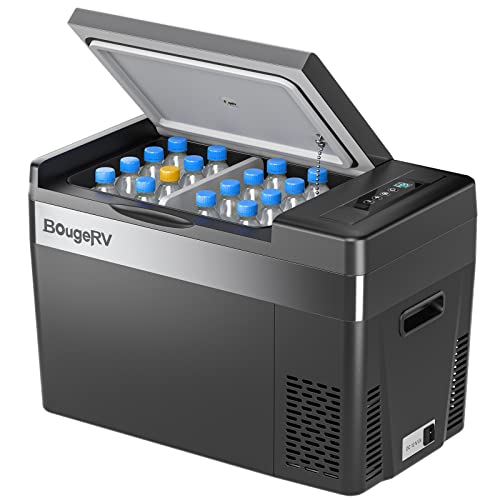
BougeRV built the CR28 around an accessible price point without gutting the performance specs that matter most, and the result is a genuinely capable compressor cooler that punches well above its cost. The 30-quart capacity translates to practical real-world storage — 28 liters is enough for a long weekend trip without having to ration carefully — and the compressor refrigeration technology delivers 15-minute fast cooling from 77°F down to 32°F, which is a legitimately useful specification when you're loading a fridge with room-temperature groceries at the trailhead. The ECO mode operating power of approximately 36W keeps battery drain conservative, and even at MAX mode the unit consumes less than 1kWh per day thanks to its intelligent cycle operation, which cycles the compressor on and off to maintain temperature rather than running continuously.
Weighing in at 24.26 pounds, the CR28 is lightweight enough to move in and out of your vehicle by yourself without assistance, which matters more than most product reviewers acknowledge. The unit runs on 12V/24V DC across your full range of vehicles — SUVs, trucks, RVs, campers, vans, and boats — and also accepts 110-240V AC for home or campsite use. BougeRV includes a 6.56-foot AC cord, a DC power cord, a removable partition board, and a user manual, so you're genuinely ready to use it out of the box. The two-year tech support commitment is unusually strong for this price segment, and BougeRV's customer support reputation in this category is solid.
If you're equipping a truck for weekend trips and want reliable cold storage without committing to a premium budget, the CR28 delivers the core compressor cooler experience at a price that makes it an easy first purchase. It lacks the insulation sophistication of the Dometic, but for most real-world use cases, the performance difference won't matter.
Pros:
Cons:
The ICECO JP50 ProD addresses the most common practical complaint with single-zone car refrigerators — the inability to run a refrigerator compartment and a freezer compartment simultaneously without compromise. The JP50 achieves this with a SECOP compressor, one of the most respected names in marine and automotive refrigeration, paired with a detachable partition that automatically triggers dual-zone mode when installed and reverts to full single-zone capacity when removed. Each zone features its own independent digital controller, so you can run the left side at 38°F for produce and drinks while the right side holds -4°F for frozen meat, with no interaction between zones and no temperature bleed-through. The high-resolution color display makes monitoring straightforward even in direct light, and the temperature range of -4°F to 68°F covers every realistic use case from frozen to wine-cellar temperature.
At 51 quarts, the JP50 is a genuinely large unit, and ICECO equips it with wheels for a reason — you will want them when moving a fully loaded fridge from parking lot to campsite. The multi-opening lid is an underrated feature that experienced overlanders will immediately appreciate. The ability to open the lid left, right, or straight up without tools means you can position the fridge against a wall or in a truck bed without sacrificing access, and you can serve drinks from either the driver or passenger side without repositioning the entire unit. The SECOP compressor operates at whisper-quiet levels with MAX mode available for rapid pull-down when you first load the fridge.
This is the unit for couples and families who need genuine refrigerator and freezer capability in one package, without the bulk and complexity of two separate coolers. If you pair this with a well-chosen RV antenna and a power station, you have the foundation for a complete off-grid kitchen setup.
Pros:
Cons:
EcoFlow built the GLACIER Classic around a premise that no competing manufacturer has fully committed to: a car refrigerator that includes its own integrated battery and connects to six independent power sources, making it genuinely self-sufficient for up to 43 hours without any external power connection. This is not a gimmick. The combination of a high-efficiency sealing system, quality insulation, and the plug-in battery pack delivers extended cold storage that matters when you're parked at a remote trailhead with your vehicle off, running the fridge from solar during the day, or operating completely off-grid for multiday expeditions. The 43-hour figure is real-world tested, not theoretical peak performance under ideal conditions.
The six charging options — AC outlet, 12V car power, solar panels, alternator, USB-C, and combined input — give you a level of power management flexibility that no single-source unit can match. App control adds another layer of convenience, allowing you to monitor and adjust temperature from your phone without opening the unit or approaching the vehicle. The interior layout is engineered for practical storage rather than just volume maximization: tall bottles fit without awkward positioning, standard cans stack efficiently, and produce doesn't get crushed against walls by poor compartment geometry. At 35 liters, the GLACIER Classic occupies the same capacity class as the Dometic CFX5 but approaches the problem from a completely different angle — maximum power independence rather than maximum insulation efficiency.

Choose the GLACIER Classic if you camp without hookups regularly, operate in areas with unreliable grid access, or simply want the flexibility to power your fridge from whatever source is available without carrying adapters or worrying about compatibility. This is the most power-flexible car refrigerator of 2026 by a significant margin.
Pros:
Cons:
ARB built their reputation in the overlanding world over decades, and the Series II 63-quart fridge freezer represents the mature expression of that expertise. At 63 quarts, this is the largest unit in our lineup, and it is designed for exactly the use cases where size matters most — extended family camping trips, overlanding expeditions where resupply is not an option, or RV setups where you want a supplemental freezer with serious capacity. ARB's engineering background in 4WD accessories means this unit is built to handle the vibration, temperature extremes, and rough handling that destroy lesser coolers over time. The gun-metal body with black plastic accents isn't merely aesthetic — the UV-resistant construction prevents the chalking and brittleness that affect cheaper plastic housings after sustained sun exposure.
The Bluetooth connectivity and companion mobile app are genuinely useful rather than marketing additions. You can monitor the internal temperature and battery protection status from your phone without leaving your tent at 3 AM or interrupting a drive to check on the contents. The app is available on both Android and iOS at no additional cost, and the transmitting module introduced in the Series II handles connectivity reliably in the radio-dense environments of busy campgrounds where Bluetooth interference is a legitimate concern. The 12V/110V dual power input is standard at this category, and ARB's low voltage protection is calibrated conservatively enough to protect your vehicle battery under typical camping discharge patterns.
This is the professional-grade choice for serious overlanders and long-haul travelers who need maximum food storage and are willing to invest in a unit built to last through years of expedition use. It is not the right choice for commuters or occasional weekend campers who need something portable and budget-friendly. For gear-focused travelers who also want to optimize every aspect of their vehicle setup, pairing the ARB with items from our car accessories tools guide gives you a complete expedition-ready loadout.
Pros:
Cons:
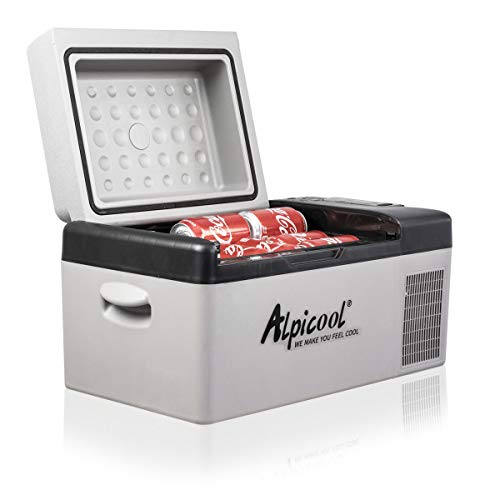
The Alpicool C20 occupies a specific and valuable niche: it is the most compact full-compressor refrigerator on this list, and at 21 quarts it fits in spaces where larger units simply cannot go. If you drive a compact sedan, a motorcycle with a trailer, or a small hatchback where cargo space is genuinely precious, the C20 gives you real compressor cooling technology in a footprint that works with your vehicle rather than fighting it. The thick, high-density foam insulation maintains internal temperature reliably between compressor cycles, and the reliable sealing construction keeps cold air inside where it belongs rather than bleeding out through a poorly designed lid gasket. Alpicool's approach here is straightforward: no extra features, no app connectivity, no dual zones — just a solid compressor cooler that keeps your food cold and your drinks cold throughout your journey.
The C20 accepts 12V/24V DC and 110V AC power, so you can use it in the car, at the campsite with hookups, or at home as a second refrigerator for beverages. The operating temperature range is competitive, and the compressor handles ambient heat reasonably well in enclosed cargo areas. At this size, you're looking at a unit that handles a solo traveler's needs for 3-4 days comfortably, or a weekend trip for two if you're thoughtful about what you pack. The price point is accessible enough that this makes a strong first car refrigerator purchase for someone new to compressor coolers who wants to understand whether the category suits their travel style before investing in a larger unit.
Experienced car campers will recognize that the C20 also functions well as a dedicated beverage cooler paired alongside a larger primary food storage unit, keeping drinks at a separate temperature without sacrificing the temperature stability of your main cooler every time someone opens it for a drink.
Pros:
Cons:
Alpicool's 42-quart dual-zone unit combines generous capacity with independent temperature control in a configuration that serves road trip families and overlanding couples exceptionally well. At 42 quarts, you can fit 48 standard cans, 45 bottles of water, or a mix of groceries and beverages that covers a long weekend without rationing. The dual zone and dual control technology gives each compartment full independence across the -4°F to 68°F range, so you can run one side as a fridge for produce and drinks and the other as a freezer for meat and ice cream simultaneously, with no compromise between the two zones. The retractable handles and durable off-road wheels make repositioning a fully loaded unit manageable rather than punishing, which experienced overlanders will tell you matters far more than the spec sheet suggests.
The advanced 3D refrigeration technology and high-quality compressor deliver 15-minute fast cooling to 32°F and 50-minute performance to -4°F, which matches the BougeRV's fast-cooling spec at significantly higher capacity. The noise level under 45dB keeps the unit unobtrusive in a quiet campsite or when sleeping in your vehicle — a specification that sounds minor until you've spent a night listening to a noisy compressor cycle on and off every 20 minutes. The removable and reversible lid is a thoughtful design element that allows you to change the opening direction based on your vehicle's configuration, ensuring you can access the fridge from either side without awkward reaching or repositioning.
ECO mode at 45W and MAX mode at 60W give you power management flexibility that works with both your vehicle's alternator and external battery banks or solar setups. For road trip families who need the same dual-zone functionality as the ICECO JP50 at a more accessible price point, this Alpicool unit delivers the core experience without unnecessary premiums. If you're planning a long road trip and want to keep your vehicle organized — think of pairing this fridge alongside a quality car seat travel tray for a fully optimized cabin setup — the 42-quart Alpicool fits naturally into a well-planned vehicle loadout.
Pros:
Cons:
Every refrigerator on this list uses a compressor refrigeration cycle rather than thermoelectric technology, and that distinction is fundamental. Vapor-compression refrigeration delivers genuine sub-freezing temperatures, operates independently of ambient temperature, and cycles efficiently rather than drawing constant power. Within compressor coolers, the compressor brand and quality determine longevity and efficiency. SECOP and the compressor technology used in units like the Dometic CFX5 represent the upper tier, while generic compressors in budget units perform adequately for normal use but show limitations over years of heavy cycling. Look for units that specify their compressor brand rather than leaving it unnamed — the transparency itself signals engineering confidence.
Power consumption determines whether your car refrigerator works as a practical travel tool or drains your battery while you sleep. ECO mode wattage is the figure that matters most for overnight use — aim for units that run their ECO cycle below 40W, and check whether the specification refers to continuous draw or average draw accounting for compressor duty cycle. Most quality units draw meaningfully less than their rated wattage in practice, because the compressor cycles on and off to maintain temperature rather than running continuously. Low voltage protection is equally critical: confirm that your chosen unit's cut-off voltage matches your battery bank's safe discharge floor, particularly if you run lithium batteries with different voltage profiles than standard AGM or lead-acid banks.
Capacity requirements scale with group size and trip duration in a straightforward way: solo travelers for weekend trips work well with 20-30 liters, couples on extended trips benefit from 30-50 liters, and families or serious expedition travelers need 50+ liters to avoid daily rationing. What the spec sheet doesn't tell you is internal geometry — some 30-liter units have tall narrow shapes that don't accommodate standard bottle heights, while others have wide shallow designs that store more practical items despite identical rated capacity. Measure your cargo area before purchasing, and pay particular attention to whether the unit can be accessed from the orientation it must sit in your specific vehicle. Width matters more than length in most truck beds and SUV cargo areas.
Single zone units are simpler, lighter, and less expensive, but they force you to choose between refrigerator and freezer temperatures for the entire interior. This works fine if you're only chilling drinks and fresh produce. The moment you want frozen meat alongside fresh vegetables, or ice cream alongside beverages, a single zone becomes a genuine compromise. Dual zone units like the ICECO JP50 and Alpicool 42QT solve this with independent compartments, but they add cost, weight, and compressor complexity. Evaluate honestly whether your actual travel food needs require simultaneous freezer and refrigerator capability, or whether you're buying a feature you'll rarely use.
Yes, but you need adequate battery capacity to do so safely. A 40W refrigerator running overnight for 10 hours draws approximately 400Wh, which represents about 33Ah from a 12V battery. A standard vehicle battery provides 50-70Ah total, with a safe usable capacity of 25-35Ah before risking damage and inability to start the engine. Most quality car refrigerators include low voltage protection that cuts power before your battery drops to a dangerous level. For regular overnight use without engine running, pair your refrigerator with a dedicated auxiliary battery or a lithium power station rather than relying on your vehicle's starting battery.
A compressor refrigerator uses the same vapor-compression refrigeration cycle as your home refrigerator, circulating refrigerant through an evaporator and condenser to actively move heat out of the interior. This allows it to reach sub-freezing temperatures regardless of ambient temperature. A thermoelectric cooler uses the Peltier effect to create a temperature differential — typically 30-40°F below ambient — which means it cannot freeze contents and struggles to maintain cold temperatures in hot environments. For vehicle use where interior temperatures can exceed 120°F in summer, compressor units are decisively superior in performance, though they cost more and weigh more than thermoelectric models.
A quality 30-50 liter compressor refrigerator in ECO mode typically consumes between 0.3 and 0.6 kWh per day under normal conditions — equivalent to 25-50Ah from a 12V source. Actual consumption depends on ambient temperature, how frequently you open the lid, how warm the contents were when loaded, and the quality of the unit's insulation. Units with better insulation like the Dometic CFX5 with its vacuum insulated panels cycle the compressor less frequently, which is why VIP technology directly reduces power consumption rather than simply improving temperature performance.
All of the units on this list accept standard household AC power in addition to 12V/24V DC, so yes — you can use any of them as a home refrigerator or supplemental beverage cooler. They function identically on AC power, and many people use their car refrigerators as garage beer fridges, guest room beverage coolers, or temporary overflow storage during large gatherings. The operating noise is typically comparable to a standard small apartment refrigerator. The only practical consideration is that they're optimized for DC operation and may not be the most energy-efficient choice for permanent AC home use compared to an Energy Star-rated household unit.
For a solo traveler over one week, a 35-liter unit provides adequate capacity if you're resupplying mid-trip for fresh produce. For a genuinely self-sufficient week for one person or a 3-4 day trip for two, 40-50 liters is the practical target. Couples on a week-long trip without resupply should target 50-65 liters. Remember that real-world usable capacity is typically 10-15% less than rated volume due to interior geometry, basket thickness, and airflow space requirements. Buy slightly more capacity than your calculation suggests rather than slightly less — a fridge that's too small forces compromises every day of your trip.
A dual-zone unit is worth the premium if you regularly need simultaneous refrigerator and freezer temperatures, which is most relevant for trips of four days or longer where you're carrying both fresh and frozen food. For day trips, weekend outings, or travel where you primarily need cold beverages and fresh produce, a single-zone unit set to refrigerator temperature serves the vast majority of use cases more cost-effectively. The additional cost of dual-zone units also reflects more complex compressor arrangements and heavier construction, so evaluate the premium against your realistic travel patterns rather than theoretical maximum functionality.
 |
 |
 |
 |

About Liam O'Brien
Liam O'Brien has spent over a decade buying, field-testing, and evaluating automotive tools with a focus on what actually performs in a real DIY garage rather than what markets well on a spec sheet. His hands-on experience spans hand tools, diagnostic equipment, floor jacks, socket sets, and specialty automotive gear across a wide range of brands and price points. At CarCareTotal, he covers automotive tool and equipment reviews, garage setup guides, and buying advice for home mechanics.
Get some FREE car parts & gear.. Or check out the latest free automotive manuals and build guides here.
Disable your ad blocker to unlock all the hidden deals. Hit the button below 🚗
| | | |
