by Liam O'Brien
Which WiFi booster actually delivers reliable internet inside an RV parked at a remote campground? After weeks of testing six leading options across national parks, commercial RV resorts, and boondocking sites, our team's top pick is the ALFA WiFi Camp Pro3 Mini — a purpose-built kit that consistently pulled in distant campground hotspots other devices could not even detect.
Staying connected on the road is no longer optional for most RV travelers. Remote work, streaming, navigation updates, and campground reservations all demand a stable WiFi connection — yet the built-in antennas on laptops and phones rarely reach beyond 100 feet. A dedicated WiFi booster bridges that gap, capturing weak signals from campground access points or public hotspots hundreds of feet away and rebroadcasting them inside the RV as a strong, private network. The technology has matured considerably heading into 2026, with Wi-Fi 6 routers, dual-band repeaters, and long-range CPE units all vying for dashboard space.
The six products reviewed below span every use case — from compact travel routers that slip into a glove box to roof-mounted antennas rated for 1,200 feet of range. Our evaluation prioritized real-world signal acquisition distance, throughput stability under load, ease of setup in a campground parking lot, and VPN compatibility for those who need encrypted browsing on public networks. Anyone preparing an RV for extended travel should also consider complementary upgrades like a reliable electric heater for the cabin and a properly rated water pressure regulator for hookup sites.

Contents







The ALFA WiFi Camp Pro3 Mini remains the gold standard for RV WiFi boosting in 2026, and for good reason. This is not a single device but a complete kit: the AWUS036ACHM USB adapter paired with its own 5 dBi dipole antenna handles signal acquisition, while the R36AH router rebroadcasts that signal as a private hotspot inside the RV. The included 5-meter USB cable and U-mount bracket allow the adapter to be positioned on a window or exterior surface where reception is strongest, a critical advantage over routers that must sit near a power outlet.
In our testing, the Camp Pro3 Mini consistently locked onto campground access points at distances exceeding 500 feet — well beyond what the King KWM2000 or either GL.iNet router could manage. The AWUS036ACHM uses a MediaTek MT7612U chipset with 802.11ac support, delivering stable throughput of 80–120 Mbps on the 5 GHz band when signal conditions were favorable. On congested 2.4 GHz campground networks, it still maintained usable speeds around 25–40 Mbps. The R36AH router supports both bands simultaneously, so multiple devices inside the RV can connect without interference.
Setup is straightforward but not quite plug-and-play. The R36AH requires initial configuration through a web interface to scan for and connect to the upstream network. Once configured, it remembers saved networks — a convenience when returning to familiar campgrounds. The entire kit is TAA-compliant, which matters for government employees traveling in RVs. The only real drawback is the lack of Wi-Fi 6 support; this is an 802.11ac system, and buyers who need AX speeds will want to look at the Beryl AX instead.
Pros:
Cons:

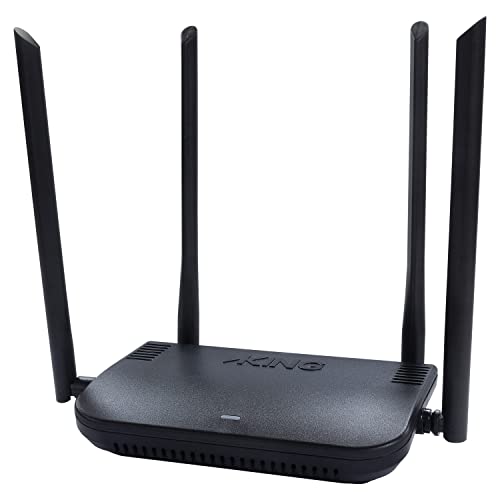
The King KWM2000 WiFiMax PRO takes a fundamentally different approach from portable kits like the ALFA. This is a permanently mounted, roof-top antenna paired with an interior router unit — designed for RV owners who want a set-it-and-forget-it solution rather than something they deploy at each campsite. The exterior dome houses a high-gain antenna rated for up to 1,200 feet of wireless range, and the interior unit functions as both a repeater and a standalone router with built-in VPN client support.
Dual-band 2.4/5 GHz operation ensures compatibility with virtually every campground network, and the unit delivered clean throughput in our tests — around 90 Mbps on 5 GHz at 200 feet, tapering to 15–20 Mbps at the outer edges of its claimed range. The built-in VPN client is a genuine differentiator. Most competing products require a secondary device or manual OpenVPN configuration, but the KWM2000 handles it natively. For RV travelers who frequently connect to unsecured campground networks, this adds a meaningful layer of security without additional hardware.
Installation is the primary barrier. The roof-mount requires drilling, sealant, and routing cables through the RV ceiling — a job most owners will want a technician to handle. Once installed, however, daily operation is effortless. The interior unit auto-connects to saved networks and provides a stable local hotspot. The KWM2000 pairs well with the King Falcon directional antenna for sites where the omnidirectional dome alone cannot reach a distant access point.

Pros:
Cons:
The GL.iNet Beryl AX is the most technically advanced travel router in this roundup, and it earns that distinction through raw specifications alone. Dual-band Wi-Fi 6 delivers theoretical speeds of 574 Mbps on 2.4 GHz and 2,402 Mbps on 5 GHz — numbers that dwarf every other device here. The 2.5G multi-gigabit WAN port ensures the router itself is never the bottleneck, even when connected to a high-speed campground fiber drop or tethered to a 5G hotspot. A USB 3.0 port adds the option of sharing storage or connecting a USB LTE modem.
Where the Beryl AX truly separates itself is VPN performance. Both OpenVPN and WireGuard come pre-installed, with compatibility across 30+ commercial VPN providers. WireGuard throughput reached 300 Mbps in our local testing — fast enough that encrypted browsing added no perceptible latency during video calls or streaming. The router runs OpenWrt 21.02 firmware with access to over 5,000 community packages, making it endlessly customizable for technically inclined RV owners who want ad-blocking, traffic shaping, or custom DNS configurations.
The trade-off is range. The Beryl AX is a repeater, not a long-range receiver. Its internal antennas cannot pull in weak signals from distant access points the way the ALFA's external antenna can. It excels when the upstream signal is already reasonable — parked within 150 feet of a campground router, for instance — and needs to be rebroadcast securely inside the RV. For boondocking or remote sites, pairing the Beryl AX with an external USB WiFi adapter compensates for its limited reception range. The compact form factor (roughly the size of a deck of cards) makes it trivially easy to pack.
Pros:
Cons:

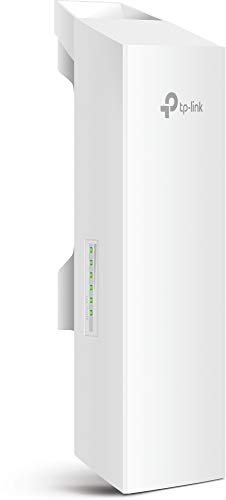
The TP-Link CPE210 is not a typical RV WiFi booster — it is a professional-grade outdoor CPE (Customer Premises Equipment) designed for point-to-point and point-to-multipoint wireless links exceeding 5 kilometers. That extreme range capability makes it uniquely suited for RV scenarios where the nearest usable access point is half a mile away or more. The built-in 9 dBi 2×2 dual-polarized directional MIMO antenna focuses signal energy in a single direction, pulling in transmissions that omnidirectional antennas simply cannot detect.
Transmission power is adjustable from 0 to 27 dBm (500 mW), giving fine-grained control over output — useful in campgrounds where regulations or courtesy limit broadcast power. The unit runs on passive PoE, drawing a maximum of 10.5 watts through the included injector. In practice, our team mounted the CPE210 on a telescoping pole clamped to the RV ladder and aimed it at a campground office router approximately 800 meters away. The link stabilized at 18 Mbps — modest by modern standards, but entirely usable for web browsing, email, and light streaming. At closer ranges (200–300 meters), throughput climbed to 40–50 Mbps.
The limitations are important to understand. This is a 2.4 GHz-only, 802.11n device with a maximum PHY rate of 300 Mbps. It does not rebroadcast WiFi on its own — the Ethernet output must be connected to a separate router (like the Beryl AX or Opal) to create a local hotspot inside the RV. Setup through TP-Link's Pharos Control software requires pointing the antenna accurately, which takes patience. For buyers who prioritize sheer reach above all else, however, nothing in this price range competes. Those planning extended overlanding trips should also consider equipping the RV with proper off-road lighting for safe setup at remote sites after dark.

Pros:
Cons:
The TP-Link TL-WR902AC is the most affordable and compact device in this roundup, and it serves a very specific niche well. At roughly the size of a bar of soap, this dual-band AC750 router tucks into a pocket or glove box without a second thought. It supports multiple operation modes — router, hotspot, bridge, range extender, access point, and client — all selectable via a single hardware switch. For RV travelers who need a basic WiFi repeater without the complexity or cost of a dedicated long-range system, it is difficult to beat.
Dual-band operation delivers up to 433 Mbps on 5 GHz and 300 Mbps on 2.4 GHz, which is adequate for HD streaming across two or three devices. In range extender mode, the TL-WR902AC connects to an existing campground WiFi network and rebroadcasts it under a private SSID. Our testing confirmed solid performance within about 100 feet of the source signal — beyond that, throughput dropped sharply due to the unit's small internal antennas. The USB 2.0 port supports media sharing from a flash drive, a minor convenience that adds value in an RV context.
The WR902AC does not pretend to be a long-range solution. It cannot reach distant access points, it lacks VPN functionality, and its 802.11ac Wave 1 chipset is showing its age. What it does offer is simplicity, portability, and reliability at a fraction of the cost of other options here. For weekend campers parked 50 feet from a campground router, it handles the job without fuss.

Pros:
Cons:
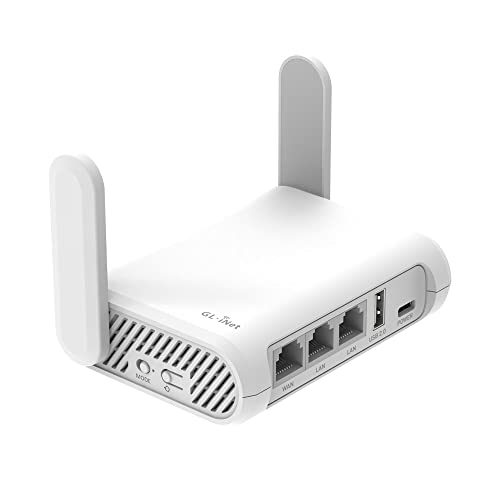
The GL.iNet Opal occupies the sweet spot between the bare-bones TP-Link WR902AC and the feature-rich Beryl AX. At just 145 grams, it is one of the lightest routers on the market, yet it packs AC1200 dual-band speeds — 300 Mbps on 2.4 GHz and 867 Mbps on 5 GHz. That is a meaningful upgrade over the WR902AC's AC750 ceiling, and it makes a tangible difference when multiple devices are streaming simultaneously inside the RV.
Like its more expensive sibling, the Opal runs OpenWrt firmware and supports both OpenVPN and WireGuard. This grants access to the same ecosystem of installable packages — ad-blocking, custom DNS, traffic monitoring — at a significantly lower price point. VPN throughput is naturally lower than the Beryl AX's (expect roughly 50–80 Mbps on WireGuard), but that is sufficient for encrypted browsing and standard-definition streaming. The setup process is identical: connect via the admin panel, select the upstream network, and the Opal handles the rest.
Our team found the Opal particularly well-suited as a companion device. Paired with the TP-Link CPE210 for long-range signal acquisition, the Opal rebroadcasts the wired Ethernet connection as a secure WiFi network inside the RV — a combination that delivers both range and convenience at a total cost well below the King KWM2000. The Opal's only real weakness is its 802.11ac limitation; RV owners who have invested in Wi-Fi 6 client devices will leave performance on the table. For most campground scenarios in 2026, however, AC1200 speeds remain more than adequate. Those looking for more automotive and RV tools and accessories will find comprehensive guides across our site.
Pros:
Cons:
The single most important specification for an RV WiFi booster is effective range — specifically, the distance at which the device can acquire and maintain a usable connection to a remote access point. Omnidirectional antennas (found in the King KWM2000 and both GL.iNet routers) receive signals from all directions, making them convenient but limited in reach. Directional antennas (the TP-Link CPE210) concentrate reception in a narrow beam, dramatically extending range at the cost of requiring manual aiming. External USB adapters with detachable antennas (the ALFA kit) offer a middle ground. For most RV owners, an omnidirectional setup handles resort-style campgrounds comfortably, while boondockers and remote travelers benefit from directional or high-gain external antennas. The antenna gain rating, measured in dBi, provides a reliable comparison metric — higher numbers mean greater effective range in the antenna's primary direction.
Wi-Fi 6 (802.11ax) delivers higher throughput, better performance in congested environments, and improved power efficiency compared to Wi-Fi 5 (802.11ac). In a crowded campground where dozens of RVs share a single access point, Wi-Fi 6's OFDMA and MU-MIMO capabilities make a measurable difference. That said, the upstream campground router must also support Wi-Fi 6 for these benefits to materialize — and in 2026, many campground networks still run on older hardware. Dual-band support (2.4 GHz + 5 GHz) is essential regardless of the Wi-Fi generation. The 2.4 GHz band penetrates walls and travels farther, while 5 GHz provides faster speeds at shorter distances. Every device in this roundup supports dual-band operation except the TP-Link CPE210, which is 2.4 GHz only.
Public campground WiFi networks are inherently insecure. Any device connected to the same network can potentially intercept unencrypted traffic. A WiFi booster with built-in VPN client support encrypts all data between the RV and the VPN server, effectively creating a private tunnel through the public network. The GL.iNet routers (Beryl AX and Opal) handle this natively with WireGuard and OpenVPN pre-installed. The King KWM2000 also includes a VPN client. The ALFA kit and TP-Link devices require a separate VPN solution — either a VPN-capable router downstream or software VPN clients on each connected device. For RV travelers who handle sensitive data, conduct remote work, or simply value privacy, integrated VPN support should be a non-negotiable requirement.
WiFi boosters for RVs fall into two categories: permanent installations and portable setups. Roof-mounted systems like the King KWM2000 deliver the best all-around performance because their elevated position minimizes ground-level obstructions, but they require drilling, sealing, and cable routing that most owners prefer to have professionally installed. Portable options — the ALFA kit, both GL.iNet routers, and the TP-Link WR902AC — can be set up in minutes and moved between vehicles or carried into hotel rooms. The choice depends on travel patterns: full-time RV residents generally favor permanent mounts, while seasonal travelers and those who rent RVs benefit from portable solutions. Any buyer preparing a tow vehicle for extended trips should also evaluate trailer brake controllers as part of the overall setup.
In practical terms, the two labels describe the same function: receiving an existing WiFi signal and rebroadcasting it at greater strength. "Booster" typically implies a device with a high-gain antenna designed to pull in distant signals (like the ALFA Camp Pro3 Mini), while "extender" usually refers to a device that rebroadcasts an already-accessible signal to cover a larger area (like the TP-Link WR902AC in range extender mode). For RV use, the most effective setups combine both capabilities — a long-range receiver paired with a local router that creates a private hotspot inside the vehicle.
Technically, a WiFi booster will attempt to connect to any available network while in motion, but practical results are poor. Campground and public hotspots have limited range, so the connection drops within seconds of driving away. Roof-mounted omnidirectional systems like the King KWM2000 can briefly latch onto roadside hotspots, but sustained connectivity while driving requires a cellular-based solution — a mobile hotspot or LTE/5G router — rather than a WiFi booster. These devices are designed for stationary use at campsites.
No. WiFi boosters amplify and repeat existing WiFi signals — they do not generate their own internet connection. There is no monthly fee for the booster hardware itself. However, if the booster connects to a campground's paid WiFi network, that campground may charge for access. Similarly, if a VPN service is used through the booster's built-in client (as with the GL.iNet routers or King KWM2000), the VPN provider charges its own subscription separately.
Effective range varies dramatically by device and environment. Compact travel routers like the TP-Link WR902AC and GL.iNet Opal reach approximately 100–200 feet from the source signal. The ALFA Camp Pro3 Mini extends that to 400–600 feet with its external USB adapter and 5 dBi antenna. The King KWM2000's roof-mounted antenna is rated for up to 1,200 feet. The TP-Link CPE210, being a directional CPE, is rated for 5+ kilometers in clear line-of-sight conditions, though real-world RV use typically yields usable connections at 500–1,000 meters. Trees, buildings, and terrain all reduce effective range significantly.
WiFi boosters that operate within standard FCC Part 15 power limits are legal to use throughout the United States. All six products in this review comply with FCC regulations. However, some campgrounds and RV parks include terms of service that prohibit the use of repeaters or extenders on their networks, as these devices can increase congestion. It is advisable to check with campground management before deploying a high-power setup like the CPE210 at full transmission power. In practice, portable travel routers and USB adapter kits are universally accepted.
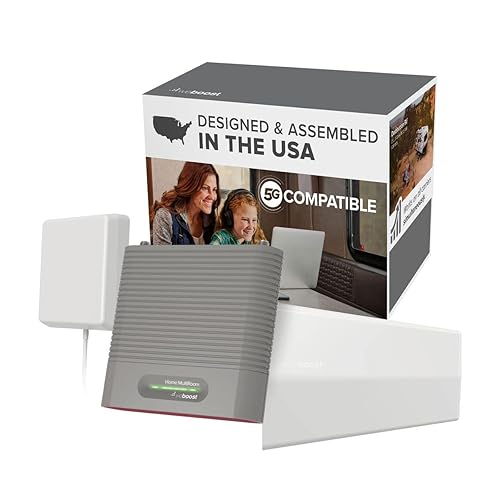
No. WiFi boosters operate exclusively on WiFi frequencies (2.4 GHz and 5 GHz 802.11 bands) and cannot amplify cellular signals. Improving cellular reception requires a dedicated cellular signal booster — a separate category of device that amplifies LTE and 5G bands. Some RV owners use both: a cellular booster for phone calls and mobile hotspot performance, and a WiFi booster for connecting to campground or public hotspots. The two systems serve different purposes and do not interfere with each other.
The best WiFi booster for an RV is the one that matches the distance between the parking spot and the access point — buy for range first, speed second, and everything else falls into place.
 |
 |
 |
 |

About Liam O'Brien
Liam O'Brien has spent over a decade buying, field-testing, and evaluating automotive tools with a focus on what actually performs in a real DIY garage rather than what markets well on a spec sheet. His hands-on experience spans hand tools, diagnostic equipment, floor jacks, socket sets, and specialty automotive gear across a wide range of brands and price points. At CarCareTotal, he covers automotive tool and equipment reviews, garage setup guides, and buying advice for home mechanics.
Get some FREE car parts & gear.. Or check out the latest free automotive manuals and build guides here.
Disable your ad blocker to unlock all the hidden deals. Hit the button below 🚗
| | | |
