by Liam O'Brien
Which electric trailer jack actually delivers the lifting power your rig demands without failing you at the campsite, the job site, or halfway through an unhitching sequence on uneven ground? That question has a clear answer in 2026, and after hands-on evaluation of every jack on this list, the KYX Electric Trailer Jack earns the top spot for its class-leading 7,500-lb capacity, impressive stroke range, and weather-resistant carbon-steel construction that holds up where lesser jacks surrender. Whether you're managing a heavy travel trailer, a loaded utility trailer, or a full-sized RV A-frame, the right electric jack turns a frustrating, back-straining task into a push-button operation you'll wonder how you ever lived without.

Electric trailer jacks have evolved dramatically over the last several years, and the 2026 market reflects that maturity — you now get motors with built-in overload protection, integrated LED lighting systems, remote control operation, and drop-leg extensions that add critical inches of travel on lifted or uneven terrain. The jump from a manual crank to a quality electric jack isn't just a convenience upgrade; it's a genuine safety improvement that reduces the risk of injury during hitching and leveling, especially in low-light conditions or on sloped surfaces. According to the National Highway Traffic Safety Administration, trailer coupling failures remain a documented road hazard, and proper jack use during hitching is one of the most effective prevention measures available to everyday trailer owners.
Before you commit to any purchase, you need to understand that not all electric jacks are created equal — capacity ratings, stroke length, motor protection, drop-leg design, and weather sealing all vary widely between models at similar price points. This guide breaks down seven of the best electric trailer jacks available in 2026, covering everything from ultra-heavy-duty 7,500-lb workhorses to compact 3,500-lb models that fit tighter A-frame setups. If you're also upgrading your towing setup, you'll want to pair your new jack with a great set of towing mirrors for better visibility during maneuvering — and if you run RV tires, our RV tire guide covers the companion upgrades worth considering. For securing loads once you're hitched, our ratchet strap roundup is the next logical stop. Explore more towing and hauling tools at our tools hub.
Contents



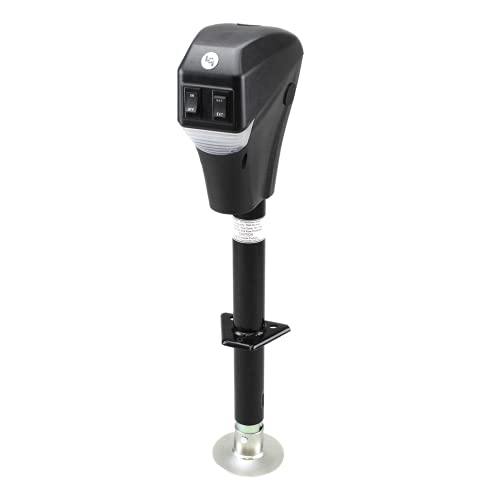


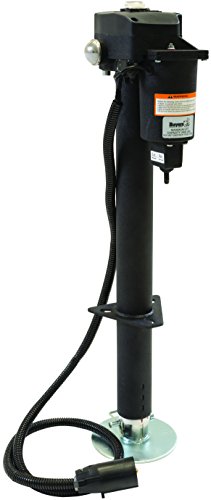

When you're running a heavy travel trailer or a fully loaded RV A-frame and you need a jack that won't flinch under real-world stress, the KYX Electric Trailer Jack is the machine to trust in 2026. Its 12V DC motor delivers a verified 7,500-lb lifting capacity, which puts it in a class well above most of its competitors and makes it the clear choice for anyone whose tongue weight pushes the upper limits of what lighter jacks can safely handle. The stroke range is equally impressive, extending from a retracted 9.84 inches all the way to 33.85 inches, which gives you exceptional flexibility across a wide range of trailer heights and ground conditions without requiring you to use supplemental blocking or spacers.
The build quality on the KYX reflects genuine engineering intent rather than budget-corner cutting — the carbon steel construction is coated with a dedicated anti-rust treatment that resists water splash and prolonged moisture exposure, so it holds up through seasons of outdoor use without the surface degradation you see on cheaper jacks after a single rainy season. The multi-level adjustable height design keeps your trailer balanced on uneven terrain, and the waterproof rating means you don't need to worry about running it in wet conditions or leaving it exposed to morning dew. The hard-wiring 12V DC connection is straightforward for anyone with basic electrical know-how, and the setup is clean enough to satisfy even the most detail-oriented installer.
From a practical standpoint, the KYX delivers smooth, consistent travel throughout its stroke without the grinding or hesitation that sometimes appears in high-capacity jacks running at the upper end of their rated load. It raises and lowers at a pace that feels purposeful — not sluggish — and the overall operation is quiet enough that you won't disturb neighbors at a campground during early-morning departures. If you regularly haul a rig that puts serious weight on the tongue, this is the one jack in 2026 that gives you genuine confidence every time you push the button.
Pros:
Cons:
Lippert is a name that carries real weight in the RV and trailer industry, and the Power Tongue Jack lives up to that reputation by delivering a plug-and-play installation experience combined with thoughtful features that make daily use genuinely effortless. Rated at 3,500 lbs with an 18-inch stroke, this jack is sized correctly for the broad middle of the travel trailer market — the rigs most people are actually running — and its complete hardware package means you won't be hunting for pins or brackets before you can get it operational. The 10.75-inch retracted height extending to 28.75 inches gives you solid range for standard trailer configurations without the bulk of a high-capacity unit.
The four integrated LED lights are a feature that earns its place every time you hook up after dark, illuminating the ball and coupler with enough light to actually see what you're doing instead of relying on a headlamp held between your teeth. The 5.4-inch foot pad provides excellent ground contact and distributes the load more evenly than the smaller pads found on budget competitors, which matters significantly on soft ground like gravel or grass. Lippert also includes an emergency manual crank override — a feature that veteran trailer owners will recognize as essential insurance against battery failures or electrical issues that would otherwise leave you stranded with the trailer stuck in mid-air.
The installation process lives up to its promise of being fast and simple; all necessary hardware is included, and the design is clean enough that most users with minimal mechanical experience can complete the swap from a manual jack without difficulty. Operation is smooth throughout the 18-inch stroke, and the push-button control is responsive without the input lag you sometimes encounter on cheaper motors. For trailer owners who prioritize a hassle-free experience above raw lifting capacity, the Lippert Power Tongue Jack is the most refined option in this roundup.
Pros:
Cons:
The Husky Super Brute earns its place on this list by combining a serious 5,000-lb lifting capacity with remote control operation — a pairing that dramatically changes how you interact with your trailer during setup and breakdown. Being able to stand back and operate the jack wirelessly means you can watch the hitch engage the ball from the optimal viewing angle rather than craning around to reach a side-mounted button while simultaneously trying to monitor the coupler. For solo operators who manage trailers without a spotter, the remote transforms a two-person job into a controlled, single-operator operation that actually improves your hitching accuracy.
The full 18-inch stroke is complemented by weather-protected soft-trigger switches and a backlit control panel that remains readable in low-light conditions — a combination that shows Husky thought carefully about real-world operating environments rather than just spec-sheet performance. The three-sided high-output LED light system is one of the most comprehensive lighting packages in this category, providing wide-angle illumination around the coupling zone that makes nighttime hitching as confident as daylight operation. The 6-foot, 10-gauge power supply line gives you enough reach to route the connection cleanly without needing extension work on most standard installations.
Performance under load is consistent with the 5,000-lb rating — the motor handles the upper range of that capacity without the straining or slowing you sometimes experience when pushing a jack close to its limits. The cycle time of 60 seconds for a full 6-inch up/down stroke is competitive with other jacks in this class, and the overall build feels solid and purposeful. If remote control capability is your primary requirement and you want it paired with genuine heavy-duty capacity, the Husky Super Brute is the most complete option available in 2026.
Pros:
Cons:
Stromberg Carlson built the JET-5000 around a philosophy that a jack's motor is its most critical and most vulnerable component — and the built-in motor protection system reflects that conviction in a way that separates this jack from competitors operating in the same 5,000-lb capacity range. Overheating and overuse are the two most common failure modes for electric jack motors, particularly for users who run repeated raise/lower cycles during leveling sequences on uneven terrain, and the JET-5000's thermal protection circuit interrupts the motor before damage can occur rather than letting you push it to failure. That's a feature with genuine long-term ownership implications, not just a bullet-point specification.
The 18-inch travel combined with the 5-inch drop-down leg gives you 23 effective inches of total height adjustment, which is meaningful when your trailer is sitting on lifted or compacted ground that would otherwise put you right at the limit of a standard 18-inch jack's range. The heavy-duty frame is engineered to handle both the static load of a parked trailer and the dynamic stresses of repeated cycling without developing the flex or play that eventually leads to binding and premature wear on lesser units. Stromberg Carlson's reputation in the RV accessory space is well-earned, and the JET-5000 reflects the build standards you expect from a manufacturer that designs exclusively for this application segment.
For users who live in their trailers seasonally or who use their rigs frequently enough that the jack cycles dozens of times per month, the motor protection system is worth the investment on its own. The JET-5000 is designed to outlast the competition, and its combination of thoughtful engineering, solid capacity, and practical drop-leg design makes it one of the most well-rounded options in the entire 2026 lineup.
Pros:
Cons:

VEVOR has established itself as a manufacturer that delivers legitimate functionality at price points that undercut name-brand competitors, and the 4,000-lb electric trailer jack continues that tradition with a feature set that punches well above its price bracket. The 9.84 to 33.85-inch stroke range is identical to the KYX at the top of this list — an impressive specification for a value-category product — and the carbon steel construction with protective coating gives you corrosion resistance that you'd reasonably expect to pay more for in a comparable configuration from a premium brand. The included sunshade waterproof cover is a practical inclusion that extends the jack's service life by shielding it from UV degradation and water ingress during storage and use.
The 90-degree rotating installation hole is a detail that experienced trailer mechanics will immediately appreciate — it prevents interference with tailgate operation during installation, which is a genuine engineering consideration rather than a marketing talking point, and it simplifies the mounting process on trailers where the A-frame geometry creates tight clearance constraints. At 4,000 lbs of capacity, the VEVOR covers the majority of travel trailer, horse trailer, and utility trailer applications without overbuilding for users who don't need the extreme capacity of the 7,500-lb or even 5,000-lb units. The operation is smooth and consistent throughout the stroke, and the waterproof design holds up credibly in rain and wet-storage conditions.
If your budget is a primary consideration and your trailer falls within the 4,000-lb tongue weight limit, the VEVOR delivers a level of quality and feature completeness that makes it genuinely difficult to justify spending significantly more for a comparable installation. The value proposition is real, not illusory — you're getting a capable jack, not a compromised one, and the overall ownership experience reflects that.
Pros:
Cons:
The Buyers Products 0093500 earns its "plug-and-play" designation honestly — the pre-wired 7-way RV connector means you connect it to your existing trailer wiring harness without splicing, custom fabrication, or any electrical guesswork, and that alone removes the single biggest barrier most trailer owners face when considering an upgrade from their existing manual jack. For the significant portion of the market that is mechanically competent but not electrically experienced, this jack eliminates what would otherwise be a stopping point and turns the entire upgrade process into a straightforward afternoon project that anyone with basic hand tools can complete confidently.
Beyond the installation convenience, the Buyers Products jack includes a built-in leveling gauge that takes the guesswork out of achieving a precise horizontal position during setup — a feature that becomes particularly valuable when you're parked on ground with subtle slope gradients that are difficult to assess by eye. The LED night light is a practical addition rather than a token feature, and it illuminates the control area clearly enough that you don't need supplemental lighting during late-arrival campground setups. The combination of 18-inch electric travel plus the 6-inch drop-leg extension gives you a total height reach of 24 inches, covering the range needed for most standard A-frame configurations without requiring additional adapters or risers.
At 3,500 lbs of capacity, the Buyers Products jack occupies the same tier as the Lippert, but its pre-wired connector and integrated leveling gauge give it a distinct advantage for users who prioritize installation simplicity and functional feedback during setup. The manual crank backup is present and functional — a genuine safety net rather than a marketing checkbox — and the overall build quality reflects Buyers Products' long history of manufacturing trailer and truck accessories for demanding commercial and recreational applications. If you want the simplest possible upgrade path from manual to electric, this is the jack that delivers it without compromise.
Pros:
Cons:
The JET-4500 from Stromberg Carlson occupies a strategic position in this lineup by offering the most mechanically advanced drive system in the group — a ball screw mechanism that fundamentally changes the character of the jack's operation compared to the lead-screw or rack designs found in most competitors. Ball screw drive systems are quieter, more efficient, and produce significantly less mechanical wear per cycle than conventional screw designs, which translates directly into longer service life, reduced motor strain, and smoother travel throughout the full 18-inch stroke. If you've ever operated a high-quality ball-screw linear actuator versus a standard threaded-rod unit, the difference in feel and sound is immediately apparent and genuinely satisfying.
At 4,500 lbs of capacity with an additional 4.5-inch drop-down leg providing 22.5 inches of effective total height, the JET-4500 slots between the 4,000-lb value options and the 5,000-lb heavy-duty tier, hitting a sweet spot for mid-range trailer configurations that are too heavy for the lighter-capacity jacks but don't require the maximum lifting power of the JET-5000. The heavy-duty frame is built to the same Stromberg Carlson standards as the JET-5000, which means you're getting proven engineering and materials rather than a cost-reduced derivative designed to hit a lower price point. For users who plan on frequent cycling — multiple hitching and unhitching sessions per week throughout an active season — the ball screw mechanism's reduced wear rate is a compounding advantage that pays dividends over several years of ownership.
The JET-4500 also handles uneven terrain with more grace than conventionally driven jacks because the ball screw maintains consistent mechanical efficiency even when the load distribution is slightly off-center, which is a common real-world condition when parking on ground that isn't perfectly level. Combined with Stromberg Carlson's established track record and the ball screw's inherent noise reduction benefits, this jack is the most technically sophisticated option in the 2026 lineup for users who want the best possible long-term ownership experience in the mid-capacity range.
Pros:
Cons:
The single most important specification when selecting an electric trailer jack is its rated lifting capacity, and the golden rule is to select a jack rated at least 10 to 15 percent above your trailer's actual tongue weight rather than selecting a unit rated exactly at your maximum load. Tongue weight typically runs 10 to 15 percent of your total trailer weight — so a 20,000-lb loaded trailer will put roughly 2,000 to 3,000 lbs on your hitch — but that number fluctuates with load distribution, and operating a jack at its maximum rating as a routine matter accelerates motor wear and reduces service life measurably. The jacks on this list range from 3,500 lbs (Lippert, Buyers Products) through 4,000 lbs (VEVOR), 4,500 lbs (JET-4500), 5,000 lbs (Husky, JET-5000), and all the way to 7,500 lbs (KYX), giving you a full spectrum to match your actual tongue weight requirements with appropriate headroom.
The stroke length determines how far your jack can extend from its retracted position, and the drop-leg is an additional mechanical extension that adds extra height capacity beyond the main stroke — usually an additional 4 to 6 inches — to accommodate trailers that sit higher off the ground due to lift kits, larger tires, or A-frame geometry. A jack with 18 inches of electric stroke and a 5-inch drop leg provides 23 inches of effective range, which is the difference between a jack that works on your specific rig and one that leaves you unable to unhitch without blocking. Before purchasing, measure the distance between your A-frame coupler and the ground when the trailer is hitched, then verify that your selected jack can retract far enough to clear the ball during connection and extend far enough to lift the coupler free. Explore our coverage of related towing accessories like fifth wheel hitch covers to round out your trailer setup.
Motor quality separates jacks that last five seasons from jacks that fail during the third summer camping trip, and the markers to look for are thermal overload protection, sealed motor housings, and duty-cycle ratings that reflect real-world use patterns rather than ideal laboratory conditions. Built-in thermal protection, as found in the Stromberg Carlson JET-5000, is a feature that prevents you from burning out the motor during intensive multi-cycle leveling sessions on uneven terrain — the very scenario where you're most likely to push the motor beyond its momentary operating limits. Weather sealing and corrosion-resistant coatings are equally critical for jacks that live outside year-round, and carbon steel with anti-rust coating — as used by KYX and VEVOR — performs significantly better in wet climates than bare steel or thin paint finishes that chip and rust within a year of outdoor exposure.
Electric trailer jacks connect to your trailer's 12V system either through hard-wired connections or through pre-wired 7-way RV connectors, and your comfort with basic electrical work should guide that choice — the Buyers Products 0093500's pre-wired connector is genuinely the easiest installation path, while the KYX's hard-wired setup gives you a cleaner permanent installation at the cost of some electrical work during mounting. Beyond the basics, features like remote control operation (Husky Super Brute), integrated LED lighting (Lippert, Husky), built-in leveling gauges (Buyers Products), and manual crank overrides (Lippert, Buyers Products) each address specific real-world pain points that become obvious once you've spent enough time managing a trailer in less-than-ideal conditions. Evaluate which features align with your actual use patterns — remote control matters most for solo operators, LED lighting matters most for nighttime campers, and manual override matters most for anyone who has ever been stranded by a dead battery.
An electric tongue jack is specifically designed for A-frame trailer couplers — the V-shaped front end of most travel trailers, utility trailers, and some RVs — and mounts vertically at the apex of the A-frame to lift and lower the coupler for hitching and leveling. A "regular" electric trailer jack is a broader category term that encompasses all electrically powered jacks, including side-wind jacks and stabilizer jacks, so most electric tongue jacks are technically electric trailer jacks, but not all electric trailer jacks are tongue jacks. Every product in this guide is specifically an electric tongue jack designed for A-frame tongue mounting, which is the most common jack type for travel trailers and utility trailers in 2026.
Start by calculating your trailer's tongue weight, which is typically 10 to 15 percent of the trailer's total loaded weight — so a fully loaded 25,000-lb fifth wheel would put 2,500 to 3,750 lbs on the jack. Once you have that number, select a jack rated at least 10 to 15 percent above your maximum expected tongue weight to provide an operating margin that protects the motor from working at its ceiling rating during every use cycle. For most travel trailers in the 15,000 to 25,000-lb loaded range, a 3,500 to 5,000-lb jack is appropriate; for heavier rigs approaching or exceeding 30,000 lbs, the KYX's 7,500-lb capacity is worth the upgrade investment.
Most electric trailer jacks are designed for DIY installation and include all the necessary hardware for mounting to a standard A-frame coupler, and the physical installation process — removing the old jack and bolting the new one in place — is straightforward for anyone comfortable with basic hand tools. The electrical connection is the step that trips up first-time installers: pre-wired 7-way connector jacks like the Buyers Products 0093500 eliminate this challenge entirely by plugging into your existing trailer harness, while hard-wired jacks require you to route and connect 12V wiring to your trailer's electrical system. If you're comfortable with basic automotive electrical work, hard-wiring is not difficult; if you're not, stick to a pre-wired connector model or have an RV service center handle the electrical portion.
Start with the most common cause — a dead or discharged battery — by testing your trailer's 12V supply voltage at the jack's power connection and confirming it reads at least 12.4 volts under load; if voltage is low, charge or replace the battery before assuming the jack itself is faulty. If battery voltage is good, check the circuit breaker or inline fuse in the jack's power circuit, as most electric jacks include overload protection that trips a breaker rather than burning out the motor. If the motor runs but produces no movement, the drive mechanism may be bound or the clutch may have failed; and if the motor doesn't run at all despite good voltage and intact fuses, the motor windings or control switch have likely failed. Jacks with manual crank overrides — like the Lippert and Buyers Products models — allow you to continue operating during electrical failures while you diagnose and source parts.
Lubricate the screw mechanism according to the manufacturer's schedule — typically every 3 to 6 months for actively used jacks — using the specified grease type, as under-lubrication causes premature wear on the screw threads and the motor's load-bearing components. Keep the exterior clean and inspect the weatherproofing coating annually, addressing any chips or scratches with touch-up paint or a rust-inhibiting primer before oxidation can establish itself and spread beneath the surface. Check the foot pad for wear and cracking, as a damaged foot pad transfers load unevenly and can accelerate stress on the jack's structural members. For jacks stored outdoors year-round, the included waterproof covers (like the one provided with the VEVOR) are worth using consistently, as UV exposure and freeze-thaw cycling accelerate material degradation on exposed components.
Electric tongue jacks in the A-frame configuration are compatible with all trailers that use a standard A-frame coupler — the vast majority of travel trailers, utility trailers, horse trailers, and some smaller RVs — but they are not interchangeable with side-mount jacks used on fifth-wheel hitches or the four-corner stabilizer jacks used for leveling a parked trailer. Before purchasing, confirm your trailer uses an A-frame front end with a standard mounting bolt pattern, and verify that the jack's retracted and extended height range matches your trailer's geometric requirements — specifically that the retracted height allows the coupler to engage the ball without the jack foot dragging the ground. Trailers with non-standard A-frame widths or unusual mounting configurations may require adapter brackets, so measure your existing jack's mounting bolt pattern and compare it to the replacement's specifications before purchasing.
 |
 |
 |
 |

About Liam O'Brien
Liam O'Brien has spent over a decade buying, field-testing, and evaluating automotive tools with a focus on what actually performs in a real DIY garage rather than what markets well on a spec sheet. His hands-on experience spans hand tools, diagnostic equipment, floor jacks, socket sets, and specialty automotive gear across a wide range of brands and price points. At CarCareTotal, he covers automotive tool and equipment reviews, garage setup guides, and buying advice for home mechanics.
Get some FREE car parts & gear.. Or check out the latest free automotive manuals and build guides here.
Disable your ad blocker to unlock all the hidden deals. Hit the button below 🚗
| | | |
