by Liam O'Brien
What separates a garage heater that actually keeps your workspace comfortable from one that just runs up your energy bill without delivering real warmth? If you've spent even one winter morning shivering over an engine block or trying to work with numb fingers, you already know the answer matters. After evaluating dozens of units across electric, gas, and propane categories, our top pick for most garages in 2026 is the Newair Hardwired 240V 10,000W Electric Garage Heater — a high-output, wall- or ceiling-mounted unit that heats up to 1,605 square feet with a digital thermostat and remote control.
Choosing the right garage heater means balancing heating capacity, fuel type, installation complexity, and safety requirements for your specific space. A 200-square-foot single-car garage has entirely different demands than a 1,000-square-foot workshop where you spend hours doing serious mechanical work. Whether you're maintaining vehicles, doing woodworking, or simply want a comfortable space to store tools and gear, this guide breaks down seven of the best options available right now so you can make a confident, informed decision before the next cold season hits. If you're already upgrading your workspace, you might also want to check out our picks for the best garage floor coatings of 2026 to complete the transformation.
In this review, you'll find detailed breakdowns of electric, natural gas, and propane heaters spanning a wide range of budgets and heating capacities. We cover everything from compact 4,000W units for small spaces to industrial-grade 15,000W and 45,000 BTU powerhouses built for large commercial garages, along with a comprehensive buying guide to help you match the right unit to your specific situation. According to the U.S. Department of Energy, properly sized supplemental heaters can dramatically reduce heating costs compared to whole-home systems, making a quality garage heater one of the smarter investments you can make for your workspace.

Contents







If your garage is on the larger side — think two-car, three-car, or a full workshop setup — the Newair 240V hardwired heater delivers the kind of muscle that most electric units simply can't match. Running on 240-volt power with a maximum output of 10,000 watts, this unit can effectively heat spaces up to 1,605 square feet using fan-forced convection that pushes warm air throughout the entire room rather than just radiating heat in a single direction. The integrated digital thermostat lets you dial in your target temperature and walk away, because the unit maintains that temperature automatically without any manual fiddling on your part.
Installation is one of the strongest points here, since the adjustable mounting bracket accommodates ceiling mounting, wall mounting, and even countertop placement depending on how you've configured your workspace. The dual power settings — 7,500W and 10,000W — give you meaningful flexibility between everyday heating and maximum output on the coldest mornings, and the included remote control means you can adjust settings from across the room without leaving your work area. The build quality reflects a commercial-grade product, with a heavy-duty housing that holds up to the demanding conditions of professional shop environments where dust, moisture, and vibration are constant variables.
For anyone setting up or upgrading a serious workspace in 2026, the Newair 240V represents an investment in year-round comfort that pays dividends in productivity. The fan-forced design ensures heat distribution is even and rapid, so you're not waiting 45 minutes for one corner of the garage to warm up while the rest remains frigid. If you're also thinking about upgrading your garage's visual appeal, pairing this heater with one of our recommended garage wall paints gives you a fully transformed workspace from top to bottom.
Pros:
Cons:
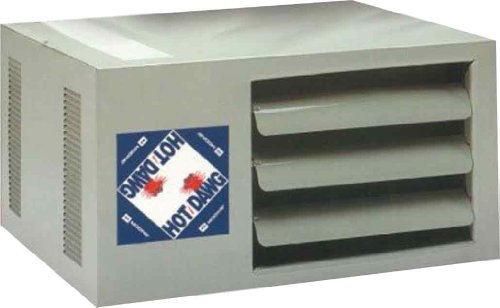
The Modine Hot Dawg is the gold standard for natural gas garage heating, and its reputation for reliability across residential, commercial, and industrial applications makes it the benchmark that other gas heaters are compared against. At 45,000 BTU with 80-percent thermal efficiency, this unit delivers serious heating power that scales well to large single or double garages, and the quiet operation is something you'll genuinely appreciate when you're trying to concentrate on precision work. The low-profile design keeps the unit unobtrusive when mounted overhead, and the neutral gray finish blends into virtually any garage aesthetic without looking industrial or out of place.
Natural gas heaters like the Modine carry a distinct advantage over electric units in operating cost, since natural gas tends to run significantly cheaper per BTU than electricity in most U.S. regions. That efficiency gap becomes especially pronounced during extended winter periods when your heater is cycling on frequently throughout the day, and over a full season the savings can be substantial enough to offset the higher installation costs of running a gas line if you don't already have one. The Hot Dawg is built to last with a reputation among contractors and tradespeople for longevity that extends well past a decade of regular use.
Installation requires a professional HVAC or plumbing contractor to connect the gas line and handle venting, which adds to the upfront cost but ensures safe, code-compliant operation from day one. Once it's up and running, the Modine Hot Dawg is genuinely a set-it-and-forget-it heating solution that heats quickly, runs quietly, and demands minimal maintenance over its long service life. This is the unit serious workshop owners choose when they want permanent, powerful, gas-fired heat without compromise.
Pros:
Cons:
If your garage heating needs don't fit neatly into a permanent installation scenario — whether you move between job sites, work in a space that doesn't permit gas line installation, or simply want the flexibility to position heat exactly where you're working — the DEWALT 12,000 BTU propane radiant heater is one of the most versatile options in its class. The combination of radiant heating, an integrated high-velocity fan, and a powerful LED light bar makes this more than just a heater; it's a complete portable worksite companion that handles illumination and device charging alongside its primary heating function.
The three USB charging ports are genuinely useful in a working environment where your phone, tablet, or Bluetooth devices need juice throughout a long session, and the integrated LED bar throws enough light to supplement overhead lighting in dimly lit corners of your workspace. Heat output runs between 6,000 and 12,000 BTU depending on which setting you select, giving you the option to conserve propane on moderately cold days while maintaining the high setting in reserve for mornings when temperatures drop well below freezing. The cordless, fully portable design means zero installation requirements — connect a standard 1-lb or larger propane cylinder and you're operational in minutes.
Radiant heat works differently than fan-forced convection: instead of warming the air, it directly heats objects and people in its line of sight, which means you feel the warmth almost immediately even before the surrounding air temperature has risen significantly. For targeted task heating in a specific zone of your garage, this approach is highly effective and efficient. The DEWALT name behind this unit also signals a commitment to build quality and durability that holds up to real worksite conditions where lesser units would fail.
Pros:
Cons:
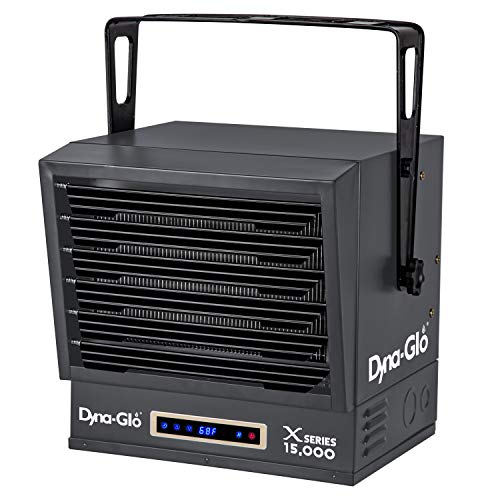
When maximum electric heating output is your priority and you have the electrical infrastructure to support it, the Dual Power 15,000W garage heater stands at the top of the electric category with 51,180 BTU of heat production that can hold its own against many gas alternatives. The 24 heat settings spanning 50°F to 95°F give you granular temperature control that most comparable units can't approach, and the dual power modes — 11,300W (38,556 BTU) and 15,000W (51,180 BTU) — let you match energy draw to your actual heating demand rather than running at maximum output all the time.
One of the most underrated features here is the summer fan-only mode, which transforms this from a seasonal appliance into a year-round garage ventilation tool that you'll actually use in warmer months. Running a high-powered fan through a hot summer garage on a 15,000W fan's airflow capacity keeps the space comfortable when you're doing light work and protects heat-sensitive materials or electronics stored in the space. The controls are straightforward and well laid out, making it easy to cycle between modes and temperature settings without consulting a manual every time you make an adjustment.
This unit's sheer output capacity places it in the premium tier of electric garage heaters, suited to large commercial workshops, auto body shops, and oversized multi-car garages where electric is the preferred or only option. You'll want to verify your electrical panel can support the load before purchasing, but if your infrastructure is already set up for heavy electric draw, this heater delivers performance that rivals gas alternatives without the ventilation complexity.
Pros:
Cons:
The Mr. Heater MH40NG is a 40,000 BTU natural gas infrared heater built specifically for garages with 12- to 15-foot ceilings, using radiant heat technology that heats objects and people directly rather than relying on air circulation to distribute warmth. This approach makes it particularly effective in garages with drafts, open doors, or high ceilings where convection heating struggles to maintain consistent temperatures, because the radiant energy heats whatever it touches regardless of air movement around it. For anyone doing vehicle work, woodworking, or metalworking in a tall garage space, the MH40NG's efficiency at height is a genuine differentiator.
At 40,000 BTU, this unit delivers enough output to comfortably heat most large residential garages and smaller commercial shops, and the infrared delivery method means you feel warmth quickly after startup rather than waiting for air temperature to build. The cost-effective operation that natural gas enables makes this an attractive long-term choice for daily users who run their heater several hours per day throughout winter, and the clearances required — 36 inches top, 30 inches sides and back, 68 inches below — are manageable in most standard garage configurations. Installation requires professional gas line work and proper venting, which is the one area where you shouldn't cut corners for both safety and code compliance reasons.
Infrared heating also produces a more comfortable, even warmth that many people describe as similar to sunlight — it warms your body and the surfaces around you rather than creating hot spots near vents and cold zones elsewhere. If you're the kind of person who spends several hours at a stretch in your garage during winter, the quality of warmth that infrared provides is noticeably more comfortable than fan-forced alternatives, especially in tall or drafty spaces where heated air escapes before it can warm the working zone.
Pros:
Cons:
The KING KB ECO2S brings a feature set that punches well above what you'd expect for an electric garage heater at this output level, combining remote control operation, a universal wall/ceiling bracket, timer programming, and a summer fan-only mode into a 10,000W package that handles garages up to around 1,000 square feet with consistent, reliable performance. The built-in fan delay function keeps the unit running briefly after the heating element shuts off, which dissipates residual heat from the element rather than letting it sit and waste energy — a small but smart engineering choice that reflects careful product development.
Remote control operation is genuinely convenient in a garage context, where you might start the heater before walking through the door on a cold morning or adjust the temperature while your hands are occupied with a project. The timer mode adds another layer of intelligence by letting you schedule heating cycles that warm the space before you arrive without running continuously when you're not there, which translates directly to lower operating costs over a full heating season. The universal mounting bracket supports both wall and ceiling installation at adjustable angles, giving you full flexibility to direct airflow exactly where your workspace demands it.
For a garage that's also used as a home gym, hobby room, or multi-purpose space — the kind of environment where comfort features matter as much as raw heating power — the KING ECO2S strikes an excellent balance. The 10,000W output is substantial enough for most residential garages, while the smart features make day-to-day operation more convenient than simpler units that require manual adjustments every time conditions change. This is particularly compelling if you already have a capable garage door opener setup and want the rest of your garage systems to match that level of thoughtful functionality.
Pros:
Cons:
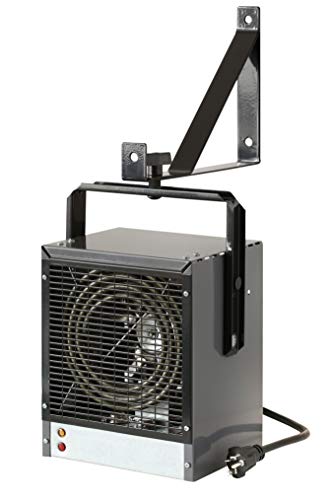
The Dimplex 4,000W garage heater proves that you don't need maximum wattage to get exceptional build quality and reliable performance in a smaller workspace. Built around a stainless steel heating element and driven by a high-performance motor, this 240V unit delivers dependable, consistent heat for single-car garages, small workshops, and utility spaces where a 10,000W+ unit would be overkill and where the additional electrical infrastructure cost doesn't make sense. The heavy-gauge steel housing with epoxy powder-coat finish is built for the kind of harsh, humid, dusty environments that garage heaters endure, resisting corrosion through years of continuous seasonal use.
The built-in thermostat handles temperature regulation automatically, which means you set your target and the unit manages its own cycling without any manual intervention on your part. The included mounting bracket supports both ceiling and wall installation, and the swivel-and-pivot adjustment mechanism lets you direct airflow at precise angles — an underrated feature when you need heat concentrated on a specific workbench area rather than distributed broadly across the room. At 4,000 watts, the Dimplex draws significantly less power than larger units, which makes it compatible with more residential electrical panels without requiring major upgrades.
If your garage is on the smaller side and you want a durable, no-nonsense electric heater that will last years without demanding attention or repairs, the Dimplex is the unit you want. The combination of stainless steel heating element, powder-coated steel body, and a proven motor platform creates a reliability profile that outlasts cheaper alternatives by a wide margin. This is the kind of heater you install once and don't think about again for many years, which is exactly what a single-car garage or small workshop environment calls for. While you're upgrading your garage, you might also consider browsing our garage and auto tools section for other equipment that complements a well-equipped workspace.
Pros:
Cons:

Getting the BTU or wattage calculation right is the most important decision you'll make in this purchase, because an undersized unit will run constantly without reaching your target temperature while an oversized unit will cycle on and off too rapidly to maintain consistent comfort. The standard rule of thumb for a well-insulated garage is approximately 10 watts or 34 BTU per square foot, but that figure climbs to 15 watts or 50 BTU per square foot for poorly insulated or uninsulated spaces. Start by measuring your garage's square footage, assess your insulation quality honestly, then calculate accordingly before you compare specs across products.
Ceiling height is a secondary sizing factor that many buyers overlook: a 10-foot ceiling holds significantly more air volume than an 8-foot ceiling at the same floor area, which means your heater has to work harder to bring that larger air mass up to temperature. For garages with 10-foot or taller ceilings, add 15–20 percent to your calculated output requirement to account for the additional volume, and consider infrared radiant options like the Mr. Heater MH40NG, which heats objects at height rather than waiting for warm air to fill the full ceiling volume before comfort reaches the working zone.
Each fuel type brings a distinct cost and convenience profile that shapes which type is the right fit for your situation. Electric heaters are the easiest to install when you already have appropriate 240V service — there's no gas line to run, no venting requirement in most cases, and no fuel to store. The trade-off is that electricity is generally the most expensive energy source per BTU in most U.S. markets, so a high-wattage unit running several hours daily can produce a noticeable impact on your monthly utility bill. Natural gas is typically the most cost-effective fuel for continuous use, with BTU costs running well below electricity and propane in most regions, but it requires professional installation of both the gas connection and the venting system, which adds substantially to your upfront investment. Propane splits the difference by offering gas-level heat output without requiring a fixed gas line, while accepting the ongoing cost and logistics of managing propane cylinder refills or tank service.
The installation path you're willing to undertake directly influences which heater categories are available to you, because the jump from plug-in to hardwired 240V to gas-fired involves escalating complexity and code requirements at each step. A 240V hardwired electric heater like the Newair or KING ECO2S requires an electrician to install a dedicated circuit with appropriate amperage, proper breaker sizing, and code-compliant wiring — straightforward work for a licensed professional but not a DIY project in most jurisdictions. Gas heaters require a gas fitter or licensed plumber to connect the supply line plus an HVAC contractor or gas technician to install the venting system, ensuring combustion gases exhaust safely outside the structure. Portable propane heaters like the DEWALT unit skip installation entirely, which is the right answer when your situation doesn't permit permanent modifications or when you need heat in multiple locations.
Once you've established which fuel type and output capacity your garage requires, the feature set becomes the deciding factor between comparable units, and a few specific features consistently deliver real value in daily garage use. A built-in or compatible digital thermostat is non-negotiable for any permanent installation, since manual cycling wastes energy and fails to maintain consistent temperatures when outdoor conditions fluctuate. Remote control is a genuine quality-of-life upgrade for any garage heater — starting your unit before you physically enter the garage on a cold morning, or adjusting temperature from across the room while your hands are occupied, eliminates small but persistent inconveniences that add up over a full winter season. Timer functions, fan delay (which dissipates residual element heat after shutdown), and summer fan-only modes round out the feature set for premium units that earn their higher price points through year-round functionality rather than serving exclusively as seasonal appliances.
A standard two-car garage of approximately 400–500 square feet in a moderately cold climate with average insulation typically requires 4,000–6,000 watts or 14,000–20,000 BTU to maintain comfortable working temperatures. In colder climates or poorly insulated spaces, sizing up to 8,000–10,000 watts or 25,000–34,000 BTU is the safer choice that avoids continuous full-load operation during the coldest periods. The Newair 240V 10,000W or KING ECO2S 10,000W are both well-matched to a large two-car garage in most North American climates.
The answer depends primarily on your infrastructure and usage patterns. Natural gas is almost always cheaper to operate per BTU, making it the better long-term choice if you use your garage heater daily throughout a full winter season and already have gas service to the home. Electric is cleaner to install, requires no venting in most configurations, and is genuinely competitive in cost when your heating sessions are shorter or your electricity rates are below average. For flexibility and zero installation requirements, propane is the practical choice when neither gas lines nor 240V circuits are available.
You can, but you need to account for the dramatically higher heat loss by sizing up significantly from the standard calculation. An uninsulated garage can lose heat two to four times faster than an insulated one, which means a heater sized for an insulated space will struggle continuously without maintaining target temperatures. In an uninsulated space, size for 15 watts or 50 BTU per square foot rather than the standard 10 watts or 34 BTU, and consider insulating at least the walls and door as a complementary project that pays for itself in reduced heating costs very quickly.
Units with a quality thermostat, automatic shutoff, and proper installation are designed for extended operation, but leaving any heater running in an unoccupied space overnight introduces risks that outweigh the convenience in most situations. For gas heaters, carbon monoxide accumulation is the primary risk if the venting develops any obstruction or leak, and CO detectors are non-negotiable in any garage with gas appliances. Electric heaters don't produce combustion byproducts, but they still present overheating and electrical fault risks. If overnight heating is part of your use case, invest in a unit with a quality thermostat, overheat protection, and a CO detector, and ensure your heater is professionally installed and properly maintained.
At the U.S. average residential electricity rate of approximately $0.16 per kWh in 2026, a 10,000W heater running at full load costs about $1.60 per hour. In practice, a unit with a thermostat won't run continuously — typical duty cycles of 40–60 percent bring effective hourly costs to $0.64–$0.96 during active heating sessions. Over a full three-month winter with four hours of daily use, you're looking at roughly $115–$175 in electricity costs depending on your local rates and thermostat cycling, which is a manageable operating expense for the comfort and productivity a properly heated garage delivers.
Electric garage heaters don't require venting because they produce no combustion byproducts — all their output is heat and airflow. Gas heaters, including natural gas and propane models, must be vented to the outside to exhaust carbon monoxide and other combustion gases safely, which is why professional installation is mandatory for these units. The only exception among gas heaters is vent-free models, which are designed for certain applications but are not recommended for enclosed garage spaces due to oxygen depletion and CO accumulation risks when ventilation is limited.

 |
 |
 |
 |

About Liam O'Brien
Liam O'Brien has spent over a decade buying, field-testing, and evaluating automotive tools with a focus on what actually performs in a real DIY garage rather than what markets well on a spec sheet. His hands-on experience spans hand tools, diagnostic equipment, floor jacks, socket sets, and specialty automotive gear across a wide range of brands and price points. At CarCareTotal, he covers automotive tool and equipment reviews, garage setup guides, and buying advice for home mechanics.
Get some FREE car parts & gear.. Or check out the latest free automotive manuals and build guides here.
Disable your ad blocker to unlock all the hidden deals. Hit the button below 🚗
| | | |
