by Liam O'Brien
Which dent puller actually works well enough to save you a trip to the body shop, and which ones will leave you more frustrated than when you started? After spending weeks testing kits across door dings, parking lot creases, and hail damage on various panel types, one product consistently outperformed the rest in both pulling force and ease of use. Whether you are dealing with a shallow surface dimple or a deeper crease that showed up after a minor parking mishap, the right paintless dent repair kit can restore your car's finish without touching the original paint — and without a four-figure repair invoice.
Paintless dent repair (PDR) has become the go-to method for professional technicians and serious DIYers alike, because it preserves your factory finish and protects your vehicle's resale value in a way that traditional body filler and repainting simply cannot match. According to Wikipedia's overview of paintless dent repair, the technique was first developed in the 1940s and has since evolved into a comprehensive professional discipline supported by a wide range of consumer-grade tools. In 2026, the market offers everything from simple three-pack suction cup sets to professional 169-piece bridge puller and slide hammer systems — and the difference between them is significant when you are trying to get a clean result on curved body panels.
In this guide, you will find in-depth reviews of the top-rated dent pullers available today, a practical buying guide covering the most important selection criteria, and answers to the most common questions buyers ask before committing to a kit. If you are also shopping for other automotive tools to round out your garage setup, you will want to bookmark our full tools directory. Now, let's get into the picks that deserve a place in your trunk or workshop this year.

Contents








The HORFUTY 3-Pack is the kind of kit you reach for when you need a quick, no-fuss solution for shallow dents on flat or gently curved panels, and it delivers that experience reliably without any glue, tabs, or curing time involved. The set includes one large 4.5-inch puller and two smaller 2.2-inch pullers, and the size difference matters because larger suction cups need more surface area to seat correctly, so you match your tool to the dent size and the panel curvature before pulling. The large cup generates up to 130 lbs of horizontal suction force and 80 lbs of vertical force, which is genuinely impressive for a rubber-cup tool and enough to pop out shallow door dings cleanly when the surface is clean and dry.
Beyond dent repair, the set doubles as a furniture mover, glass lifter, tile handler, and even a temporary phone holder or door pull, which makes it a versatile item to keep in your car year-round. The build quality uses dense, high-grip rubber that seats firmly on painted metal and glass without leaving marks, and the pull handles are ergonomically shaped for controlled, steady force rather than jerky yanks that could damage the panel. These cups are not going to replace a full bridge puller system for deep or irregularly shaped dents, but for the casual DIYer who just wants something simple and reusable in the trunk, this kit punches well above its price point.
If you are approaching dent repair for the very first time and want to understand the basics before investing in a more complex system, starting with a suction cup set like this one and pairing it with good waterless car wash products to prep the panel surface is a smart, low-cost entry point into DIY body repair.
Pros:
Cons:
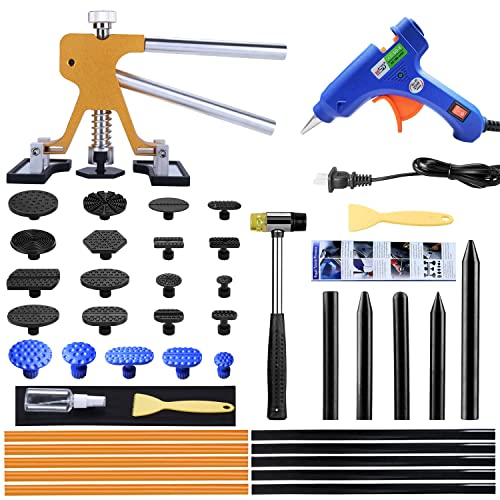
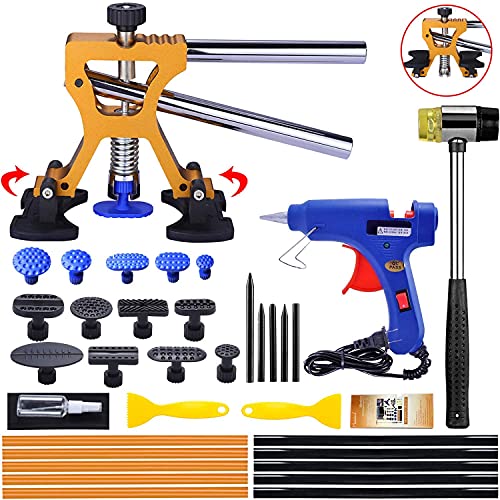
The Gliston kit stands out in the mid-range PDR category because the golden dent lifter is fully adjustable in both width and height, allowing you to tackle small door dings and larger hail damage depressions with the same tool by simply repositioning the feet and resetting the bridge height. The 21-size tab assortment covers a genuinely wide range of dent profiles, and each tab is made from a special hardened material with a textured gripping surface that resists glue separation during the pulling cycle — a common failure point in cheaper tab sets that use smooth-faced plastic.
Gliston also includes a professional adhesive glue formulated specifically for PDR applications, which maintains bond strength throughout the slow, controlled pulling process without suddenly releasing mid-pull and snapping your hand back. The included glue gun accelerates the melt cycle significantly compared to a standard craft gun, so you spend less time waiting and more time working. The rubber feet on the bridge base protect your paint from scratching while the puller is seated on the panel, which is an important detail that budget kits frequently overlook. For someone who wants a single kit that handles everything from small dings to large hail clusters across a full car, the Gliston delivers consistent, repeatable results at a competitive price.
Pros:
Cons:
The AUTOPDR kit is designed for buyers who want a complete, professional-grade setup without the steep learning curve that comes with multi-rod systems, and it delivers that experience through a focused toolkit built around a metal dent lifter and a carefully selected set of puller tabs that cover the most common dent shapes and sizes you encounter in real-world parking lot and hail scenarios. The emphasis on paint safety is not just marketing copy — the tools genuinely avoid any sanding, filling, or spot-painting workflow, which means your factory finish stays intact, your warranty implications remain minimal, and your car's resale value is protected in a way that a poorly executed body filler repair never could be.
The metal dent lifter construction gives you more rigidity and precise force control than plastic-body alternatives, which translates directly into cleaner pulls with less overshoot on shallow dents. The tab selection covers both small circular dings and larger oval depressions, and the adhesive provided bonds quickly without requiring extended cure times before you can begin the pull sequence. This kit is the right choice if you have just started encountering regular minor damage from door dings and hail and want a reliable system that will not overwhelm you with rods and accessories you do not yet know how to use correctly.
Pros:
Cons:
The Manelord kit earns its place near the top of this list by solving the problem that stymies most budget golden lifters — depth adjustment that actually works on pronounced depressions. The golden dent lifter uses a leverage-based mechanical design that is ergonomically sound, distributing your pulling effort more efficiently than simple screw-turn designs so you get more consistent results with less physical strain over a full hail repair session. The rotary adjustment button on the lifter lets you fine-tune the foot angle to match the panel curvature around the dent, which is critical for maintaining even contact pressure without rocking the bridge and smearing your paint.
Material quality is a genuine differentiator here — the primary lifter body uses tempered high-carbon stainless steel for the structural frame, while all body-contact surfaces are wrapped in precision-fitted rubber to eliminate any metal-on-paint contact during operation. This is not a thin rubber strip glued over a sharp edge; it is a properly engineered protective layer that stays in place under repeated use cycles. The kit also works effectively on refrigerators, washing machines, and other metal appliance surfaces, making it one of the more versatile investments in this price range. Pair it with a quality paint care routine — reviewing your options in our polish versus wax comparison is a good starting point — to keep your panels looking sharp after every repair.
Pros:
Cons:
The YOOHE kit takes a fundamentally different approach from bridge-lifter systems by centering the workflow around a slide hammer T-bar puller, which generates pulling force through controlled forward momentum rather than slow leverage rotation, and that difference makes it noticeably more effective on dents where the metal has a tight return memory and does not respond well to gradual pressure. The 16-piece pulling tab set covers a solid range of dent sizes, and each tab is designed to accept glue cleanly and release from the surface with a quick alcohol-spray wipe that leaves no residue on your paint.
One useful design detail is that the T-bar tool disassembles into two separate bar formats, giving you flexibility to approach the dent from different angles depending on the panel location and the depth of the depression. The lever-type mechanics underlying the slide hammer design apply force more precisely to the dent center compared to off-axis pulling, which reduces the risk of creating a peak or ring around the original dent that requires secondary correction. The YOOHE kit also performs on motorcycle body panels, refrigerators, and washing machines — not just automotive surfaces — which expands its value for anyone who deals with metal appliance damage regularly. Keeping your overall vehicle maintenance toolset organized with purpose-built tools, such as a quality floor jack alongside your PDR kit, ensures you are always equipped for the full range of garage repair tasks.
Pros:
Cons:
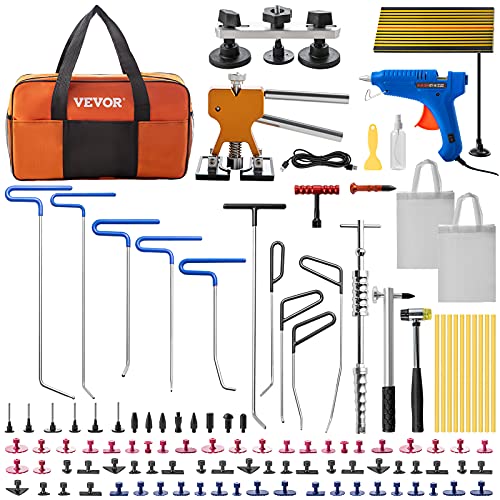
The VEVOR 89-piece kit is the most complete mid-range system on this list, and the piece count is not inflated with redundant accessories — every item in the package has a specific repair function, from the ten assorted rods covering different reach and angle requirements to the LED reflecting board that lets you see the dent surface clearly during the pulling process by reflecting the light and shadow contrast that reveals remaining distortion after each pull. That LED board is one of the most underrated tools in any PDR kit because without it, you are essentially working blind, guessing at progress by feel rather than visual confirmation.
The slide hammer, golden dent lifter, bridge puller, tap-down tool with nine interchangeable heads, rubber hammer, and 66 pulling tabs give you every method of dent correction in a single package, which means you can choose the right approach for each dent type rather than being limited to one technique. The hot glue gun heats efficiently and the included glue sticks have the right viscosity for reliable tab bonding across various ambient temperatures. The carry bag and two woven bags keep everything organized and portable, so you can bring the full kit to a job site or store it cleanly in your garage without tabs and rods scattering into your tool drawer. For 2026, the VEVOR 89-piece kit remains one of the strongest value propositions in the mid-range PDR market for buyers who want professional-level versatility without the professional price tag.
Pros:
Cons:
The Super PDR 169-piece kit is the most complete consumer-grade PDR system available in 2026, and it earns that distinction not through inflated component counts but through the genuine breadth of repair scenarios it covers without requiring you to buy supplemental tools afterward. The adjustable dent lifter handles dents ranging from 0.2 inches to 5.3 inches in diameter, which covers the full spectrum from the tiniest hailstone marks to the kind of broad shallow depression that a grocery cart or car door produces in a parking lot. The rubber foot pads on the bridge base grip the panel surface without slipping during the pull cycle, and they provide a protective layer that prevents the bridge frame from scratching the paint when you are adjusting the setup between pulls.
The bridge dent puller uses a brushed surface treatment on the center body for improved grip during operation, and the six interchangeable pull head shapes allow you to match the tab contact geometry to the specific dent profile you are working on — a level of customization that cheaper single-head bridge pullers simply cannot offer. The copper nut at the center adjustment point is a meaningful quality detail because copper resists corrosion better than steel in a tool that regularly contacts adhesive, moisture, and solvents, and its longevity over extended use cycles is measurably better as a result. The brand claims the kit can remove 99% of car dents in under 30 minutes, and while that specific claim deserves healthy skepticism on complex creases, the reality is that for the straightforward shallow-to-medium dent categories that make up the vast majority of everyday damage, this kit consistently delivers clean results faster than most competitors at this price tier.
If you are a detailer, a fleet manager, or simply someone who takes car maintenance seriously enough to invest in a long-term solution rather than a one-time fix, the Super PDR 169-piece kit is the system you should reach for in 2026. For context on how good DIY tools compare to professional shop solutions in terms of total cost of ownership, it is worth reading through our wheel locks buying guide for insight into how the right preventive tools compound in value over time.
Pros:
Cons:
The single most important decision you make when selecting a dent puller is which pulling method fits your repair scenario, because each method has specific strengths and clear limitations that determine whether you get a clean result or a secondary problem to fix. Your three primary options are suction cup pullers, glue-tab bridge systems, and slide hammer T-bar kits, and understanding when each one applies will save you from buying the wrong tool for the job.
The quality and size range of pulling tabs included in a kit determines how precisely you can match your pulling geometry to the specific dent shape, and low-quality tabs are the most common single point of failure in budget PDR kits because they either detach mid-pull or leave glue residue that requires aggressive removal. When evaluating a kit's tab assortment, focus on material hardness, surface texture, and the range of sizes and profiles included rather than the raw tab count alone.
Every point of contact between your dent pulling tool and your car's panel is a potential scratch or paint transfer risk, and the difference between well-engineered kits and budget alternatives is often most visible in how thoughtfully the contact surfaces are protected. You should inspect — or at minimum research — the rubber padding on bridge feet, the edge treatment on lifter frames, and the quality of the pivot joints before committing to a kit for repeated use.
A kit that only handles one size category of dent forces you to buy supplemental tools as soon as you encounter a damage type it cannot address, which eliminates the cost savings that make DIY PDR worthwhile in the first place. Before purchasing, confirm that the kit's stated dent size range matches the types of damage you realistically encounter in your driving environment — urban parking damage skews toward small dings, while hail-prone regions require full-range capability from pinpoint marks to broad shallow depressions.
Paintless dent pullers work effectively on shallow to medium-depth dents where the paint surface is still intact and the metal has not been sharply creased or stretched beyond its elastic limit. Suction cup tools handle shallow surface dents on flat panels, while glue-tab bridge systems and slide hammer kits extend the range to hail damage and medium-depth door dings. Sharp creases, high-crown damage where metal has stretched permanently, and any dent with broken or cracked paint requires conventional body work rather than PDR tools — no suction or glue-pull system can restore structurally deformed metal.
When used correctly on clean, dry panels with properly formulated PDR adhesive, glue-tab and suction cup dent pullers do not damage automotive paint in 2026. The PDR method was specifically designed to preserve factory finishes, and the rubber-padded contact surfaces on quality bridge pullers prevent any metal-on-paint abrasion during the repair cycle. The risk of paint damage increases when you use excessive pulling force, seat a tab on waxed or contaminated paint that causes partial adhesion, or attempt PDR on a panel that already has micro-cracks in the clearcoat from age or prior damage.
A straightforward door ding or small hail dent on a clean, accessible panel takes between 15 and 45 minutes from tab placement to final result for someone with basic PDR experience. The time range depends primarily on dent depth, panel accessibility, the adhesive cure time of the glue you are using, and how many correction passes are needed after the initial pull to eliminate residual high or low spots. Larger hail damage jobs covering an entire hood or roof panel can require several hours of incremental pulling, repositioning, and tap-down correction before the surface is fully restored to factory profile.
You can use glue-tab PDR systems on aluminum body panels, but aluminum requires more careful technique than steel because it work-hardens more quickly and has less elastic memory, meaning overcorrection creates a new problem rather than returning the metal to its original shape. Suction cup pullers are generally safe on aluminum when properly seated, since they distribute force over a broad contact area rather than concentrating it at a tab center point. Slide hammer tools require extra caution on aluminum because the momentum-based pulling force is harder to modulate precisely enough to avoid overshooting the target on a panel with lower ductility.
Suction cup pullers work by creating negative pressure over the dent surface to lift the metal outward through atmospheric pressure differential — they require no consumables, work instantly, and are effective on smooth flat-surface dents but lose seating ability on curved panels or deep depressions where the cup cannot fully seal. Glue-tab systems bond a plastic pulling tab to the dent center with hot-melt adhesive, then use a bridge lifter or slide hammer to pull the tab outward with mechanical force — they work on curved panels, deep dents, and hail damage where suction cups cannot maintain contact, but require consumable glue sticks and some preparation time between repairs.
A dent is beyond DIY PDR capability when the paint has cracked, chipped, or bubbled over the damaged area, when the metal has a sharp crease line through the center rather than a smooth rounded depression, or when pressing gently around the dent edge reveals that the panel metal has stretched and thinned in the impacted zone. Additionally, dents near panel edges, body line creases, or structural reinforcement points are much more difficult to address without professional equipment because the metal geometry at those locations resists the smooth outward return motion that PDR relies on for a clean finish.
 |
 |
 |
 |

About Liam O'Brien
Liam O'Brien has spent over a decade buying, field-testing, and evaluating automotive tools with a focus on what actually performs in a real DIY garage rather than what markets well on a spec sheet. His hands-on experience spans hand tools, diagnostic equipment, floor jacks, socket sets, and specialty automotive gear across a wide range of brands and price points. At CarCareTotal, he covers automotive tool and equipment reviews, garage setup guides, and buying advice for home mechanics.
Get some FREE car parts & gear.. Or check out the latest free automotive manuals and build guides here.
Disable your ad blocker to unlock all the hidden deals. Hit the button below 🚗
| | | |
