by Liam O'Brien
Picture this: you're mid-repair on a radiator hose, your knuckles already scraped from wrestling with a stubborn spring clamp in a cramped engine bay, and the only tool you have is a pair of regular slip-joint pliers that keeps slipping off the clamp ears. It's a familiar frustration for anyone who has done cooling system work without the right specialized tool. Hose clamp pliers exist precisely to solve that problem, giving you controlled grip and leverage in spaces where standard pliers simply cannot reach or hold.
Choosing the right pair in 2026, however, is not as straightforward as it might seem, because the market spans everything from single-purpose Corbin-clamp tools to comprehensive kits with seven or eight specialized heads. The clamp type you're working with — spring wire, Clic-R, band, or flat — largely determines which tool you need, and buying the wrong one means you're right back to wrestling. This guide reviews six of the best hose clamp pliers available today, breaks down the key buying criteria, and answers the questions that come up most often so you can shop with confidence.
Whether you're a professional technician handling cooling system repairs daily or a dedicated DIYer who wants the right tool for the job, you'll find an option here that matches your access requirements, budget, and the clamp styles you encounter most. You can also browse our full automotive tools section for related hand-tool reviews and buying guides that complement this one nicely.
Contents










If you spend any meaningful amount of time working on cooling systems or fuel lines, the Knipex 85 51 250AFSBA is the kind of tool that quickly becomes indispensable. At 10 inches long with a slim head and joint profile, it can access clamps tucked behind engine mounts, firewall brackets, and intake manifolds that would stop a bulkier pair of pliers cold. The rotating jaw inserts are the standout design feature here — they allow the jaws to swivel and grip hose clamps reliably across a wide range of angular positions, which means you're not forced to contort your wrist to get the right bite on a clamp that's oriented awkwardly in the engine bay.
The locking device on this model separates it from the standard KNIPEX hose clamp pliers by letting you hold the clamp in the open or compressed position without maintaining hand pressure, which is a genuine quality-of-life upgrade when you're working alone on a clamp that's under spring tension. The push-button adjustment system offers 19 discrete positions, so once you dial in the setting for a specific clamp size, the tool stays put for the rest of that job. Working capacity tops out at 2-3/4 inches, covering the vast majority of coolant and heater hose clamps you'll encounter on passenger cars and light trucks through the 2026 model year.
Build quality is quintessentially KNIPEX — the tool is made in Germany from high-grade chrome vanadium steel with a precise fit and finish that you can feel the moment you pick it up. The price point is firmly in the professional tier, so if you only change a radiator hose once every few years, the investment might feel steep. But if cooling system work is a regular part of your week, this is the pair that will outlast several cheaper alternatives without ever letting you down mid-job.
Pros:
Cons:
Clic-R style clamps — those distinctive plastic-eared, snap-open collar clamps found on OEM coolant connections in many European and Asian vehicles — require a very specific jaw geometry that standard hose clamp pliers simply do not provide. KNIPEX engineered this model with exactly that application in mind, and the result is a purpose-built tool that makes Clic-R clamp removal and reinstallation noticeably easier than any improvised alternative. The rotating jaw inserts give the same multi-angle grip capability found on the locking model above, letting you approach the clamp from whatever direction the surrounding components allow.
With 15 push-button adjustment positions, you have enough range to cover most Clic-R clamp sizes from compact engine bay hoses up to larger heater core connections, and the slim head profile keeps access manageable even in crowded compartments. The absence of a dedicated locking device is the most notable difference from the 250AFSBA — you need to maintain hand pressure to hold the clamp open during installation, which takes some practice when you're guiding a hose onto a fitting simultaneously. That said, the ergonomics of the handle and the quality of the adjustment detents make sustained squeezing less fatiguing than it sounds in practice.
If your vehicle fleet or workshop regularly sees European models with Clic-R clamps — and many technicians working on VAG-group, BMW, or Mercedes vehicles will encounter them frequently — this tool earns its shelf space quickly. Pairing it with the locking version above gives you coverage across virtually every spring-type clamp configuration you're likely to encounter. Like all KNIPEX products, construction quality is excellent, and the tool should remain serviceable for years of regular professional use without any meaningful degradation in function.
Pros:
Cons:
Flat-type hose clamps positioned deep behind engine components — the ones that seem specifically designed to require three extra knuckle sacrifices to reach — are exactly where the OTC 4525 earns its keep. The cable-actuated design decouples the working end from the handle entirely, meaning you can route the cable around obstacles and work the clamp from a comfortable angle while the tool head does the actual gripping. This approach opens up repair possibilities that rigid-jaw pliers simply cannot offer in any reasonable amount of time, especially on older vehicles where clamp positioning was never optimized for serviceability.
The locking mechanism on the OTC 4525 holds the flat-type clamp in the open position once you've compressed it, freeing both hands to remove or seat the hose properly before releasing the clamp. That feature alone can turn a two-person job into a solo operation on tight hose connections behind valve covers, firewalls, or chassis components. The cable design does introduce some limitations — feedback is less direct than with a rigid tool, and the cable assembly requires periodic inspection to ensure it hasn't kinked or frayed from repeated flexing under load, which is an ongoing maintenance consideration worth keeping in mind.
OTC is a well-established name in professional automotive tooling, and the 4525 reflects the brand's practical, no-frills engineering philosophy. It's not the most premium-feeling tool in hand, but it solves a specific problem reliably and holds up well under shop conditions. If your work frequently involves flat-type spring clamps in cramped locations — radiator hose connections on compact crossovers and pickup trucks are a common example — this cable-type pliers format is worth serious consideration. You might also want to check out our review of the best serpentine belts if you're already doing cooling system maintenance, since both jobs often come up at similar mileage intervals.
Pros:
Cons:
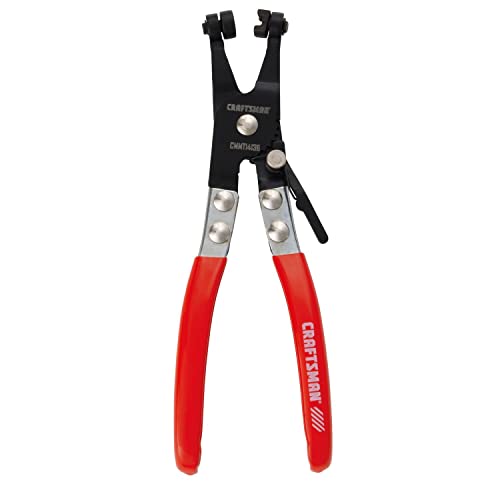
Corbin-style hose clamps — the flat, stamped-metal spring clamps that are ubiquitous on domestic vehicles from the 1980s through today — need a specific jaw profile to compress reliably without slipping off the clamp tabs, and the CRAFTSMAN CMMT14136 delivers exactly that at a price point that makes it an easy purchase for home garage mechanics. The dipped rubber handles provide a comfortable, non-slip grip during the sustained squeezing that spring clamp work often demands, and the overall ergonomics reflect a thoughtful design approach that you don't always find at this price level.
The locking mechanism is the feature that elevates the CMMT14136 above basic Corbin-clamp pliers, since it lets you compress the clamp, lock it open, and then use both hands to guide the hose onto the fitting before releasing. That hands-free capability is especially useful when you're working alone on a heater core connection or a thermostat housing where one hand needs to hold the hose and the other needs to push it onto a tapered nipple. Build quality is solid for the price — CRAFTSMAN's improved manufacturing standards since the Stanley Black & Decker acquisition show clearly in a tool like this, where fit and finish are noticeably better than budget alternatives from generic brands.
The CMMT14136 is not the tool for Clic-R clamps, cable-style applications, or accessing clamps in deeply buried positions — for those jobs, you'll want something from higher up this list. But for straightforward Corbin clamp work on radiator, heater, and coolant bypass hoses in a home garage setting, it performs well above its price point and will handle the occasional repair job without issue for years. If you're also doing broader engine bay maintenance, pairing this with one of our recommended rust removers can help you deal with any corroded clamp hardware you encounter along the way.
Pros:
Cons:
GEARWRENCH built a strong reputation in the automotive tool segment by delivering professional-grade quality at prices that sit comfortably between budget tools and premium brands, and the 3976D straight hose clamp pliers are a clear expression of that positioning. The straight-jaw geometry makes this the right tool for spring clamps that are relatively accessible — think radiator hose connections on the top of the engine, or heater hose connections near the firewall where you have a clear, direct approach angle without having to navigate around major obstacles in the way.
The locking feature is easy to engage and release with one hand, which is a practical design choice that reduces fumbling when your other hand is managing a hose or a component. Comfort grip handles with a textured, dipped rubber overlay reduce hand fatigue during repeated use, a feature that makes a tangible difference if you're servicing multiple vehicles in a shift rather than just doing a one-off repair. The overall build quality is consistent with GEARWRENCH's broader hand tool line — solid steel construction, tight tolerances, and a finish that holds up well against shop fluid exposure and repeated use over time.
Where the 3976D comes up short is in access capability relative to cable-type or slim-profile tools — if the clamp is buried behind an intake manifold or radiator support, you'll likely need a more specialized solution. But for the high-frequency, relatively accessible spring clamp work that makes up the bulk of cooling system maintenance on most North American vehicles, this is a highly capable and honest tool that delivers a great balance of ergonomics, durability, and value. It pairs naturally with a quality bottle jack as part of a well-rounded garage tool setup for DIY mechanics.
Pros:
Cons:
If you're tired of discovering mid-repair that the one hose clamp pliers you own is the wrong style for the clamp you're actually staring at, the Orion Motor Tech set eliminates that problem entirely by including seven specialized tools in a single kit. The lineup covers long-reach cabled pliers, Clic-R type collar pliers, swivel jaw band clip pliers, spring wire clip pliers, regular and angled flat band hose clamp pliers, hose removal pliers, a dual-headed screwdriver, and a hose hook — which means you're equipped for virtually every clamp configuration you'll encounter on cars, trucks, and motorcycles from standard spring types to the plastic-eared OEM collar styles.
The 5 spring-clamp pliers in the set all feature locking capability, which lets you compress and hold clamps open without maintaining squeeze pressure, accelerating the actual hose-swapping work considerably. The working range covers clamp sizes from 11/16 inch up to 2-1/2 inches, which handles the overwhelming majority of automotive cooling system, fuel system, and heater hose applications you're likely to encounter across most vehicle platforms on the road in 2026. Hose clamps in automotive applications are described in detail in Wikipedia's hose clamp article, which gives useful context on the different styles and their typical applications if you're mapping your fleet's clamp types before buying.
The honest trade-off with the Orion kit is that none of the individual tools reach the precision and premium feel of the KNIPEX single-purpose options — the materials and finishing are functional rather than exceptional, and tolerances are slightly looser than what a KNIPEX user would expect. That said, for a home mechanic or a technician who needs comprehensive coverage without spending on multiple premium tools, the value proposition is genuinely strong. You get purpose-built coverage across every clamp style for roughly the price of one mid-tier single-purpose tool, and the included carry case keeps everything organized and accessible at the workbench.
Pros:
Cons:
This carbon steel ratchet-locking hose clamp tool occupies the value end of the market without feeling like it cut corners where it counts most — the build uses solid carbon steel throughout, with firm non-slip rubber handles that give you confident grip even when your hands are coated in coolant. The ratchet locking mechanism is the central design feature, engaging progressively as you squeeze the handles to hold the clamp compressed at whatever position you've reached, which supports one-handed operation without requiring you to maintain constant squeeze pressure through the entire installation process.
The primary application focus is radiator hoses, coolant lines, and fuel hoses — exactly the connections that see the most replacement work on aging vehicles with high mileage, and a solid match for the DIY mechanic who does their own cooling system maintenance at home. The flexible design allows some angular access beyond what a fully rigid straight-jaw tool can manage, which helps when a clamp is positioned slightly off-axis from the most natural approach angle available in the engine compartment. That said, this tool's reach is still limited compared to cable-type designs or the slim-profile KNIPEX options reviewed above.
The manufacturer is clear that this is designed for occasional maintenance and DIY repairs rather than high-cycle professional shop use, which is an honest framing that should guide your buying decision accordingly. If you're a technician doing cooling system work multiple times per week, the KNIPEX or OTC options above will hold up better over thousands of cycles. But if you're a home mechanic doing annual coolant flushes, the occasional thermostat replacement, and a heater core job every few years, this tool provides reliable performance at a price that's easy to justify without second-guessing.
Pros:
Cons:

The single most important factor in selecting hose clamp pliers is understanding the style of clamp you're working with, because jaw geometry is not universal across clamp types. Spring wire clamps — the round, coiled wire clamps common on OEM coolant connections — need a jaw that captures both ears of the wire loop cleanly without the tool riding up and slipping off under spring pressure. Flat-type or Corbin-style clamps, which are stamped from a single piece of spring steel, need a different jaw shape that engages the flat tabs rather than wire ears. Clic-R plastic collar clamps, increasingly common on European vehicles, require their own dedicated jaw profile, as reviewed in the KNIPEX click clamp section above. If you work on a single vehicle with one consistent clamp style, a purpose-built single tool is the right choice; if you service a variety of vehicles with mixed clamp types, a multi-tool kit like the Orion Motor Tech set makes more practical sense.
A hose clamp pliers that works beautifully on an easily accessible upper radiator hose may be completely useless on a heater core inlet connection tucked behind the dashboard firewall or a coolant bypass line buried under an intake manifold. Think carefully about where the clamps you need to service are actually located before committing to a specific tool format. Straight-jaw tools like the GEARWRENCH 3976D give you the best feedback and control when access is clear, while cable-type tools like the OTC 4525 are the only practical option for deeply buried flat-type clamps. Slim-profile professional tools like the KNIPEX 250AFSBA thread into tight spaces that standard-body pliers cannot enter. If you're frequently working in confined engine bays — as is increasingly common on modern transversely-mounted four-cylinder and six-cylinder layouts — a longer, slimmer tool with rotating jaws will save you significant time and frustration compared to a more basic option.
A locking mechanism that holds the clamp compressed without requiring continuous hand pressure is not a luxury feature — it's a genuine functional upgrade that enables single-person hose installations that would otherwise require an assistant. When you're squeezing a spring clamp open, holding it, and simultaneously trying to align a hose onto a fitting with coolant-slicked hands, having the tool lock in place and free both your hands makes the operation measurably faster and less stressful. Ratchet-style locks, push-button detent locks, and manually-set friction locks all achieve this goal but with different feel and reliability characteristics — a ratchet system generally provides more positive engagement at intermediate positions, while a detent lock offers quick one-step operation but fewer holding positions. Check the specific locking style for any tool you're considering and match it to the way you actually work.
Hose clamp pliers range from under $20 for basic home-use tools to well over $100 for premium German-made professional pliers, and the quality difference is real and meaningful for high-frequency use. If you're replacing a radiator hose once every two years on your own vehicle, a mid-range option like the CRAFTSMAN or the carbon steel ratchet tool will serve you reliably without the premium investment. If you're a technician doing cooling system work on multiple vehicles daily, the KNIPEX tools' superior build tolerances, more precise jaw engagement, and better long-term durability genuinely justify the price premium over the course of a professional career. Consider also the materials you'll encounter — tools exposed to shop fluids, coolant, and road grime repeatedly will corrode or degrade faster than tools stored in a controlled home garage environment, making corrosion resistance a more significant factor in professional settings than in DIY use.
Regular slip-joint or groove-joint pliers do not have the jaw geometry, reach, or locking capability that hose clamp work requires, particularly for spring-type clamps that must be compressed and held open simultaneously during hose removal. Hose clamp pliers are purpose-designed with jaw profiles that capture specific clamp styles securely, locking mechanisms that hold the clamp open without continuous hand pressure, and in many cases slim or cable-type head designs that access clamps buried deep in the engine bay. Using regular pliers on spring clamps risks slipping under spring tension, damaging the clamp ears, and potentially scratching or marring adjacent coolant hoses or components.
No single pair handles every clamp style optimally — jaw geometry is specific to each clamp type. Spring wire clamps, Corbin flat clamps, Clic-R plastic collar clamps, and cable-type flat clamps each benefit from a purpose-built jaw profile. If you encounter only one or two clamp styles regularly, a single purpose-built tool is the right choice. If your vehicles use a variety of clamp styles, a multi-tool kit covering multiple jaw configurations — like the Orion Motor Tech set reviewed above — provides more comprehensive coverage than any single pair can offer.
The relevant dimension is the working capacity of the tool relative to the diameter of the hose clamps you need to compress. Most passenger car and light truck radiator, heater, and coolant hose connections use clamps in the 3/4-inch to 2-1/2-inch diameter range. Check the working capacity specification listed for any tool you're considering and confirm it covers the clamp sizes present on your specific vehicle. The KNIPEX 250AFSBA, for example, lists a 2-3/4-inch working capacity, which covers nearly all common automotive hose clamp sizes without adjustment issues.
Cooling systems are the most common application, but hose clamp pliers are also useful for fuel system hose connections, vacuum line clamps, power steering hose connections, and in some cases hydraulic brake system lines. Any application where a spring-type or Clic-R collar clamp secures a flexible hose connection can potentially benefit from the proper hose clamp pliers. In marine, HVAC, and industrial settings, the same clamp types appear on water lines, refrigerant hoses, and pneumatic connections, making hose clamp pliers a useful multi-industry tool beyond strictly automotive applications.
A locking mechanism is not strictly necessary if you always have an assistant available to hold the compressed clamp open while you manage the hose. For solo work, however, a locking mechanism transforms many hose installations from two-person jobs into single-person operations by holding the spring clamp compressed and freeing both your hands to guide the hose onto the fitting. Most professional-grade and mid-range hose clamp pliers include some form of locking capability in 2026, and for most buyers it is a feature worth prioritizing over non-locking alternatives at comparable price points.
A well-made pair of hose clamp pliers from a reputable brand — KNIPEX, OTC, or GEARWRENCH — should last a decade or more under regular professional use if kept clean, lightly oiled at the pivot, and stored away from prolonged moisture exposure. The components most prone to wear are the jaw inserts on rotating-jaw designs and the adjustment detent mechanism on push-button style tools. Budget and home-use tools have shorter service lives under professional shop conditions but can serve a home garage mechanic reliably for many years given the infrequent use they typically see in that setting.
 |
 |
 |
 |

About Liam O'Brien
Liam O'Brien has spent over a decade buying, field-testing, and evaluating automotive tools with a focus on what actually performs in a real DIY garage rather than what markets well on a spec sheet. His hands-on experience spans hand tools, diagnostic equipment, floor jacks, socket sets, and specialty automotive gear across a wide range of brands and price points. At CarCareTotal, he covers automotive tool and equipment reviews, garage setup guides, and buying advice for home mechanics.
Get some FREE car parts & gear.. Or check out the latest free automotive manuals and build guides here.
Disable your ad blocker to unlock all the hidden deals. Hit the button below 🚗
| | | |
