by Liam O'Brien
The ARB ARB710LB Recovery Snatch Strap is our top pick for 2026 — its genuine 20% kinetic stretch and 24,000 lb breaking strength make it the most reliable snatch strap you can carry in your rig. Whether you wheel rocky trails, push through muddy forest roads, or run deep sand, a quality recovery strap is the single most important piece of gear in your kit. Getting stuck without one means waiting for a tow truck — getting stuck with the right strap means you're back on the trail in minutes.

Not all recovery straps are created equal. Static tow straps, kinetic snatch straps, and kinetic recovery ropes each work differently — and using the wrong type can damage your vehicle's frame, snap a strap under load, or worse. In 2026, manufacturers have pushed breaking strengths past 55,000 lbs while adding features like soft shackles, wear-sleeve protection, and damage-indicator webbing. The market has more options than ever, which makes picking the right one harder. That's exactly why we put together this guide. We tested and evaluated seven of the best recovery straps available, covering everything from budget-friendly options to professional-grade kinetic ropes. If you're also building out your off-road toolkit, check out our best tire repair kits guide — a flat tire and a stuck vehicle are the two most common trail emergencies, and you want solutions for both.
Below you'll find our full reviews, a buying guide that breaks down what actually matters, and answers to the questions we get most often. Browse all our vehicle recovery and tool content on the tools category page. Let's get into it.
Contents







ARB has been building off-road recovery equipment for decades, and the ARB710LB is the reason serious four-wheelers trust the brand implicitly. This 30-foot snatch strap is made from 100% nylon and delivers genuine 20% elasticity — not the padded numbers you see from cheaper brands. That kinetic stretch is the whole point of a snatch strap: when the recovering vehicle accelerates and reaches the end of the strap, the stored elastic energy yanks the stuck vehicle free with a force multiplier that a stiff tow strap simply cannot replicate. At 24,000 lbs minimum breaking strength, it handles full-size trucks and SUVs without question.
The reinforced loop eyes are wrapped in protective sleeves that prevent fraying at the shackle connection points — the exact spot where cheap straps fail first. Weighing in at about 3.5 lbs, it's compact enough to toss in a trail bag without taking up serious space. ARB's reputation for quality control means the specs on the label are the real specs, not marketing minimums. This is a buy-once, use-for-years piece of equipment, and it shows in every stitched seam.
Pros:
Cons:

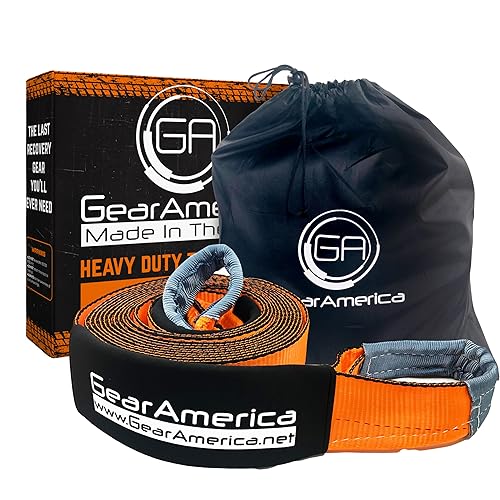
ARB also offers a lighter 17,600 lb orange variant (shown above) sized for mid-weight 4x4s and crossovers. If you're running a smaller platform, that model gives you the same ARB quality at a slightly reduced spec.
WARN built its name on winches, but the 88924 Recovery Strap proves the company understands kinetic recovery just as well. At 10.8 tons (21,600 lbs) capacity, this 3-inch by 30-foot strap is sized for heavy-duty trucks, commercial vehicles, and serious overlanding builds. The nylon webbing is woven to premium spec, and the end loops are reinforced with abrasion-resistant wear pads that protect against the grit and gravel that kills cheap strap eyes. The white colorway makes it easy to spot in a gear bag or truck bed.
One standout feature you don't find on most straps: an encased red warning marker embedded in the webbing. When the strap takes enough damage to compromise its structural integrity, the marker becomes visible — giving you a clear visual cue to retire the strap before it fails under load. That's a safety feature that matters when you're miles from cell service. Pair this strap with a quality set of cordless impact wrenches and you've got a serious field recovery toolkit.
Pros:
Cons:
Rhino USA punches well above its price class. The 3" x 20' polyester strap is lab-tested to 31,518 lbs break strength — a number that's independently verified, not just printed on a hang tag. Polyester gives you better weather resistance than nylon, meaning this strap won't absorb as much water and won't lose strength when wet. For drivers who mostly deal with flat-surface recoveries — pulling out of a muddy parking lot, dragging a stuck truck off a boat ramp, or unsticking a neighbor's SUV after a snowstorm — this is exactly what you need.
The strap is rated for flat-surface towing and recovery situations, which is what most everyday drivers actually face. Rhino USA is a family-owned American company with responsive customer support, and the strap comes in bright safety colors that are easy to see when you're working roadside. It's not designed for technical rock-crawling snatch recoveries — but for the 95% of stuck-vehicle scenarios you'll encounter in real life, it delivers reliable performance at a fraction of premium pricing.
Pros:
Cons:

Bubba Rope's Power Stretch is a true kinetic recovery rope — and it's the choice of serious off-road enthusiasts who need a rope-format option over flat webbing. The 7/8" diameter double-eye design delivers 28,600 lbs of breaking strength while the kinetic elasticity stores and releases energy in a controlled, progressive snap. That energy storage is what separates kinetic ropes from static straps: instead of a jarring jolt, you get a smooth, building pull that's easier on both vehicles and recovery hardware.
At 20 feet, it's on the shorter side, but kinetic ropes work best with less slack — a shorter working distance means faster energy transfer. The double-eye construction is rated for trucks, SUVs, Jeeps, ATVs, and UTVs. Bubba Rope has been the go-to brand for kinetic recovery rope in the North American off-road community for years, and the Power Stretch remains their flagship product. If you're committed to technical trail use and want the smoothest possible kinetic recovery, this is the rope that delivers it.
Pros:
Cons:
Most recovery straps in this category make you source your own shackles separately. HORUSDY bundles two 3/4" D-ring shackles with the strap, which pushes the value proposition significantly higher than the price tag suggests. The strap itself is 3 inches wide by 30 feet long with 35,000 lbs of break strength — respectable numbers for the price point. The nylon webbing handles high tension loads, and the reinforced D-ring shackles are built to withstand the same forces the strap sees at the connection points.
The 30-foot working length gives you solid standoff distance between vehicles during recovery, which keeps the recovery vehicle out of the danger zone if a strap lets go. HORUSDY positions this as a versatile tool for off-roaders, farmers, emergency personnel, and anyone who moves heavy objects outdoors. It handles standard stuck-vehicle recoveries cleanly, and the included shackles are well-machined — no loose gates or rough casting marks that indicate corner-cutting. For buyers who want a complete plug-and-use kit without extra purchases, this is the best single-box deal in the category.
Pros:
Cons:
Keeper's 4-inch wide recovery strap is the widest flat webbing strap in our lineup, and that extra inch of width translates directly to higher surface contact at the loop eyes and more even load distribution across the strap's full cross-section. Rated for 20,000 lbs break strength with a 10,000 lb maximum vehicle weight rating, this strap is sized specifically for cars, SUVs, and light trucks — not full-size HD pickups or commercial vehicles. The hi-test abrasion-resistant webbing is lighter and more compact than steel chain alternatives, and it won't rust or leave grease marks on your gear.
Keeper is a well-established brand in the towing and recovery accessories space, and the 30-foot length gives you plenty of working room. The simple loop-end design makes connection fast in the field — no shackles required if your recovery points have hooks or pins. This is a solid choice for everyday drivers who want a reliable strap in the trunk for emergencies, or for light-duty off-roaders who run stock vehicles on moderate terrain. It's not built for serious rock crawling, but for pavement and light trail use, it does exactly what you need.
Pros:
Cons:
If you're running a heavy expedition build, a diesel truck with a loaded bed, or you simply refuse to compromise on breaking strength, this kinetic recovery rope is the most capable option in this roundup. The 1.26-inch diameter rope is constructed from 36 strands of double-braided nylon 66 — 24 outer strands over 12 inner core strands — delivering a verified 55,000 lb maximum breaking strength. The inner 12-strand core uses torque-balanced nylon to achieve 30–35% stretch capacity, which is 15% more elasticity than a traditional snatch strap and 4x the energy storage of a standard tow strap. During recovery, that stored energy converts to kinetic traction that pulls smoothly without a shock-load spike.
The kit includes two UHMWPE soft shackles rated to 60,600 lbs each. Soft shackles are lighter than steel, float on water, and can be secured to mounting points where D-rings won't fit — a genuine advantage in complex recovery scenarios. The UHMWPE fiber self-tightens under tension for a grip that doesn't slip. According to Wikipedia's vehicle recovery article, kinetic energy transfer during snatch recovery is significantly more effective than static towing — and this rope is built to maximize that effect. At 30 feet, it gives you solid working distance for two-vehicle setups. The efficiency advantage over steel winch rope is 45%, making this the go-to choice when you're committed to doing serious off-road recovery correctly.
Pros:
Cons:


Shopping for a recovery strap in 2026 means sorting through an enormous range of specs, materials, and price points. Here's what actually matters when you're making this purchase.
This is the single biggest choice in recovery strap selection, and most buyers get it wrong by defaulting to whatever is cheapest.
For serious technical off-road use — deep mud, sand, snow, or rock — you want a kinetic option. For casual emergencies and pavement towing, a quality static strap is sufficient.
A common rule of thumb: your recovery strap's working load limit should be at least 2–3x your vehicle's gross weight. Breaking strength is not the working load — it's the catastrophic failure point. Most manufacturers recommend a safety factor of 3:1 or higher.

Both materials are used in quality recovery straps, but they behave differently:
For kinetic recovery: nylon is correct. For static towing in wet environments: polyester has the edge. If you pair your recovery kit with good LED light bars for night recovery, you'll also want gear that performs reliably in rain.

Most recovery scenarios work best with a 30-foot strap. It keeps the recovery vehicle out of the danger zone while providing enough slack for proper kinetic loading. 20-foot options work in tight spaces but limit working distance.

A tow strap is a static, non-stretching webbing strap designed to tow a moveable vehicle from Point A to Point B. A recovery strap (specifically a kinetic or snatch strap) is made from elastic material — typically nylon — that stretches under load and releases stored energy to help extract a stuck vehicle. Using a static tow strap for a kinetic snatch recovery puts enormous shock load on both vehicles and can cause frame damage, broken recovery points, or strap failure. Match the strap type to the job.
Use a minimum safety factor of 3:1 relative to your vehicle's gross vehicle weight (GVW). For a 5,000 lb SUV, you want at least 15,000 lb break strength — but 20,000–30,000 lb is a better real-world target. For full-size trucks at 7,000–8,500 lbs GVW, 30,000+ lb straps are appropriate. For loaded expedition rigs or commercial vehicles, the 55,000 lb kinetic ropes in this guide provide the margin you need.
A recovery strap should not be connected directly to a winch hook as a standard setup. Winches use winch lines or snatch blocks for recovery pulls. However, a kinetic strap can be used with a snatch block to redirect a pull angle, or connected between a vehicle and a tree saver strap as part of a multi-anchor system. Never attach a stretchy kinetic strap directly inline with a winch under power — the energy release when the winch engages against the pre-loaded strap creates unpredictable shock forces.
Static straps don't stretch — they transmit force directly and are suitable for towing moveable vehicles. Kinetic straps (snatch straps and kinetic ropes) stretch 20–35% under load, storing elastic energy like a giant rubber band. When the recovering vehicle reaches the end of the strap and the elastic releases, that stored energy provides a progressive pulling force that can free vehicles stuck in mud, sand, or snow without the jarring jolt of a static pull. Kinetic recovery is faster, gentler on vehicles, and more effective for deep-stuck scenarios.
Dry the strap completely before storing — especially nylon straps, which absorb water and can develop mildew or corrosion at the metal shackle points. Fold or loosely coil the strap and store it in a dry bag or case, away from direct sunlight (UV degradation weakens nylon and polyester over time). Inspect the strap before every use: look for fraying, cuts, discoloration, or visible damage at the loop eyes. If your strap has a built-in damage indicator (like WARN's red marker), check it each time. Retire any strap that shows structural damage.
Kinetic and static recovery straps both require a second vehicle to operate — they are two-vehicle tools. A winch is the appropriate solution for self-recovery with no second vehicle present. If you frequently wheel solo, you need a winch and a tree saver strap as your primary recovery system, with a snatch strap as a backup for assisted recovery when another rig is available. Never attempt to anchor a kinetic strap to a fixed object and drive against it — the shock loading when the elasticity releases can cause the anchor to fail violently.
 |
 |
 |
 |

About Liam O'Brien
Liam O'Brien has spent over a decade buying, field-testing, and evaluating automotive tools with a focus on what actually performs in a real DIY garage rather than what markets well on a spec sheet. His hands-on experience spans hand tools, diagnostic equipment, floor jacks, socket sets, and specialty automotive gear across a wide range of brands and price points. At CarCareTotal, he covers automotive tool and equipment reviews, garage setup guides, and buying advice for home mechanics.
Get some FREE car parts & gear.. Or check out the latest free automotive manuals and build guides here.
Disable your ad blocker to unlock all the hidden deals. Hit the button below 🚗
| | | |
