Lighting ›
by Joshua Thomas
Which LED pod delivers the most usable light output for off-road, overlanding, and work-truck applications in 2026 — and which brands are worth the premium? After evaluating specifications, build materials, optical engineering, and verified buyer feedback across dozens of options, the Baja Designs Squadron Pro emerges as the top pick for drivers who demand professional-grade performance in unforgiving conditions.
The automotive lighting market has expanded rapidly, with manufacturers offering everything from budget-oriented flood pods to race-proven dual-beam systems that retail for hundreds of dollars per pair. Understanding the technical distinctions between IP ratings, beam patterns, color temperatures, and drive circuitry separates a purchase that performs for years from one that fails on the first muddy trail. This guide examines seven leading LED pod options across multiple price points, providing detailed analysis of each product's strengths, limitations, and ideal use cases for 2026 buyers.
Auxiliary lighting technology has evolved considerably since the early days of halogen supplemental lights, with modern LED technology now offering lifespan ratings exceeding 50,000 hours, IP69K waterproofing, and optical precision that rivals factory driving lights. Buyers upgrading their truck, Jeep, UTV, or ATV will find the options below represent the most thoroughly vetted picks available at the time of publication. For drivers who also need to address rear visibility, our guide to the best tailgate light bars of 2026 covers complementary products that pair well with front-mounted pods.

Contents






The Baja Designs Squadron Pro stands as the definitive benchmark for serious off-road LED pod performance in 2026, combining proprietary optical engineering with military-grade weather resistance into a package that professional racing teams and weekend trail runners rely on equally. The pods ship with an IP69K waterproof rating backed by Baja Designs' MoistureBlock technology, which hermetically seals the housing against submersion and high-pressure wash environments — a genuine field advantage over competitors that merely claim splash resistance. The CopperDrive circuitry drives each LED to 100% of rated power output while simultaneously providing vibration dampening, addressing one of the most common failure points in off-road lighting applications where sustained jarring degrades solder connections over time.
The 5,000K color temperature selected by Baja Designs' engineering team reflects a deliberate choice rooted in vision science: at that specific Kelvin rating, human eyes experience maximum contrast recognition against terrain features, rocks, and animals without the blue-shift fatigue associated with higher color temperatures. The exclusive ClearView optical lenses, developed by in-house racing engineers, shape beam patterns with a precision that mass-produced alternatives cannot replicate at competitive price points. Buyers selecting the Driving/Combo configuration in Amber receive the added benefit of superior fog, dust, and precipitation penetration that white LEDs cannot match in those specific atmospheric conditions.
The wiring harness included in the pair package eliminates the need for separate relay and switch sourcing, allowing installation without additional electrical components. Build quality across the housing, mount, and lens bezel consistently receives top marks from verified purchasers who have subjected the lights to extended desert racing, rock crawling, and marine-adjacent environments. At the upper end of the pod pricing spectrum, the Squadron Pro targets buyers who view auxiliary lighting as safety equipment rather than aesthetic modification — a distinction that justifies the investment for high-mileage off-road drivers.
Pros:
Cons:
Rigid Industries has maintained its reputation as one of the most respected names in professional auxiliary lighting since establishing the modern LED light bar category, and the D-Series PRO Midnight Edition pair delivers the brand's signature build philosophy in a compact pod format that mounts cleanly on bumpers, A-pillars, roll cages, and roof racks. The spot beam configuration projects a tight, long-distance cone of light that proves particularly effective for high-speed trail driving and vehicle recovery operations where maximum throw distance matters more than wide-area coverage. A rated lifespan exceeding 50,000 hours places the D-Series PRO among the most durable options evaluated in this roundup, offering a service life that should outlast the vehicle on most applications.
The 9-36V DC input range provides genuine versatility across automotive, marine, powersports, and commercial vehicle platforms without requiring voltage regulators or step-down converters, making the D-Series PRO a practical choice for buyers managing multiple vehicles with different electrical architectures. The UV-resistant powder coat finish on the Midnight Edition housing resists the color fading and surface chalking that affects lesser anodized and painted housings after prolonged sun exposure in desert environments. Rigid Industries builds the D-Series PRO in the United States, a manufacturing origin that carries measurable quality-control implications and appeals to buyers with strong preferences for domestic production.
The spot-only beam pattern represents the primary consideration buyers must evaluate honestly before purchasing: in scenarios where a wide flood pattern would better serve camp lighting, work-site illumination, or slow-speed rock crawling, the D-Series PRO spot configuration delivers narrower coverage than alternatives designed with combo beam optics. The Midnight Edition's blacked-out aesthetic integrates cleanly with factory and aftermarket bumper systems, avoiding the chrome or polished-aluminum appearance that clashes with modern truck and Jeep build styles.
Pros:
Cons:
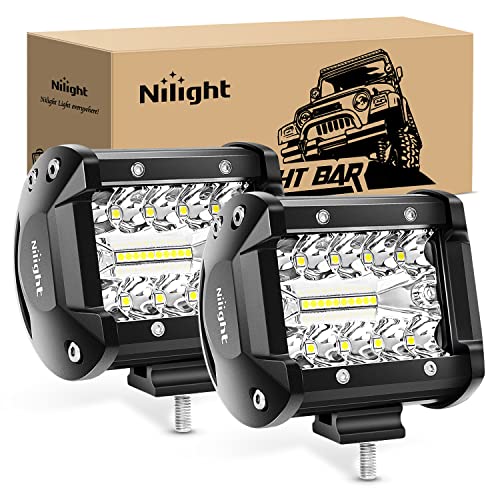
Nilight's 4-inch, 60W triple-row LED pod pair occupies the most competitive segment of the market, delivering a specification sheet that would have commanded premium pricing just five years ago at a price point accessible to first-time auxiliary lighting buyers and budget-constrained fleet operators alike. The triple-row LED chip arrangement increases total emitter surface area relative to single and dual-row configurations, contributing to the 6,000K pure-white output and broader perceived brightness that distinguishes this pod from lower-wattage alternatives in its price class. The combination of spot and flood beam patterns within a single housing provides the versatile wide-and-far illumination profile that most general-purpose off-road and work applications require without requiring separate pods for different beam functions.
The sliding mounting bracket represents a practical engineering decision: adjustable angle positioning allows drivers to dial in beam aim after installation without removing the pod from its mount, a time-saving feature that proves particularly valuable during trail adjustments where tool access is limited. The clear polycarbonate lens and high-quality chip selection deliver reliable white light output that performs well in the rain, mud, and low-visibility conditions common to the agricultural, construction, and recreational off-road contexts where these pods frequently appear. Verified purchasers across platforms consistently note that the Nilight pair competes favorably against products retailing at two to three times the price in terms of raw light output.
Build material quality reflects the accessible price point: the housing construction and weather sealing, while rated for outdoor use, does not match the IP69K certification and proprietary sealing technologies found on premium competitors. Buyers running the pods in submersion-capable scenarios or sustained high-pressure environments should consider upgrading to a more robustly sealed option. For trail-rated trucks, ATVs, and UTVs operating in typical weather conditions, the Nilight triple-row pods represent one of the strongest value propositions evaluated in this 2026 roundup.
Pros:
Cons:
Auxbeam's 4-inch 120W dual-color pods distinguish themselves from every other product in this roundup through a six-mode switching system that allows drivers to transition between white light, amber light, simultaneous white-and-amber, strobe white, strobe amber, and combined white-and-amber strobe from a single wiring harness controller — a feature set that rivals purpose-built emergency and work-vehicle lighting rigs at a fraction of the cost. The upgraded 2026 version incorporates both a memory function and a restore function, solving a persistent complaint from earlier-generation users who found the pods reverting to default white mode after each ignition cycle, forcing manual re-selection of preferred amber or combined modes at the start of every drive. The 120W power rating and 12,000-lumen output place the Auxbeam among the brightest compact pods evaluated, with the triple-row chip configuration distributing both white and amber emitters for the spot-flood combo beam pattern.
The included wiring harness with dedicated MODE button controller integrates the switching logic without requiring separate relays or additional electrical work beyond a standard pod installation, which makes the six-mode system accessible to buyers without advanced automotive electrical experience. Amber light selection proves its value in rain, snow, and dust scenarios where shorter amber wavelengths penetrate precipitation without reflecting back into the driver's eyes as severely as high-intensity white beams do under the same conditions. The 4-inch form factor mounts cleanly on bumper pods, ditch brackets, A-pillar mounts, and hood mounts across the truck, Jeep, and UTV platforms most commonly paired with auxiliary lighting.
The complexity of the mode system introduces a small operational learning curve, particularly for drivers accustomed to simple on-off auxiliary lighting configurations, and the controller adds a cable management consideration that single-mode pods do not require. The 120W draw also demands attention during installation to ensure the vehicle's electrical system and wiring harness can sustain the load without stressing charging circuits or triggering protection fuses. Buyers running similar pods alongside winch systems — covered in the companion guide to the best synthetic winch ropes of 2026 — should calculate total accessory electrical draw before finalizing installation.
Pros:
Cons:
The Baja Designs LP6 Pro represents the brand's larger-format pod offering, engineered for Jeep, truck, and UTV applications where maximum single-pod output is the primary requirement and mounting real estate exists to accommodate the larger LP6 housing. Built from materials the manufacturer describes as the highest quality available at the time of production, the LP6 Pro carries the same core optical and electrical engineering philosophy as the Squadron Pro — including Baja Designs' proprietary 5,000K LED selection and the ClearView optics system — scaled into a physically larger package that produces more total lumens per pod than the smaller Squadron configuration. The Driving/Combo beam pattern in the Clear configuration delivers the full optical performance of both beam types simultaneously, eliminating the need for separate spot and flood pods in most trail and work-light applications.
The LP6 Pro's physical dimensions (30.0 H × 25.2 W × 12.8 L cm housing envelope at 2.44 kg) reflect a pod designed for serious auxiliary lighting duties rather than discreet supplemental illumination, and mounting location planning is essential before purchase to ensure the selected bracket points and vehicle structure can accommodate both the physical size and the operational vibration loads. Jeep Wrangler and Gladiator owners running the LP6 Pro on factory or aftermarket A-pillar mounts, bumper pods, and ditch bracket systems report clean integration with the vehicle's existing lighting ecosystem and wiring infrastructure. The combination of Baja Designs' racing heritage, optical engineering, and material quality makes the LP6 Pro a defensible investment for buyers who will subject the pod to sustained punishment across multiple seasons.
The price premium over the Squadron Pro reflects the LP6's increased light output, larger optical array, and heavier housing construction, placing it at the top of the Baja Designs pod lineup in both capability and cost. Buyers focused purely on value per lumen may find the Squadron Pro or S2 Sport better suited to their requirements, but drivers who need the maximum possible output from a single compact pod housing will find the LP6 Pro's performance justifies the additional expenditure.
Pros:
Cons:
The Baja Designs S2 Sport pair delivers the foundational elements of the brand's engineering philosophy — MoistureBlock IP69K waterproofing, CopperDrive LED power delivery, 5,000K color temperature, and ClearView custom optics — at a price point positioned below the Squadron Pro, making it the logical entry point for buyers who want genuine Baja Designs quality without the full Squadron Pro investment. The Driving/Combo Amber configuration provides the same precipitation and dust penetration benefits of the amber wavelength as the Squadron Pro, with the optical system shaped to deliver a beam appropriate for the vehicle speeds and terrain types encountered in recreational trail riding, overlanding, and agricultural use. The wiring harness included with the pair handles the complete electrical installation without additional components, consistent with the Squadron Pro's plug-and-play approach.
The S2 Sport's smaller housing relative to the Squadron Pro produces less total output per pod, making it better suited to secondary auxiliary lighting roles — ditch bracket placement for side-trail illumination, bumper-corner pods for obstacle detection, or A-pillar mounts supplementing a primary light bar — rather than the lead driving light position where the Squadron Pro and LP6 Pro excel. That use-case positioning makes the S2 Sport an excellent pairing for buyers already running a quality bumper-mounted light bar who need additional directional pods without redundant forward throw. The S2 Sport's compact footprint also integrates more discreetly onto daily-driven trucks and Jeeps that transition between off-road use and urban environments where large pod housings attract unwanted attention.
Baja Designs backs the S2 Sport with the same warranty and customer support infrastructure as the premium Squadron Pro and LP6 Pro, which carries meaningful value for buyers investing in auxiliary lighting that will see real working conditions. The black housing finish resists corrosion and UV degradation better than the chrome alternatives still offered by some competitors, and the build quality throughout the housing and mounting hardware reflects Baja Designs' manufacturing standards rather than the cost-cutting evident in value-tier competitors.
Pros:
Cons:
AKD Part's 3-inch CREE-based flood pods fill a specific niche in the LED pod market that the larger 4-inch and LP6-format products cannot address: ultra-compact mounting applications on motorcycles, dirt bikes, electric bicycles like the Surron, small ATVs, and tight bumper or skid-plate positions on full-size vehicles where physical clearance makes anything larger impractical. The four 10W high-intensity CREE LED chips per pod combine for a 40W total draw across the pair and a claimed 4,000-lumen output, packaged in a housing small enough to mount on motorcycle handlebars and forks without the visual intrusion or aerodynamic impact of larger pod formats. The 6,000K color temperature places the beam in the cool white range that most buyers associate with modern LED lighting quality.
The flood beam pattern, shaped by an optimized refractive optical surface across the lens, distributes light in the wide-spread pattern best suited for area illumination, close-range obstacle detection, and scene lighting around a campsite or work area rather than the long-distance throw that spot beams provide. Adjustable stainless mounting brackets allow angle fine-tuning after installation, and the aluminum alloy heat sink design extends the rated lifespan beyond 50,000 hours by maintaining LED junction temperatures within safe operating ranges even during sustained high-output operation. The brackets' adjustability proves particularly valuable on motorcycle applications where optimal beam angle varies by rider height and riding position.
The 40W output and flood-only beam configuration position the AKD Part pods as supplemental lighting for slower-speed scenarios rather than high-speed driving lights, and buyers expecting spot-beam distance performance will need to select one of the combo-beam alternatives reviewed elsewhere in this guide. The compact 3-inch housing delivers proportionally less total output than the 4-inch and LP6-format pods, a physics reality that AKD Part's specification sheet accurately reflects. For the use cases the pods target — compact vehicle auxiliary lighting, motorcycle off-road illumination, backup and reverse scene lighting — the 3-inch CREE pods represent a well-engineered and honestly specified option for 2026 buyers. Drivers seeking similar electrical accessory guidance for their vehicle may also benefit from reviewing the selection of the best nerf bars of 2026 for complementary truck and SUV accessories.
Pros:
Cons:

Selecting the correct LED pod for a specific vehicle and use case requires evaluating several interdependent technical factors rather than simply choosing the highest wattage or lowest price point available. The following criteria represent the primary decision points that separate a well-matched purchase from an expensive mistake that fails in the field.
Beam pattern is the single most important specification for matching a pod's output to its intended use case, and most buyers benefit from understanding the practical distinction before evaluating any other specification. Spot beams concentrate output into a tight, long-distance column of light that excels for high-speed trail driving, search-and-rescue illumination, and any scenario where maximum throw distance is the priority, but produces narrow lateral coverage that misses obstacles at the sides of the beam. Flood beams spread light across a wide horizontal and vertical arc, making them ideal for close-range area lighting, campsite illumination, work-site use, and backing maneuvers — but at the cost of the long-range projection that spot beams deliver. Combo beams integrate both patterns into a single lens array, representing the most practical choice for general-purpose buyers who need adequate performance across both range categories without mounting two separate pod types. The Nilight, Auxbeam, and Baja Designs Squadron Pro all offer combo configurations that suit the majority of recreational off-road and work-truck use cases.
The Ingress Protection (IP) rating system defines a pod's resistance to solid particles and liquid ingress on a standardized two-digit scale, with the second digit describing water resistance from simple drip protection at IP41 through full submersion and high-pressure jet resistance at IP68 and IP69K respectively. Off-road applications that include water crossings, mudding, and high-pressure cleaning require a minimum IP67 rating, with IP69K providing the maximum available protection against sustained pressure-wash exposure at close range. Budget pods frequently carry IP65 or IP67 ratings adequate for rain and splash exposure but insufficient for submersion or pressure washing, while the Baja Designs MoistureBlock pods achieve IP69K — the top rating in the scale. Buyers who regularly submerge their vehicle during trail use should treat anything below IP67 as a provisional weather seal rather than genuine waterproofing.
Color temperature, measured in Kelvin, determines the perceived warmth or coolness of a pod's light output and carries direct implications for driver visibility in various atmospheric conditions. The 5,000K color temperature used exclusively by Baja Designs sits in the middle of the cool-white range, balancing terrain contrast recognition with reduced blue-light fatigue — characteristics that vision research consistently associates with optimal driving visibility in clear conditions. The 6,000K output of the Nilight and AKD Part pods produces a slightly cooler blue-white appearance that many drivers prefer aesthetically but that performs marginally less well in fog, precipitation, and dust. Amber-wavelength output, available in the Baja Designs Squadron Pro, S2 Sport, and as a mode option in the Auxbeam dual-color pods, scatters less in particulate-laden air than white light, making amber the preferred choice for buyers who frequently operate in dusty or foggy environments. The Auxbeam's six-mode switching system provides the most flexible approach by delivering white, amber, or combined output on demand without requiring separate pod sets for different conditions. Buyers researching broader vehicle lighting upgrades can find complementary guidance in the roundup of the best tailgate light bars of 2026 for rear-facing auxiliary lighting options.
Wattage ratings describe a pod's power consumption rather than its actual light output, making lumen specifications the more accurate metric for comparing brightness across different products and LED chip generations. A 40W pod using high-efficiency CREE chips may deliver more usable lumens than a 60W pod using lower-quality emitters, and buyers comparing specifications across brands should look for independent lumen measurements or verified buyer testimony rather than relying solely on manufacturer claims. Total electrical draw across all auxiliary lighting should be calculated against the vehicle's alternator capacity and wiring harness rating before installation, particularly when combining multiple pods with winches, air compressors, refrigerators, and communication equipment in a full overlanding electrical build. The Auxbeam 120W pair represents the highest total draw of the products evaluated, requiring verification of available circuit capacity before installation, while the 40W AKD Part pair places the lightest electrical load on the vehicle's charging system.
Spot pods concentrate their output into a narrow, long-distance beam ideal for high-speed trail driving and maximum throw distance, while flood pods spread light across a wide area suited for close-range scene illumination, campsite use, and backing maneuvers. Combo pods integrate both patterns into a single housing, making them the most practical choice for buyers who need adequate performance in both scenarios without mounting separate pod types for each function.
Off-road applications that include water crossings, mudding, and high-pressure washing require a minimum IP67 rating, which provides protection against immersion in water up to one meter deep for 30 minutes. IP69K provides the maximum available protection — including high-pressure jet resistance at close range — and is the specification to seek for serious off-road and powersports applications. Budget pods rated at IP65 or below provide adequate splash protection but should not be expected to survive submersion or pressure-wash cleaning without potential water ingress.
The optimal choice depends on the driving environment rather than a universal preference. White light at 5,000–6,000K delivers maximum terrain contrast recognition in clear conditions and dry environments, making it the better choice for the majority of recreational trail driving. Amber wavelength output scatters less in fog, dust, rain, and snow because the longer amber wavelength penetrates particulate matter more effectively than shorter-wavelength white light, making amber the preferred selection for consistently dusty environments such as desert racing and agricultural work sites.
Regulations governing auxiliary LED lighting on public roads vary by jurisdiction, and buyers should verify local laws before mounting forward-facing pods for on-road use. In most U.S. states, auxiliary driving lights with white or selective amber output are permitted on public roads subject to mounting height and switch requirements, but forward-facing pods with strobe modes are generally prohibited from road use regardless of color. Many manufacturers recommend covering or disabling auxiliary pods when transitioning from off-road to on-road driving to comply with varying state regulations regarding supplemental lighting intensity and beam aim.
Wattage requirements scale with the number of pods installed and the specific products selected, ranging from 40W total for a compact pair like the AKD Part 3-inch pods to 120W total for a high-output pair like the Auxbeam dual-color pods. Full auxiliary lighting builds that include bumper pods, ditch bracket pods, and a primary light bar can draw 200–400W or more from the vehicle's electrical system, requiring assessment of alternator output capacity and dedicated relay-switched wiring to prevent voltage drop, charging system strain, and circuit protection failures during extended operation.
Most pods in the premium and mid-range categories include a wiring harness with relay, switch, and mounting hardware, providing the complete installation kit needed for a straightforward single-circuit auxiliary lighting setup. Budget pods occasionally include only the pod and mounting bracket, requiring buyers to source a relay harness separately. The Baja Designs Squadron Pro, S2 Sport, and Auxbeam pods all include complete wiring harnesses, while the Rigid Industries D-Series PRO's harness inclusion should be verified at purchase since configurations vary by retailer listing. Multi-pod installations and builds that integrate with existing switchgear typically require custom wiring work beyond what a standard single-pair harness provides.
Buyers ready to commit to an LED pod upgrade in 2026 will find the Baja Designs Squadron Pro the most defensible all-around choice for serious off-road use, the Auxbeam dual-color pods the strongest option for buyers who need versatile multi-mode output across variable conditions, and the Nilight triple-row pods the most compelling value for budget-conscious first-time auxiliary lighting installations — and whichever direction the application points, matching the pod's beam pattern, IP rating, and color temperature to the specific vehicle and environment will always deliver better long-term results than chasing the highest wattage number on the spec sheet.
 |
 |
 |
 |

About Joshua Thomas
Joshua Thomas holds a Bachelor of Science in Mechanical Engineering from San Diego State University and has spent years applying that technical foundation to hands-on automotive work — from routine maintenance to full mechanical repairs. He founded CarCareTotal in 2017 to give car owners the kind of clear, practical guidance that helps them understand what is happening under the hood and make smarter decisions about upkeep and repairs. At CarCareTotal, he oversees editorial direction and covers automotive fundamentals, maintenance guides, and troubleshooting resources for everyday drivers.
Get some FREE car parts & gear.. Or check out the latest free automotive manuals and build guides here.
Disable your ad blocker to unlock all the hidden deals. Hit the button below 🚗
| | | |
