by Liam O'Brien
You're standing in the bay, staring at a 120-pound dual rear wheel assembly that needs to come off before the end of the shift, and the back that's been giving you trouble all month is already sending warning signals. That's the exact moment a quality wheel dolly stops being a luxury and starts being a necessity. Whether you're running a tire shop, managing a fleet, or tackling your own heavy-duty maintenance at home, the right wheel dolly turns a two-person, back-breaking job into something one person handles with confidence and precision.
Car wheel dollies have evolved considerably in 2026, with manufacturers pushing heavier load ratings, smarter roller configurations, and more ergonomic designs that actually respect how a human body moves under a vehicle. From compact units built for passenger cars to industrial-grade platforms rated for semi-truck dual assemblies topping 1,500 pounds, the market covers a wide range of applications. The challenge is matching the right tool to your actual workflow rather than buying based on a headline capacity number you'll never actually use.
This guide walks you through the seven best car wheel dollies of 2026, covering everything from lightweight single-tire handlers to full four-dolly vehicle positioning systems. You'll find honest breakdowns of each option's strengths, clear buying criteria, and answers to the questions most guides skip. If you're also building out your shop toolkit, our roundup of the best mechanic tool sets of 2026 pairs well with this guide. Browse the complete lineup of automotive tools for more options across every category.

Contents




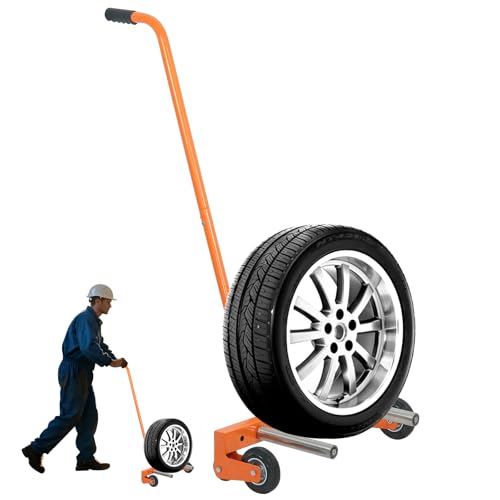





The WINNTEC Rolling Wheel Dolly earns the top spot on this list because it solves the most common frustration with cheaper dollies: roller length. WINNTEC's extra-long rollers handle super single tires without the tire dropping off the sides mid-maneuver, which is a real safety issue that less expensive options ignore entirely. The 485-pound capacity covers the majority of commercial truck tire and wheel assemblies you'll encounter in a fleet shop or independent garage, and the industrial-grade bearings are built to survive daily punishment rather than the occasional weekend job.
The three adjustable roller positions give you genuine flexibility across tire sizes, from standard passenger car tires up to the oversized profiles on skid steers and trailers. Setup takes minutes, and the design keeps the tire securely cradled throughout the installation and removal process. If you're using a torque wrench or impact gun alongside this dolly, you'll appreciate that it holds the assembly stable enough to keep the wheel aligned with the hub studs while you fasten the lug nuts.
For shops dealing with ATV fleets, trailer tires, or commercial truck work on a regular basis, this dolly eliminates the need for a second person to hold and guide heavy wheel assemblies. According to OSHA's ergonomics guidelines, repeated heavy lifting is one of the top contributors to musculoskeletal injuries in automotive workplaces — this dolly directly addresses that risk.
Pros:
Cons:
When you're working with dual rear wheel setups on heavy trucks, a 485-pound-capacity single dolly isn't going to cut it. The Strongway 3/4-Ton Dual Wheel Dolly steps up with a 1,500-pound rated capacity, making it one of the most capable units in this price range and one of the few options purpose-built for dual-wheel configurations. The 3-inch steel roller bearing casters roll smoothly on shop floors, concrete, and asphalt without requiring you to manhandle the assembly into position.
The 26-inch lift arm with its 21-to-25-inch adjustable spread is the defining feature here, because it lets you dial in the exact width needed to properly cradle a dual-wheel assembly without improvising with blocks or risking a lateral tip. The spread adjustment mechanism is straightforward and doesn't require tools to configure, which keeps your workflow moving rather than stopping to fuss with hardware. For tire shops that service Class 6, 7, and 8 trucks regularly, this dolly pays for itself in labor savings within the first week of use.
The build quality reflects a commercial-grade design philosophy — this is not a unit where you'll find plastic components in load-bearing positions. The steel frame handles the rated capacity without flex, and the caster quality is noticeably better than what you get on bargain-priced alternatives. The Strongway is purpose-built for a specific job, and it executes that job with precision.
Pros:
Cons:
The ALLOYNIX 2.0 Pro is a meaningful upgrade over its predecessor, and the spec sheet backs that claim up with hard numbers. The increased pipe diameter from the 1.0 version — now at 1.3 inches — and the reinforced rod-to-pallet connection bring the capacity up to 500 pounds while eliminating the flex that plagued the original under heavy loads. The result is a dolly that handles heavy-duty automotive and full-size truck tires without any of the wobble or give that makes cheaper units feel unreliable when you're trying to line up studs.
The 360-degree movement capability is genuinely useful and not just a marketing bullet point — the smooth rollers allow you to rotate and precisely position a tire assembly during hub alignment without fighting the dolly or dragging it across the floor. Tire size compatibility ranges from 9 to 33 inches, which covers everything from compact car rubber up to light-duty truck tires, and the three roller positions let you dial that fit in rather than forcing the tire into a one-size-fits-all cradle.
If you're maintaining a mixed fleet of vehicles or working across multiple vehicle categories in the same shop, the ALLOYNIX 2.0 Pro's versatility is its greatest asset. Pair it with a good set of ratchet straps for securing loads during transport and you've got a capable mobile tire management setup. The upgraded wheels handle uneven surfaces better than previous-generation designs, which matters if your shop floor isn't perfectly smooth concrete.
Pros:
Cons:
AME International has been supplying professional tire shops and fleet maintenance operations for decades, and the 71300 model reflects that institutional knowledge in its design. The 9.5-inch rollers are specifically sized to accommodate low-profile tires, which most heavy-duty truck dollies struggle with because their roller geometry assumes a taller tire profile. If your shop services wide-base single tires or low-profile commercial rubber, this distinction matters enormously for safe, controlled handling.
The ergonomic design focus is visible in every aspect of the 71300's construction — the handle height, the roller angle, and the way the dolly guides the wheel assembly toward the hub rather than requiring you to fight for alignment. AME designed this unit to reduce back injuries, and the geometry supports that goal by keeping the load close to center and minimizing awkward reaching or twisting during installation. For a shop where technicians are handling heavy wheel assemblies multiple times per shift, the cumulative reduction in physical strain translates directly to reduced injury risk and faster work.
The professional-grade build quality shows in the fit and finish — there's no sloppiness in the welds, no rough edges on the frame, and no rattles under load. This is a tool built to live in a professional shop environment where it gets used hard every day, not a garage-grade unit dressed up in commercial packaging. The price reflects that quality, but for a production tire shop, the AME 71300 is a legitimate investment rather than an expense.
Pros:
Cons:
The Pro Trucking Products Wheel Dolly fills a very specific niche — 10-hole Budd type wheels on heavy trucks — and it fills that niche better than any other option on this list. Budd wheels require precise stud hole alignment during installation, and this dolly's tiltable rollers are the key feature that makes that alignment process practical rather than agonizing. You can angle the tire assembly to walk the holes onto the studs without lifting and repositioning, which cuts installation time significantly while also protecting the threads from cross-threading damage caused by misalignment.
This is a direct replacement for the Esco 70130, a well-regarded industry standard, and it matches or improves on the original's specifications. Fleet maintenance operations that already own Esco units will find the Pro Trucking version compatible with their existing workflow and tool storage. The productivity gains are real and measurable — faster installs, less physical effort per wheel change, and reduced risk of the type of musculoskeletal strain that takes technicians off the floor.
For shops running large commercial truck fleets where Budd wheels are the norm rather than the exception, this is the most specialized and therefore most valuable tool on this list. It doesn't try to be all things to all applications — it does one job precisely right, and that focus shows in every aspect of the design from the tilt mechanism to the handle ergonomics.
Pros:
Cons:
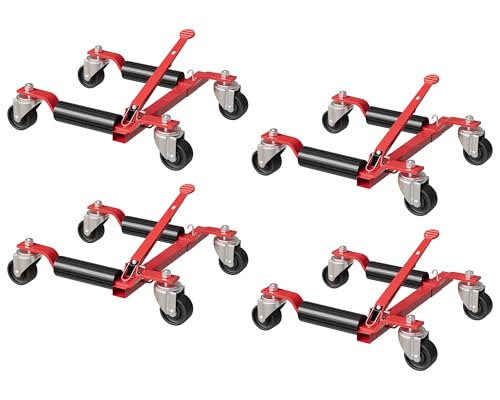
The Car Wheel Dolly Jack Set of 4 operates on a completely different principle than the tire-handling dollies above — rather than moving individual wheel assemblies, this system moves the entire vehicle. Slide one under each tire, operate the foot pedal on each unit to lift the wheel, and suddenly a 6,000-pound vehicle becomes repositionable without a running engine or a second driver. For tight garage storage situations, body shop positioning, or getting a non-running vehicle into the perfect work angle, there's no better solution in this price range.
The reinforced steel construction with rust-resistant powder coating supports 1,500 pounds per dolly, and the 4-inch ball-bearing casters provide the 360-degree movement that makes precision positioning possible in constrained spaces. The foot-operated ratchet mechanism is the critical innovation here — it lifts the wheel and locks it in position while keeping both of your hands free, which is essential for the kind of controlled, incremental positioning work this system is designed for. The safety lock prevents sudden drops during positioning, eliminating the most dangerous failure mode of cheaper vehicle dolly systems.
Pre-assembled and requiring no separate jack, this set works immediately out of the box. The 40-percent reduction in required force compared to crank-type models is a genuine ergonomic improvement, and the anti-slip ergonomic handle design reduces hand fatigue during extended positioning sessions. If you're building out your garage for serious DIY work, pair this system with a quality garage storage system to keep all four units accessible and organized.
Pros:
Cons:
The WINMAX 2 Pack Wheel Dolly Set approaches vehicle moving from a practical, budget-conscious angle that makes sense for home garage users who need occasional vehicle repositioning without the investment of a four-unit system. With 3,000 pounds of combined capacity split between two dollies, you can handle most standard passenger vehicles and light trucks by positioning a unit under each end of the vehicle after lifting with a floor jack. The 3-inch ball-bearing wheels assemble quickly and provide smooth movement across concrete garage floors once locked into position.
The locking wheel mechanism is a critical safety feature that prevents the vehicle from rolling unexpectedly during positioning or storage, which is particularly important if you're using these for long-term storage situations where the vehicle will sit on the dollies for weeks or months at a time. The stake dolly design, which uses vertical posts rather than a flat platform, provides a stable base that keeps the tire seated without slipping sideways under the vehicle's weight.
This is a two-dolly set rather than four, which means you'll work front-to-back rather than moving all four wheels simultaneously. For a single-car garage where you need to rotate the vehicle's position periodically, or for tow storage arrangements, the WINMAX set delivers solid functionality at a price point that justifies the limited application scope. Assembly is simple and quick, and the included hardware is complete.
Pros:
Cons:

Load capacity is the most critical spec to evaluate, and the most commonly misread. A 485-pound single-tire dolly is appropriate for individual tire and wheel assemblies on commercial vehicles, while a 1,500-pound dual-wheel dolly is a completely different tool for a different application. The four-dolly vehicle positioning systems use per-unit ratings — 1,500 pounds per dolly times four equals 6,000 pounds of combined capacity — which is the correct number to compare against your vehicle's curb weight.
Roller length, diameter, and adjustability determine whether a dolly actually supports the tire profile you're working with. Short rollers on wide tires result in the tire hanging off the sides, which creates instability and risks a tip during maneuvering. Three-position adjustable roller systems give you the flexibility to properly cradle tires from 9 inches up to 33 inches in diameter, while fixed-roller designs are optimized for a specific tire profile and struggle outside that range.
The difference between a dolly that lasts a decade of professional use and one that fails in six months usually comes down to bearing quality and weld integrity. Industrial-grade bearings in the rollers and casters handle the repeated loading cycles of daily commercial use without developing slop or seizing. Consumer-grade units use lower-cost bearings that work fine for occasional home garage use but degrade quickly under professional workloads.
Before you compare specific models, clarify which of the two fundamentally different applications you're buying for. Tire-handling dollies move individual wheel assemblies during tire changes and service work — they're tools for the lift bay. Vehicle positioning dollies move an entire vehicle with all four wheels on the ground — they're tools for the garage floor, storage facility, or body shop. Buying the wrong category for your application means you'll own a well-made tool that doesn't solve your actual problem.
A car wheel dolly is a rolling platform or cradle designed to lift, move, and position tire and wheel assemblies during vehicle service work, or to move an entire vehicle by placing dollies under each wheel. Tire-handling dollies support individual wheel assemblies during installation and removal, reducing the physical effort and injury risk associated with lifting heavy truck and commercial vehicle wheels. Vehicle positioning dollies move the entire car without a running engine, which is useful for garage storage arrangement, body shop work, and moving non-running vehicles into service position.
Wheel dolly capacity ranges significantly based on design and application. Single-tire dollies for commercial vehicles typically handle 485 to 500 pounds, which covers most individual truck wheel and tire assemblies. Dual-wheel dollies step up to 1,500 pounds for the combined dual-rear-wheel assembly. Vehicle positioning dolly sets list capacity per unit — a four-unit set with 1,500 pounds per dolly provides 6,000 pounds of combined capacity, which covers most passenger vehicles and light trucks. Always apply a 15–20 percent safety margin and never operate at the rated maximum in production use.
One of the primary advantages of a quality wheel dolly is eliminating the second-person requirement for heavy wheel handling. A well-designed single-tire dolly allows one technician to lift, maneuver, and align a heavy wheel assembly with the hub studs without assistance. The tiltable roller designs on professional truck dollies specifically address the stud hole alignment step that previously required a second set of hands to guide the wheel. Vehicle positioning dollies go further by enabling a single person to move an entire vehicle with full control, using the foot-operated ratchet lift mechanism to raise each wheel independently.
A wheel dolly in the tire-service sense is a cradle-type tool that holds and moves an individual tire and wheel assembly during removal and installation — it stays in the shop bay near the vehicle lift. A vehicle positioning dolly is a platform placed under each wheel of a complete vehicle, allowing the entire vehicle to be moved laterally or rotated on the garage floor without driving it. The Car Wheel Dolly Jack Set of 4 reviewed here is the positioning type. Tire-handling dollies and vehicle positioning dollies serve completely different purposes and are not interchangeable tools.
Wheel dollies are designed for flat, hard surfaces such as concrete shop floors and level driveways. Operating a tire-handling dolly on a sloped surface introduces lateral load forces that can cause the assembly to slip or tip sideways, creating a serious injury risk. Vehicle positioning dollies present an even greater hazard on slopes because the entire vehicle can move unexpectedly if a caster locks up or a locking mechanism fails. For any dolly operation on a surface that isn't level, use wheel chocks on the stationary wheels, engage all available locking casters, and keep all personnel clear of the vehicle's path of potential movement.
The choice between a two-pack and four-pack depends on the type of movement you need. A two-pack positions one dolly at the front axle and one at the rear axle, allowing you to slide the vehicle forward and backward or rotate it around a central axis — adequate for repositioning within a garage or storage bay. A four-pack places a dolly under each individual wheel, enabling full 360-degree vehicle movement in any direction, including sideways, which is essential for body shop work, tight storage configurations, and frame alignment tasks. If you simply need to rotate a parked car to gain access to one side, a two-pack is sufficient. If you need to slide a vehicle sideways into a narrow storage position, four dollies are the right tool.
The right wheel dolly is the one matched to your heaviest job — buy for the toughest application you face regularly, not the average one.
 |
 |
 |
 |

About Liam O'Brien
Liam O'Brien has spent over a decade buying, field-testing, and evaluating automotive tools with a focus on what actually performs in a real DIY garage rather than what markets well on a spec sheet. His hands-on experience spans hand tools, diagnostic equipment, floor jacks, socket sets, and specialty automotive gear across a wide range of brands and price points. At CarCareTotal, he covers automotive tool and equipment reviews, garage setup guides, and buying advice for home mechanics.
Get some FREE car parts & gear.. Or check out the latest free automotive manuals and build guides here.
Disable your ad blocker to unlock all the hidden deals. Hit the button below 🚗
| | | |
