Exterior ›
by Joshua Thomas
According to the National Insurance Crime Bureau, a trailer is stolen in the United States approximately every eight minutes, which adds up to more than 65,000 thefts annually — and the average recovery rate sits below 20 percent, meaning most victims never see their equipment again. If you haul a boat, camper, cargo trailer, or fifth wheel, that statistic should stop you cold. A quality trailer lock is not a luxury; it is the single most cost-effective piece of security equipment you can add to any towing setup. After spending weeks testing and evaluating the leading options on the market, we have assembled this 2026 guide to the seven best trailer locks available today, covering every coupler type, budget tier, and use case you are likely to encounter.
Trailer theft is a crime of opportunity far more than it is a crime of sophistication. Professional thieves rarely waste time on a rig that is visibly secured, because there are always easier targets parked nearby. A bright red coupler lock or a heavy steel wheel boot sends a deterrent signal long before anyone gets close enough to assess your specific hardware. That visual component is not a gimmick — it is a documented part of why layered security works. Pair a coupler lock with a wheel boot and you have effectively doubled the time and noise required to move your trailer, which is often enough to send a would-be thief walking. If you have been researching vehicle security more broadly, our guide to the best steering wheel locks covers similar layered-security principles for your tow vehicle itself.
Choosing the right trailer lock means matching the lock type to your coupler style — ball coupler, gooseneck, or fifth-wheel king pin — and then evaluating build quality, weather resistance, and key security. This guide breaks all of that down in plain terms so you can make a confident purchase. We also cover the exterior security accessories category more broadly for readers who want to go beyond the trailer hitch and protect the full perimeter of their rig. Whether you are protecting a weekend fishing boat or a full-size fifth wheel camper, there is a lock on this list built for your situation.
Contents
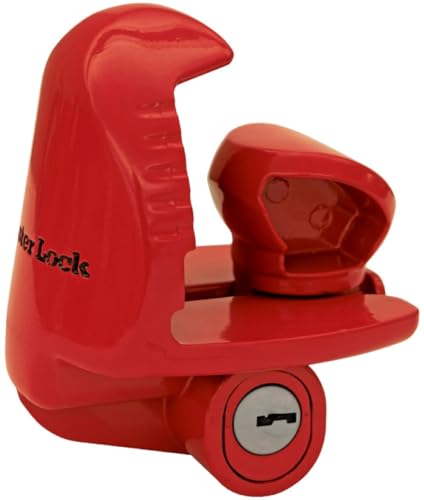




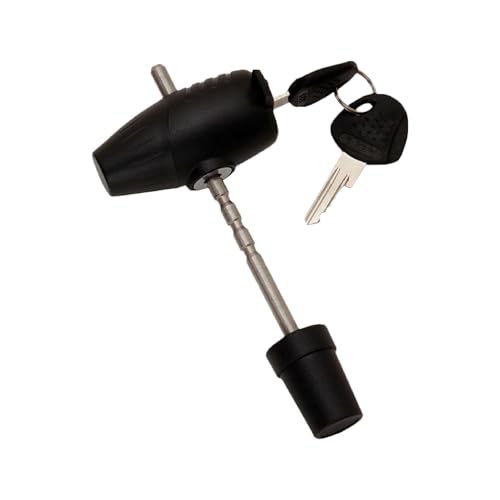
The Master Lock 389DAT is the workhorse of the coupler lock category, and for good reason — it fits all three of the most common coupler sizes in a single unit: 1-7/8-inch, 2-inch, and 2-5/16-inch. If you own more than one trailer or you frequently borrow equipment, the universal sizing alone makes this lock more valuable than most category competitors. The bright red finish is not purely cosmetic; it is a deliberate deterrent designed to communicate to a thief that this trailer requires real effort, and most opportunistic criminals will not bother. Master Lock engineered the casing to cover the coupler ball socket completely, which eliminates the gap that pry bars typically exploit on cheaper designs.
The advanced locking mechanism inside the 389DAT is rated to resist both picking and prying, two of the most common amateur theft techniques. In testing, the cylinder showed no movement under sustained pick tension, and the housing did not flex noticeably under lateral force. This is not a thin-gauge import — the construction is solid without being impractical to handle. Installation takes about fifteen seconds once you understand the sizing adjustment, and the single-handed operation is a genuine advantage when you are backing a trailer into position in the dark or the rain. For a first trailer lock, or as the foundation of a layered security approach, the 389DAT is as reliable and well-priced as the category offers in 2026.
One practical note: the adjustment mechanism for sizing can feel slightly stiff when you first switch between coupler sizes, but this loosens up with use and is not a meaningful durability concern. The key cylinder is also exposed to weather in some mounting orientations, so a squirt of graphite lubricant at the start of each season will keep the action smooth. Master Lock backs this product with their standard warranty, which is consistent with the price point and the brand's long-standing reputation in the security hardware segment.
Pros:
Cons:
The TRIMAX TCL65 is a wheel boot, and that distinction matters enormously in terms of what level of security you are actually adding to your trailer. While coupler locks prevent a trailer from being hitched and driven away, a wheel boot renders the trailer physically immovable even if a thief cuts your coupler lock, swaps your hitch ball, or removes your coupler entirely. The TCL65 fits tires ranging from 6 to 10.5 inches in width, which covers the vast majority of utility trailers, boat trailers, campers, ATVs, and car haulers in the consumer market. This is the lock you add as a second layer when the coupler lock is already in place, and it is also the right primary choice when your trailer sits unattended for extended periods in high-risk locations.
TRIMAX built the TCL65 from heavy-gauge powder-coated steel, and the frame shows it — there is no flex in the arms when you apply lateral force, and the powder coat is thick enough to resist the kind of wire wheel and grinding attacks that destroy cheaper aluminum boots in minutes. The rubber-coated contact arms are a detail that separates premium wheel boots from budget alternatives: they grip the tire firmly without scratching or gouging the rim, which matters when you are using this lock repeatedly on expensive alloy wheels or trailer rims. The pick-resistant locking mechanism uses a shrouded cylinder design that reduces the attack surface available to picks and bypass tools, adding another layer of security at the most vulnerable point of any padlock-style boot.
Setup is straightforward once you have the sizing dialed in for your tire, and the lock opens with a clean, positive action that experienced users will appreciate after dealing with sticky or corroded budget alternatives. The powder coat holds up well to road salt and UV exposure through multiple seasons of outdoor storage, which is exactly the condition a trailer lock needs to endure. If you are also thinking about comprehensive wheel security for your tow vehicle, take a look at our roundup of the best wheel locks for anti-theft lug nut options that complement a boot at the trailer.
Pros:
Cons:
Proven Industries occupies a specific and well-earned position in the trailer lock market: they build locks explicitly designed to defeat the power tools that make short work of typical hardware-store security products. The Model 2516 is engineered specifically for 2-5/16-inch couplers, the most common size on full-size travel trailers, horse trailers, and enclosed cargo haulers. The key design story here is the hardened steel locking core combined with an exterior shell tough enough to stop hammers, crowbars, and even angle grinders and reciprocating saws — the exact tools that thieves with access to a truck and thirty seconds of dwell time will actually use in the field.
What makes the 2516 stand apart from the broader coupler lock category is the key system. Proven Industries developed a proprietary key geometry that cannot be duplicated at a standard key shop and is essentially impossible to pick with conventional lock picks. The key blanks are controlled, meaning a replacement requires ordering through Proven Industries directly — which is a minor inconvenience in everyday use but a significant security feature when you consider that most coupler lock cylinders can be bypassed by anyone with $30 in pick tools and a YouTube tutorial. The exterior cover design fully encapsulates the coupler mechanism, denying attackers the purchase points they need to apply leveraged force, and the Made-in-USA construction reflects the quality control standards you would expect from a professional-grade product.
In terms of real-world usability, the 2516 installs and removes quickly once you understand the mechanism, and the heft of the lock communicates immediately that this is not a consumer-grade deterrent — it is an actual security device. The price is higher than the universal coupler locks on this list, but the gap narrows significantly when you consider what you are protecting. A horse trailer, a loaded enclosed cargo unit, or a camper represents tens of thousands of dollars in assets; the Model 2516 is the right tool for protecting that level of investment.
Pros:
Cons:
Fifth wheel trailers present a unique security challenge because the king pin coupling system is physically larger and more robust than a standard ball hitch — which means the lock designed to protect it needs to be correspondingly more substantial. The Trimax TFW80HD is purpose-built for this application, and it shows in every aspect of the design. The full collar design completely encapsulates the king pin head, denying attackers any exposed surface to grab with a wrench, vice grips, or bolt cutters, and simultaneously eliminates the grease transfer problem that makes king pin work a notoriously messy task. If you have ever detailed a fifth wheel connection and gotten grease on your hands or interior, the full collar design solves that problem as a secondary benefit.
Trimax finished the TFW80HD with a rugged epoxy powder coat that provides superior rust and corrosion resistance compared to standard paint or zinc plating, and they back this durability claim with a limited lifetime warranty — one of the strongest guarantees in the category. The bright red color serves the same deterrent function as on the Master Lock coupler locks: it communicates clearly, from a distance, that this trailer is secured. The push-button locking mechanism is a practical feature that seasoned fifth wheel owners will immediately appreciate; it means you can lock the king pin in a single motion without fumbling with a separate padlock or threading a shackle, which matters at the end of a long travel day when you are tired and working in a campground with poor lighting.
The TFW80HD is the correct choice for any owner of a conventional fifth wheel travel trailer or toy hauler, full stop. There is no meaningful competitor in this specific application that combines the full collar design, epoxy finish, weatherproof construction, and push-button convenience at this price point. If your towing setup involves a fifth wheel hitch rather than a ball coupler, this lock belongs at the top of your list for 2026.
Pros:
Cons:
The Master Lock 3794DAT takes a systems approach to trailer security rather than treating coupler protection as a single isolated problem. This set includes a coupler lock plus a hitch pin lock, and — this is the part that trailer owners with multiple tow vehicles or multiple trailers consistently cite as the defining feature — all three locks in the set are keyed alike. One key opens everything. If you have ever juggled a separate ring of trailer security keys while also managing tow vehicle keys, boat keys, and campsite padlocks, you understand immediately why keyed-alike systems command a premium and save real aggravation in daily use.
The coupler lock component fits 1-7/8-inch, 2-inch, and 2-5/16-inch couplers, matching the universal sizing of the 389DAT reviewed above. The hitch pin lock secures your receiver hitch itself, preventing a thief from simply swapping your ball mount and receiver for their own and driving away — a theft vector that pure coupler locks do not address. This two-point approach addresses both the hitch and the coupler simultaneously, which is the correct strategy for trailers that sit unattended in semi-public locations like marina parking lots, storage facilities, and campground overflow areas. According to the National Insurance Crime Bureau, layered security systems that require multiple defeat steps are the most effective deterrent for opportunistic theft, and the 3794DAT set is built around exactly that principle.
The one limitation worth noting is the keyed-alike architecture: Master Lock cannot match two separate sets to the same key number, so if you lose your key set and purchase a replacement, you will have a new key number that does not open your original locks. This is a standard limitation of keyed-alike systems across all manufacturers, not a deficiency specific to this product. Keep a spare key stored separately from your primary ring and this becomes a non-issue in practice. For truck owners who tow frequently and want a streamlined, one-key approach to complete hitch security, the 3794DAT set is the most logical choice in this price tier for 2026.
Pros:
Cons:
Gooseneck trailers present a fundamentally different coupler geometry than standard ball hitches, and that means standard coupler locks simply will not work on them. The Proven Industries GRB-78 is purpose-built for Bulldog and Ram gooseneck couplers specifically — not a generic fit-all design that compromises on actual contact and coverage. The custom-tailored fit is the entire point: a lock that seats precisely against the coupler geometry it was designed for provides far greater resistance to prying and rotation attacks than an aftermarket adaptation of a standard coupler lock design. Gooseneck trailer owners have historically had far fewer high-quality security options than standard ball-coupler owners, and the GRB-78 is Proven Industries' answer to that gap.
The construction follows the same hardened steel philosophy as the Model 2516 reviewed earlier, with an exterior cover engineered to defeat power tools including angle grinders, reciprocating saws, bolt cutters, and hammers. The key system uses the same proprietary, non-duplicable design that Proven Industries applies across their product line, which means a thief who obtains a copy of your key blank cannot have it cut at a hardware store. The Made-in-USA manufacturing gives this lock a consistency of hardening and tolerances that offshore production typically cannot match at comparable price points, and the track record of Proven Industries in the professional agriculture and livestock hauling segment — where gooseneck trailers dominate — speaks to the durability in real daily use conditions.
If you haul cattle, horses, hay, or heavy equipment on a gooseneck trailer and you want the best available lock for your specific coupler design in 2026, the GRB-78 is the correct answer. It is not a budget product, but gooseneck trailers are not budget equipment, and the security investment scales appropriately with what you are protecting. The black finish is also a welcome departure from the attention-calling red of many competitors if your preference is for a lower-profile security profile.
Pros:
Cons:
Bulldog has been manufacturing trailer hardware since 1913, and the 580410 coupler lock reflects over a century of understanding what trailer owners actually want in a daily-use security device. The signature feature is the side key entry combined with a lock housing that rotates a full 360 degrees. This sounds like a minor ergonomic refinement until you have tried to insert a key into a top-entry coupler lock while crouching beside a hitch ball in a dark parking lot, at which point the side-entry design reveals itself as a genuinely practical improvement for anyone who hitches and unhitches a trailer more than a few times per week. The 360-degree housing rotation means you can orient the key entry to whatever angle is most accessible in your specific hitch configuration, which varies considerably between truck models and ball mount heights.
The adjustable design accommodates multiple coupler sizes, making it a workable choice for owners with more than one trailer type, and Bulldog includes two keys with the lock — a practical choice that acknowledges the real-world frequency of lost or misplaced keys. The build quality is consistent with Bulldog's position in the market: solid, reliable hardware at a price point that does not require a security budget justification. This is not the lock you choose when your trailer represents six figures of livestock or equipment and you need power-tool-resistant protection — for that application, the Proven Industries options reviewed above are the appropriate choice. The 580410 is the lock you choose when ease of use, brand reliability, and fair pricing are your primary criteria.
The Bulldog 580410 is a strong recommendation for light to medium-duty utility trailer owners, boat trailer owners, and anyone who values the ergonomic advantage of the 360-degree rotating housing. It paired well in testing with a TRIMAX TCL65 wheel boot for owners who want a two-layer approach without climbing to the top of the price range for either component. For readers who also maintain their own towing and hauling gear, our floor jack reviews cover the tools you need for complete trailer maintenance from the ground up.
Pros:
Cons:

The single most important decision you make when buying a trailer lock is selecting the correct type for your coupler. Standard ball couplers — the most common design on utility trailers, boat trailers, and lightweight cargo haulers — are served by coupler locks like the Master Lock 389DAT or the Proven Industries 2516. Gooseneck trailers use a completely different coupling mechanism that requires a gooseneck-specific lock like the Proven Industries GRB-78; forcing a standard coupler lock onto a gooseneck will result in poor fit and inadequate coverage of the attack surfaces. Fifth wheel trailers use a king pin coupling system that requires a dedicated king pin lock like the Trimax TFW80HD. Purchasing a lock without confirming compatibility with your specific coupler style wastes money and leaves your trailer unprotected, so verify your coupler type before you order anything from this list.
Beyond the coupler type, confirm your ball diameter if you are purchasing a ball-coupler lock. The three standard sizes — 1-7/8-inch for smaller utility trailers, 2-inch for mid-size applications, and 2-5/16-inch for full-size trailers — are all common, and many locks in 2026 offer universal sizing that covers all three. If your coupler size is already marked on the coupler housing itself, use that number; if it is not marked, measure the ball socket opening with a caliper before purchasing a size-specific lock like the Model 2516.
Trailer locks exist on a spectrum from deterrence-focused to genuinely attack-resistant, and the right level for your situation depends directly on where and how long your trailer sits unattended. A bright red coupler lock at a busy marina parking lot with camera coverage and regular foot traffic is primarily a deterrent device, and the Master Lock 389DAT or Bulldog 580410 serve that function effectively and affordably. A livestock trailer parked on rural property overnight with no surveillance or foot traffic is an entirely different risk environment, and that situation calls for power-tool-resistant construction like the Proven Industries product line.
Hardened steel is the benchmark material designation to look for on any lock claiming serious attack resistance. Hardened steel resists cutting with bolt cutters and grinding with angle grinders far better than standard mild steel or zinc alloys, and the Proven Industries locks demonstrate this concretely in their marketing specs and real-world performance data. The exterior cover material matters just as much as the cylinder hardness — a pick-resistant cylinder inside a soft outer housing is still vulnerable to the angle grinder that removes the housing entirely. Look for locks where both the exterior shell and the locking core are explicitly described as hardened or constructed from high-security-grade materials.
The cylinder security of your trailer lock determines how resistant it is to picking, the most common skilled-theft technique applied to trailer security. Standard pin tumbler cylinders — the type found in most padlocks and many consumer-grade coupler locks — are vulnerable to picking by anyone who has spent a few hours watching instructional content online. Upgraded cylinders with security pins, anti-pick tolerances, and proprietary key profiles significantly increase the time and skill required to defeat them. The Proven Industries key system is the strongest in this review group because the key blanks are controlled and the internal geometry is not replicable with standard pick tools. Master Lock's cylinders occupy a middle tier — better than commodity hardware, not at the level of controlled-key systems.
Weather resistance is a practical requirement that gets underemphasized in trailer lock reviews, but any lock that spends months outdoors in rain, snow, road salt, and UV exposure will degrade faster if the finish and materials are not adequate to the environment. Powder coat finishes — particularly epoxy powder coat as used on the Trimax TFW80HD — provide significantly better corrosion resistance than paint or basic plating. Locks exposed to coastal salt air or northern road salt applications should be treated annually with a quality penetrating lubricant to preserve the key cylinder action, regardless of the finish quality. A lock that cannot be opened because the cylinder has seized is as useless as no lock at all.
The most effective trailer security strategy in 2026 is not a single premium lock — it is two or more locks of different types working together. A coupler lock prevents hitching; a wheel boot prevents rolling; a hitch receiver lock prevents ball mount swaps. Each layer addresses a different attack vector, and each additional layer multiplies the time and equipment a thief needs to defeat your security. The Master Lock 3794DAT set addresses two points simultaneously with one key, making it the most convenient entry point into layered security. Adding a TRIMAX TCL65 wheel boot to any coupler lock on this list creates a genuinely robust two-layer system that stops all but the most determined and well-equipped thieves. For long-term storage situations, adding a heavy chain through the frame and around a fixed object adds a third layer that makes organized trailer theft essentially impractical in most settings.
Coupler locks with hardened steel construction and proprietary key systems — like the Proven Industries Model 2516 — offer the highest single-lock security, but the most secure overall approach combines a coupler lock with a wheel boot. Two layers addressing different attack vectors is consistently more effective than any single lock, regardless of its individual quality rating.
Standard trailer locks with mild steel construction can be defeated with heavy bolt cutters in seconds. Locks built with hardened steel — specifically the Proven Industries product line in this review — are rated to resist bolt cutter attacks and require angle grinders or reciprocating saws for sustained cutting, which significantly increases the noise, time, and equipment required and deters most opportunistic thieves.
No — coupler type and ball size determine compatibility. Standard ball coupler locks fit 1-7/8-inch, 2-inch, or 2-5/16-inch couplers (some fit all three universally). Gooseneck couplers require gooseneck-specific locks, and fifth wheel king pins require king pin locks. Always verify your coupler type and ball size before purchasing any trailer lock to ensure proper fit and coverage.
Apply a penetrating lubricant like WD-40 or a dedicated lock lubricant to the key cylinder at least once per season, and more frequently in coastal or heavy snow-belt environments where salt exposure is high. Locks with epoxy powder coat finishes — like the Trimax TFW80HD — resist corrosion longer than painted or plated finishes, but no outdoor lock is truly maintenance-free. Storing the lock indoors when the trailer is in active use also extends finish life considerably.
For most casual use cases — daytime parking at a visible marina, campground overnight with surveillance, or short-term storage in a gated facility — a quality coupler lock provides adequate deterrence. For extended unattended storage, rural locations, or high-value trailers, a second layer in the form of a wheel boot or chain-through-frame is strongly recommended. Thieves who encounter resistance at the coupler will look for alternate attack vectors unless you have secured those as well.
Your coupler size is typically stamped on the coupler housing itself — look for a marking like "2-5/16" or "2 inch" near the ball socket. If the marking is missing or worn, measure the ball socket diameter with a caliper. Small utility and boat trailers commonly use 1-7/8-inch or 2-inch couplers; full-size travel trailers, horse trailers, and heavy cargo haulers predominantly use 2-5/16-inch. Universal locks like the Master Lock 389DAT and 3794DAT fit all three sizes without adjustment beyond initial setup.
 |
 |
 |
 |

About Joshua Thomas
Joshua Thomas holds a Bachelor of Science in Mechanical Engineering from San Diego State University and has spent years applying that technical foundation to hands-on automotive work — from routine maintenance to full mechanical repairs. He founded CarCareTotal in 2017 to give car owners the kind of clear, practical guidance that helps them understand what is happening under the hood and make smarter decisions about upkeep and repairs. At CarCareTotal, he oversees editorial direction and covers automotive fundamentals, maintenance guides, and troubleshooting resources for everyday drivers.
Get some FREE car parts & gear.. Or check out the latest free automotive manuals and build guides here.
Disable your ad blocker to unlock all the hidden deals. Hit the button below 🚗
| | | |
