by Liam O'Brien
Which oxy acetylene torch kit actually delivers the precision, durability, and safety you need — without burning through your budget? If you've spent any time researching welding equipment, you know the market is crowded with options that look identical on paper but perform worlds apart in the shop. After evaluating the top contenders available in 2026, the Victor 0384-2111 Journeyman II EDGE 2.0 earns the top spot as the most complete, professional-grade kit on the market today.
Oxy acetylene setups remain the gold standard for cutting, welding, brazing, and heating operations that demand pinpoint flame control. Unlike MIG or TIG welders, a properly configured torch outfit gives you the flexibility to switch between heavy steel cutting and fine silver brazing with a simple tip swap. That versatility is exactly why automotive fabricators, HVAC technicians, pipeline workers, and serious hobbyists keep coming back to the technology, even as newer alternatives emerge. If you're building out your shop with quality hand tools, you'll find this pairs naturally with a solid set of air ratchets for rounding out your mechanical work.
This guide covers seven of the best oxy acetylene torch kits of 2026 — from professional-grade Victor outfits with industrial pedigree to accessible entry-level packages from Lincoln Electric and Hobart. You'll find detailed reviews, a focused buying guide, and answers to the most common questions buyers ask before making this investment. All pricing referenced assumes standard market availability; prices fluctuate, so always verify current rates on Amazon. For a broader look at the tools category, visit our tools section.

Contents









The Victor Journeyman II EDGE 2.0 is the kit professional welders reach for when they need reliability that doesn't compromise. At its core, the outfit ships with Victor's ESS42 Series regulators — dual-stage units engineered to maintain consistent outlet pressure even as cylinder pressure drops during extended work sessions. That consistency is the difference between a clean cut and a frustrating wander mid-job. The WH 315FC+ torch handle raises the bar further by integrating built-in flash arrestors and check valves directly into the body, eliminating the need for separate inline safety devices and reducing potential leak points in your gas circuit.
The CA2460+ cutting attachment handles the heavy work with authority. Victor specifies this attachment for cutting steel plate up to 6 inches thick, and it delivers that capability without the sputtering or pressure fluctuations you'd expect from lesser outfits. The 90° Plus configuration positions the cutting attachment at a right angle to the torch body, which significantly reduces wrist fatigue during extended overhead or horizontal cutting runs. Rebuild kits and replacement tips are widely available through both Victor and third-party suppliers, so long-term ownership costs remain predictable.
What sets this kit apart from the competition in 2026 is the integrated safety architecture. Victor engineered the flash arrestors into the torch body itself rather than treating them as optional add-ons. For shop environments where apprentices or less experienced operators may use the equipment, that built-in protection layer is not a luxury — it's essential risk management. The Journeyman II EDGE 2.0 commands a premium price, but every specification justifies the investment for anyone who welds or cuts professionally.
Pros:
Cons:
The Victor Performer 540/510 EDGE 2.0 targets the serious hobbyist and light professional who needs genuine Victor quality without the Journeyman II's price premium. The ESS32 Series regulators — one step below the ESS42 in the Victor lineup — still deliver single-stage regulation that satisfies the demands of most fabrication and automotive work. The kit handles cutting up to 6 inches (152.4 mm) and welding up to 1/4 inch (6.4 mm) with the included CA1350 cutting attachment and tip set, covering the vast majority of tasks you'll encounter in a general-purpose shop or automotive garage.
The Performer's strength lies in its accessible performance envelope. Most automotive applications — cutting exhaust pipe, welding frame sections, brazing radiator fittings — fall well within the 1/4-inch welding capacity. The CA1350 cutting attachment is lighter than the CA2460+ on the Journeyman II, which translates to noticeably less fatigue during extended work. Victor's reputation for parts availability extends fully to the Performer outfit; you can source replacement tips, seats, and torch bodies from virtually any welding supply house in the country.
The EDGE 2.0 regulator series brings an updated internal valve design that reduces creep — the slow pressure rise that occurs when a regulator is under load for extended periods. For users cutting or welding for 30 to 60 minutes at a stretch, this refinement produces cleaner, more consistent results. The Performer occupies a compelling middle ground in the 2026 market: genuine professional heritage, honest performance specs, and a price point that doesn't require a business justification to buy.
Pros:
Cons:


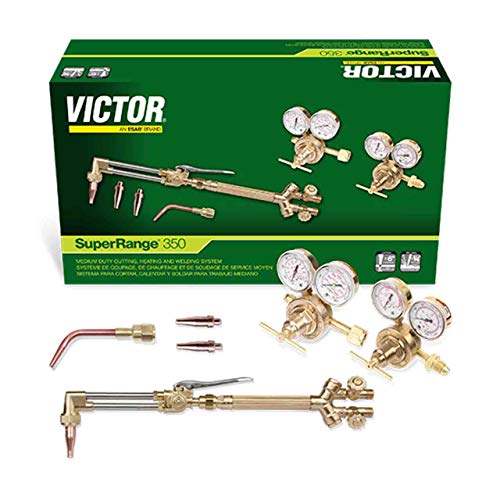
The Victor Super Range 350 is a dedicated cutting outfit, and it makes no apologies for that specialization. Where the Journeyman II and Performer balance cutting and welding capability, the Super Range 350 leans entirely into high-volume cutting performance. The SR350 regulators are purpose-engineered for the high flow rates that heavy cutting demands — the kind of sustained oxygen delivery that maintains a clean kerf through thick plate without pressure sag robbing your flame of its authority.
The included cutting torch body is Victor's Super Range design, recognized in the field for its precision and thermal management. Multiple cutting and brazing tips ship with the outfit, and Victor's quick-change tip system lets you move between tip sizes in seconds rather than minutes. That versatility matters when a single work session requires both fine work on thin sheet metal and aggressive cuts through 2-inch stock. The SR350 regulators apply the same logic — broad adjustment range, consistent delivery across that range.
The Super Range 350 is not the outfit for someone who brazes one fitting a month. It's the outfit for the fabrication shop, salvage yard, or ironwork operation that runs a cutting torch for hours daily. The SR350 regulators hold their calibration under that kind of sustained use, and the torch body's thermal design prevents the handle warmth that plagues cheaper alternatives during long sessions. If you're equipping a professional cutting station in 2026, this is the kit worth specifying.
Pros:
Cons:

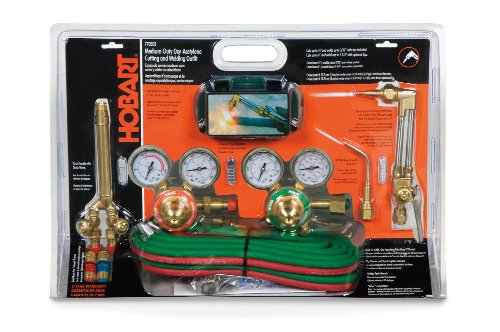
Hobart built the 770502 for the user who needs a competent, safe, and affordable oxy acetylene setup without the learning curve of a full professional outfit. The kit hits the medium-duty target squarely: capable enough to handle farming repairs, automotive exhaust work, and light fabrication, but priced and configured to meet a beginner where they are. Reverse Flow Check Valves ship standard — a safety feature that prevents backflow of gas mixtures into regulators and hoses, and one that some competing kits in this price range still treat as optional.
The fuel flexibility built into the Hobart 770502 sets it apart from comparably priced alternatives. The kit runs on acetylene as standard, but it's designed for compatibility with propane tips, giving you the option to source propane locally when acetylene isn't available or when cost is a factor. That adaptability makes the 770502 particularly useful in rural and agricultural settings where welding supply houses can be hours away. The included user manual is genuinely thorough — Hobart wrote it for someone picking up an oxy acetylene torch for the first time, and it covers setup, lighting, adjustment, and shutdown procedures in plain language.
For the DIYer who needs to cut rusted exhaust bolts, weld a cracked trailer hitch, or braze copper fittings on a farm outbuilding, the Hobart 770502 delivers without demanding professional training as a prerequisite. If you're equipping a home garage alongside other quality tools — a good low profile floor jack for under-car work, for instance — the Hobart fits that accessible professional toolkit perfectly. It's not a production shop tool, but for its intended audience it's exactly right.
Pros:
Cons:

Univeld's KC100P Centurion is the specialist in this lineup — a contractor-grade portable outfit built for the HVAC technician, plumber, and refrigeration mechanic who brazes copper tubing every working day. The two included welding and brazing tips cover the most common tasks in the trade: brazing copper tubing up to 1 inch in diameter and welding steel up to 1/8 inch thick. These are not supplementary capabilities — they are the entire professional envelope for the trades the Centurion targets, and Uniweld executed them with contractor-grade components throughout.
The single-stage Centurion Series regulators ship with protective rubber gauge boots — a practical detail that prevents the gauge glass cracking that's endemic in job-site environments where equipment gets set down hard and stacked in vans. The 511 plastic carrying stand provides a stable base for cylinder positioning during work and organizes hoses and torch components during transport. Tanks are sold separately, which is standard for contractor-grade outfits — HVAC technicians typically maintain their own cylinder accounts with local gas suppliers and don't need to pay for cylinders they won't use.
The Centurion's portability is its defining competitive advantage. The 511 stand was designed for a reason: HVAC and refrigeration work happens in mechanical rooms, rooftops, crawlspaces, and equipment closets where a full shop cart is impossible. This outfit moves with you. For tradespeople who need a reliable portable brazing setup that goes where the job is, the Uniweld KC100P represents purpose-built engineering at a competitive price point for 2026.
Pros:
Cons:

The Forney 1705 attacks the budget segment with a Victor-compatible design that leverages the widest tip ecosystem in the market. The 450-style regulators are industry-standard hardware, which means replacement parts, rebuilt kits, and accessories are available at any welding supply counter without special ordering. Standard accessories enable welding up to 3/16 inch and cutting up to 6 inches with the appropriate tip — a genuine performance specification that covers automotive and light fabrication work without requiring expensive upgrades from the start.
Forney included check valves in the kit, correctly treating them as standard safety equipment rather than an upgrade option. The Victor-style design of the torch body and fittings means you're not locked into proprietary Forney tips and accessories. You can source Victor tips, Forney tips, or any 450-style compatible component from dozens of manufacturers at competitive prices. For the shop owner who wants to keep consumable costs low over the ownership life of the outfit, that compatibility is worth real money over time.
The Forney 1705 won't match the regulator precision or build quality of the Victor professional outfits reviewed above — that's the honest trade-off at this price point. But for the weekend fabricator, small farm, or urban homesteader who needs functional oxy acetylene capability without professional-grade pricing, the Forney delivers the core experience reliably. Consider this the starting point for building oxy acetylene skills before graduating to a Victor professional kit, much like you'd start with a basic car lift before investing in full shop-grade equipment.
Pros:
Cons:

Lincoln Electric's KH995 answers a specific question: what's the most capable oxy acetylene outfit you can carry in one bag to a job site? The rugged storage bag that ships with the kit is not a marketing afterthought — it's the defining feature that separates this outfit from shop-bound alternatives. Every component of the KH995 was selected for field deployment. The CGA 510 acetylene and CGA 540 oxygen cylinder connections cover the standard cylinder types you'll find at rental houses and welding supply branches across North America. Cylinders are not included, as is standard, but the connection specifications match the most commonly available rental cylinders.
As supplied, the KH995 cuts 1 inch and welds 1/16 inch — modest numbers that reflect the compact tip set included. The significant detail Lincoln Electric discloses upfront is the upgrade path: with larger tips and the appropriate acetylene cylinder, the outfit is capable of cutting up to 4 inches and welding up to 1/2 inch. That scalability transforms the KH995 from a light-duty portable kit into a genuinely versatile platform. The kit contains all the quality equipment needed for cutting, welding, and brazing, Lincoln Electric states — and the component quality backs that claim with the manufacturer's established reputation in the professional welding market.
The KH995 is the right choice for the contractor who moves between job sites, the field service technician who needs emergency cutting capability in a single bag, or the instructional environment that needs a complete, portable demonstration outfit. OSHA's oxy-fuel welding and cutting standards apply to all professional deployments — the KH995's portable format makes compliance documentation straightforward since the outfit travels as a defined unit. In 2026, no other kit at this price point combines portability, upgrade potential, and professional brand heritage as effectively.
Pros:
Cons:

Regulators are the most critical components in any oxy acetylene outfit. They determine how consistently your flame performs across the full life of a gas cylinder — and consistency is everything in precision welding and cutting. Single-stage regulators reduce cylinder pressure to working pressure in one step. They're lighter and less expensive, but outlet pressure rises as cylinder pressure drops, which means your flame characteristics shift during a session. Dual-stage regulators reduce pressure in two steps, delivering dramatically more stable outlet pressure regardless of cylinder fill level. For production cutting and high-precision welding, dual-stage units like the ESS42 Series on the Victor Journeyman II justify their cost. For occasional use and light fabrication, single-stage units perform adequately.
Regulator build quality affects long-term accuracy and leak resistance. Victor and Uniweld both use internal valve designs that resist creep — the slow, unintended pressure increase that develops over time under load. Cheaper regulators develop creep more quickly, requiring more frequent attention and eventual replacement. When evaluating total cost of ownership, a premium regulator that lasts 15 years beats a budget unit replaced every 3 years, even at twice the initial price.
Flash arrestors and check valves are not optional safety accessories — they are the primary defense against two of the most serious hazards in oxy acetylene work: flashback and backflow. Backflow occurs when gas pressure imbalances allow one gas to enter the other gas's hose, creating a potentially explosive mixture. Check valves prevent this by allowing gas to flow in only one direction. Flash arrestors go further, stopping a flame front that has already entered a hose from traveling back to the regulator or cylinder.
Every kit on this list includes check valves as a minimum. The Victor Journeyman II integrates flash arrestors directly into the WH 315FC+ torch handle body, which is the gold standard. Outfits without integrated flash arrestors should have standalone flash arrestor devices added at the regulator connections before first use. This is a mandatory safety step, not a suggestion. Review your specific outfit's documentation and verify your safety equipment configuration before lighting the torch for the first time.
Every oxy acetylene kit specifies maximum cutting thickness and welding thickness for the tips and attachments included. These specifications matter, but they're often misunderstood. The numbers represent what the included tip set achieves — not the limits of the torch body and regulators themselves. Most professional torch bodies and quality regulators support a wide range of tip sizes, so an outfit that cuts 6 inches as supplied can potentially cut much thicker material with the appropriate tips.
Matching capacity to your actual work is more important than chasing maximum specifications. A welder who primarily works on automotive bodywork and exhaust systems needs clean, precise control in thin material — not the ability to cut 6-inch plate. Conversely, a salvage and demolition operation cutting structural steel needs sustained high-flow oxygen delivery that a light-duty outfit's regulators simply won't support. Be honest about your application before selecting a kit, and verify that the included tips cover your core tasks before supplemental purchases.
Where you work determines how much portability matters. Shop-bound setups benefit from carts, organized hose management, and fixed regulator positions that don't shift during use. Field deployment — HVAC, plumbing, on-site fabrication, agricultural repair — demands a setup that travels without becoming a logistics problem. The Uniweld KC100P's 511 carrying stand and Lincoln Electric KH995's storage bag represent two different philosophies for the same portability challenge. Evaluate your most common deployment scenario and choose accordingly. A kit that's theoretically portable but awkward to carry will stay in the shop.
The primary differences are regulator quality, tip capacity, and long-term durability. Professional kits use dual-stage regulators that maintain consistent pressure as cylinder pressure drops, support a wider range of tip sizes for more demanding applications, and are built to withstand daily use cycles over many years. Hobby-grade kits use single-stage regulators and lighter-duty torch bodies appropriate for occasional use. Safety features like check valves are now standard across both categories, so the safety gap has narrowed significantly — the performance and longevity gap has not.
No. Virtually every oxy acetylene outfit, at every price point, is sold without cylinders. This is a deliberate design decision: gas cylinders are regulated as pressure vessels, and ownership, filling, and transport are subject to local regulations that vary by jurisdiction. The standard approach is to open a cylinder account with a local welding supply company, pay a deposit, and exchange empty cylinders for full ones. The CGA 510 (acetylene) and CGA 540 (oxygen) connection specifications on the kits reviewed here are the industry-standard types accepted by virtually all cylinder rental accounts in North America.
No, but acetylene is the most capable and remains the standard for cutting, welding, and high-temperature brazing. Acetylene produces the highest flame temperature of any fuel gas — approximately 3,500°C (6,332°F) with oxygen — and the only flame capable of the neutral, carburizing, and oxidizing adjustment required for precision welding. Propane, natural gas, and MAPP gas can substitute for heating, brazing, and cutting in outfits specifically configured for them (like the Hobart 770502 with propane-compatible tips), but they don't replicate acetylene's welding capability. If your work involves cutting only, propane is a cost-effective alternative. If you weld, acetylene is the correct choice.
Industry standard practice calls for regulator inspection and service every one to three years under regular professional use conditions, and immediately following any incident involving flashback, regulator damage, or suspected contamination. Service intervals depend on use frequency, gas cleanliness, and storage conditions. A regulator that sits unused in a damp environment for two years may need service before use even without clock-based triggering. Victor and Uniweld both maintain authorized service networks; sending a premium regulator out for professional service rather than replacing it is cost-effective and extends service life significantly. Always replace regulators that show signs of internal contamination or mechanical damage rather than attempting field repairs.
At minimum: proper welding goggles or a welding face shield with shade 5 lenses for gas welding and a shade 3–4 lens for torch brazing, leather welding gloves, flame-resistant clothing (no synthetic fabrics), and a fire extinguisher within arm's reach of the work area. A dedicated welding table or steel work surface prevents fire from combustible workbench materials. If your kit does not include flash arrestors at both the torch handle and regulator connections, purchase standalone flash arrestors before first use — they're inexpensive and non-negotiable from a safety standpoint. Cylinder storage requires upright positioning, securing against tipping, and separation from heat sources and combustibles.
Yes, with appropriate technique and tip selection. Oxy acetylene is particularly effective for removing rusted fasteners, cutting exhaust systems, shrinking stretched sheet metal panels, and brazing copper and brass fittings in cooling systems. Paint stripping with a torch carries fire risk and releases toxic fumes from lead-based paints in older vehicles — wear appropriate respiratory protection and work in ventilated spaces. For precision automotive sheet metal work, flame temperature control is critical; a tip set that matches the material thickness prevents burn-through on thin body panels. Many automotive shops that use oxy acetylene for cutting and heating pair it with MIG welding for joining, rather than gas welding, for speed and consistency on production bodywork.
Buy the regulator quality you need for your actual application — the torch body lasts decades, but a cheap regulator costs you in consistency, safety, and replacement parts every single year.
 |
 |
 |
 |

About Liam O'Brien
Liam O'Brien has spent over a decade buying, field-testing, and evaluating automotive tools with a focus on what actually performs in a real DIY garage rather than what markets well on a spec sheet. His hands-on experience spans hand tools, diagnostic equipment, floor jacks, socket sets, and specialty automotive gear across a wide range of brands and price points. At CarCareTotal, he covers automotive tool and equipment reviews, garage setup guides, and buying advice for home mechanics.
Get some FREE car parts & gear.. Or check out the latest free automotive manuals and build guides here.
Disable your ad blocker to unlock all the hidden deals. Hit the button below 🚗
| | | |
