Audio ›
by Rachel Park
What separates a car audio setup that rattles windows from one that just plays music loud? The amplifier — specifically, a dedicated monoblock Class D unit engineered to push subwoofers hard, cleanly, and without cooking itself on a summer afternoon. If you've been hunting for the best car amplifiers for bass in 2026, you already know the market is crowded with options ranging from budget-friendly powerhouses to premium precision units that cost serious money. The good news: our top pick is the Rockford Fosgate R500X1D, a compact Class D monoblock that punches well above its price point and integrates cleanly into virtually any install.
Choosing the right bass amplifier means understanding your subwoofer's impedance, your electrical system's headroom, and the trade-offs between raw wattage and signal integrity. A 1,900-watt amp means nothing if your alternator can't supply the current or if the amp's SNR introduces hiss at moderate volumes. The six amplifiers on this list were selected across different power tiers and price points — from the space-saving Alpine S-A60M at 600W RMS to the Hifonics Brutus Gamma pushing 1,900W — so whether you're building a street-legal daily or a dedicated SPL demo rig, there's a match here. Pair any of these with the right enclosure, and check out our guide to the best powered car subwoofers if you're still deciding on the driver side of the equation.
Class D topology dominates this category in 2026 for good reason: efficiencies above 85% mean less heat, smaller chassis, and more usable power delivered to the woofer cone rather than dissipated as thermal loss. Every amp on this list runs Class D or Super D, and all seven are monoblock designs optimized for subwoofer duty. The audio category covers the full speaker chain, but here we're laser-focused on the amplification stage — the component that determines how cleanly, how powerfully, and how reliably your bass hits every single time you press play.
Contents
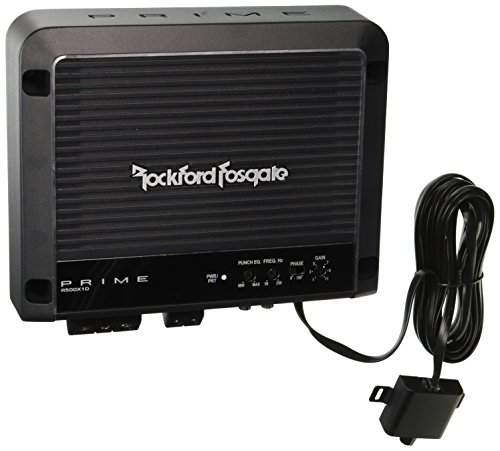








Rockford Fosgate's R500X1D earns its top-pick status through a combination of engineering restraint and real-world practicality that the competition rarely matches at this price tier. The 23% increase in thermal mass per square inch compared to previous Prime generation units means the heatsink disperses heat faster under sustained heavy loads, which translates directly to longer thermal headroom before protection circuits engage on hot summer days with the bass cranked. The small chassis design — genuinely compact by monoblock standards — opens installation options in tight enclosures, under seats, and in hatchback builds where physical footprint is a hard constraint.
OEM vehicle integration support is more significant than it might first appear. Many factory headunits output a filtered, time-aligned signal that confuses aftermarket amps; Rockford's integration circuitry handles these scenarios cleanly, making the R500X1D a natural choice for anyone upgrading an existing factory system without swapping the head unit. Rated at 500W RMS into 2 ohms, this amp delivers honest, measured power — not inflated peak figures — and the Punch EQ circuitry adds that classic Rockford bass contour without introducing phase distortion in the critical 40–80Hz octave where most subwoofer fundamentals live. The build quality feels appropriately dense for the price, with solid terminal blocks and a chassis that doesn't flex.
For daily drivers and enthusiasts who want reliable, clean bass without over-engineering their electrical system, the R500X1D is the amplifier you install once and forget about. It doesn't demand a second alternator or a bank of lithium cells — it simply works, session after session, without drama. If you're also upgrading your vehicle's maintenance game while building out the audio system, the best spark plug wire sets of 2026 are worth reviewing alongside your electrical load calculations.
Pros:
Cons:
Pioneer's GM-D9701 sits in the GM Digital Champion Series, a lineup that has earned consistent respect across SPL forums and street-audio communities alike for delivering verified power numbers at a price that undercuts many comparable competitors. At 1,200W RMS into 1 ohm with the Pulse Width Modulated MOSFET power supply handling voltage regulation efficiently, this amplifier delivers the kind of sustained output that pushes a large 12" or 15" subwoofer to genuine reference levels without triggering protection on every bass transient. The tiered impedance ratings — 500W at 4 ohms, 800W at 2 ohms, and 1,200W at 1 ohm — give you practical flexibility depending on how you wire your subwoofer load.
The wired remote bass level control is a standard inclusion in this class, but Pioneer's implementation is clean and responsive, with a good throw range that doesn't jump from inaudible to overwhelming in a narrow rotation. Preamp RCA outputs for daisy-chaining multiple amplifiers make this a logical anchor in multi-amp builds where a separate four-channel handles midbass and mids. Three-way protection circuitry — thermal, overload, and speaker short — adds real-world durability assurance, particularly in competitive listening environments where clipping events are frequent and protection reliability becomes critical to long-term equipment survival.
The inclusion of Alphasonik Erabuds as a bundle item is largely irrelevant to a serious bass build, but the core amplifier here is legitimately competitive against units costing significantly more. If you're running a dual-sub setup at 1 ohm, the GM-D9701 delivers the headroom to make both drivers work hard without sacrificing stability. Pioneer's build quality at this price range is consistently above average, with a chassis that dissipates heat effectively and terminals that accept large-gauge wire without the fitment issues common in budget units.
Pros:
Cons:
Alpine's S Series carries serious credibility in the car audio world, and the S-A60M justifies that reputation with a 600W RMS output rating backed by an 85 dBA signal-to-noise ratio that separates this amplifier from similarly-priced alternatives. That SNR figure means the noise floor stays well below audible threshold even at moderate gain settings, which matters enormously when your subwoofer enclosure is positioned close to listening position and the driver is highly sensitive. The S-A60M operates cleanly down to 2 ohms, and the variable bass boost gives you fine-grained control over the low-frequency emphasis without introducing the phase artifacts that crude bass boost circuits impose.
Both preamp and speaker-level inputs are included, making the S-A60M genuinely compatible with factory integration scenarios as well as full aftermarket signal chains. The chassis is remarkably compact for a 600W RMS monoblock, which is the defining characteristic of the S Series approach: Alpine engineers the efficiency so tightly that you get premium-tier performance in a footprint that fits under seats, in trunk corners, and in spare-tire wells without requiring custom fabrication. The crossover implementation is precise and adjustable, allowing proper high-pass filtering to protect the subwoofer from below-resonance excursion while the bass boost adds authority in the 40–60Hz range where most listeners feel bass pressure most viscerally.
For listeners who prioritize sound quality metrics — specifically low distortion, accurate imaging of bass transients, and flat group delay — over raw wattage figures, the Alpine S-A60M is the correct choice in 2026. It's not the most powerful option on this list, but it's the most refined, and for a single quality 10" or 12" subwoofer in a sealed or ported enclosure tuned correctly, 600W RMS is more than sufficient to achieve reference-level bass reproduction. According to Wikipedia's amplifier overview, Class D efficiency advantages are most significant in mobile applications where power supply headroom is limited — and Alpine leverages that efficiency better than almost anyone at this price point.
Pros:
Cons:
Skar Audio has built a loyal following among the SPL and daily-driver communities by delivering amplifiers that match or exceed their rated specifications at prices that undercut established brands significantly, and the RP-1500.1D is the model that best exemplifies that value proposition. At 1,500W RMS into 1 ohm and 1,900W peak, this amplifier handles a broad range of subwoofer applications from single 12" builds to dual 10" setups without running out of headroom at moderate listening levels. The MOSFET power supply delivers stable current delivery even as battery voltage sags under load, which is the critical behavior you need during hard bass transients where instantaneous current demand spikes significantly.
The on-board Bass EQ switch offering +6 or +12dB boost at 45Hz is a genuinely useful feature for sealed enclosure builds where the natural rolloff begins around that frequency and a targeted shelf boost restores the perceived low-end extension without over-driving the driver at other frequencies. The frequency response specification of 20Hz–250Hz covers the full subwoofer operating range, and the variable crossover lets you integrate the sub cleanly whether you're crossing over at 80Hz for a music-focused system or pushing to 120Hz in a truck cab with a narrow soundstage. Remote subwoofer level control is included and operates smoothly across its range without introducing noise when adjusted mid-playback.
Build quality on the RP-1500.1D is competitive with amplifiers at twice the price. The terminal blocks are generously sized, accepting 0-gauge wire without adapters, and the chassis heatsinking is substantial enough to run at full power in warm ambient conditions without frequent thermal cutouts. Skar's warranty support has improved significantly as the company has matured, which reduces the perceived risk of going with a newer brand over an established alternative. For the bass enthusiast who wants legitimate 1,500W RMS performance without financing a premium nameplate, this is the amplifier that actually delivers in 2026.
Pros:
Cons:
The Hifonics Brutus Gamma BG-1900.1D occupies the high-wattage budget tier with characteristic Hifonics aggression — this is an amplifier built for listeners who want maximum cone movement and aren't prioritizing audiophile-grade signal fidelity. The Super D Class designation indicates a hybrid topology that pushes efficiency beyond standard Class D under certain load conditions, and at 1,900W the BG-1900.1D delivers the kind of sustained output that makes large displacement subwoofers work hard in properly tuned ported enclosures. The Ultra-Fi MOSFET output device technology and classic Hifonics aluminum construction address both the power delivery and thermal dissipation sides of the equation simultaneously.
The variable electronic crossover and equalizer capabilities give you meaningful control over the output signal, and the illuminated overload and speaker short protection indicators on the end panel are more than cosmetic — they give you real-time visual feedback when the amp is operating outside safe parameters, which is valuable during system tuning sessions where you're pushing gain structure to find headroom limits. The wired bass remote is included and provides the volume-knob bass control that casual listeners appreciate during varied playback scenarios where different recordings have different low-end energy levels.
You're accepting trade-offs with the Hifonics at this price point: the SNR isn't going to match the Alpine S-A60M, and the chassis size reflects the heat management requirements of a near-2,000W amplifier working efficiently. But if your priority is moving maximum air volume on a constrained budget — for demo events, for a dedicated bass competition vehicle, or simply because you want your daily driver to be genuinely loud — the BG-1900.1D delivers that result more affordably than most competitors at this wattage tier. The build quality is adequate for the price, with no obvious corners cut that would compromise reliability under sustained use.
Pros:
Cons:
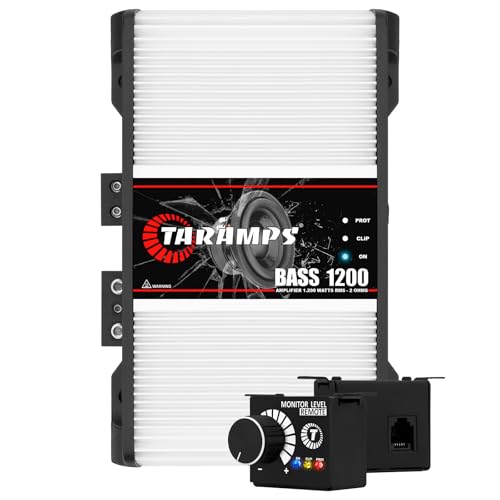
Taramps is a Brazilian amplifier brand that has earned a legitimate cult following in the competitive car audio community through products engineered specifically for low-impedance, high-excursion subwoofer applications, and the BASS 1200 exemplifies that focused engineering philosophy. Rated at 1,200W RMS at 1, 2, or 4 ohms — an unusual multi-impedance rating that indicates genuine output stability across the impedance curve rather than a single optimistic measurement point — this amplifier is designed from the ground up to enhance sub-bass and bass frequencies with superior performance in the lowest octaves of the audible spectrum.
The compact design belies the output capability, and both RCA and high-level inputs are included, which gives you genuine flexibility whether you're feeding the amp from a dedicated DSP processor or tapping the factory system's speaker outputs. The operating voltage range of 9V–17V is broader than many competitors, meaning the BASS 1200 maintains stable operation during the voltage excursions that occur during high-demand bass transients when a stock alternator is working near its limits. The monitor level remote control is included and allows driver-position adjustment without interrupting playback, which is critical during dynamic content where bass energy varies significantly between tracks.
Taramps distinguishes itself from comparable-wattage alternatives through its focus on sub-bass frequency enhancement specifically — the crossover and boost controls are tuned with the low-frequency extension in mind, making this amplifier particularly effective when paired with subwoofers optimized for infrasonic reproduction below 40Hz. If you're building a system where felt bass pressure and infrasonic content are the primary objectives, the Taramps BASS 1200 delivers that character more effectively than most competitors at this price point. The crossover implementation is flexible enough to integrate cleanly with both sealed and ported enclosure designs across a wide tuning frequency range.
Pros:
Cons:
Kicker's CX1200.1 brings the Oklahoma brand's characteristically robust engineering to the 1,200W monoblock category, delivering what the CX Series promises most consistently: big power with significant flexibility and the reliability that a brand with Kicker's track record can credibly back up. The 1-ohm stability is a headline specification here — the ability to drive a 1-ohm load cleanly expands your subwoofer wiring options considerably, allowing dual voice coil drivers wired in parallel or multiple drivers in a bank configuration without compromising amplifier stability or triggering protection circuits under sustained load.
The variable 12dB crossover, KickEQ 6dB variable bass boost, and 24dB subsonic filter combination represents the most comprehensive on-board signal processing suite among the amplifiers on this list. The 24dB subsonic filter deserves specific mention: it's a hard requirement for ported enclosure builds, where driver excursion below the port tuning frequency is uncontrolled and can destroy voice coils quickly at high power levels. The steepness of a 24dB/octave slope provides meaningful protection that a typical 12dB filter does not, and Kicker including it as a variable feature rather than a fixed frequency shows genuine understanding of how these amplifiers are actually used in diverse enclosure scenarios. The KickEQ bass boost adds authority without the phase smearing that cheaper boost circuits introduce.
Kicker's build quality is consistently above average for the price, with well-machined terminal blocks, a solid chassis, and heatsinking geometry that handles continuous high-power operation in warm trunk environments without throttling. The CX1200.1 is the amplifier you recommend to someone who wants a single unit that handles every scenario competently — daily driving, competition days, sealed boxes, ported enclosures, single subs, multiple drivers — without requiring compromise in any single application. If you're upgrading other vehicle systems simultaneously, the best HID headlights of 2026 are another high-impact audio-adjacent upgrade worth scheduling alongside your amplifier install.
Pros:
Cons:
The single most important discipline when evaluating car amplifiers for bass reproduction is ignoring peak power ratings entirely and focusing exclusively on RMS power at your target impedance. Peak power is a marketing figure representing what the amplifier can sustain for milliseconds under ideal laboratory conditions, while RMS power is the continuous output the amplifier delivers across actual listening sessions. Your subwoofer's RMS power handling rating needs to match the amplifier's RMS output at your chosen impedance — overpowering by more than 150% risks voice coil failure, while significant underpowering causes the clipped signal from a driven amp to damage drivers more efficiently than clean high power ever would. Match RMS to RMS, always.
Understanding impedance is non-negotiable when you're building a bass-focused system, because your wiring configuration determines the load your amplifier sees, and different amplifiers handle low-impedance loads with vastly different stability and efficiency. Dual voice coil subwoofers wired in parallel present 1 ohm to a monoblock amplifier, which maximizes power output but demands that the amplifier is genuinely rated for 1-ohm operation — not all are, despite marketing claims. Single voice coil drivers wired to a 2-ohm stable amp represent the safer middle ground for daily-driver builds where long-term reliability outweighs maximum output. The best mechanic tool sets of 2026 are handy during installation, where crimping, cutting, and terminal work require quality hand tools for reliable connections.
A bass amplifier's signal-to-noise ratio determines how cleanly it amplifies the input signal relative to the noise floor it adds to the audio chain, and while most listeners don't consciously hear amplifier noise at low volumes, it becomes audible during quiet passages and at idle when the subwoofer is sensitive and positioned close to the listening position. Look for SNR ratings above 80 dBA for daily drivers and 85 dBA or higher for quality-focused builds. The crossover implementation quality matters equally: a variable low-pass crossover with 24dB/octave slope gives you precise control over the frequency handed off to the subwoofer, and a subsonic filter with similar slope protects ported enclosure builds from the destructive excursion that occurs below port tuning frequency.
Every watt your amplifier produces comes from your vehicle's electrical system, and the most common mistake in car audio builds is installing a high-power amplifier without accounting for the charging system's ability to supply the required current continuously. A 1,500W RMS amplifier operating at 85% efficiency draws approximately 130 amperes at 13.5V, which exceeds the output of most factory alternators by a significant margin. For systems above 1,000W RMS, you need to calculate your total system current draw against your alternator's rated output, account for factory electrical loads, and either upgrade the alternator or add supplemental battery capacity to maintain stable voltage above 12.5V during hard bass transients. Voltage sag below this threshold causes power compression that robs you of the headroom you paid for.
Class D monoblock amplifiers are the definitive choice for bass reproduction in 2026, operating at efficiencies above 85% that reduce heat generation, allow compact chassis designs, and deliver more usable power to subwoofer voice coils. Super D Class variants like the Hifonics Brutus push efficiency even higher under certain load conditions. Class A/B amplifiers were once considered sonically superior, but modern Class D designs have eliminated the measurable distortion differences that justified that preference in earlier generations.
For a single 10" subwoofer in a sealed enclosure, 300–500W RMS is sufficient for reference-level bass in most vehicles. A 12" driver in a ported enclosure benefits from 500–800W RMS for genuine impact. Dual 12" or single 15" applications warrant 1,000–1,500W RMS, and competition-level builds running multiple large-displacement drivers require 1,500W or more. The critical principle is matching the amplifier's RMS output to the subwoofer's RMS power handling — not chasing peak wattage numbers.
1-ohm stability expands your wiring flexibility significantly, but it's not a requirement for every build. If you're running a single dual voice coil subwoofer wired in series (4 ohms), or a single voice coil driver, 2-ohm stability is entirely adequate. 1-ohm operation is most valuable when you're wiring dual drivers in parallel or a dual voice coil driver with coils wired in parallel, maximizing power output from a given amplifier. The trade-off is that 1-ohm operation generates more heat, which demands better chassis cooling and typically favors less trunk-mounted, less-ventilated installation positions.
For systems where the bass amplifier exceeds 800W RMS, calculating your electrical system's current supply against total demand is essential before deciding on an upgrade. A stock alternator typically outputs 90–130 amperes, and a 1,200W RMS amplifier at 85% efficiency draws roughly 105 amperes at 13.5V — leaving minimal headroom for factory electrical loads. High-output alternators in the 200–250 ampere range are the correct solution for builds above 1,500W RMS, while secondary AGM batteries provide supplemental current during peaks and reduce voltage sag during hard bass transients in moderate-power systems.
A subsonic filter is a high-pass filter positioned below the subwoofer's operating range — typically between 15Hz and 35Hz — that prevents amplified energy below that frequency from reaching the driver's voice coil. It's essential in ported enclosure builds because a ported enclosure loses mechanical control of the driver below its tuning frequency, allowing the amplifier to drive the cone to destructive excursion levels without audible output. In sealed enclosure builds the filter is less critical because the sealed airspace provides natural rolloff, but it's still good practice to use it as protection against low-frequency artifacts in recordings.
A dedicated monoblock bass amplifier is optimized for low-frequency, single-channel subwoofer applications and is entirely unsuitable for driving full-range door speakers, which require stereo channels and flat frequency response from 60Hz to 20kHz. Running door speakers from a monoblock bass amp would produce mono, low-pass filtered output at mismatched impedance — the result would be heavily bass-colored, mono sound with no high-frequency content. A separate multichannel amplifier handles the full-range speaker duties, with the monoblock dedicated exclusively to the subwoofer. This two-amplifier approach is standard practice in properly engineered car audio systems.
Buy the amplifier that matches your subwoofer's RMS rating at your target impedance — everything else is secondary to getting that one pairing right.
 |
 |
 |
 |

About Rachel Park
Rachel Park specializes in the interior and exterior upgrades that meaningfully change how a car looks, sounds, and feels on a daily basis. She has hands-on experience with head unit installations and audio system builds, LED and HID lighting conversions, interior refresh projects, and cosmetic exterior work — evaluated from both a DIY accessibility and quality-of-result perspective. At CarCareTotal, she covers car audio and electronics, lighting upgrades, and interior and exterior styling accessories.
Get some FREE car parts & gear.. Or check out the latest free automotive manuals and build guides here.
Disable your ad blocker to unlock all the hidden deals. Hit the button below 🚗
| | | |
