by Marcus Chen
The Tru-Cool Max LPD4739 earns our top recommendation for 2026 because its thermal bypass valve and low-pressure drop design protect your transmission better than almost any competing unit at this price point. Whether you tow heavy trailers, haul cargo through brutal summer heat, or simply want to extend the life of an automatic transmission that costs $2,000 to $5,000 to replace, bolting on an aftermarket transmission cooler is one of the highest-ROI upgrades you can make without touching the engine itself.
Your automatic transmission generates enormous heat under sustained load, and that heat is its primary enemy. According to research on transmission oil coolers, fluid temperatures above 200°F begin to degrade the lubricant's protective properties, and every 20°F rise beyond that threshold roughly halves the fluid's effective service life. The factory cooler integrated into your radiator manages normal daily driving reasonably well, but the moment you start towing a fifth wheel, climbing sustained mountain grades with a loaded pickup, or crawling through stop-and-go traffic in a Phoenix summer, it gets overwhelmed fast. An aftermarket unit mounted in the airstream ahead of the radiator can reduce fluid temps by 30°F to 50°F — and that temperature reduction translates directly into longer clutch pack life, smoother shifts under load, and years of additional transmission durability. If you're building out a comprehensive drivetrain maintenance plan, our guide to the best high mileage oils of 2026 covers the engine side of that equation with equal depth.
We evaluated seven transmission coolers for 2026 across the full range of applications — compact sedans, half-ton pickups, diesel heavy-duties, and everything in between. The lineup spans universal plate-and-fin add-ons, tube-and-fin cores, fan-assisted active coolers, and direct-fit replacement units engineered for specific platforms. These are the best transmission coolers you can buy right now, and every pick on this list is available through our performance upgrades section with full specs and buying context.






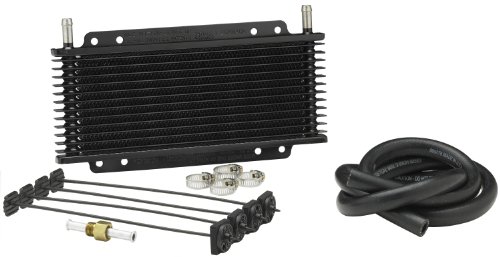


The Tru-Cool Max LPD4739 is built for trucks, SUVs, and tow vehicles operating at up to 40,000 pounds GVW, and it delivers at that weight class without compromise. The defining engineering choice here is the Low Pressure Drop design, which maintains proper transmission fluid flow even at lower pump pressures — a critical advantage for vehicles equipped with electronically controlled transmissions that monitor line pressure and trigger fault codes or shift quality degradation when pressure falls outside programmed parameters. Most budget add-on coolers ignore this concern entirely; the LPD4739 engineers around it from the ground up, which is what separates a truly professional-grade cooler from a parts-store commodity unit.
The integrated thermal bypass valve is equally important to the LPD4739's real-world performance. On cold starts, it routes transmission fluid around the cooler entirely, allowing the fluid to reach operating temperature quickly without fighting the resistance of a cold aluminum core — protecting the transmission during the high-viscosity warm-up phase where cold fluid moving through a cold cooler creates dangerous restriction. Once fluid reaches operating temperature, the bypass valve opens and full cooling capacity comes online. Installation uses standard barbed fittings compatible with 3/8-inch transmission cooler hose, and the unit ships with the hardware you need to plumb it into your existing cooler lines. The aluminum core construction is robust and clearly built to last through years of thermal cycling, road debris exposure, and the vibration inherent to truck applications. For anyone who regularly tows at GVW ratings that stress the factory cooling system, the LPD4739 is the single most effective transmission protection upgrade available in 2026.

Pros:
Cons:
Mishimoto built its reputation on high-performance cooling components for enthusiast and motorsport applications, and the MMTC-U brings that engineering heritage into a compact, universal package that fits an impressively wide range of vehicles. The cooler measures 15.5 inches in length, 5 inches in height, and 3/4 inches in thickness, with a 12-inch core that delivers meaningful cooling capacity in a profile slim enough to mount in tight engine bays where most larger units simply don't have room. The 3/8-inch push-on fittings are a standout design choice — they eliminate the need for specialized tools and make routing hoses from your transmission lines to the cooler a genuinely accessible job even for first-time installers who have never touched a transmission cooling circuit before.
Beyond transmission fluid, the MMTC-U handles power steering fluid cooling with equal effectiveness, which makes it a genuinely versatile component for both performance builds and daily drivers running vehicles with steering rack cooling requirements. Mishimoto's bar-and-plate core construction gives this cooler excellent rigidity and meaningful resistance to road debris impact — important for a unit mounted forward in the airstream where rocks and debris are a regular hazard. The build quality consistently exceeds what you find from budget alternatives at two-thirds the price, and the fit and finish reflects a manufacturer that takes quality control seriously across its entire product lineup. For a universal unit that performs reliably across a broad range of applications without requiring vehicle-specific engineering, the MMTC-U is the most complete product at its price point in 2026.

Pros:
Cons:
If you operate a 2011–2016 Ford F-Series equipped with the 6.7L Powerstroke diesel engine, the MMTC-F2D-11SL is the transmission cooler engineered specifically for your platform — and every aspect of its design reflects that purpose-built intent. Rather than simply replacing the OEM cooler, Mishimoto's integration strategy adds a stacked-plate supplemental cooler that works in concert with the factory unit, effectively doubling cooling capacity by stacking additional heat rejection on top of what Ford's engineers already provided. The stacked-plate construction with turbulated internal fins dramatically increases heat exchange surface area and flow turbulence simultaneously, which pushes fluid-to-core heat transfer efficiency well beyond what a simple add-on plate unit achieves in the same mounting footprint.
The direct-fit nature of the MMTC-F2D-11SL is what separates it from universal alternatives for Powerstroke owners — there's no bracket fabrication, no hose routing puzzles, and no compromises on clearance or fitment. Every bracket, bolt, and fitting is designed specifically for your truck's existing cooling circuit and mounting points, and the result is an installation that looks and functions like factory engineering. Most mechanically competent DIYers complete the install in two to three hours using standard hand tools, and the end result is clean enough that it passes as OEM at a casual glance. Mishimoto backs the MMTC-F2D-11SL with a lifetime warranty — a statement of manufacturing confidence that no-name alternatives simply cannot make. For Powerstroke owners who regularly tow at maximum capacity or live in high-temperature climates where transmission thermal management is a genuine operational concern, this is the definitive 2026 answer.
Pros:
Cons:
Hayden has manufactured thermal management products for the automotive aftermarket for decades, and the 678 Rapid-Cool represents the company's proven sweet spot for trucks, full-size vans, and Class C motor homes that need serious supplemental cooling without serious premium-brand pricing. Measuring 3/4 inch x 11 inches x 9.5 inches, this plate-and-fin unit covers vehicles with GVWR up to 24,000 pounds and towing capacity up to 5,000 pounds — which addresses the vast majority of light-duty and medium-duty applications where factory cooling gets overwhelmed. The 678 is classified as an add-on unit rather than a direct OEM replacement, designed to work alongside your existing radiator-integrated cooler to provide the supplemental capacity that demanding driving conditions require.
Installation follows a straightforward splice-in approach using standard transmission cooler hose and the fittings supplied with the kit, making it accessible to any DIY mechanic comfortable with basic fluid line work. Hayden's durability reputation in this category is well earned through decades of product history — the 678 holds up against the road debris impacts, temperature cycling, and drivetrain vibration that truck applications generate without developing the fitting leaks or core stress cracks that plague cheaper alternatives at comparable mileages. If you own a pickup truck, cargo van, or motorhome and want reliable cooling performance from a manufacturer with a real track record, the 678 delivers exactly what it promises year after year. Pair the install with a comprehensive fluid maintenance schedule — our review of the best engine flushes covers complementary maintenance steps that keep the rest of your drivetrain equally clean.

Pros:
Cons:
The Hayden 676 addresses a market segment that full-size transmission coolers physically cannot serve: the sub-compact and compact car category, where engine bay packaging is tight and where even a modestly sized aftermarket cooler can meaningfully reduce fluid temperatures during the stop-and-go city driving that heats compact automatic transmissions more than most owners realize. At 11.0 inches long, 5.875 inches wide, and just 0.70 inches thick — rated for GVWR up to 18,000 pounds — the 676 is purpose-sized for smaller vehicles that still generate enough transmission heat under urban driving conditions to benefit from supplemental cooling. The steel construction delivers genuine durability at its price point, with clean finishing and precise fitting tolerances that reflect Hayden's manufacturing consistency.
The 0.70-inch thickness is the specification that makes the 676 viable for compact car applications — it's what allows this unit to mount in locations where any thicker cooler physically cannot fit without contacting adjacent components or restricting airflow to the radiator. If your automatic-equipped compact or sub-compact sees heavy city traffic, regular summer heat soaks, or sustained highway driving in hot climates, the 676 provides measurable fluid temperature protection at a price that's difficult to argue against. It won't drop temps as dramatically as a full-size unit under maximum tow load, but for its intended application — compact vehicles in heat-stress driving conditions — it performs precisely as designed and provides real-world protection that your transmission's long-term health depends on.

Pros:
Cons:
The Derale 15865 is the unit you need when guaranteed airflow through the grille is not a given — which describes more real-world driving scenarios than most buyers initially consider. Slow traffic, off-road low-speed crawling, sustained uphill towing at reduced speeds in summer heat, and high-idle work applications all share a common characteristic: vehicle speed does not generate meaningful airflow across a passively mounted cooler. Derale's solution integrates a dedicated electric fan directly with the plate-type cooler, ensuring active airflow across the core regardless of how fast your vehicle is moving. The unit measures 13 x 10 x 5.625 inches, uses 10 AN female O-ring inlet and outlet fittings, and ships complete with 10 AN male adapters — everything you need to connect it cleanly to your transmission cooling circuit without a separate hardware run.
The black powder coat finish on the aluminum construction looks purposeful, resists corrosion through years of thermal cycling and moisture exposure, and holds up against the road environment that a forward-mounted cooler faces. Wiring the integrated fan requires a relay installation and basic automotive electrical skills — Derale provides wiring guidance, and the job is straightforward for anyone who has wired an electric fan or auxiliary lighting before. Once installed and wired, the forced-air cooling that this unit delivers in low-airflow conditions is simply not achievable with any passive cooler regardless of how large or efficient its core is. For off-road builds, dedicated tow vehicles, or daily drivers that spend significant time in dense urban traffic during summer months, the 15865 is the technically correct transmission cooling solution in 2026.


Pros:
Cons:
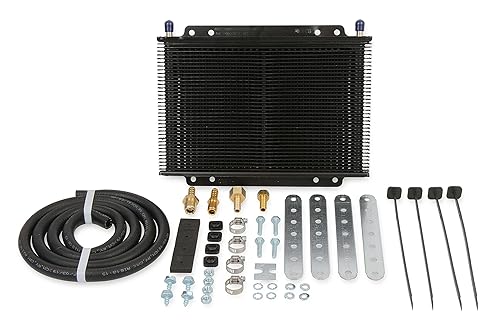
The Derale 15300 is a tube-and-fin cooler core that takes a different thermal management approach from the plate-style units that dominate this product category — and in certain mounting configurations and airflow environments, that construction difference matters in measurable ways. The package dimensions of 18.62 inches long by 13 inches wide by 2.12 inches tall describe a substantive core with real heat rejection capacity, and the 8.56-pound weight reflects the material investment in this unit's construction. Made in the United States and finished in black, the 15300 integrates cleanly into custom cooling installations where you're routing your own lines, choosing your own fittings, and positioning the cooler precisely where your vehicle's airflow characteristics are most favorable.
Tube-and-fin construction uses fluid-filled tubes bonded to corrugated aluminum fins that dramatically increase the core's surface area exposed to passing air, delivering efficient convective heat transfer across the full width of the unit. Where stacked-plate designs excel under high-pressure, high-load circuits that demand maximum thermal density, tube-and-fin cores like the 15300 offer a favorable combination of low internal restriction and solid moderate-duty cooling performance that suits a wide range of custom build applications. You'll source your own fittings and mounting hardware — this is a core, not a complete kit — but that flexibility also means you position the 15300 exactly where your specific vehicle's airflow is strongest rather than compromising to fit a pre-configured bracket. For the hands-on builder constructing a custom cooling circuit who wants Derale's quality core material as the foundation, the 15300 is the most practical and adaptable starting point on this list.
Pros:
Cons:

Selecting the right transmission cooler requires honest assessment of four variables: your vehicle's GVW rating, your typical driving conditions, your installation environment, and the severity of the heat loads your transmission regularly generates. Getting this right the first time prevents the frustration of undersizing and the unnecessary expense of over-engineering a solution for a vehicle that doesn't need it.
Every transmission cooler carries a Gross Vehicle Weight rating that defines the maximum vehicle weight class it's designed to manage effectively. Running a cooler comfortably below its rating gives you thermal headroom that translates to consistently lower fluid temperatures; running it at or near its ceiling means any inefficiency in mounting position or airflow will push your fluid temps higher than the cooler's ratings suggest. The practical rule here is straightforward: always size up if your driving involves sustained high-load towing, because the incremental cost of the next larger unit is trivial compared to the cost of a transmission that overheated during a long mountain haul.
The three dominant construction types each carry meaningful differences in performance characteristics that make them more or less appropriate depending on your specific application and pressure circuit requirements.
The pressure drop across a cooler — the difference in fluid pressure between inlet and outlet — matters significantly for modern electronically controlled transmissions that depend on precise line pressure to execute correct shift logic. A high-resistance cooler reduces downstream line pressure in ways that manifest as shift quality degradation, torque converter shudder, or pressure-related fault codes. The Tru-Cool LPD4739's Low Pressure Drop engineering directly addresses this concern by maintaining full flow rate across its core at the pressure levels that modern automatic transmissions expect. The thermal bypass valve is a separate but complementary feature: it protects your transmission during cold starts by keeping thick, cold fluid out of the cooler until it reaches operating temperature — a function that standard add-on coolers without bypass valves simply don't provide. For a comprehensive diagnostic perspective on your drivetrain's health alongside your cooler install, our guide to the best compression testers covers the engine monitoring tools that round out a serious maintenance toolkit.
Passive coolers rely entirely on vehicle-speed-generated airflow to remove heat from the fluid — they're simpler, require no electrical connections, and perform perfectly well for the majority of highway driving and towing-at-speed applications where consistent airflow is guaranteed by forward vehicle motion. Active coolers like the Derale 15865 add an electric fan that pulls air across the core regardless of vehicle speed, delivering consistent cooling performance precisely in the conditions where passive units underperform: slow urban traffic, off-road low-speed work, stationary idling under load, and sustained low-speed mountain grades in summer heat. The added complexity of relay wiring and the slightly higher power draw are minor practical considerations compared to the protection that active cooling provides when vehicle speed alone cannot guarantee adequate airflow across the core.
A transmission cooler is a heat exchanger that routes hot automatic transmission fluid through a core exposed to ambient airflow, reducing fluid temperature before returning it to the transmission. Lower operating temperatures slow the chemical degradation of the fluid's protective additives, reduce wear on internal clutch packs, bands, and valve body components, and significantly extend the service life of the entire transmission assembly. The factory cooler integrated into most vehicles' radiators handles normal driving adequately, but an aftermarket unit mounted in forward airflow provides the additional capacity that heavy-load, high-heat, and towing applications demand.
Every automatic transmission vehicle ships with some form of factory cooling — typically a small cooler integrated into the engine radiator that shares coolant circuits with the cooling system. Under normal driving conditions, that factory unit manages adequately. However, if your driving profile includes regular towing, sustained heavy hauling, frequent stop-and-go traffic in hot climates, or off-road use, the factory cooler operates near or at its thermal capacity limit under those stress conditions. Adding an aftermarket cooler brings supplemental capacity that protects a transmission costing $2,000 to $5,000 to replace — an investment in insurance that pays for itself the first time it prevents a heat-related failure.
Start with your vehicle's Gross Vehicle Weight Rating from the door placard or owner's manual, and match that figure to the cooler's stated GVW capacity. For towing applications specifically, use your maximum tow weight as your reference figure rather than your vehicle's curb weight alone. The conservative approach is to select a cooler rated for at least 20 percent more capacity than your expected maximum load, giving the unit comfortable thermal headroom so it operates below its ceiling even under adverse mounting position or airflow conditions. When genuinely uncertain between two sizes, the larger unit always performs better and the price difference is rarely significant relative to the protection it provides.
Most universal add-on coolers — including every Hayden and Mishimoto universal unit on this list — are fully DIY-accessible for anyone comfortable with basic mechanical work and fluid line handling. The installation process involves locating the transmission cooler lines running between your transmission and the factory radiator cooler, splicing the aftermarket unit in using the provided barbed fittings and hose clamps, and securing the cooler to a frame rail or radiator support using the included brackets. The Derale 15865 adds a relay wiring step for its electric fan that requires basic automotive electrical skills. Direct-fit units like the Mishimoto MMTC-F2D-11SL are the simplest installation of all — every component is designed for your specific vehicle, and the job is essentially bolt-on with factory-quality results.
A low-pressure drop cooler is engineered so that transmission fluid passes through its internal flow paths with minimal restriction, preserving the line pressure that your transmission's hydraulic control system depends on for proper shift execution. Standard coolers create measurable internal resistance that reduces downstream pressure, which in electronically controlled transmissions can trigger erratic shift behavior, torque converter engagement issues, or pressure-fault diagnostic codes. The Tru-Cool LPD4739's internal geometry is specifically designed to minimize this pressure differential while maintaining full cooling capacity — making it the technically correct choice for any vehicle with an electronically controlled automatic transmission that monitors and responds to line pressure variations.
An aftermarket cooler extends your fluid's effective service life by keeping it cooler and slowing oxidative degradation, but it does not eliminate the need for regular fluid changes on a defined schedule. Most manufacturers recommend changing automatic transmission fluid every 30,000 to 60,000 miles under normal operating conditions, or every 15,000 to 30,000 miles under severe service conditions that include regular towing, extreme heat exposure, or frequent stop-and-go driving. The cooler reduces thermal stress, but internal contamination from metal wear particles, clutch friction material, and normal oxidation byproducts still accumulates over time regardless of fluid temperature. Check fluid color and odor at every service interval and change it on schedule rather than relying on appearance alone to determine when it's due.
 |
 |
 |
 |

About Marcus Chen
Marcus Chen has over twelve years of hands-on experience modifying cars across a range of platforms — from commuter builds to track-focused setups — with deep expertise in suspension tuning, wheel and tire fitment, and performance upgrades that improve driving dynamics without sacrificing day-to-day reliability. He has worked with both bolt-on and engineered modifications and brings a methodical, results-focused approach to evaluating performance parts. At CarCareTotal, he covers performance upgrades, suspension and handling, and wheel, tire, and drivetrain modifications.
Get some FREE car parts & gear.. Or check out the latest free automotive manuals and build guides here.
Disable your ad blocker to unlock all the hidden deals. Hit the button below 🚗
| | | |
