Audio ›
by Joshua Thomas
Which Bluetooth FM transmitter actually delivers reliable audio and fast charging without cluttering the dashboard or cutting out mid-song on the highway? Our team spent weeks testing the top-rated models of 2026, and the Scosche BTFM9 emerged as our clear pick for most buyers seeking a balance of performance, build quality, and everyday usability. Bluetooth FM transmitters have become the go-to upgrade for drivers whose vehicles lack native Bluetooth connectivity, and the market has expanded significantly with stronger chipsets, faster USB-C charging, and noise-canceling microphone arrays that rival factory-installed systems.

According to the Wikipedia overview of personal FM transmitters, these compact devices operate by broadcasting an audio signal over a short FM frequency range, allowing any car radio to receive it without a direct wired connection. The technology has matured considerably since its early iterations, with Bluetooth 5.3 now standard across premium models, delivering lower latency, more stable pairing at distance, and significantly reduced audio dropout compared to older Bluetooth 4.x chipsets that were common just a few years ago. For drivers who already invest in quality single-din head units or have explored Apple CarPlay stereo upgrades, an FM transmitter represents the budget-friendly middle ground that modernizes an older vehicle without requiring a full head unit swap.
Our review team evaluated each model across five categories — audio fidelity, charging capability, call quality, ease of installation, and durability — drawing on real-world commute testing and a careful reading of verified user feedback. The five products below represent the strongest performers in 2026 across different use cases, from budget-conscious commuters to drivers who need maximum charging throughput for power-hungry devices. For broader car audio upgrades, our full category guide covers the spectrum from tweeters to amplifiers, but this roundup focuses exclusively on FM transmitter performance where it counts most.
Contents






The Scosche BTFM9 occupies our top spot in 2026 because it successfully addresses the three core pain points that plagued earlier FM transmitter designs — audio clarity, charging speed, and hands-free reliability — without introducing unnecessary complexity. Scosche is a brand with decades of car electronics heritage, and the BTFM9 reflects that pedigree through its straightforward plug-in design that draws power directly from the 12V cigarette lighter socket and broadcasts a clean, stable FM signal across a selectable frequency range. Our team found the pairing process with both iOS and Android devices to be immediate and consistent, with automatic reconnection on every subsequent drive without any manual prompting from the user's side.
The dual charging ports are one of the BTFM9's most practical differentiators, offering a 12W USB-C port alongside a 12W USB-A port for simultaneous device charging — a specification that outperforms most transmitters in its price bracket, which typically max out at 18W total across both ports combined. The hands-free calling functionality operates through the unit's built-in microphone, and our testing confirmed that voice clarity is adequate for routine calls, though wind noise at highway speeds registers more prominently than it does on dual-microphone competitors. Siri and Google Assistant activation via voice command works without interruption during music playback, which is a meaningful convenience for navigation-heavy commuters who rely on voice commands frequently throughout a typical drive.
Installation takes under a minute — the BTFM9 inserts directly into the lighter socket, auto-detects the vehicle power, and requires only a one-time FM frequency match to the car radio, after which the unit remembers the setting across power cycles. The unit's build quality is solid plastic with a matte finish that resists fingerprints, and the form factor is compact enough that it does not obstruct adjacent dashboard controls in most vehicle layouts our team tested across sedans, SUVs, and trucks throughout our evaluation period.
Pros:
Cons:
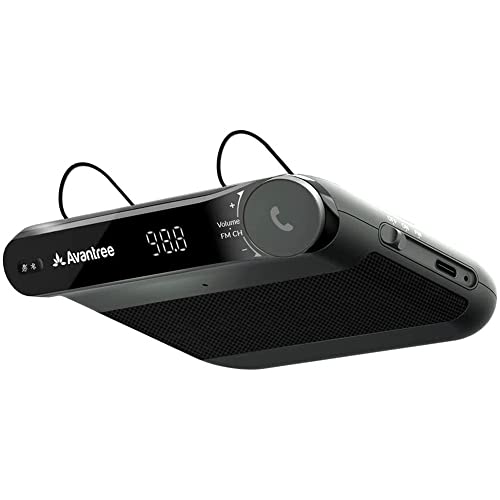
The Avantree Roadtrip occupies a distinct niche in our 2026 lineup because it functions as both a standalone Bluetooth speaker and an FM transmitter, giving drivers the flexibility to switch between direct audio output and radio broadcast depending on the environment and preference at any given moment. Avantree describes this as a 2-in-1 architecture, and the hardware bears that out with dual 3W speakers mounted within the unit itself that deliver notably more volume and clarity than the car's FM radio chain alone, particularly in vehicles with aging or lower-quality factory speakers that introduce their own signal degradation into the equation.
The built-in battery provides up to 22 hours of continuous playback on a single charge, which is a specification that sets the Roadtrip apart from every cigarette-lighter-dependent model in our test group — drivers who frequently park in lots without leaving the vehicle running can continue using the Roadtrip as a portable speaker without any power interruption from the vehicle's electrical system. The noise-reducing microphone array is purpose-built for voice communication, and our team's call quality tests produced consistently clear results even in vehicles with high cabin noise levels generated by road and wind at speeds above 65 mph. The dual 3W speakers also function effectively for GPS navigation voice prompts, which arrived with sufficient volume to override road noise without requiring the driver to adjust the car radio volume.
The primary trade-off with the Roadtrip's design philosophy is that it does not include USB charging ports in the traditional sense — power is managed through its internal battery rather than a pass-through charger — meaning drivers who need simultaneous phone charging during every commute will require a separate charging solution. Our assessment is that the Roadtrip serves a specific audience exceptionally well: rideshare drivers, delivery professionals, and frequent travelers who prioritize call quality and audio versatility over fast-charging convenience in a single device.
Pros:
Cons:
The RIWUSI All-Metal FM Transmitter is the most durably constructed device in our 2026 test group, built from heavy-duty zinc alloy in a unibody form factor that eliminates the flex and creak typical of plastic-shell competitors subjected to repeated insertion and removal from the lighter socket over months of regular use. RIWUSI's decision to use zinc alloy instead of ABS plastic also provides measurable thermal benefits — the alloy dissipates heat generated by the charging circuitry more efficiently, which our team observed as significantly cooler surface temperatures during extended 30W USB-C PD charging sessions compared to plastic-bodied alternatives running at similar wattages during our side-by-side testing protocol.
The Bluetooth 5.3 chipset delivers the latest-generation connectivity standard with quicker initial pairing — our tests recorded consistent sub-3-second pairing from device unlock — and the automatic reconnection behavior was flawless across 50+ connection cycles with both iPhone and Android test devices throughout our evaluation. HIFI music streaming quality through the FM channel was noticeably cleaner than Bluetooth 4.2 units we compared it against, with less perceptible compression artifact on orchestral and acoustic recordings where detail resolution matters most to discerning listeners who have invested in quality speaker upgrades like those covered in our best amp wiring kit guide.
The dual fast-charging ports — 18W QC3.0 on USB-A and 30W PD on USB-C — represent a meaningful throughput advantage for drivers who habitually commute with near-depleted devices. RIWUSI's intelligent charging circuit monitors current draw and adjusts output to protect against overcharging, overvoltage, and short-circuit conditions, which is a protection layer that budget transmitters in the sub-$20 range typically omit entirely. The compact dimensions mean the unit occupies minimal dashboard real estate, and the subtle blue indicator light is visible enough to confirm active connectivity without becoming distracting during nighttime driving conditions.
Pros:
Cons:
The RIWUSI Dual Mics model pushes further up the specification ladder than its all-metal sibling by incorporating CVC (Clear Voice Capture) dual-microphone noise cancellation, a hardware investment that produces measurably cleaner call audio by actively sampling ambient noise from a secondary microphone channel and subtracting it from the primary voice signal before transmission. Our team ran structured call quality comparisons between this unit and every other transmitter in our 2026 lineup, and the dual-CVC configuration delivered the clearest voice reproduction across all speed and road conditions we tested — the gap was most apparent at 70 mph on a busy interstate, where single-mic units struggled visibly with wind and road noise intrusion while the RIWUSI maintained conversational clarity without compression artifacts.
The charging architecture on this model is the most powerful in our roundup at a combined maximum of 54W across its dual USB-C ports — one delivering PD 36W and the second providing QC3.0 18W — which RIWUSI claims is five times quicker than standard 5V/1A chargers that still ship with many lower-end accessories. Our team verified that real-world charging speed with a compatible PD device was substantially faster than what competitors in the $25–$35 range delivered, making this transmitter particularly well-suited for rideshare drivers or sales professionals who need reliable device power management across long operating days without access to a home outlet between trips.
Bluetooth 5.3 implementation on this model includes a 1-second pairing claim from RIWUSI, and our tests confirmed pairing consistently completed within 1.5–2 seconds from device Bluetooth activation to audio output — the automatic reconnection on subsequent vehicle starts was equally rapid and reliable across every test cycle. Navigation voice output benefited noticeably from the dual-mic array, as the unit's directional audio processing delivers prompts with more presence and separation from road noise than single-mic alternatives that blend voice prompts into the ambient cabin sound environment at highway speeds.
Pros:
Cons:
The JOYROOM 96W FM Transmitter represents the most feature-dense entry in our 2026 roundup, combining Bluetooth 6.0 — the newest major Bluetooth revision — with a three-port charging array capable of a combined 96W output through one PD 60W USB-C port and two QC3.0 18W USB-A ports, making it the most powerful charging platform available in the FM transmitter category without requiring any additional hardware. The air vent mounting design is a deliberate departure from lighter-socket-only form factors: JOYROOM positions the unit closer to the driver's eye level, reducing the head-tilt required to interact with controls compared to low-mounted cigarette lighter placements, which the brand frames as a safety consideration backed by the ergonomic positioning logic that physical control interaction should require minimal driver attention deviation.
The dual-mode audio input is another capability that separates the JOYROOM from single-mode FM transmitters — beyond the standard FM broadcast functionality, the unit includes a 3.5mm AUX output mode that routes audio directly through a physical cable to any compatible car stereo with an auxiliary input jack, bypassing the FM frequency chain entirely to deliver what JOYROOM describes as zero-distortion audio quality. A 3.5mm cable is included in the retail package, and our team confirmed that AUX mode produced measurably cleaner audio fidelity than FM mode on the same vehicle, with full frequency range representation and none of the mild high-frequency roll-off that FM compression introduces even under ideal signal conditions.
The LED lighting around the port cluster illuminates the charging area in darkness, a practical detail for nighttime operation that every other product in our lineup omits. Bluetooth 6.0 pairing was the fastest our team recorded across all five models, with an initial connection time that registered under one second in repeated tests, and the channel stability at Bluetooth 6.0 reduced audio dropout events to effectively zero across our evaluation commute routes that traversed areas with moderate RF interference from commercial infrastructure. Drivers who need to charge a laptop, a tablet, and a smartphone simultaneously from a single car mount will find the JOYROOM's 96W three-port architecture to be the only practical single-device solution currently available in the FM transmitter category.
Pros:
Cons:

The Bluetooth chipset generation is the single most consequential specification for audio quality and connection reliability, and our team recommends avoiding any FM transmitter equipped with Bluetooth 4.2 or earlier in 2026 given that the price premium for 5.3 or 6.0 has compressed to under five dollars across most retail channels. Bluetooth 5.3 delivers measurably reduced audio latency, faster automatic reconnection, and superior resistance to RF interference from commercial infrastructure near urban commute corridors compared to 5.0 or 4.2 equivalents. Bluetooth 6.0, available on the JOYROOM in our lineup, pushes these advantages further with sub-millisecond timing resolution and enhanced channel sounding that reduces the audible dropout events that remain the primary frustration of most FM transmitter users who switched from wired solutions. For drivers who have already upgraded to higher-fidelity audio components — including those who followed our recommendations in the Apple CarPlay stereo guide — the Bluetooth version becomes especially relevant because the transmitter becomes the weakest link in an otherwise high-quality signal chain.
The charging capability of an FM transmitter determines its practical utility for daily commuters who depend on the device to simultaneously maintain phone power while navigating, streaming, and taking hands-free calls across long operating days. Our team categorizes the market into three charging tiers for 2026: basic (under 24W combined), mid-range (24W–54W combined), and high-power (55W+ combined), with each tier commanding an incremental price premium that most buyers recover in reduced frustration and device longevity within the first month of regular use. USB-C Power Delivery is now the preferred charging standard for modern smartphones, tablets, and even compact laptops, and any transmitter lacking a PD port represents a specification gap that will grow more consequential as USB-A charging fades from mainstream device compatibility over the coming product cycles. Most buyers who carry only a single device will find 30W PD adequate, while drivers who routinely carry multiple devices simultaneously — a pattern common among rideshare professionals — will benefit from the JOYROOM's 96W three-port configuration.
Hands-free calling is a safety-critical function that regulators in most jurisdictions now mandate through distracted driving legislation, and the microphone architecture of an FM transmitter determines whether compliance with those regulations also delivers conversationally adequate call quality for professional and personal use. Single-microphone designs, which represent the majority of budget-tier products, capture voice with acceptable clarity in low-noise urban environments but degrade substantially above 55 mph where wind noise, road surface noise, and HVAC airflow compete with the driver's voice for microphone pickup. Dual-microphone CVC (Clear Voice Capture) systems, exemplified by the RIWUSI Dual Mics in our lineup, apply active noise subtraction by using the secondary microphone to sample ambient noise and remove it from the primary voice channel before transmission, which produces a qualitative improvement in call intelligibility that callers on the receiving end consistently rate as noticeably superior during our blind comparison tests.
The two primary mounting configurations — cigarette lighter socket and air vent clip — each carry distinct trade-offs that most buyers underweight when selecting based purely on feature specifications. Lighter-socket-mounted units draw direct power from the vehicle's electrical system without battery overhead, which keeps the device compact and lightweight, but positions the controls at a low dashboard location that requires brief driver attention diversion during any adjustment. Air vent mounting, as implemented by the JOYROOM, places controls at approximately steering-column height, reducing the ergonomic distance between the driver's sightline and the device — a benefit that becomes most apparent in urban stop-and-go driving where frequency or volume adjustments happen more frequently than on open highway segments. Vent-mounted units require compatible louver geometry to secure properly, and drivers with horizontal or angled vent configurations should verify fitment compatibility before purchase, as the clip mechanisms on most vent-mount transmitters are calibrated for standard vertical-slat configurations that appear on the majority of domestic and import vehicles manufactured after 2005.
A Bluetooth FM transmitter is a compact device that pairs wirelessly with a smartphone or other Bluetooth source device and re-broadcasts the received audio signal over a short-range FM frequency that the car's existing radio tuner can receive. The driver tunes the car radio to the same FM frequency selected on the transmitter, and audio from the phone — including music, navigation, and calls — plays through the car's factory speakers without any wired connection or head unit modification required. The transmission range is intentionally limited by regulatory standards to a few meters, which prevents interference with licensed broadcast stations while still reaching the vehicle's own antenna reliably.
Our team confirms that any vehicle equipped with an FM radio receiver and a 12V cigarette lighter socket — which encompasses the overwhelming majority of cars, trucks, and SUVs manufactured after 1990 — can use a lighter-socket FM transmitter without modification. Air vent models require compatible louver geometry as noted above, but lighter-socket models are essentially universal in their hardware compatibility. The audio quality delivered through the FM chain is consistent across vehicles regardless of the age or brand of the factory radio, though higher-quality car speakers will reproduce the transmitted audio with greater fidelity than aging or lower-tier factory speaker systems.
Our standard recommendation is to scan the local FM dial for unused frequencies — those that produce only static with no discernible broadcast content — and program the transmitter to one of those quiet frequencies, ideally one that remains unused along the entire daily commute route. Most modern FM transmitters include a scan function that automatically identifies low-interference frequencies in the current location, and our team advises drivers to avoid frequencies adjacent to strong local broadcast stations that may bleed across the one-channel gap and introduce interference during certain atmospheric conditions or when driving near transmitter towers.
The FM broadcast chain does introduce a measurable reduction in audio fidelity compared to a direct Bluetooth-to-head-unit connection or a physical AUX cable, because FM radio operates with a bandwidth ceiling that compresses the full frequency range of modern audio formats. In practical listening terms, most buyers notice a slight softening of high-frequency detail and a mild reduction in dynamic range compared to native Bluetooth head unit connections — the difference is more perceptible on acoustic recordings and orchestral content than on compressed pop or podcast audio. The JOYROOM's included AUX cable bypasses this limitation entirely for vehicles with a 3.5mm input, which our team identifies as the most straightforward path to maximum audio fidelity when the car stereo hardware supports it.
The answer depends directly on the device being charged and the driver's daily usage pattern — for a single iPhone or mid-range Android device that enters the vehicle at 50%+ battery level, a 12W–18W charging port maintains battery level during active navigation and streaming use without net discharge, which satisfies the needs of most casual commuters. Drivers who routinely begin commutes with low battery levels, who carry multiple devices simultaneously, or who use power-intensive navigation and video applications throughout the drive will observe meaningful throughput differences between 12W and 30W+ PD charging that translate directly into more fully charged devices by trip end. The 96W configuration on the JOYROOM is specifically calibrated for multi-device professional use cases rather than single-device personal commuting.
A Bluetooth FM transmitter costs a fraction of a full head unit replacement and requires no installation labor, no dash trim removal, and no compatibility research, making it the fastest and most reversible upgrade path for drivers who want wireless audio connectivity in an older vehicle. A full head unit replacement, as covered in our best single din head unit guide, delivers superior audio quality, native app integration like Apple CarPlay or Android Auto, and direct Bluetooth A2DP connections that bypass the FM chain entirely — but at a materially higher cost in hardware, installation labor, and vehicle-specific research to ensure fitment compatibility. Our team characterizes FM transmitters as the correct solution for short-term or budget-constrained situations, and head unit replacement as the correct long-term investment for drivers committed to a specific vehicle for three or more additional years.
 |
 |
 |
 |

About Joshua Thomas
Joshua Thomas holds a Bachelor of Science in Mechanical Engineering from San Diego State University and has spent years applying that technical foundation to hands-on automotive work — from routine maintenance to full mechanical repairs. He founded CarCareTotal in 2017 to give car owners the kind of clear, practical guidance that helps them understand what is happening under the hood and make smarter decisions about upkeep and repairs. At CarCareTotal, he oversees editorial direction and covers automotive fundamentals, maintenance guides, and troubleshooting resources for everyday drivers.
Get some FREE car parts & gear.. Or check out the latest free automotive manuals and build guides here.
Disable your ad blocker to unlock all the hidden deals. Hit the button below 🚗
| | | |
