by Joshua Thomas
Picture this: a weekend detailer staring down an aisle of car buffers at the auto parts store, overwhelmed by orbit sizes, motor ratings, and brand names that mean nothing without context. We've been there — and after testing dozens of machines across paint correction sessions, we know exactly how confusing that first purchase feels. The right car buffer transforms a swirl-marked, dull finish into something that looks fresh off the showroom floor in 2026.

Car buffers fall into two broad camps: dual-action orbital polishers and rotary polishers. DA polishers use a random orbital motion that makes them forgiving and safe for paint — the tool of choice for removing light scratches and swirl marks without burning through clear coat. Rotary polishers spin on a fixed axis, delivering more aggressive cutting power ideal for professionals correcting heavy paint defects. Knowing which category fits a given task is the first step toward choosing the right machine.
Our team evaluated machines across all skill levels and budgets — from the entry-level PORTER-CABLE that's been a workshop staple for years to the professional-grade RUPES BigFoot lineup that dominates competition detailing events. We looked at orbit size, motor torque, vibration, ergonomics, and real-world polishing performance on a range of paint types. Whether shopping for a first DA or upgrading to a pro-level tool, the seven picks below cover the full spectrum of what's available in 2026. For a broader look at car care tools and gear, our full category covers everything from waxes to dent pullers. We also recommend pairing any buffer purchase with quality compound and polish — understanding the difference between polish and wax is essential before putting any machine to clear coat.
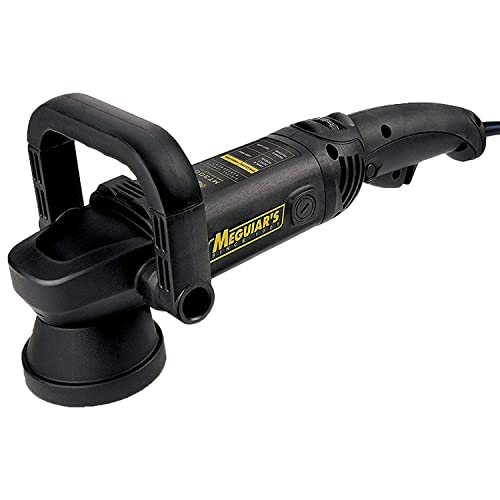







The Meguiar's MT300 earns its spot at the top of our beginner list because it genuinely removes the intimidation factor from paint correction. The multi-position D-handle is one of the most thoughtfully designed grips we've tested — it accommodates different hand positions depending on whether operators are working on horizontal panels or vertical door edges. That flexibility matters during long sessions. The digital torque management system keeps the machine from bogging down when the pad loads up with compound, which is a common frustration on cheaper DAs.
Soft start technology sets the MT300 apart from budget alternatives. On startup, the motor ramps up gradually rather than lurching — this controls pad movement and reduces the chance of compound fling across a freshly washed panel. The billet counterweight is a detail often overlooked on entry-level machines; it's what keeps the MT300 from vibrating aggressively at mid-to-high speed settings, which translates directly into better paint finish quality. We ran this machine through multiple full-vehicle correction sessions on soft Japanese lacquer and harder European clear coats — both polished out evenly without hot spots.
Where the MT300 shows its entry-level positioning is in raw cutting power. It won't match a RUPES BigFoot on heavily oxidized or scratched paint — for serious defect correction, a more aggressive machine or a dedicated body repair approach may be necessary first. But for swirl removal, gloss enhancement, and light compound work, it covers everything most home detailers need.
Pros:
Cons:
The PORTER-CABLE 7424XP has been the benchmark entry-level DA polisher for well over a decade, and in 2026 it still earns a recommendation for budget-conscious buyers who want a reliable starting point. The 4.5-amp motor won't win any power contests against the RUPES machines on this list, but it handles light-to-medium correction tasks on most everyday paint types with consistent results. The 6-inch backing pad and random orbital action produce swirl-free finishes on sedans and daily drivers where heavy paint defects aren't a concern.
The electronic variable-speed dial ranging from 2,500 to 6,800 OPM gives operators enough control to match speed to the task — lower settings for wax application and final polish, higher settings for compound work. Our team found the ergonomics functional if unspectacular; the grip is slightly bulkier than newer designs, but it's manageable for full-vehicle sessions on compact to mid-size cars. Vibration at higher speed settings is noticeable but not excessive.
The 7424XP's greatest strength is its price-to-performance ratio and parts availability. Replacement backing plates, pad accessories, and service parts are easy to source. For first-time users who want to learn paint correction before committing to a premium machine, it remains one of the most sensible starting points on the market.
Pros:
Cons:
The RUPES LHR15V Mark V represents the Italian brand's fifth-generation refinement of what many professionals consider the gold standard in mid-size random orbital polishers. The Mark V designation signals meaningful engineering updates — not just cosmetic changes. The composite POLYSYNTHEC gears deliver approximately 47% noise and vibration reduction compared to previous generations, which makes a tangible difference during multi-panel correction sessions. Less vibration means better feedback through the pad and reduced operator fatigue.
The 5-inch backing pad and 0.5-inch orbit make this the precision tool in the RUPES lineup. Smaller orbit means less aggressive cutting per pass, but greater control — ideal for working around trim pieces, tight body lines, and curved panels where pad slipping is a real concern. The PrecisionPro pads included with the LHR15V Mark V feature a protective rubber edge that prevents marring adjacent trim and improves control at the pad perimeter. The anti-spinning ring is a thoughtful addition that prevents the pad from free-spinning under zero load, eliminating one of the more common causes of surface damage during repositioning.
Build quality is what separates RUPES from the field. The compact body design balances well in hand, and the engineering tolerances are noticeably tighter than anything at a similar price point from generic brands. For professional detailers or serious enthusiasts who want a mid-size DA that handles both maintenance polishing and moderate defect correction, the LHR15V Mark V is our top choice in this class.
Pros:
Cons:
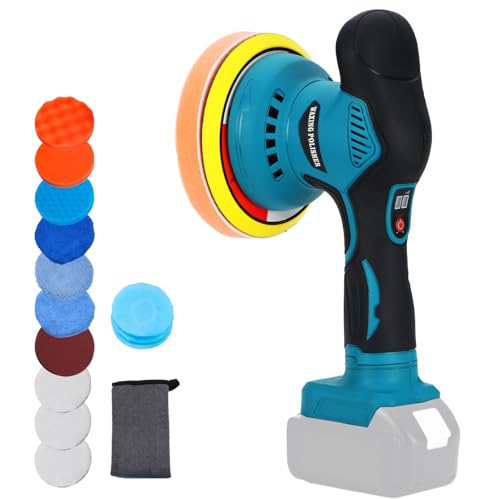
Cord management on a car that's been pulled into a garage for detailing sounds like a minor inconvenience until the power cable snags a mirror or drags compound across a freshly polished hood. The Alrigon cordless orbital buffer eliminates that frustration entirely by running off Makita 18V lithium-ion batteries — the same platform that powers millions of workshops worldwide. Compatibility extends across the BL1815N, BL1820B, BL1830, BL1840B, BL1850B, BL1860B, and related variants, meaning most Makita tool owners can pick this up as a drop-in addition to an existing battery ecosystem.
The brushless motor is the headline spec here. Compared to conventional brushed motors, brushless technology delivers approximately 50% longer runtime per charge cycle — a meaningful number when a full correction session on a full-size truck can run 90 minutes or more. Brushless motors also generate less heat, which extends both motor and battery longevity over time. The 6-inch orbital action handles standard correction and finishing work with good pad contact across flat and moderately curved panels.
The primary limitation is that this is a tool-only listing — no battery or charger included. For buyers who already own Makita 18V batteries, this is a non-issue. For buyers new to the Makita ecosystem, factor in battery cost. Cordless polishing does sacrifice some sustained torque compared to direct-wired professional units, but for detailing work on personal vehicles, the freedom of movement more than compensates.
Pros:
Cons:
The RUPES LHR21V Mark V is built for operators who need to cover ground fast without sacrificing finish quality. The 6-inch backing pad paired with a 1-inch orbit creates significantly more aggressive material removal per pass than the 15V's tighter orbit — which is exactly what's needed when correcting hood panels, roofs, and doors on full-size vehicles. Our team ran this machine on a deeply scratched hood with a moderate-cut compound, and the defect removal rate was impressive compared to smaller-orbit alternatives.
The POLYSYNTHEC composite gear system carries over from the Mark V platform with the same 47% noise and vibration reduction benefit. For a machine with a 1-inch orbit, the vibration levels are remarkably controlled — a direct result of the precision-balanced rotating mass and improved gear geometry. The minimal lubrication requirement of the POLYSYNTHEC gears is also a practical benefit for shops running high-volume detailing work, where gear maintenance on conventional machines adds operational overhead.
Motor efficiency is another Mark V hallmark. The redesigned motor runs cooler and converts more electrical input into working torque rather than heat dissipation — which translates to more consistent cutting performance on long sessions. This is the machine that handles paint correction on large commercial vehicles, fleet cars, and any project where working speed matters. Professionals and serious enthusiasts who need real throughput — this is our pick. Understanding the relationship between the polishing stage and the protection stage is important here; read our wax vs. sealant comparison to choose the right final protection after buffing.
Pros:
Cons:
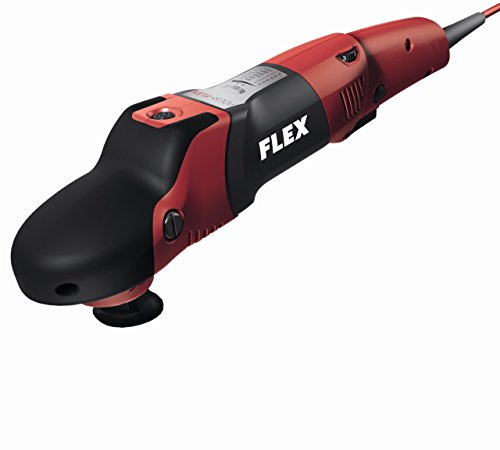
When DA polishers reach their correction limit, a rotary machine is the answer. The FLEX PE 14-2 150 is a professional-grade rotary polisher built around a 1,400-watt motor — genuine power that removes deep scratches, severe oxidation, and heavy swirl patterns that orbital machines simply cannot address in a reasonable number of passes. According to established automotive polishing principles, rotary polishers generate more heat through friction, which is precisely what enables aggressive paint correction — and what demands respect from the operator.
The PE 14-2's planetary and angular gear combination is an engineering distinction that separates it from rotary machines with simpler gear arrangements. The result is quieter operation and smoother torque delivery than traditional single-stage rotary gearing. The high-efficiency ventilator keeps the motor operating at optimal temperature even during extended high-load sessions — a meaningful feature when running aggressive compounds on oxidized fleet vehicles or show car restoration projects where the machine runs for hours at a stretch.
This tool demands skill and respect. Rotary polishers in the wrong hands burn clear coat, create holograms, and cause irreversible paint damage. Our team treats the PE 14-2 as a professional's instrument — not a beginner's tool. For operators who understand heat management, pad selection, and machine speed relative to paint hardness, this is among the most capable correction platforms available in 2026. Pair it with a quality DA for finishing and any paint correction scenario is addressable.
Pros:
Cons:
The RUPES LHR75E occupies a specific and important niche: tight spaces that full-size polishers simply cannot access. Door jambs, mirror backs, A-pillars, bumper corners, and the tight radius curves around headlights — these are areas where a standard 6-inch DA creates more problems than it solves. The LHR75E's compact form factor and 3-inch pad size access these zones with genuine polishing effectiveness rather than the awkward hand-polishing that most detailers resort to when the big machine won't fit.
The ergonomic design is exceptional for this machine class. RUPES shaped the front cover with non-slip rubber inserts that provide a secure grip without requiring the operator to white-knuckle the machine on tricky angles. The on/off lever is lined in non-slip rubber and delivers a controlled soft start — a refinement that matters when the machine is positioned in a tight cavity where an abrupt startup could cause unwanted pad movement. The electronic speed control adjusts easily without interrupting polishing work, which operators appreciate when transitioning between tight concave areas and flat surfaces in the same pass.
The LHR75E is not a replacement for a full-size DA on large panels — its 3-inch coverage makes whole-vehicle correction impractical. It's a specialist tool that eliminates the compromise of leaving tight areas unpolished on an otherwise perfect correction job. Professional detailers who demand complete coverage on every panel will find it indispensable. It also pairs naturally with any of the larger machines on this list for a complete two-machine correction setup.
Pros:
Cons:
This is the first decision, and it matters more than any other spec on the box.
On DA polishers, orbit size (measured in inches or millimeters) determines how aggressively the machine cuts per pass.
A dual-action (DA) polisher moves the pad in a random orbital pattern — simultaneously rotating and oscillating — which distributes heat and makes it safe for clear coat on most paint types. A rotary polisher spins on a fixed axis, generating more concentrated friction and more aggressive cutting power. DA polishers are safe for beginners; rotary polishers require skilled operation to avoid paint damage.
For most home detailers and enthusiasts, a machine with a 15mm (approximately 0.6-inch) or larger orbit provides a practical balance of cutting ability and safety. Larger orbits like the 21mm (approximately 0.8–1-inch) on the RUPES LHR21V are better for aggressive correction on large panels, while smaller orbits provide greater control on curved and delicate surfaces.
DA polishers combined with cutting compounds handle light-to-moderate scratches effectively — swirl marks, light clear coat scuffs, and water spot etching respond well to machine polishing. Deep scratches that penetrate through the clear coat and into the base coat or primer cannot be removed by polishing alone. Those defects require wet sanding, paint touch-up, or professional bodywork before polishing can restore gloss.
A single-stage polish on a clean, prepared vehicle takes most operators between 3 and 6 hours depending on vehicle size, defect severity, and operator experience. A two-stage correction — heavy compound followed by a finishing polish — on a heavily swirled vehicle can extend to 8–12 hours. Using a larger-orbit machine like the RUPES LHR21V reduces session time on large panels compared to smaller-orbit alternatives.
Pad selection depends on the task. Cutting pads (firm foam or microfiber) pair with compound for defect removal. Polishing pads (medium foam) work with polish for refining the finish after cutting. Finishing pads (soft foam) apply wax, sealant, or finishing gloss. Most manufacturers provide pad recommendation charts — matching pad and product to the correction stage produces better results than mixing pad firmness arbitrarily.
A rotary polisher is not recommended for home detailers without prior training. The fixed-axis rotation generates concentrated heat that can burn through clear coat, create buffer trails, or leave hologram patterns in paint — all permanent damage without professional correction. Home users achieve better results and avoid paint damage risk with a quality DA polisher. Reserve the rotary for professional shops or operators who have trained specifically on the tool.
Every machine on this list earns its place — from the beginner-friendly Meguiar's MT300 to the professional FLEX PE 14-2 rotary — and the right choice comes down to matching the tool to the specific correction task and operator skill level. Our team recommends starting with the RUPES LHR15V Mark V for anyone serious about paint quality without the learning curve of a rotary, or the PORTER-CABLE 7424XP for budget-conscious first-time buyers who want a reliable entry point. Pick the machine that fits the job, invest in quality pads and compound, and the results will speak for themselves.
 |
 |
 |
 |

About Joshua Thomas
Joshua Thomas holds a Bachelor of Science in Mechanical Engineering from San Diego State University and has spent years applying that technical foundation to hands-on automotive work — from routine maintenance to full mechanical repairs. He founded CarCareTotal in 2017 to give car owners the kind of clear, practical guidance that helps them understand what is happening under the hood and make smarter decisions about upkeep and repairs. At CarCareTotal, he oversees editorial direction and covers automotive fundamentals, maintenance guides, and troubleshooting resources for everyday drivers.
Get some FREE car parts & gear.. Or check out the latest free automotive manuals and build guides here.
Disable your ad blocker to unlock all the hidden deals. Hit the button below 🚗
| | | |
