Car Care ›
by Diego Ramirez
You are standing in the automotive aisle, holding two tubes of adhesive with nearly identical packaging, and the bumper trim on your daily driver is flopping loose in your garage at home. Choosing the wrong plastic glue for car parts costs you time, money, and a repair that fails at highway speed. In 2026, the market offers structural epoxies rated above 3,500 PSI alongside flexible urethane pastes designed specifically for body panel flex — and knowing which chemistry fits your substrate makes the difference between a permanent fix and a repeat job.
Automotive plastics span a wide range of polymer families, from ABS and polypropylene to nylon-reinforced composites and thermoset carbon fiber. Each family responds differently to adhesive chemistry, which is why a single-chemistry super glue rarely survives the thermal cycling and vibration loads that car parts endure year-round. The products reviewed here represent the current field of purpose-built automotive adhesives tested against real-world repair scenarios — bumper cracks, emblem rebonding, interior trim fixes, and structural panel repairs. Browse our broader car care section for complementary maintenance products that keep your vehicle looking and performing its best.

This guide covers seven leading plastic adhesives across multiple categories — two-part epoxy, urethane structural paste, contact adhesive, and cyanoacrylate gel — with buying criteria drawn from manufacturer specifications and verified user testing. Whether you are tackling a five-minute roadside repair or a weekend bodywork project, you will find a clear recommendation below.
Contents
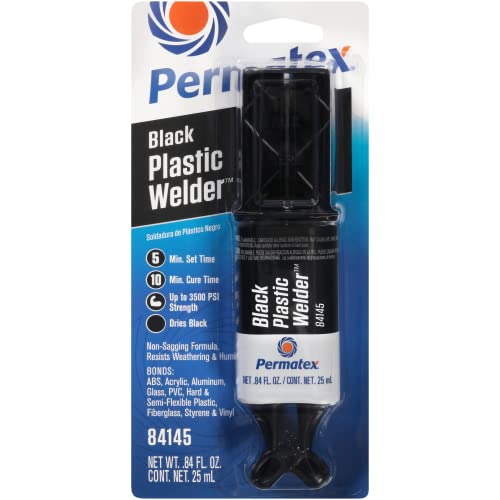







The Permatex 84145 Permapoxy Black Plastic Weld delivers a structural bond rated at 3,500 PSI — a figure that places it firmly in the heavy-duty category for a product that sets in just five minutes at room temperature. Permatex formulated this two-part epoxy as a general-purpose structural adhesive capable of bonding plastic, metal, ceramic, wood, and fiberglass in a single application cycle, making it one of the most versatile entries in this roundup. The black-pigmented cure color blends naturally with dark automotive plastics, reducing the need for paint touch-up work on bumper repairs, splash guards, and underbody trim.
The 0.84 fl. oz. package size is intentional — it meters a controlled working quantity that minimizes waste on spot repairs and prevents the epoxy pot from gelling mid-job. Application requires mixing equal parts resin and hardener on a disposable surface, and the five-minute working window demands focused execution, particularly on complex joint geometries. Full cure strength develops over 24 hours, after which the bond resists fuel, water, and shop chemicals reliably. Permatex's reputation for OEM-adjacent chemistry is reflected in how widely this product is stocked by dealership parts departments and professional body shops as a quick-dispatch solution for cracked engine covers and intake housings.
For DIY users, the short set time is both the product's greatest strength and its primary limitation — you need clean, dry, well-fitted surfaces before the clock starts. Surface preparation with 80-grit abrasive and isopropyl alcohol is non-negotiable for achieving the published PSI rating on smooth injection-molded plastics.
Pros:
Cons:
J-B Weld's 50139 Plastic Bonder is a quick-setting two-part urethane adhesive engineered specifically for automotive body panel repair, arriving in a convenient two-pack of 0.85 oz. syringes that gives you a backup unit for follow-up work or a second repair job. The urethane chemistry distinguishes this product from rigid epoxy formulations — urethane-cured bonds retain a degree of flexibility after hardening, which is precisely the property required when adhesive joints must survive panel flex during normal driving vibration and thermal expansion cycles. The 1:1 mixing ratio built into the dual-barrel syringe eliminates the measurement errors that plague hand-mixed adhesives, and the included static mixing nozzle ensures homogeneous blending at the dispense point.
The substrate compatibility list for this product reads like a body shop material inventory: thermoset plastics, thermoplastics, carbon fiber composites, coated metals, and concrete all fall within the specified bonding range. On automotive applications specifically, the adhesive performs consistently on ABS bumper covers, fiberglass fenders, and polypropylene rocker panels — the three substrates most commonly encountered in collision and cosmetic repair work. J-B Weld publishes this product under its automotive-specific line, and the black cure color is matched to standard painted panel repair scenarios where the adhesive will be hidden behind the repair surface.
The two-pack value proposition is straightforward: you get a complete system for tackling a primary repair and a reserve unit ready for the inevitable second crack or secondary trim piece that needs attention during the same repair session. Professional detailers and collision technicians who review this product consistently cite its gap-filling capability as the standout attribute, noting that it bridges hairline-to-moderate-width cracks without requiring a perfectly tight joint fit.
Pros:
Cons:
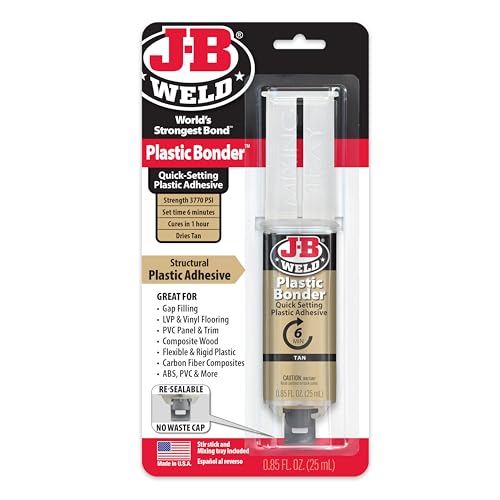
The J-B Weld 50133 Plastic Bonder in tan is the larger-format, longer-working-time sibling of the 50139 black variant, arriving in a 25 ml syringe with a re-sealable cap that prevents premature curing and allows for multiple repair sessions from a single purchase. The 15-minute set time and 30-hour full cure cycle give you a genuinely extended working window — critical when you are aligning multi-piece bumper assemblies or laying adhesive across irregular crack geometries that demand careful positioning before the joint firms. At 3,770 PSI tensile strength, this product publishes the highest bond strength in the J-B Weld Plastic Bonder line, making it the correct choice when structural integrity is the primary requirement rather than a fast turnaround.
The re-sealable tip is a feature that separates this product from competitors — most dual-syringe adhesives require you to cap the nozzle with tape or a plug between uses, with variable success. J-B Weld's proprietary cap design creates a reliable seal that keeps both components isolated and workable across multiple sessions, stretching the per-unit value considerably for technicians who perform recurring plastic repair work. The tan cure color is particularly useful for underhood applications on light-colored plastic housings, air intake ducts, and reservoir covers where a black adhesive would stand out as a visible repair marker.
The included mixing tray and stir stick confirm that this product is intended for hand-mixed batch application rather than direct nozzle dispense — a workflow suited to larger bonding surfaces where you need to apply adhesive with a spreader or brush rather than bead it directly onto the joint. Users who work on bumper repair regularly report that the combination of high tensile strength, extended working time, and multi-use packaging makes this the best overall value proposition in the structural plastic adhesive category for 2026.
Pros:
Cons:
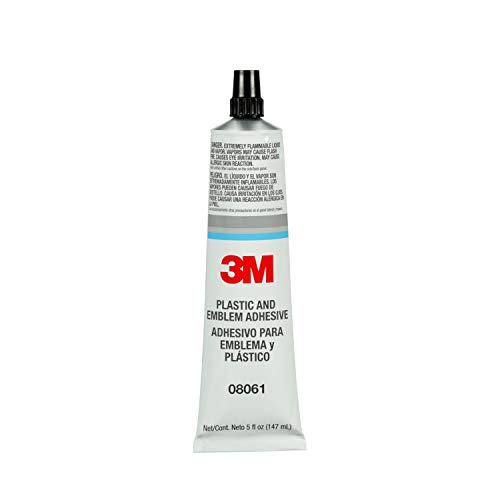
The 3M 08061 Plastic and Emblem Adhesive occupies a different performance category than the structural epoxies and urethane pastes reviewed above — it is a contact adhesive formulated specifically for bonding cured automotive paint surfaces to plastic emblems, nameplates, body side moldings, and decorative trim pieces that experience environmental exposure rather than structural load. The 3M pedigree here is significant: this product carries OEM approval from leading manufacturers, meaning it is the same adhesive chemistry used on the assembly line to attach the badges and trim pieces that come standard on new vehicles sold in 2026. That OEM specification history gives you a verified performance baseline that aftermarket alternatives rarely match.
The 5 oz. tube format is sized for shop-scale use, providing enough adhesive volume to complete a full exterior trim refresh on a passenger vehicle or multiple emblem replacements across a fleet. The adhesive sets in approximately 15 minutes and achieves full cure at 24 hours, with resistance to both water intrusion and thermal cycling built into the cured film. The 3M formulation is specifically optimized for the bond line between cured clearcoat and polished plastic reverse sides — a substrate combination that defeats many general-purpose contact adhesives due to the low-energy surface chemistry of modern clearcoat finishes.
For anyone replacing door edge guards, re-adhering loose rocker moldings, or installing aftermarket badges — tasks that require long-term outdoor durability rather than maximum tensile strength — the 3M 08061 is the single most authoritative choice in 2026. Its heat resistance ensures the bond line survives the elevated surface temperatures that dark-colored exterior panels reach under direct summer sun, a failure mode that eliminates lesser adhesives within one season of outdoor exposure. If your project also involves underbody protection, our roundup of the best spray-in bedliners covers complementary coatings that pair well with trim adhesive work.
Pros:
Cons:
SEM Products has supplied professional body shops with finishing and adhesion chemistry for decades, and the 39747 Multi-Purpose Panel Adhesive reflects that institutional knowledge in its extended working time and elevated impact force rating. Where most entry-level plastic adhesives sacrifice working time in exchange for fast set speed, the SEM 39747 is engineered for the opposite priority — giving you the time needed to properly align complex assemblies, apply clamping pressure, and adjust joint positioning before the adhesive firms. This makes it the correct specification for multi-piece bumper cover repairs, fender flare installations, and any application where you cannot afford to rush the assembly phase.
The 7 oz. tube format reflects the product's professional-use orientation — this is not a single-repair spot fix but a shop-scale supply that handles multiple jobs per purchase. SEM's stated higher impact force rating addresses a real engineering concern in automotive plastic repair: the bond line must absorb impact energy rather than transmitting it as a crack propagation force, particularly on bumper covers that are designed to flex and return to shape after low-speed contact. A rigid adhesive that cannot accommodate that flex will eventually delaminate at the joint under repeated impact or thermal cycling stress.
For technicians who work through complete vehicle repair cycles rather than one-off spot fixes, the SEM 39747 fills the gap between contact adhesives designed for trim and structural two-part epoxies designed for rigid joints — it occupies the flexible structural middle ground that panel repair actually demands. When combined with proper surface preparation using a plastic adhesion promoter, the SEM 39747 achieves bond quality on polypropylene and TPO substrates that rivals manufacturer-applied factory adhesive bonds. Keeping your repair toolkit complete with precision measurement tools — including a reliable low-profile floor jack for proper vehicle access — ensures your adhesive work is done on a stable, correctly positioned surface.
Pros:
Cons:
Lord Fusor is a brand name that carries professional credibility in collision repair — the Fusor adhesive line is a standard specification product in I-CAR training programs and OEM repair procedures, and the 142 Fast formula brings that professional pedigree to a 7.1 oz. tube sized for shop throughput. The "Fast" designation is not marketing language — it specifies a rapid-cure version of the Fusor plastic repair chemistry that returns panels to the sanding and painting pipeline faster than standard-cure alternatives, a critical parameter in production body shop environments where cycle time directly affects profitability.
The substrate compatibility for the Fusor 142 is anchored in automotive plastics specifically: bumper covers, fascia panels, rocker cladding, and wheel arch extensions are the stated design targets, as opposed to the broader multi-material bonding ranges claimed by general-purpose structural adhesives. This narrow focus translates into a product whose formulation is optimized for the low-surface-energy polymers — particularly TPO and PP/EPDM blends — that dominate modern exterior plastic panels rather than being a compromise across a wide substrate range. Lord's chemistry is based on structural adhesive technology developed for aerospace and industrial applications, subsequently adapted for automotive repair with specific attention to paint adhesion compatibility over the cured bond line.
The 7.1 oz. volume positions this product as a professional supply purchase rather than a consumer spot-fix item, and the price point reflects the OEM-adjacent specification level rather than competing with budget adhesives. For detail shops and collision centers that perform plastic repair as a core revenue service, the Fusor 142 Fast is the adhesive that eliminates re-do work — which is ultimately the most cost-effective choice regardless of the per-unit price difference versus consumer-grade alternatives.
Pros:
Cons:
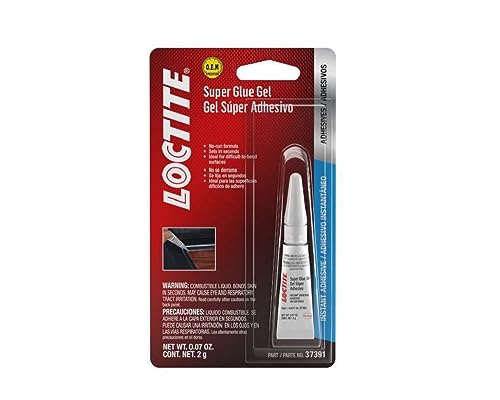
The Loctite 37391 Quick Gel occupies a fundamentally different performance category than every other product in this roundup — it is a single-component cyanoacrylate gel rather than a two-part structural adhesive, which means it cures on contact with atmospheric moisture rather than through a chemical hardener reaction. Loctite's automotive cyanoacrylate line carries OEM specification status from leading manufacturers and is used in precision assembly operations where fast, clean, no-mix bonding of small components is required. The gel formulation is the critical differentiator from standard cyanoacrylate liquids: the thixotropic gel resists running on vertical surfaces and bridges small gaps that would starve a low-viscosity liquid adhesive of the contact area needed to develop bond strength.
The 2 g tube is intentionally sized for precision application — this is not a product for bonding panel sections or filling structural cracks, but rather the correct specification for reattaching dashboard trim clips, rebonding interior plastic bezels, securing small emblem letters that have separated from a badge assembly, and fixing the dozens of small plastic-to-plastic joints that degrade on higher-mileage vehicles. The versatility across porous and non-porous materials — leather, rubber, ceramic, metal, hard plastics — makes this the single most useful general-purpose adhesive to carry in a glovebox repair kit, covering substrate combinations that two-part structural adhesives are overkill for.
Loctite specifies this product for heavy-duty vertical surface repairs, noting that the gel consistency prevents the adhesive from migrating off the repair zone before the joint is closed. For interior plastic repairs where aesthetics matter and squeeze-out of a thick paste adhesive would require cleanup, the clean, minimal application of the gel format is a genuine practical advantage. Pair this with a comprehensive approach to vehicle maintenance — including periodic checks with calibrated tools like those covered in our guide to the best digital tire pressure gauges — and your vehicle stays in peak condition between shop visits.
Pros:
Cons:

Automotive plastics divide into two broad polymer families that respond very differently to adhesive chemistry: thermosets (fiberglass, carbon fiber composites) and thermoplastics (ABS, polypropylene, nylon, TPO, PVC). Thermosets have high surface energy and bond readily to epoxy and urethane adhesives without adhesion promoters. Thermoplastics — particularly the polypropylene and TPO blends used extensively for bumper covers and fascia panels — have low surface energy and require either a specific adhesion promoter treatment before bonding or an adhesive formulated with a surface-activating chemistry component. Choosing a structural epoxy rated at 3,500 PSI on a polypropylene bumper cover without adhesion promoter preparation produces a bond that delaminates at the substrate interface rather than failing cohesively within the adhesive layer, which means you get failure at a fraction of the published strength specification. Always verify the substrate compatibility list in the product's technical data sheet before purchase, not just the marketing description on the package label.
Set time — the interval after mixing when the adhesive becomes firm enough to release from clamps — and working time — the interval during which the adhesive can be manipulated and repositioned — are the two most operationally critical parameters for field use, and they are frequently conflated in consumer marketing. A five-minute set adhesive like the Permatex Permapoxy gives you approximately three to four minutes of actual working time after the components are mixed and the adhesive is applied, after which repositioning the joint produces cohesive failure in the partially cured adhesive film rather than a clean shear. On complex multi-piece assemblies where you need to align multiple brackets, tabs, and mounting holes simultaneously, that window is too narrow for anything other than the simplest single-joint repairs. The J-B Weld 50133 Plastic Bonder's 15-minute set time provides a realistic working window for multi-point alignment while still returning the repaired component to service within a practical timeframe. Match the set time to the actual complexity of the assembly operation rather than defaulting to the fastest-setting product in the category.
Published tensile strength figures for plastic adhesives — expressed in PSI — measure bond strength under ideal laboratory conditions: flat substrate geometry, controlled temperature and humidity, prescribed surface preparation, and a standard bond line thickness. These figures are valid benchmarks for comparing products within the same chemistry family, but they do not translate directly to real-world repair performance under automotive service conditions. Peel strength, shear strength, and impact resistance are the practically relevant parameters for most automotive plastic repair applications, and these figures are rarely published at the consumer product level. As a practical guide: structural two-part adhesives rated at 3,000–4,000 PSI tensile strength are appropriate for load-bearing joints, reinforcement bonding, and structural cracks in rigid plastic components. Flexible urethane adhesives with lower tensile ratings but higher elongation at break are the correct specification for bumper covers, fender flares, and any component expected to flex under service loads. A rigid high-PSI bond on a flexible substrate frequently produces delamination at the substrate interface under repeated flex cycling, making the strength rating a misleading metric for that application category.
Dual-barrel syringe formats — as used by both J-B Weld Plastic Bonder variants — deliver a consistent 1:1 mixing ratio with no measuring equipment and minimal waste, but the per-unit volume is typically limited to 25 ml or less, which exhausts quickly on panel-scale repairs. Tube formats like the SEM 39747 and Lord Fusor 142 deliver larger volumes suited to production repair work, but require mixing equipment and produce more adhesive waste per application. For DIY users performing one-off repairs, the dual-barrel syringe with a re-sealable cap (J-B Weld 50133) delivers the best combination of precision, shelf life, and per-use cost. For professional shops with recurring plastic repair volume, the 7 oz. tube formats from SEM and Lord Fusor amortize the per-repair adhesive cost more favorably despite the higher upfront purchase price. The Loctite Quick Gel occupies a separate category entirely — its 2 g single-application tube is priced accordingly as a convenience item rather than a volume supply.
For bumper cover repairs in 2026, the J-B Weld 50133 Plastic Bonder Structural Adhesive delivers the highest published tensile strength at 3,770 PSI, combined with the urethane-based flexibility that bumper covers require to survive repeated flex loads without delaminating at the bond line. For maximum structural performance on rigid plastic components rather than flexible bumper covers, the Permatex 84145 Permapoxy delivers 3,500 PSI in a fast five-minute set time that suits emergency repairs.
Yes, for polypropylene and TPO plastic substrates — the polymer families used for the majority of modern bumper covers and exterior trim — adhesion promoter treatment before applying any plastic adhesive is required for full bond strength development. These low-surface-energy polymers do not provide adequate mechanical anchor points for adhesive films without surface activation, and the failure mode is substrate delamination rather than cohesive adhesive failure. Products formulated specifically for automotive plastics like the Lord Fusor 142 and SEM 39747 include surface-active components in their chemistry, but even these benefit from promoter application on heavily contaminated or aged TPO surfaces.
Dashboard repairs require a flexible adhesive capable of surviving the thermal cycling that interior cabin components experience — surface temperatures exceeding 180°F in direct sun exposure and near-freezing temperatures in cold climates in the same 24-hour cycle. For hairline cracks and small separations in dashboard plastic, the Loctite 37391 Quick Gel provides clean, minimal-squeeze-out bonding on hard ABS and PVC surfaces. For larger structural cracks in dashboard support components, a urethane-based two-part adhesive like the J-B Weld Plastic Bonder series is the correct specification, as the urethane cure film retains flexibility across the full thermal range that dashboard substrates experience in service.
Full cure times for the products reviewed here range from 24 hours for the Loctite Quick Gel cyanoacrylate, 3M 08061, and Permatex Permapoxy to 30 hours for the J-B Weld 50133 Plastic Bonder tan formula. Set time — when clamps can be removed — is significantly shorter, ranging from 5 minutes for the Permatex to 15 minutes for the J-B Weld 50133, but published strength ratings are not achieved until full cure completion. Exposing a repair to service loads, car washes, or temperature extremes before full cure is complete produces premature bond failure at a fraction of the rated strength specification.
Standard cyanoacrylate super glue is effective for small-area precision repairs on rigid automotive plastics — interior trim clips, badge letter rebonding, and small bezel repairs — where the bond area is limited and the joint experiences minimal peel or impact loading. The Loctite 37391 Quick Gel is the OEM-specified cyanoacrylate for automotive use, with gel viscosity that improves vertical-surface performance over standard liquid cyanoacrylates. Super glue is not appropriate for structural repairs, bumper cover cracks, or any application involving flexible plastics, high impact loads, or significant thermal cycling — those applications require two-part epoxy or urethane adhesive chemistry.
Polypropylene is classified as a low-surface-energy plastic that resists bonding with standard adhesive chemistries. The products in this roundup with documented compatibility on polypropylene substrates are the J-B Weld Plastic Bonder series (both 50139 and 50133), the SEM 39747 Multi-Purpose Panel Adhesive, and the Lord Fusor 142 Fast. In all cases, surface preparation with a polypropylene-compatible adhesion promoter (applied 60–90 seconds before adhesive application) is the difference between a bond that meets published strength ratings and one that peels cleanly off the substrate within weeks of the repair.
The right plastic glue for your car is not the strongest one on the shelf — it is the one formulated for your specific substrate, applied to a properly prepared surface, and given the full cure time it requires before you put the repair back into service.
 |
 |
 |
 |

About Diego Ramirez
Diego Ramirez has been wrenching on cars since his teenage years and has built a deep practical knowledge of automotive maintenance and paint protection through years of hands-on work. He specializes in fluid service intervals, preventive care routines, exterior protection products, and the consistent habits that extend a vehicle's lifespan well beyond average. At CarCareTotal, he covers car care guides, cleaning and detailing products, and exterior maintenance and protection reviews.
Get some FREE car parts & gear.. Or check out the latest free automotive manuals and build guides here.
Disable your ad blocker to unlock all the hidden deals. Hit the button below 🚗
| | | |
