by Liam O'Brien
Which steam cleaner actually delivers on its promises — and which ones just push hot air? If you've spent any time researching this category, you already know the market is flooded with options at every price point, from budget-friendly floor mops to professional-grade canister systems that rival commercial equipment. The good news: after rigorous testing and deep-dive research in 2026, one model consistently rises above the competition — the Vapamore MR-100 Primo, a professional-grade Italian-designed system that sets the standard for chemical-free sanitization at home. But the right choice for you depends heavily on your specific cleaning challenges, your floors, and whether you need something that pulls double duty as a car detailer or garment steamer.
Steam cleaning has become the go-to solution for households that want hospital-grade sanitation without the chemical residue that traditional cleaners leave behind. According to the EPA's Safer Choice program, reducing household chemical exposure is a meaningful step toward healthier indoor air quality — and steam cleaners accomplish exactly that, using nothing but heated water to eliminate up to 99.9% of bacteria, viruses, and allergens on contact. Whether you're dealing with grout stains in a tiled bathroom, hardwood floors that can't tolerate harsh detergents, or a vehicle interior that needs professional-level attention, the right steam cleaner transforms what used to be a laborious chore into an efficient, satisfying process. If you're also upgrading your garage workspace, our roundup of the best garage floor mats of 2026 pairs naturally with a quality steam cleaner for a complete floor-care setup.
We evaluated seven leading steam cleaners across multiple dimensions — heat-up time, steam pressure, tank capacity, accessory quality, and real-world versatility — to bring you this definitive guide. The products below represent the best options across distinct use cases, from the lightest everyday mop to the most capable multi-surface canister system. Read through the detailed reviews, consult the buying guide, and you'll have everything you need to make a confident purchase decision today.

Contents







The BISSELL PowerFresh 1940A has earned its reputation as one of the most dependable everyday floor steam mops on the market, and in 2026 it still holds that title with confidence. Its 12-inch cleaning path covers meaningful ground with each pass, and the variable three-setting steam control gives you real flexibility — dial it down for a quick refresh on sealed hardwood, then crank it up when you're dealing with dried-on spills and grease on tile. The built-in Easy Scrubber is the feature that separates this model from basic mops: rather than requiring a separate scrubbing tool or extra elbow grease, you simply flip it down directly over stubborn messes and the concentrated steam does the work. That scrubber is particularly effective on grout lines where dirt tends to accumulate and resist flat-pad cleaning.
BISSELL's sanitization claim is backed by independent laboratory testing — this mop kills 99.9% of germs, bacteria, and viruses when used as directed, which means no chemical additives, no residue, and no lingering odors after cleaning. The spring-loaded swivel head navigates around chair legs and along baseboards without requiring you to manually reposition the unit, and the washable microfiber pads hold up through hundreds of cleaning cycles without losing their effectiveness. If you have pets or young children who spend time on your floors, the chemical-free approach here isn't just a selling point — it's a meaningful safety advantage over traditional floor cleaners.
Where the 1940A shows its limitations is in versatility: this is a dedicated floor mop, and it doesn't convert to a handheld unit or reach above-floor surfaces. The tank capacity is modest, which means you'll refill more frequently on larger open-plan floors. It also performs best on sealed hard floors — it's not designed for carpet spot cleaning or textile sanitization, so if those are priorities, you'll want to look further down this list. For its core purpose, though — keeping your hardwood, tile, and laminate floors consistently clean without chemicals — it's difficult to beat at this price point.
Pros:
Cons:
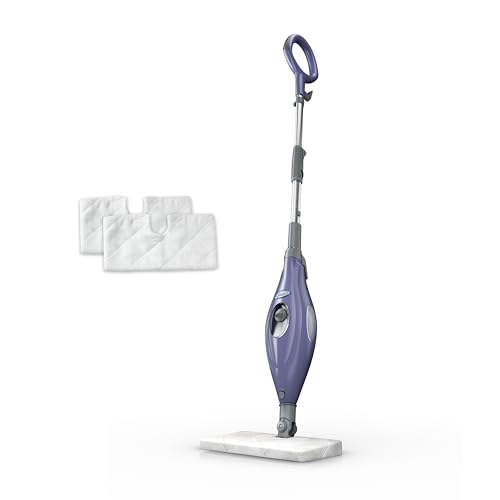
If you prioritize a steam mop that feels almost effortless to use — one you'll actually reach for consistently rather than leaving in the closet — the Shark Steam Pocket Mop S3501 makes a compelling case for itself. At under five pounds, it's genuinely lightweight in a way that most steam mops claiming that descriptor simply aren't, and the swivel steering responds intuitively as you guide it around furniture legs, into corners, and across uneven transitions between flooring types. The double-sided washable pads are a clever design choice: you flip the mop head to use both sides of a single pad before it needs washing, which extends your cleaning session meaningfully and reduces how often you stop to deal with pad management.
The steam sanitization performance is solid and consistent across sealed hardwood, marble, and tile — all surfaces that require a gentle but effective touch. Shark's steam system heats quickly and maintains a steady output without the pressure fluctuations you encounter with cheaper mops, which translates to more uniform cleaning results across an entire floor rather than hot spots near the head and cooler output at the fringe of the cleaning path. The lightweight construction also makes the S3501 genuinely easy to store — it doesn't require wall mounting or a dedicated hook, and it collapses to a compact footprint that fits in a narrow closet without a fight.
The S3501's primary limitation is its focus on a single job: floor cleaning. It doesn't detach into a handheld unit, doesn't address above-floor surfaces, and its pads aren't optimized for heavy-duty scrubbing of deeply embedded grime. On very dirty tile with caked grout staining, you'll notice the flat pad working overtime without the concentrated scrubber action that the BISSELL 1940A provides. Still, for regular maintenance cleaning on sealed floors across a typical home, the Shark's combination of light weight, smart pad design, and reliable steam output makes it the easiest everyday mop on this list to actually live with.
Pros:
Cons:
The PurSteam 10-in-1 is the category's most compelling argument for buying a single unit that genuinely covers your entire home, and in 2026 it remains a standout value proposition for households that want floor-to-ceiling steam cleaning capability without investing in a full canister system. The detachable handheld unit is the centerpiece of its versatility: it separates cleanly from the mop body and handles garment steaming, upholstery refreshing, sofa fabric cleaning, and drape treatment with the same water tank, the same heating element, and the same chemical-free approach. The 30-second heat-up time is accurate in practice and one of the fastest among upright mops — you're cleaning within half a minute of plugging it in, which encourages more frequent use rather than treating steam cleaning as a weekend project.
The PurSteam handles hardwood, tile, laminate, and even carpet cleaning through its carpet glider attachment, which is a meaningful capability expansion over single-purpose floor mops. For homes with mixed flooring — a common reality in open-plan layouts with hardwood living areas and tiled kitchens — having a single tool that transitions between surfaces without changing units is a genuine convenience. The included measuring cup and funnel for water filling are small but thoughtful touches that prevent overfilling and reduce the guesswork that causes users to underfill tanks and wonder why steam output drops prematurely.
The trade-off for all that versatility is that the PurSteam doesn't reach the same steam temperature or pressure that dedicated canister systems achieve. For routine cleaning across multiple surface types, that's completely acceptable. But if your primary challenge is heavily calcified grout, years of baked-on grime in a commercial-grade kitchen, or automotive interior detailing at a professional level, you'll want the additional power that the Vapamore or McCulloch provides. Think of the PurSteam as the most capable all-rounder in the sub-$100 tier — a tool that handles 90% of what most households need without requiring the investment or storage space of a premium canister unit.
Pros:
Cons:
The Vapamore MR-100 Primo is the cleaner you buy when you're serious about steam cleaning — when you want a system that performs at a professional level, lasts for years without degrading in output, and handles every surface in and around your home without compromise. The Italian design heritage here is more than a marketing claim: the engineering reflects decades of commercial steam cleaning expertise, translated into a home-use format that's accessible without sacrificing capability. At 220°F maximum steam temperature, the MR-100 operates at the high end of what residential steam cleaners can safely deliver, and that additional heat makes a measurable difference when you're tackling calcified grout, stubborn pet stains, heavily soiled auto interiors, or surfaces that have accumulated years of embedded grime.
The 1.6-liter stainless steel boiler tank is one of the largest in this category, and the 60-minute continuous steam runtime it enables is a genuine operational advantage — you clean entire areas without stopping to refill and wait for reheat cycles, which is particularly important when you're working through a large home or conducting a detailed automotive session. The 20 included accessories cover an impressive range of applications: floor brushes, detail brushes for grout and crevices, a squeegee for glass surfaces, a fabric attachment for upholstery, and jewelry-cleaning tools that most users don't expect from a home steam system. Adjustable steam control lets you dial output precisely to the sensitivity of the surface you're cleaning, from aggressive tile scrubbing to gentle garment steaming. For pet owners specifically, the MR-100's combination of high temperature and versatile attachments makes it exceptionally effective at addressing the full range of pet-related messes — stains, odors, crate cleaning, and bedding sanitization — without any chemical intervention.
The Vapamore MR-100 commands a premium price, and that investment is only justified if you're genuinely going to use its full capability. If your cleaning needs are limited to basic floor maintenance, you'll find more value in one of the lighter mops on this list. But if you want a steam cleaner that rivals professional service equipment — one that handles floors, grout, appliances, upholstery, vehicles, and even jewelry with equal confidence — the MR-100 Primo is the definitive answer in 2026.
Pros:
Cons:
Kärcher has built its reputation on commercial and industrial cleaning equipment, and the SC 3 Easy Fix brings that engineering discipline to the home-use steam cleaner segment in a way that sets it apart from the crowded budget tier. The 40-second heat-up time is fast and consistent, and the over-200°F steam output is hot enough to eliminate 99.9% of common household bacteria and viruses on contact — without harsh chemicals, without residue, and without the lingering fumes that traditional tile cleaners produce. What genuinely distinguishes the SC 3 from comparable mops is the Lamella technology integrated into the floor nozzle: a flexible strip design that distributes steam evenly from edge to edge across the full cleaning path, eliminating the dead zones along the sides of the nozzle that cause streaky results on tile grout lines.
On tile specifically — particularly bathroom and kitchen tile with grout that has absorbed years of soap scum, food residue, and biological buildup — the SC 3's high-temperature output combined with the even edge-to-edge distribution delivers results that are noticeably better than what you get from a standard flat-pad mop. The grout cleaning performance is the headline capability here, and it's the primary reason to choose this unit over other options at a similar price. Kärcher's accessory compatibility also extends the SC 3's range beyond floors: window and mirror attachments produce streak-free glass results that typically require a dedicated window cleaner to achieve, and the multi-surface head handles laminate, vinyl, and stone with appropriate steam control that prevents damage to more sensitive surfaces.
The SC 3 Easy Fix earns its name from the tool-free accessory attachment system, which swaps heads in seconds without tools or complicated locking mechanisms — a practical convenience during multi-surface cleaning sessions when you're transitioning between the floor, the countertop, and the shower in a single pass. If tile grout is your primary cleaning nemesis and you want a unit engineered with that specific challenge in mind, the Kärcher SC 3 Easy Fix is your answer in 2026.
Pros:
Cons:
If you're the kind of driver who keeps their vehicle maintained to a high standard — or if you've ever been quoted a price for professional car detailing and decided you'd rather invest in capability you can use repeatedly — the McCulloch MC1385 Deluxe Canister is the steam cleaner that changes the economics of that calculation permanently. Its 2-hour continuous steam runtime is the standout specification in this entire roundup: no other unit on this list comes close to that working time, which means you can detail an entire vehicle interior — seats, carpet, door panels, dashboard crevices, vents, and floor mats — in a single session without stopping to refill or wait for reheat cycles. If you're also dealing with rust on exterior components or tools, our review of the best rust removers of 2026 pairs effectively with steam cleaning prep work for surface treatment.
The MC1385's 23 included accessories are specifically well-suited to automotive work: the angled nozzle reaches into the vents and gap areas that collect dust and odors in vehicle interiors, the brass brush handles tough surface buildup without the scratching risk of steel bristles, the scraper addresses adhesive residue and label remnants on glass and trim, and the squeegee produces clean, streak-free windows after steam treatment. The canister format — with a long hose and multiple extension wands — gives you the reach and articulation to work every corner of a vehicle interior from a single standing position, without repositioning the unit constantly. For pet owners who transport dogs in their vehicles and deal with the resulting hair, odors, and staining, the MC1385's steam power combined with the upholstery attachment provides a level of deep cleaning that rivals commercial detailing results. You might also want to look at dog car seat covers as a complementary investment to protect your interior between steam cleaning sessions.
The MC1385 is a full canister system, which means it's larger, heavier, and requires more storage space than any upright mop on this list. It's also not the fastest to set up — canister systems require hose connection and accessory selection before you begin, which makes it less suitable for the "grab and clean one room" convenience that floor mops offer. But for the user whose priorities include automotive detailing, comprehensive home cleaning, and a runtime that handles extended sessions without interruption, the McCulloch MC1385 is the most operationally capable unit in this roundup.
Pros:
Cons:
The BISSELL PowerFresh Slim 2075A addresses a specific and common household frustration: the desire for a steam system that covers floors, above-floor surfaces, and handheld tasks without requiring you to buy three separate tools. Its three-mode design — upright mop, extended-reach wand configuration, and detachable handheld unit — handles the full vertical range of your home's cleaning needs with a single purchase, and the slim profile makes it genuinely easy to store in spaces where a bulkier canister system simply wouldn't fit. The nine included tools give you a grout brush for tile lines, a scraper for adhesive and residue, detail brushes for appliance seams and hardware, a flat surface tool for countertops and shelving, and a clothing steamer attachment that refreshes garments and removes wrinkles without ironing.
BISSELL's sanitization credentials are consistent with the rest of their lineup: the PowerFresh Slim eliminates 99.9% of germs, bacteria, and viruses including Coronavirus and Influenza when used as directed, using only water. That covers not just floors but every surface you clean with the handheld and wand configurations — bathroom tile, kitchen backsplash, appliance exteriors, and upholstered furniture. The extended-reach wand is particularly useful for cleaning high-surface areas like range hoods, ceiling fan blades, and upper cabinet faces, which are typically the most tedious surfaces to address with any cleaning tool. The slim design is not marketing language — it's meaningfully narrower than competing units and passes through tight spaces between appliances and along narrow hallway baseboards without requiring you to angle and tilt the unit awkwardly.
The 2075A's limitation is tank size: the slim profile requires a smaller water reservoir, which means more refill stops on large jobs than you'd encounter with the Vapamore or McCulloch. The steam pressure is also calibrated for home surfaces rather than the heavy-duty output that characterizes professional-grade systems, so for deeply embedded automotive grime or severely neglected grout, it will require more passes and more time than the top-tier canister options. For households that want one tool covering floors, kitchen and bathroom surfaces, and clothing care in a compact package that stores easily, however, the BISSELL PowerFresh Slim 2075A is the smartest all-in-one choice at its price point in 2026. If you're building out a complete home maintenance toolkit, browse our tools category for complementary equipment recommendations.
Pros:
Cons:

The single most important decision you'll make when choosing a steam cleaner is whether you need an upright floor mop or a canister system with a hose and wand. Upright mops — like the BISSELL 1940A, Shark S3501, and Kärcher SC 3 — are purpose-built for floor cleaning, are faster to set up, and store with minimal space. They're the right choice if your primary use case is routine floor maintenance on hardwood, tile, and laminate. Canister systems — the Vapamore MR-100, McCulloch MC1385, and by extension any professional-grade unit — sacrifice that quick-deploy convenience in exchange for far greater surface coverage, longer runtime, higher steam temperatures, and accessory versatility that reaches every corner of your home and vehicle. If you clean floors daily but steam-clean your car or deep-clean grout only monthly, an upright mop for daily use and a canister session for intensive jobs is a rational approach. If you're buying only one tool, define your primary use case first and let that drive the format decision.
Steam temperature and pressure directly determine how effectively a cleaner penetrates and breaks down soiling — and not all manufacturers disclose these specs with equal transparency. At a minimum, effective bacterial sanitization requires sustained steam output above 212°F (the boiling point of water), with the best systems reaching 220°F or higher. Higher temperatures also mean the steam is drier and more concentrated, which reduces the risk of leaving surfaces excessively wet and speeds drying time after cleaning. Pressure affects how forcefully the steam is delivered into porous surfaces like grout: units with higher pressure push steam deeper into the material rather than simply floating it across the surface. When evaluating specs, treat claimed temperatures above 200°F as meaningful and below 200°F as marginal for heavy-duty sanitization tasks — and look for units that maintain consistent temperature throughout the tank cycle rather than starting hot and degrading as the tank empties.
Tank capacity determines how long you can clean continuously before stopping to refill and waiting for the unit to reheat — a process that typically takes two to five minutes and interrupts your cleaning momentum in ways that matter more than they might seem. A 1-liter tank typically yields 20 to 30 minutes of steam; a 1.6-liter tank like the Vapamore MR-100's delivers up to 60 minutes; and the McCulloch MC1385's larger boiler achieves a full 2-hour runtime. For cleaning a studio apartment or small home, a 20-minute tank is adequate. For a full-size house, a multi-room session, or an automotive detail, anything under 45 minutes will result in multiple refill stops. Prioritize tank capacity proportionally to the square footage you intend to clean in a single session, and consider whether your water hardness requires distilled water — most manufacturers recommend it, and hard water accelerates mineral scale buildup that degrades heating element efficiency over time.
The accessory set a steam cleaner ships with largely determines its practical versatility, and the gap between a basic floor mop with two pad types and a 23-accessory canister system is enormous in real-world capability. When evaluating accessories, focus on whether the specific surfaces you need to clean are addressed: grout brushes for tile lines, detail nozzles for appliance seams and vents, squeegees for glass, upholstery tools for fabric surfaces, and extension wands for overhead reach. Verify that replacement pads and consumable accessories are readily available — several budget-brand steam mops use proprietary pad dimensions that become difficult to source within two years of purchase. Also confirm that the unit is rated for the floor types you have: some steam mops specify incompatibility with certain hardwood finishes or unsealed stone, and using them on incompatible surfaces can void flooring warranties or cause surface damage that isn't immediately obvious.
Steam cleaners are safe on sealed hardwood floors when used correctly — the key word being sealed. Sealed hardwood has a protective coating that prevents moisture from penetrating the wood grain, and a steam mop used on the appropriate steam setting passes over the surface too quickly to cause warping or swelling. Unsealed or waxed hardwood is a different matter: steam can penetrate the wood fibers directly and cause irreversible damage including warping, cupping, and finish lifting. Always verify your hardwood flooring's finish type before steam cleaning, and use the lowest steam setting on any hardwood surface. When in doubt, test in an inconspicuous area and inspect for any finish changes after 24 hours.
Yes — steam at sustained temperatures above 212°F kills the vast majority of common household pathogens, including bacteria, viruses, dust mites, and mold spores. The sanitization claims made by BISSELL, Shark, Kärcher, and Vapamore in this roundup — typically 99.9% bacterial elimination — are based on independent laboratory testing conducted under controlled conditions. Effective sanitization requires maintaining contact between the hot steam and the surface for a sufficient dwell time, which means moving the mop at an appropriate pace rather than rushing through cleaning passes. For surfaces with heavy biological contamination, multiple slow passes are more effective than a single quick sweep.
Some steam cleaners include carpet glider attachments that allow surface-level steam treatment of carpet fibers — the PurSteam 10-in-1 is the clearest example in this roundup. Carpet steam treatment is effective for sanitizing the surface layer, refreshing fibers, and addressing light staining. However, steam mops and canister cleaners are not substitutes for steam extraction carpet cleaners — they don't have the suction to pull loosened soil and moisture back out of the carpet pile. For deep carpet cleaning and heavy staining, a dedicated extraction cleaner is the appropriate tool. Steam mop carpet treatment is best used for maintenance sanitization between extraction cleaning sessions.
Most steam cleaner manufacturers recommend distilled or demineralized water, particularly in areas with hard tap water. Hard water contains dissolved minerals — primarily calcium and magnesium — that deposit as white scale on heating elements and internal components when water is boiled repeatedly. Scale buildup reduces heating efficiency, decreases steam output over time, and shortens the operational lifespan of the unit. Distilled water eliminates mineral content entirely and is the safest long-term choice. If your tap water is soft, some manufacturers approve its use — always check your specific model's guidelines before filling the tank with tap water, especially if you're using a premium unit like the Vapamore MR-100 where protecting the stainless steel boiler is particularly important.
Steam cleaners offer three meaningful advantages over traditional mops: chemical-free sanitization, faster drying times, and more effective deep cleaning of grout and textured surfaces. A traditional wet mop distributes cleaning solution across a floor but doesn't sanitize at the bacterial level — it moves dirt around as much as it removes it, particularly as the mop head becomes soiled mid-session. Steam cleaning eliminates pathogens through heat rather than chemistry, leaves floors drier because steam evaporates more quickly than liquid cleaner, and penetrates into porous surfaces that a flat mop pad simply slides over. The trade-offs are higher upfront cost, the need for electricity, and the refill-and-reheat cycle that interrupts continuous cleaning on large areas.
The McCulloch MC1385 Deluxe Canister is the clear choice for automotive detailing, with its 2-hour runtime, canister format, and 23 accessories specifically including the angled nozzle, brass brush, scraper, and squeegee that professional detailers rely on. The Vapamore MR-100 Primo is a close second — its higher steam temperature and professional-grade build make it exceptionally effective on stubborn automotive soiling, though its accessory set is smaller. For users who want a single home unit that also handles automotive work occasionally, both canister systems are appropriate choices. Upright floor mops are not suitable for vehicle detailing due to their fixed head configuration and limited reach into vehicle interior surfaces.
 |
 |
 |
 |

About Liam O'Brien
Liam O'Brien has spent over a decade buying, field-testing, and evaluating automotive tools with a focus on what actually performs in a real DIY garage rather than what markets well on a spec sheet. His hands-on experience spans hand tools, diagnostic equipment, floor jacks, socket sets, and specialty automotive gear across a wide range of brands and price points. At CarCareTotal, he covers automotive tool and equipment reviews, garage setup guides, and buying advice for home mechanics.
Get some FREE car parts & gear.. Or check out the latest free automotive manuals and build guides here.
Disable your ad blocker to unlock all the hidden deals. Hit the button below 🚗
| | | |
