Car Care ›
by Joshua Thomas
Which waterless car wash actually delivers a swirl-free, showroom-quality finish without a single drop of running water? We tested seven top-rated formulas in 2026, and the Chemical Guys EcoSmart consistently came out on top — but the right pick depends heavily on paint type, usage frequency, and whether a concentrated or ready-to-use formula fits the workflow best.
Waterless car washes have moved well beyond novelty status. According to the U.S. Environmental Protection Agency, a standard driveway hose wash can consume between 80 and 140 gallons of water per session. Waterless formulas eliminate that entirely. For apartment dwellers, RV owners, motorcycle enthusiasts, and anyone dealing with water restrictions, these sprays have become a practical first-choice solution rather than a backup option.
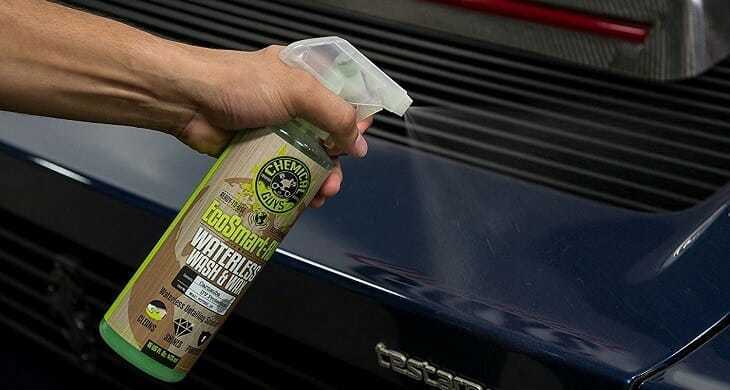
Our team evaluated each formula across four criteria: cleaning effectiveness on light-to-moderate dust and grime, lubrication quality during the wipe-off stage, post-wash protection, and value per ounce. The full breakdown is below. For anyone building a complete detailing kit, our guides on the best car microfiber towels and best paint sealants pair directly with this category — microfiber quality is arguably as important as the formula itself. All seven products reviewed here are available through our car care hub.
Contents





Chemical Guys EcoSmart holds the top spot in our 2026 rankings because it genuinely delivers on every front: cleaning, shine, and paint protection in a single application. The ready-to-use 16 oz bottle requires zero mixing — spray on, work in with a quality microfiber, buff off. The formula is built around a Brazilian carnauba wax emulsion combined with high-efficiency lubricating polymers that encapsulate surface contaminants before the wiping stage, reducing the scratch risk that concerns most paint-conscious buyers.
Our team ran EcoSmart through a series of real-world scenarios: a film of road dust on black paint, light mud splash on a truck rocker panel, and dried water spots on glass. Performance was consistently strong in all three. The carnauba content leaves a warm, reflective glow that reads as a proper wax job rather than a temporary plastic-looking shine. It is also available in concentrated form for high-volume users who want to reduce packaging waste and per-wash cost.
The 16 oz ready-to-use size is the entry point, but Chemical Guys offers gallon concentrates for detailing shops and fleet operators. For a product covering cars, trucks, SUVs, motorcycles, and RVs, the versatility-to-cost ratio is difficult to match at this price tier.
Pros:
Cons:
Meguiar's Ultimate Waterless Wash & Wax comes as a two-pack of 26 oz bottles, delivering 52 total ounces at a cost per ounce that is among the lowest in this segment. For regular washers who go through product quickly — weekend detailers, fleet managers, or anyone washing multiple vehicles — this bundle format makes strong economic sense. The formula follows Meguiar's established approach: a multi-polymer system that cleans and seals in one step.
Performance sits solidly in the upper tier. Our team found the finish to be glossy and streak-free on light-colored paint, though very dark finishes require careful technique and a premium microfiber to avoid micro-marring. Meguiar's explicitly recommends a high-quality microfiber towel in the product notes — a detail worth taking seriously. The protection layer added post-wipe holds up well against light rain and road dust between sessions.
The two-pack format also means always having a backup bottle in the garage. For buyers who already trust the Meguiar's brand from traditional wash products, this waterless extension feels immediately familiar in both scent profile and performance behavior.
Pros:
Cons:
Optimum No Rinse (ONR) Version 5 is the professional detailer's concentrated rinseless wash, and its reputation among enthusiasts is well-earned. At just 1 oz per 2 gallons of water, a 32 oz bottle yields 64 wash-ready gallons — enough for dozens of full vehicle washes. The polymer technology at the core of ONR works differently than most spray-and-wipe products: polymers encapsulate dirt particles, creating a protective barrier between the grit and the paint before the towel ever makes contact.
Version 5 introduces refined polymer chemistry compared to earlier iterations, with improved shine enhancement and better performance on ceramic-coated finishes. ONR also functions as a clay bar lubricant, a quick detailer, and an interior cleaning solution — its multi-role capability is genuinely useful and reduces how many products a detailer needs to carry. Our testing confirmed strong results on paint, wheels, glass, vinyl dashboards, and leather surfaces when diluted appropriately for each application.
The bucket-wash method — 1 oz per 2 gallons, wash section by section with multiple microfibers, lay down and air dry — is the preferred professional technique and maximizes paint safety. For anyone serious about detail work, ONR V5 is the benchmark in the rinseless category.
Pros:
Cons:
Adam's Polishes built its reputation on chemistry that prioritizes paint safety, and the 16 oz Waterless Wash maintains that focus. The formula uses an increased concentration of lubrication and emulsifying polymers compared to standard waterless sprays, which means the dirt particle is lifted and suspended before the wiping action rather than dragged across the surface. This is the critical mechanism that separates safe waterless washing from the swirl-inducing variety.
Our team evaluated the Adam's formula specifically on a matte black finish — a notoriously unforgiving surface that highlights any dragging or micro-scratching immediately. Results were clean, with no visible marring under direct light inspection. The spray consistency is slightly thicker than competitors, which provides a tactile indication that the lubricants are active. Dwell time of 20–30 seconds before wiping produced the best outcomes in our testing.
The product works without a hose, without soap, and without a foam cannon — Adam's leans into this directly in the product positioning. For owners of motorcycles, boats, and RVs who often lack convenient water access, the spray-on, wipe-off simplicity is the primary selling point. The 16 oz bottle covers one to two average-sized vehicles per wash session.
Pros:
Cons:
Rain-X brings its well-known hydrophobic water-beading technology into a 23 oz waterless wash formula that doubles as a windshield and paint protectant. This is the product's primary differentiator: where most waterless washes add a generic protective layer, Rain-X applies the same glass-treatment chemistry that has made the brand synonymous with water repellency since the 1970s. Post-wash, water sheets cleanly off all treated surfaces, including glass — eliminating the need for a separate wiper-fluid additive or glass treatment.
The cleaning performance is effective on light-to-moderate dust and grime. Our team notes that Rain-X's formula is not designed for heavily soiled vehicles — the spray-and-wipe process works best when the contamination layer is relatively light. As a weekly touchup product after an initial deep wash, however, it performs excellently. The 23 oz bottle is a generous size for a ready-to-use format, and the spray mechanism delivers a fine, even mist that covers panel sections efficiently.
For regions with heavy rainfall or buyers who regularly drive through wet weather, the built-in Rain-X technology is a functional upgrade over standard waterless washes. Combined with a proper exterior detail schedule, this product maintains both cleanliness and glass clarity between full wash sessions.
Pros:
Cons:
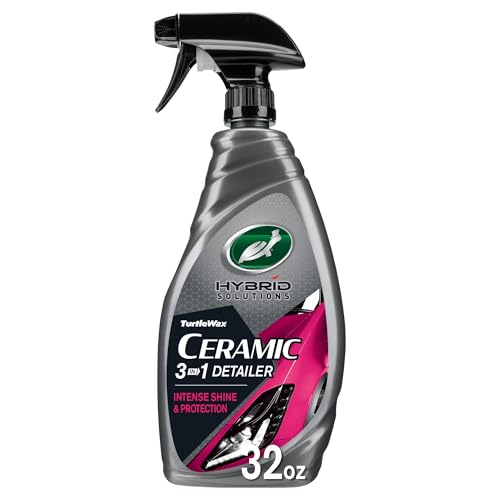
Turtle Wax Hybrid Solutions Ceramic 3-in-1 brings silicon dioxide (SiO2) ceramic coating technology into a 32 oz waterless wash at a mainstream price point. The three-in-one claim — clean, shine, protect — is accurate in our testing: the formula removes light contamination, deposits a glossy finish, and leaves behind a hydrophobic ceramic barrier that visibly beads water for several weeks post-application. This long-duration protection is what separates it from standard wax-enhanced waterless washes.
The 32 oz bottle size is practical for regular use, and the formula is safe for all exterior surfaces including painted panels, trim, glass, and chrome. Our team tested it on a ceramic-coated vehicle as a maintenance spray, and it performed as a proper coating-compatible topper — refreshing the hydrophobicity of the base ceramic layer without stripping or degrading it. For anyone already running a ceramic coating on their vehicle, this compatibility is a key factor.
Turtle Wax's hybrid approach — combining traditional detailing chemistry with ceramic SiO2 — reflects the broader industry direction in 2026. The protection durability per application is notably higher than carnauba-based competitors, though the raw shine depth of pure carnauba products like the Chemical Guys EcoSmart remains the gold standard for show-quality aesthetics.
Pros:
Cons:
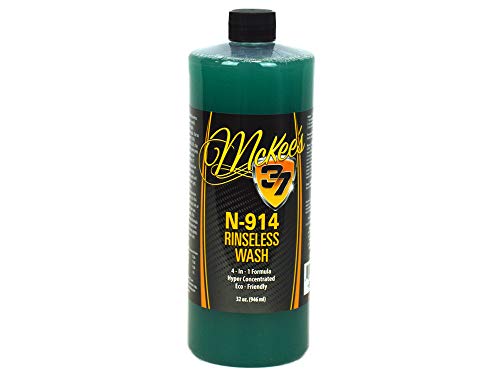
McKee's 37 N-914 Rinseless Wash V2 is the specialist rinseless concentrate on this list — a 32 oz bottle designed for the bucket-wash method used by professional detailers and serious enthusiasts. The formula uses a blend of high-lubricity polymers and cleaning agents engineered to lift and encapsulate dirt without requiring the mechanical agitation of a traditional hose-and-foam process. Mix with 2 gallons of water, work section by section with a fresh microfiber per panel, and dry to a spot-free finish.
Our team placed N-914 V2 against Optimum No Rinse in a direct comparison wash session on identically contaminated panels. McKee's produced a slightly cleaner initial result on panels with heavier grime accumulation, while ONR's polymer protection layer felt marginally more slick during the wipe-off stage. Both are elite-tier rinseless concentrates. The N-914's main practical advantage is the 32 oz dilutable format — high yield, low waste, and economical for anyone washing frequently.
N-914 V2 is rated safe for all vehicle finishes including single-stage paint, clear coat, and ceramic-coated surfaces. It is also compatible with clay bar lubrication and quick-detailing applications when further diluted. For detailers looking to consolidate their waterless and rinseless workflow into a single concentrate, this product earns its placement.
Pros:
Cons:
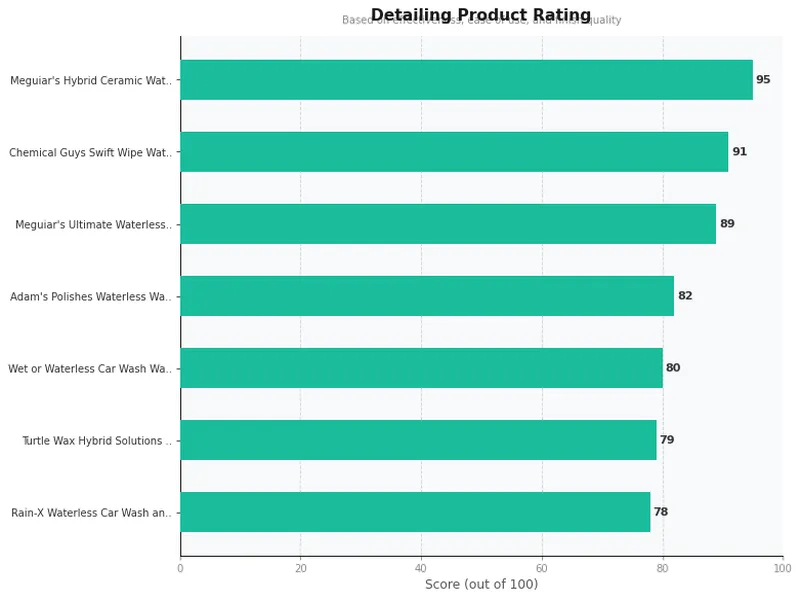
The most fundamental choice is between a ready-to-use spray and a dilutable concentrate. Ready-to-use formulas (Chemical Guys EcoSmart, Meguiar's, Rain-X, Adam's, Rain-X) are faster and require zero prep — spray, wipe, done. Concentrates (ONR V5, McKee's N-914) require mixing with water and a bucket, which adds a step but delivers far better cost-per-wash economics and is the preferred method for professional detailers.
The single most important technical specification in a waterless wash is the lubrication level of the formula. Insufficient lubrication means dirt particles drag across the clear coat during the wipe-off stage, creating micro-scratches and swirl marks that are visible in direct sunlight. High-lubricity polymer concentrations — the approach taken by Adam's Polishes and the ONR series — suspend particles and allow the microfiber to lift them away cleanly.
Most waterless washes add a protection layer after cleaning, but the type differs significantly across products. Understanding which protection type fits the vehicle's current paint situation determines long-term results.
All seven products on this list are formulated for painted exterior surfaces. However, multi-surface capability varies significantly and matters for owners of motorcycles, RVs, boats, and vehicles with diverse trim types.
Yes — when used correctly. High-quality waterless formulas with adequate lubrication are safe on clear coat, single-stage paint, matte finishes, and ceramic-coated surfaces. The risk factor is not the formula itself but insufficient lubrication combined with a low-quality microfiber, which can drag abrasive particles across the paint. Premium products with emulsifying polymer technology effectively suspend contaminants before the wipe-off stage, minimizing scratch risk substantially.
The general industry guideline is light-to-moderate soiling: road dust, light grime, fingerprints, and water spots. Heavy mud, thick caked-on contamination, bird dropping buildup, or post-off-road soiling exceeds what a waterless formula can safely handle. In those cases, a traditional rinse wash or two-bucket method is the safer approach. Most detailing professionals use waterless products as a between-wash maintenance system rather than a replacement for periodic full washes.
Volume yield depends heavily on vehicle size and application technique. On a compact car, a 16 oz ready-to-use bottle typically covers two to three full washes. On a full-size truck or SUV, expect one to two washes per bottle. Concentrate products like Optimum No Rinse (32 oz, diluted at 1 oz per 2 gallons) yield 32 full wash batches from a single bottle — making the cost-per-wash substantially lower despite the higher upfront price.
No — they supplement but do not replace dedicated protection products. The protection layers deposited by waterless wash formulas are thin compared to a dedicated carnauba wax, paint sealant, or ceramic coating. For vehicles that prioritize long-term paint protection, a dedicated sealant applied quarterly alongside regular waterless washing provides superior durability. Our team reviews those options in the paint sealants guide.
Our team recommends a minimum 300 GSM microfiber for waterless wash applications, with 400–500 GSM towels preferred for dark or sensitive paint. The towel must be clean — even a few contaminated fibers carry enough grit to cause visible micro-scratching on glossy paint. Most detailing professionals use multiple clean towels per wash session, rotating to a fresh towel for each panel or when a towel becomes visibly loaded with lifted dirt.
Working in direct sunlight or on hot paint surfaces is not recommended with any waterless wash formula. Heat accelerates evaporation of the carrier solution, which can cause streaking and reduces the lubrication window available during wiping. The recommended working condition is a shaded area with ambient temperatures between 50°F and 85°F. In warmer climates, early morning application before panel temperatures rise is the standard professional approach.
 |
 |
 |
 |

About Joshua Thomas
Joshua Thomas holds a Bachelor of Science in Mechanical Engineering from San Diego State University and has spent years applying that technical foundation to hands-on automotive work — from routine maintenance to full mechanical repairs. He founded CarCareTotal in 2017 to give car owners the kind of clear, practical guidance that helps them understand what is happening under the hood and make smarter decisions about upkeep and repairs. At CarCareTotal, he oversees editorial direction and covers automotive fundamentals, maintenance guides, and troubleshooting resources for everyday drivers.
Get some FREE car parts & gear.. Or check out the latest free automotive manuals and build guides here.
Disable your ad blocker to unlock all the hidden deals. Hit the button below 🚗
| | | |
