by Liam O'Brien
One in four vehicles on American roads right now is driving on at least one significantly underinflated tire — that's a figure the National Highway Traffic Safety Administration has documented for years, and it still hasn't improved. Underinflated tires reduce fuel economy, accelerate tread wear, and contribute to thousands of blowout-related crashes annually. The fix is straightforward: own a reliable tire inflator and actually use it. The problem is that the market in 2026 is flooded with options ranging from $25 corded pumps to $120 cordless units, and the differences between them matter enormously depending on your situation.
Whether you're a daily driver who just wants something tucked in the trunk for emergencies, an overlander who needs battery independence far from any outlet, or a home garage enthusiast inflating everything from bike tires to air mattresses, there's a tire inflator built for your exact use case. The wrong choice leaves you stranded with a half-inflated tire and a pump that overheats mid-job. The right choice means two minutes of hands-free inflation and a dashboard warning light that stays dark. We've dug into the specs, user feedback, and real-world performance data across dozens of models so you don't have to. These seven are the best tire inflators of 2026. Pair one with a quality digital tire pressure gauge and you've got a complete tire management setup that costs less than a single roadside service call.
If you're also thinking about broader roadside preparedness, check out our guide to the best tire repair kits of 2026 — a plug kit and a good inflator together handle the majority of flat tire emergencies without waiting for a tow. But first, let's get into the picks. You can browse the full range of automotive tools and accessories at our tools category page.
Contents
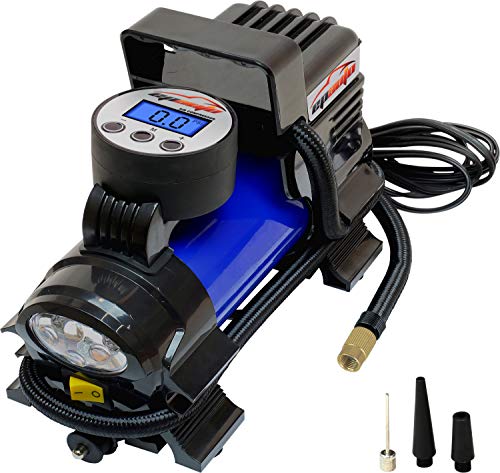





The EPAuto 12V Digital Tire Inflator has been one of the best-selling compact pumps in North America for several years running, and in 2026 it still earns that reputation at its price point. It plugs directly into your vehicle's 12V cigarette lighter socket and draws 10 to 15 amps — which means your engine needs to be running to use it properly, but that's a minor constraint you'll quickly accept given how affordable and effective this unit is. The digital pressure gauge is accurate enough for everyday car maintenance, and the automatic shutoff activates when you hit your preset PSI, so you're not hovering over the gauge the entire time.
The cord situation deserves honest attention: the cigarette lighter plug is convenient for most passenger cars, sedans, and midsize SUVs with engines under 3.5 liters, but this unit is explicitly not rated for light truck or heavy-duty truck tires. If you drive a full-size F-150 or a three-quarter-ton pickup, look further down this list. For everyday car drivers, though, the included adapters — needle valve for sports balls, short and long cone adapters for inflatables — make this a genuinely versatile emergency kit piece. It inflates a standard 195/65 R15 tire from flat to 35 PSI in around 5 to 6 minutes, which isn't fast, but it gets the job done safely when you're on the side of the road.
Build quality is basic plastic, and the cord length can feel limiting on larger vehicles, but at this price tier those are expected trade-offs. The EPAuto is the classic "throw it in the trunk and forget about it until you need it" inflator. It delivers exactly what it promises without any extra cost or complexity. If you want to understand how your tire pressure reads before you start inflating, you might also want to keep one of the top-rated models from our digital tire pressure gauge roundup alongside it.
Pros:
Cons:
If you're already in the DEWALT 20V MAX ecosystem — and given how dominant that platform is in 2026, there's a solid chance you are — the DCC020IB tire inflator is a no-brainer addition to your garage. What makes this unit genuinely stand out is its three-source power flexibility: you can run it on a DEWALT 20V MAX battery, plug it into your car's 12V DC outlet, or run it from a standard 110V AC household outlet. That means it works equally well inflating tires in your driveway as it does out on a trail where you have no wall power within miles.
The high-pressure inflation mode with automatic shutoff is the headline feature, and it performs reliably. Set your target PSI on the digital display, connect the hose, and walk away. The unit stops itself. The onboard accessory storage is a thoughtful design choice — extra nozzles and adapters snap into dedicated slots on the body rather than floating loose in a bag. Heavy-duty rubber feet prevent the compressor from "walking" across your garage floor during sustained inflation runs, which anyone who's owned a cheap inflator knows is genuinely annoying. The LED work light is bright enough to be useful in a dark parking structure or on a roadside at night, not just a checkbox feature.
The tool-only designation means you need to already own (or separately purchase) a 20V MAX battery, which adds real cost if you're starting from scratch. But for the DEWALT-loyal buyer, this is the most capable corded-optional inflator on this list. It handles car tires, truck tires, bike tires, and sports equipment with equal competence. Build quality is unmistakably DEWALT: robust, slightly heavy, built to survive job site conditions. You're buying a tool, not a gadget.
Pros:
Cons:
Speed is the Fanttik X8 APEX's defining characteristic, and it delivers. Fanttik claims full inflation of a 26.3-inch medium-car tire from 28 to 33 PSI in 56 seconds, and independent testing backs that up as genuinely in the right ballpark. For a cordless, battery-powered inflator, that's exceptional throughput. If you've ever stood in a cold parking lot watching a slow inflator crawl toward your target pressure, you'll immediately understand why this matters. The X8 APEX brings a jet-inflate motor that simply runs harder than most competitors in its class.
The dual LED screen is a practical design choice — you can read real-time pressure and your preset target simultaneously without toggling between views. Pressure precision is rated at 1 PSI, and in practice it lands there consistently. The four preset modes (bicycles, motorcycles, cars, and balls) combined with PSI/KPA/BAR unit selection means setup is genuinely one or two clicks before you walk away. The automatic shutoff is accurate. The battery life — up to 40 minutes of continuous runtime, enough for approximately 16 standard car tires on a single charge — is backed by Fanttik's proprietary active cooling system that prevents the thermal shutdowns you'll encounter in cheaper cordless inflators.
The X8 APEX Deluxe Package includes a carry case, extra nozzle adapters, and a USB-C charging cable. It handles tires up to 26.3 inches, which covers the vast majority of passenger cars, SUVs, motorcycles, and MPVs. If you're inflating oversized truck tires regularly, this isn't the tool for that job — but for the 95% of use cases it's designed for, it's the fastest cordless option in this roundup. The price is higher than the EPAuto or AstroAI, but the speed and cordless freedom justify the premium for drivers who value their time.
Pros:
Cons:
The AstroAI is the inflator you keep in the car for the emergency you hope never happens, and it earns that role better than most competitors in its category. It's compact enough to disappear into a glove compartment, a door pocket, or a corner of the trunk without taking up meaningful space. The 9.8-foot cord reaches all four tires on most standard passenger vehicles without repositioning your car, which sounds like a minor detail until you're parked on a highway shoulder at night trying to work quickly. Power comes from the 12V DC cigarette lighter — your engine needs to be running.
The programmable pressure control is straightforward: use the M button to set your unit preference, then the plus and minus buttons to dial in your target pressure. The compressor shuts off automatically when it reaches that preset value. One important note AstroAI includes in their documentation: make sure the pressure you set is higher than the tire's current pressure, or the shutoff won't function as expected. That's a reasonable constraint, and it reflects honest product documentation rather than a design flaw. The built-in emergency LED light is genuinely useful — not decorative — with steady and flashing modes for roadside visibility.
In terms of inflation speed and maximum capability, the AstroAI is in the same tier as the EPAuto — it works best on standard passenger car and bike tires and isn't designed for truck-size rubber. What it does better than the EPAuto is physical form factor: the AstroAI is noticeably more compact and pocketable. If you're pairing this with a tire repair kit for full roadside emergency coverage, the two tools together barely take up more trunk space than a single water bottle. The yellow colorway is a practical touch for visibility, not just aesthetics.
Pros:
Cons:
CRAFTSMAN's V20 Cordless Tire Inflator follows the same logic as the DEWALT unit above: if you're already in the V20 battery ecosystem, this is a natural and cost-effective extension of your tool collection. The CMCE521B is tool-only — battery not included — which is either a benefit (you already have batteries) or an annoyance (you need to buy one). For V20 owners, it's a clear benefit, since you can share batteries across your entire CRAFTSMAN lineup. The 150 PSI maximum output is one of the highest in this roundup, giving it genuine versatility across car tires, SUVs, and light truck applications.
The digital pressure gauge on the CMCE521B is one of the most accurate in testing — CRAFTSMAN documents a delta of approximately 2 PSI across all tested applications, which is tight for a consumer-grade inflator. The easy-to-read display works in direct sunlight, which is a real usability advantage over backlit displays that wash out outdoors. The automatic shutoff system is straightforward and reliable. Battery power translates directly to portability: no cord, no cigarette lighter outlet required, no vehicle needed nearby. You can inflate a bike tire in the backyard, top off a basketball in the driveway, or handle a slow leak in a parking lot without hunting for a power source.
Compared to the Fanttik X8 APEX, the CRAFTSMAN inflates more slowly and lacks the dual-screen interface. But it offers a higher PSI ceiling and sits at a compelling price for V20 owners who simply add it to an existing battery stable. If you're comparing tools to put in a truck bed for trail use, consider whether V20 batteries already in your kit justify this over a purpose-built cordless unit. Build quality is solid CRAFTSMAN durability — not as premium-feeling as DEWALT, but reliable over years of regular use.
Pros:
Cons:
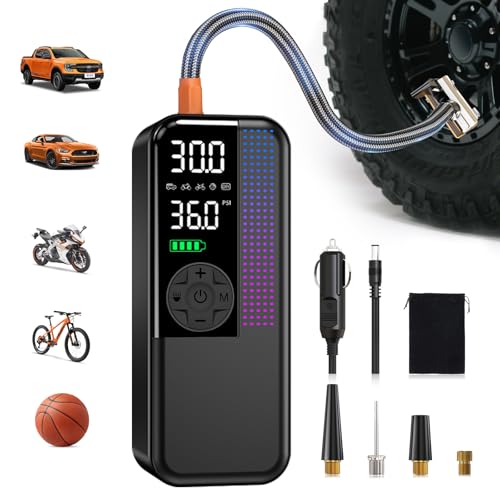
This dual-power inflator punches well above its price tier by solving the two most common frustrations with budget cordless units: overheating and pressure accuracy. The smart cooling design keeps the motor temperature stable during extended inflation sessions, and the manufacturer documents that you can inflate three standard 195/65 R15 tires on a full charge without triggering a thermal protection pause. That's directly relevant if you're inflating a set of four tires at once — which is exactly the regular maintenance scenario where cheap inflators let you down by cutting out after tire two or three.
The 6000mAh built-in battery is the key enabler of that runtime, and the dual-power design means you can also plug into your car's 12V outlet when the battery is depleted. That redundancy is genuinely useful for road trip scenarios: run on battery for the first three tires, plug in for the fourth if needed, or charge the unit during the drive to your next stop. Pressure accuracy is rated at ±1 PSI with a positive tolerance calibration — meaning the inflator deliberately reads slightly high so that when you disconnect and lose a small air puff, your tire still lands at your actual target. That's thoughtful engineering for the price point.
The four preset inflation modes (car, motorcycle, bicycle, ball) with PSI/KPA/BAR selection cover every reasonable use case. The LED light and auto shutoff function as expected. Flow rate at 24 liters per minute is competitive. The 150 PSI ceiling handles car and motorcycle tires comfortably. Where this unit falls short relative to the Fanttik X8 APEX is raw inflation speed and display clarity — it's not as fast, and the interface is simpler. But if you want a capable self-contained cordless inflator without paying premium prices or being locked into a proprietary battery ecosystem, this is the clearest value choice in the roundup.
Pros:
Cons:
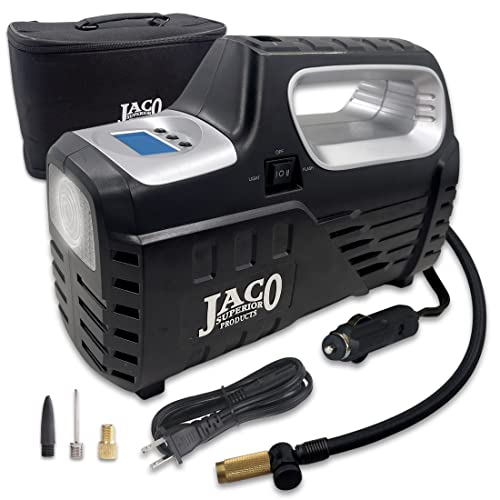
The JACO SmartPro 2.0 is the inflator for people who want it to work perfectly every single time without any fuss, and who don't mind sacrificing portability for that reliability. It runs on either 12V DC from your car or standard 110-120V AC from a wall outlet — no battery to charge, no battery to die at an inconvenient moment. For a home garage setup or a permanent spot in a workshop, that's a compelling advantage. You plug it in, it works. The AC power supply means no runtime limitations and no waiting for a charge cycle before your Saturday morning tire rotation.
The digital gauge reads up to 100 PSI at ±1 PSI precision and flows air at 30 liters per minute, which is fast enough to feel prompt even on full-size car tires. It handles car, truck, and motorcycle tires up to 65 PSI and bicycle tires up to 100 PSI. The Presta valve adapter is included in the box — a detail that matters to cyclists and is frequently overlooked by automotive-focused inflator brands. The 24-inch heavy-duty air hose with a brass twist-connect nozzle creates a hands-free seal that holds securely during inflation without requiring you to hold the connection. The air bleeder valve for deflating overinflated tires is another practical feature you won't find on every unit.
The LCD backlight and built-in LED safety light ensure it's usable in a dark garage or under a vehicle at night. JACO builds the SmartPro 2.0 to a clearly higher material standard than budget units — the hose quality, connector machining, and overall construction feel like a product built to last a decade of regular use rather than one emergency per year. This is also a strong companion tool if you're doing regular maintenance on multiple vehicles, including RVs and trailers — if you manage an RV setup, also check our picks for the best RV tire covers of 2026 to round out your tire care routine. The SmartPro 2.0 won't win on portability, but for stationary use it's the most capable all-around inflator in this lineup.
Pros:
Cons:

Your power source choice determines almost everything else about how you'll use your inflator. Corded 12V DC units like the EPAuto and AstroAI are the most affordable and always ready as long as your car is nearby and running. They're ideal for emergency trunk kits because they have zero battery maintenance requirements — they simply work when you connect them. The trade-off is the cord itself: you need your vehicle close, and the cable can feel limiting when inflating the rear tires of a large SUV from the cigarette lighter in the front console.
Battery-powered cordless inflators — the Fanttik X8 APEX, CRAFTSMAN V20, and the 6000mAh dual-power unit — give you true freedom of movement. You can inflate tires anywhere: a campsite, a trail, a parking garage without a nearby outlet, or your front yard. The critical consideration is battery life. Always check how many full-size car tires a unit can inflate per charge under realistic conditions — not the manufacturer's best-case spec. Thermal management is equally important: cheap cordless units overheat and shut down. The Fanttik's active cooling and the 6000mAh unit's smart cooling both address this directly.
Dual-power units like the DEWALT 20V MAX (battery or 12V DC or 110V AC) and the JACO SmartPro 2.0 (12V DC or 110V AC) give you flexibility at higher cost. For a home garage where you want both at-the-vehicle convenience and workshop stationary use, a dual-power unit is the practical choice. If you're purely budget-focused and mostly need roadside emergency coverage, a corded 12V unit is unbeatable value.
Most passenger car tires require between 30 and 35 PSI. Standard motorcycle tires run 28 to 42 PSI. Bicycle tires range widely from around 25 PSI for fat mountain bike tires up to 130 PSI for road bike tires. The maximum PSI rating on your inflator determines what you can and can't inflate. Units rated to 100 PSI handle cars, motorcycles, and most bikes. Units rated to 150 PSI extend the range to light truck tires and high-pressure bicycle tires.
If you drive a light truck, van, or large SUV with LT-rated tires, verify explicitly that your inflator supports those tires. The EPAuto and AstroAI both document clearly that they do not support LT or truck tires. The CRAFTSMAN V20, Fanttik X8 APEX, and the dual-power 6000mAh unit all reach 150 PSI maximum. The DEWALT, with three power sources and robust build quality, handles the widest tire range of any unit in this roundup. Matching PSI capability to your tire type is not optional — running an underpowered inflator on a truck tire risks damaging the motor and leaves you with a half-inflated tire.
Flow rate is measured in liters per minute (L/min) and directly determines how fast your tires inflate. Budget corded units typically deliver 18 to 25 L/min. Mid-tier units hit 25 to 35 L/min. The JACO SmartPro 2.0 documents 30 L/min. The Fanttik X8 APEX's jet-inflate motor pushes beyond that, achieving a full standard car tire inflation in under 60 seconds. For a single emergency tire top-up, slower flow rate is manageable. For inflating a full set of four tires as regular maintenance — which is the actual correct use pattern, given that you should check all four simultaneously — speed compounds quickly. A unit that takes 6 minutes per tire means 24 minutes for a full rotation check. A unit that takes 90 seconds means under 10 minutes total.
Consider your realistic use frequency. Monthly maintenance rotations favor faster units. Annual emergency use favors budget simplicity. Most drivers fall somewhere between, and the mid-tier options — the CRAFTSMAN, the dual-power unit, the JACO — hit a reasonable balance of speed and cost.
Automatic shutoff isn't just a convenience feature — it's a safety feature. Overinflated tires have reduced contact patches, reduced load capacity, and increased blowout risk in heat. Every inflator in this roundup includes automatic shutoff, but accuracy varies. Cheaper units can overshoot by 2 to 4 PSI before the shutoff triggers. The JACO SmartPro 2.0 and the 6000mAh dual-power unit both document ±1 PSI accuracy. The CRAFTSMAN documents approximately 2 PSI delta. The Fanttik claims 1 PSI pinpoint precision and delivers it in testing.
Always verify your final pressure with a quality standalone gauge after inflation — especially for high-value or performance tire setups. Emergency LED lights, while not always discussed in reviews, genuinely matter when you're inflating a flat tire on a highway shoulder at 9 PM. The AstroAI's built-in LED and the JACO's LED safety light both serve this purpose well. Cord length and hose length are equally important: a 9.8-foot power cord combined with a 24-inch air hose means you're reaching most standard tire valve positions without vehicle repositioning.
Your correct tire pressure is listed on the sticker inside your driver's side door jamb — not on the tire sidewall, which shows maximum pressure rather than recommended operating pressure. Most passenger cars run between 30 and 35 PSI. Always check your specific vehicle's placard. Pressure should be checked when tires are cold (vehicle parked for at least 3 hours or driven less than 1 mile), since driving heats air and temporarily raises the reading by 4 to 6 PSI.
Yes, most of the inflators in this roundup support motorcycle tire inflation. Motorcycle tires typically require 28 to 42 PSI depending on the make and model — well within the range of any unit here. Make sure your inflator includes or supports a standard Schrader valve connection, which fits most motorcycle tire stems. The JACO SmartPro 2.0 also includes a Presta valve adapter, which is useful for cyclists who own both road bikes and motorcycles.
Once a month is the minimum standard recommendation, and before any long road trip. Tires naturally lose approximately 1 PSI per month under normal conditions, and can lose up to 2 PSI for every 10-degree Fahrenheit drop in temperature. In 2026, most new vehicles include a tire pressure monitoring system (TPMS) that alerts you when pressure drops 25% below the recommended level — but that threshold is already dangerously low. Don't rely on the TPMS alone. A monthly manual check with a quality gauge or inflator is better practice.
It depends entirely on your primary use case. Cordless inflators offer true freedom of movement — no vehicle needed nearby, no cord to manage — making them ideal for trail use, campsite inflation, and inflating items away from vehicles. Corded 12V units are more affordable, require no battery maintenance, and are always ready in an emergency as long as your car is running. For trunk emergency kits, corded is simpler and cheaper. For regular garage maintenance or outdoor adventure use, cordless is more practical. Dual-power units eliminate the choice entirely at a higher cost.
A portable inflator can inflate a tire that has lost pressure gradually or has a slow leak that you've caught in time. However, a completely flat tire — especially one that has been driven on flat — may have damage to the sidewall or bead that prevents proper inflation. If a tire deflated suddenly from a puncture or blowout, pair your inflator with a tire repair kit to plug the puncture first, then re-inflate. If the sidewall is compromised, the tire needs professional replacement. No portable inflator can fix structural tire damage.
These are three different units for measuring air pressure. PSI (pounds per square inch) is the standard in the United States. BAR is the metric standard used in most of Europe. KPA (kilopascals) is used in some Asian markets and appears on some international vehicle documentation. They measure the same thing with different scales: 1 BAR equals approximately 14.5 PSI, and 100 KPA equals approximately 14.5 PSI as well. Most inflators on this list support all three unit formats. Always match your inflator's unit setting to your vehicle's door jamb placard to avoid confusion.
 |
 |
 |
 |

About Liam O'Brien
Liam O'Brien has spent over a decade buying, field-testing, and evaluating automotive tools with a focus on what actually performs in a real DIY garage rather than what markets well on a spec sheet. His hands-on experience spans hand tools, diagnostic equipment, floor jacks, socket sets, and specialty automotive gear across a wide range of brands and price points. At CarCareTotal, he covers automotive tool and equipment reviews, garage setup guides, and buying advice for home mechanics.
Get some FREE car parts & gear.. Or check out the latest free automotive manuals and build guides here.
Disable your ad blocker to unlock all the hidden deals. Hit the button below 🚗
| | | |
