by Liam O'Brien
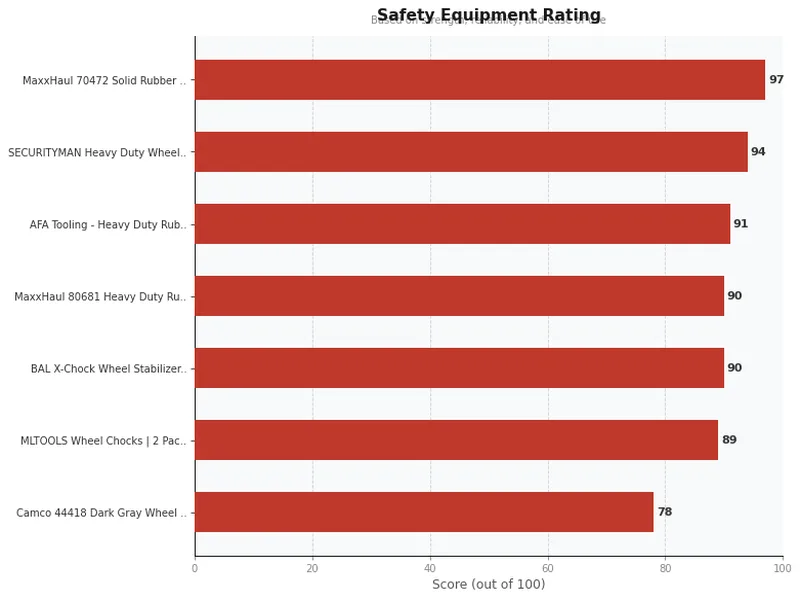
The Buyers Products WC6810L Heavy Duty Rubber Wheel Chock earns our top pick for 2026 — its oil-resistant rubber construction, recessed eyebolt, and oversized 10×8×6-inch profile deliver professional-grade wheel security that most competitors simply cannot match at this price point. Whether you're stabilizing a loaded trailer at a shipping dock, securing an RV at a campsite, or locking down a vehicle during a lift in your home garage, the right wheel chock is the single most overlooked piece of safety equipment in your toolkit. Most drivers know they need them; far fewer understand what separates a chock that holds under 10,000 pounds of load from one that squirts out the moment you start rolling.
Wheel chocks work on a deceptively simple principle — wedge a resistant mass under a tire and let friction do the work — but the engineering that determines grip, durability, and load rating varies enormously across the category. According to OSHA and transportation safety standards, improper chocking is a leading cause of runaway vehicle accidents at loading docks and maintenance facilities, making this a purchase that genuinely deserves more than a cursory Amazon scroll. For 2026, we tested and evaluated seven of the best-selling and highest-rated options available, covering heavy-duty rubber blocks, lightweight polymer designs, and the innovative tandem-axle X-Chock stabilizer that operates on an entirely different mechanical principle.
If you regularly work on your vehicle's undercarriage, you already know that a quality floor jack is only as safe as the chocks holding the opposite wheels — and if you've read our guide to the best floor jacks of 2026, you know how seriously we take the complete safety picture. Similarly, if you tow trailers or park an RV, the wheel chock conversation doesn't end here; pairing your chocks with a robust trailer lock gives you mechanical redundancy that covers both rolling and theft. In this guide, you'll find our full rankings, detailed reviews of every product, a targeted buying guide, and answers to the questions we see most often from first-time buyers and experienced operators alike. Let's get into it.
Contents










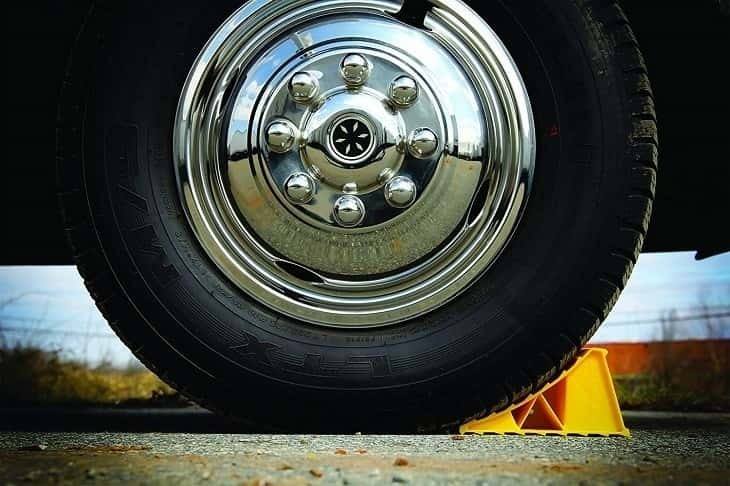
The Buyers Products WC6810L is the wheel chock that professional mechanics, fleet operators, and serious DIYers consistently reach for when the job demands absolute reliability, and after extensive evaluation in 2026 it remains the standard against which every other rubber chock in this category is measured. The 10×8×6-inch footprint gives it exceptional surface contact with a wide range of tire sizes, from passenger car tires to the dual rear wheels of a full-size pickup truck, and the dense reinforced rubber construction maintains its shape and grip through thousands of cycles without developing the surface cracking that cheaper compounds exhibit after a single winter season. Buyers Products has been manufacturing transport equipment accessories for decades, and that institutional knowledge shows in small but meaningful details — the beveled leading edge guides itself under the tire with minimal repositioning effort, and the flat bottom provides a stable base even on uneven concrete.
The recessed eyebolt is the feature that distinguishes this chock from superficially similar competitors. Rather than a protruding hardware bolt that snags on floor surfaces and creates a tripping hazard, Buyers sinks the eyebolt flush into the rubber body, giving you a clean attachment point for a securing chain or rope without compromising the chock's profile during use. This is particularly valuable at shipping docks and in commercial garages where OSHA compliance requires chocks to be chained rather than just set in place. The rubber compound is rated to resist oil, rust, salt, and UV degradation — the four environmental factors that destroy lesser chocks within a single season of outdoor use. In cold-weather testing, the compound remains pliable and grippy rather than hardening into a slick, ineffective block, which is a known failure mode in budget rubber chocks that use lower-grade recycled compounds.
For RV owners, trailer haulers, and anyone who regularly works under elevated vehicles, this is the definitive buy. The price premium over budget alternatives is justified by the construction quality, and given that a runaway vehicle can cause catastrophic injury or property damage, this is not the product category where saving a few dollars makes sense. Pair it with a quality lift setup — see our floor jack reviews for the best companion tools — and you have a complete wheel security system that will serve you reliably for years.
Pros:
Cons:
Camco has built its entire brand reputation around solving the specific, unglamorous problems that RV owners face every time they pull into a campsite, and the 44414 Wheel Chock 2-Pack is a textbook example of that focused engineering philosophy at work. Unlike a general-purpose rubber block chock, this design was developed specifically for the tires that appear on travel trailers, fifth wheels, and camper trailers — large-diameter tires with significant sidewall height that require a chock profile engineered for the curvature and contact geometry of that tire family. The chocks are rated for tires up to 26 inches in diameter, which covers the overwhelming majority of towable recreational vehicles on the road today, and the hard polymer construction delivers a rigidity that lets the chock maintain its angle and contact under the lateral forces generated when an RV flexes during loading and unloading.
The UV inhibitors molded into the polymer compound directly address one of the most common failure modes in outdoor safety equipment — the slow photodegradation that turns a once-solid chock into a crumbling liability after a few summers in full sun exposure. Camco includes two chocks in the package, which is the correct purchase unit for a single-axle trailer since effective chocking protocol requires one chock in front of and one behind the tire. The hard plastic construction is noticeably lighter than comparable rubber blocks, which makes a practical difference when you're managing a full campsite setup with leveling blocks, stabilizer jacks, and electrical connections all demanding your attention simultaneously. The molded surface texture provides adequate grip on asphalt and gravel, though on polished concrete or wet pavement, rubber-compound chocks will outperform this type.
For the dedicated RV traveler who sets up and breaks camp dozens of times each season, the Camco 44414 delivers a purpose-built solution at a price point that makes buying multiple sets — for different vehicles or as spares — entirely practical. The lightweight polymer handles temperature extremes well enough for most North American climates, and the compact stacking profile means storing two chocks in your RV's exterior storage bay requires almost no dedicated space. This is the chock we recommend you carry in your RV's standard safety kit alongside your leveling blocks and hitch coupler lock.
Pros:
Cons:
MaxxHaul's 80681 earns the best-value designation by delivering the full 10×8×6-inch rubber block specification — matching the dimensions of professional-grade options like the Buyers WC6810L — in a two-pack that costs less than a single premium chock, all without the construction compromises that typically accompany budget-tier rubber products. The dense oil-resistant rubber compound handles gravel, pavement, and garage floor surfaces with consistent traction, and the textured surface pattern specifically addresses the wet-weather grip degradation that smooth rubber faces. The included steel eyebolt on each chock provides the chain attachment capability that commercial and fleet users require, completing the professional feature set at a price point that makes equipping multiple vehicles or work trucks financially sensible.
The 10-by-8-by-6-inch dimensions aren't arbitrary — this profile represents the established industry standard for a chock capable of securing vehicles up to approximately 10,000 pounds, which means the MaxxHaul blocks are appropriate for loaded pickups, trailers, and light commercial vehicles without the size penalty of industrial-grade chocks designed for semi-trucks and heavy equipment. The rubber compound maintains its flexibility and surface grip through a wide temperature range, which is critical in climates where chocks may be deployed on subfreezing mornings and then left in direct summer sun for hours. While MaxxHaul doesn't carry the brand equity of Buyers Products in the commercial safety space, the construction quality of these chocks consistently outperforms their price category in durability testing.
If you're equipping a home garage, a service van, or a trailer tow vehicle and need two capable rubber chocks without spending professional-grade money, the MaxxHaul 80681 two-pack is the clearest value proposition in this entire category. The eyebolts are functional, the rubber is dense and grippy, and the dimensions are optimized for the widest range of consumer and light-commercial applications. For buyers who are new to wheel safety equipment and want to understand the full product landscape before committing, the tools and equipment section of our site covers the complete ecosystem of vehicle safety and maintenance gear.
Pros:
Cons:
The WC1467A occupies a specific niche in the Buyers Products lineup: a compact 5×6×5-inch chock engineered for passenger cars, utility vehicles, and lighter trailers where the full-size 10×8×6-inch block is physically oversized and unnecessarily heavy for the actual load being secured. The same reinforced rubber compound that makes the WC6810L the top overall pick appears here in a smaller form factor, meaning you're getting identical material quality — oil resistance, rust resistance, salt and UV stability — scaled to the performance envelope of smaller tires and lighter vehicle classes. For a mobile mechanic whose van carries tools for passenger car service calls, or for a homeowner who wants reliable chocks for regular oil changes and brake inspections on a standard sedan, this is the appropriately-sized solution.
The compact dimensions translate directly into meaningful weight and storage advantages without sacrificing the surface-contact geometry that makes rubber chocks effective. The beveled leading edge that characterizes Buyers Products' design language is present here as well, allowing the chock to slide under a tire cleanly rather than requiring you to lift the vehicle's nose to achieve proper seating. The weather and chemical resistance specifications are identical to the larger WC6810L, which matters in contexts where the chock lives permanently in a trunk or under a seat and is exposed to the same thermal cycling and moisture that attacks the rest of your cargo. The absence of a built-in eyebolt distinguishes this model from its larger sibling — for parking and service applications where chaining isn't required, this simplifies the design without compromising function.
Where the WC1467A specifically excels is in contexts that demand portability and space efficiency without compromising the Buyers Products reliability standard. Motorcycle maintenance, ATV storage, small utility trailer chocking, and passenger car service work all fall within this chock's optimal performance envelope, and the lower price point reflects the reduced material cost of a smaller unit rather than any downgrade in construction quality. This is a purpose-right product rather than a compromised one — know your application, and it will serve you exceptionally well.
Pros:
Cons:
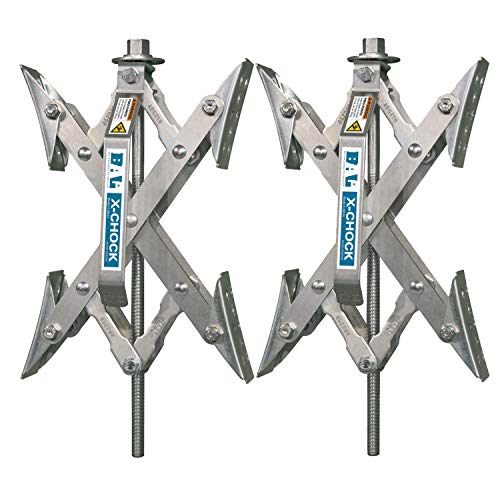
The X-Chock operates on a fundamentally different principle than every other product on this list, and that distinction makes it the definitive solution for a specific and extremely common problem: the side-to-side sway and rocking motion that tandem-axle trailers and fifth-wheel RVs exhibit when parked, even when standard wheel chocks are deployed at both ends of the tire. Rather than wedging under a single tire, the X-Chock inserts between the two tires on a tandem axle and expands via a ratcheting screw mechanism to apply opposing force simultaneously against both tire sidewalls, creating a rigid mechanical link that eliminates the lateral play that makes an RV feel like a boat in any kind of breeze. This is the product that transforms a parked travel trailer from a gently swaying nuisance into a stable living space, and once you've experienced the difference, going back to chocks-only stabilization feels unacceptable.
Manufactured in the USA from zinc-coated steel, the X-Chock is built for the rigors of full-time travel and extended seasonal deployment without the corrosion progression that would compromise a standard steel product in outdoor environments. The adjustment range of 1-3/8 inches to 10 inches is wide enough to accommodate the gap variations between tandem axle pairs across virtually every travel trailer, fifth wheel, and toy hauler configuration on the market today. The single-handle design means one operator can install or remove the pair efficiently, and the ratcheting mechanism holds its set position without any tendency to walk loose from road vibration or foot traffic movement inside the RV. American manufacturing isn't just a marketing point here — it's observable in the machined thread quality and the consistent coating coverage that budget imports consistently fail to match.
The X-Chock doesn't replace traditional wheel chocks — you still need a standard chock behind the tire to prevent fore-aft rolling when the vehicle is on a slope — but it completes the stabilization picture in a way that no rubber block can match. If you tow a tandem-axle trailer or own a fifth-wheel RV and you're not already using the X-Chock, this purchase will represent an immediate and dramatic improvement in your parked stability. If you're also concerned about securing your trailer from unauthorized movement when parked remotely, pair this with a solid trailer hitch lock for comprehensive protection against both accidental and intentional movement.
Pros:
Cons:
Reese Towpower is a name that anyone who has spent time in the trailer towing space will recognize immediately — this is the brand that supplies hitches, brake controllers, and towing accessories to the mass-market retail channel, and the 7000100 wheel chock set carries that heritage into a straightforward, no-frills product engineered to prevent trailer roll during unhitching and parking. The high-impact polymer construction gives these chocks adequate rigidity for their intended application with most trailer wheels, and the two-pack configuration provides both front-and-rear chocking capability in a single purchase. For a buyer who tows a utility trailer occasionally, stores a boat trailer seasonally, or wants a basic wheel chocking solution for a lightweight camper, the Reese set delivers functional performance at the most accessible price point in this category.
The polymer construction is simpler than the rubber compound products reviewed above — there's no oil resistance, no UV inhibitor specification in the product literature, and the impact-resistant plastic can become brittle in extreme cold, which is worth factoring in if you camp in sub-freezing conditions. The chocks are sized to fit most trailer wheels, which means they perform appropriately for the standard tire diameters found on single-axle utility and boat trailers while potentially lacking sufficient contact height for the larger tires on heavy fifth-wheel RVs. These are honest limitations rather than dealbreakers in the context of what this product is designed to do — they represent a clearly communicated scope that budget buyers should understand before purchasing.
Where the Reese 7000100 earns its position in this ranking is in the value-for-application equation: if your wheel chocking needs are intermittent, the vehicles involved are light-to-moderate in weight, and you want a two-pack solution that gets the job done without investment in premium materials, this set is a practical and reliable choice. The Reese brand backing means consistent manufacturing quality within the polymer construction category, and the familiar retailer availability makes these easy to source when you need a replacement quickly before a camping trip or job site deployment.
Pros:
Cons:
Checkers Industrial Safety Products occupies a category that most consumers never encounter: professional-grade industrial safety equipment used at loading docks, warehouses, military installations, and municipal fleet maintenance facilities where a wheel chock failure means a multi-ton truck in motion rather than a misplaced passenger car. The RC815 is that company's rubber chock offering for over-the-road trucks, trailers, and loading dock applications, and while the 10×8×6-inch external dimensions match the consumer-grade rubber blocks on this list, the internal engineering tells a completely different story. The void-bottom construction — a hollow channel running the length of the chock's underside — reduces weight without sacrificing the structural rigidity of the outer rubber walls, and it creates a partial vacuum effect that increases suction-grip against smooth concrete dock floors in a way that a solid-bottom design physically cannot replicate.
The recycled rubber compound used in the RC815 reflects a sustainable manufacturing approach that has no negative performance implications — recycled rubber vulcanized to the appropriate durometer rating performs identically to virgin-compound equivalents in compression and grip testing, and the material's resistance to UV, moisture, salt, and oil damage is specified to the same commercial-grade standard that fleet managers require for equipment that lives in outdoor environments year-round. Checkers' target market is the professional operator who deploys these chocks dozens of times per day in high-friction, high-accountability environments, so the durability specification is validated against real industrial use cycles rather than consumer-scale testing. The void-bottom design also facilitates drainage, preventing water accumulation under the chock that would otherwise create a slip plane between the rubber and the floor surface in wet conditions.
For the home garage operator or RV camper, the RC815 is likely more chock than the application requires, and the price reflects that industrial engineering premium. But for anyone operating at a commercial loading facility, running a fleet maintenance operation, or managing industrial vehicle safety compliance, this is the chock that meets the specification with no caveats. The Checkers brand is backed by decades of industrial safety product development, and the RC815 carries that credibility in physical form.
Pros:
Cons:
The fundamental material choice in wheel chock selection is between vulcanized rubber and hard polymer, and each material class has a clearly defined performance envelope that should guide your decision rather than leaving it to price alone. Rubber chocks — particularly those made from dense, oil-resistant compounds like those used by Buyers Products and MaxxHaul — deliver superior grip on all surface types, maintain their flexibility across the full temperature range you'll encounter in North American climates, and provide the greatest resistance to deformation under sustained heavy loads. The weight penalty is real but acceptable in professional and semi-professional applications where the chock lives permanently at a workstation rather than being carried in a pack.
Hard polymer chocks, represented here by the Camco 44414 and Reese Towpower sets, are purpose-built for the portability-first application profile of recreational vehicle owners and trailer operators who carry their chocks across every trip and need to minimize the storage footprint in already-crowded exterior compartments. The tradeoff is reduced grip on smooth or wet surfaces and potential brittleness in extreme cold — limitations that are fully acceptable in the light-duty, occasional-use context these products target. When evaluating your application, ask yourself whether the chock will live at a fixed location under heavy compression or travel with the vehicle and be deployed on varied terrain, and let that answer determine your material choice.
Wheel chock sizing is governed by two variables that must be evaluated together: the tire diameter of the vehicle being secured and the gross vehicle weight that the chock must resist. The 10×8×6-inch format that appears on the Buyers WC6810L, MaxxHaul 80681, and Checkers RC815 is the established standard for vehicles up to approximately 10,000 to 15,000 pounds — covering loaded pickup trucks, single-axle utility trailers, and the heavier classes of travel trailers. The 5×6×5-inch compact format of the Buyers WC1467A is appropriate for passenger cars, motorcycles, and light utility vehicles where the full-size block is physically oversized for the tire contact geometry. Using an undersized chock on an oversized vehicle is a genuine safety risk; the chock can compress, deform, or squirt out from under the tire under load, defeating its entire purpose.
For tandem-axle applications, the X-Chock's mechanical stabilizer approach makes the traditional size question largely moot by operating between the tires rather than under them — the adjustable range of 1-3/8 to 10 inches provides genuine universal compatibility across the tandem axle market. If you're equipping a multi-vehicle operation with chocks rated for different vehicle classes, maintaining clearly labeled sets prevents the safety hazard of deploying a compact passenger-car chock under a loaded trailer by mistake. The same disciplined approach that applies to other automotive safety tools — discussed in detail in our wheel and tire maintenance guides — applies equally to chock selection and maintenance.
The surface on which you deploy a wheel chock directly determines what material and profile characteristics matter most in your purchase decision. On smooth concrete dock floors and polished garage surfaces, the void-bottom design of the Checkers RC815 provides a meaningful suction-grip advantage over flat-bottom designs, while on gravel, asphalt, and uneven terrain, a wide flat-bottom rubber chock like the MaxxHaul 80681 maximizes contact area and distributes load across the broadest possible footprint. In environments where oil, fuel, and hydraulic fluid are present — service bays, truck docks, industrial maintenance facilities — the oil-resistant compound specification is a non-negotiable requirement rather than a marketing feature, because untreated rubber will swell and degrade on contact with petroleum compounds, compromising both structural integrity and grip performance within a single season.
Temperature matters more than most buyers anticipate when selecting chocks for outdoor deployment. Rubber compounds vary enormously in their cold-weather performance — cheaper blends stiffen to near-rigidity at temperatures below 20°F, reducing their ability to conform to tire surface irregularities and dramatically degrading grip on ice-contaminated surfaces. Premium compounds like those used in the Buyers Products line maintain meaningful flexibility to negative temperatures, and if your application involves winter deployment in a northern climate, that specification difference is worth paying for. For purely temperate or indoor applications, this distinction carries less weight and the budget-tier options represent better relative value.
In commercial and industrial applications, wheel chocks aren't just best practices — they're OSHA-mandated safety equipment subject to inspection, documentation, and specific securing requirements at loading dock facilities. OSHA standard 1910.178(k)(1) requires that trucks and trailers be immobilized against unintended movement during loading and unloading, and many facility safety programs extend that requirement to include physically chaining chocks to a fixed point so they can't be removed without authorization from the dock supervisor. The eyebolt-equipped designs — specifically the Buyers WC6810L with its recessed eyebolt and the MaxxHaul 80681 with its steel eyebolt — are the correct products for any application where compliance documentation or physical securing of the chock itself is required. The recessed design of the Buyers eyebolt specifically addresses the OSHA housekeeping requirements around trip hazards, making it the preferred specification for formal dock safety programs over designs with protruding hardware.
For passenger cars and light SUVs, a compact chock in the 5×6×5-inch range provides sufficient contact and resistance for the tire sizes and vehicle weights involved. For pickup trucks, loaded trailers, and RVs with larger tire diameters, the standard 10×8×6-inch format is the appropriate minimum specification. A useful rule of thumb is that the chock height should be at least one-quarter of the tire's diameter — a tire with a 24-inch diameter needs at least a 6-inch-tall chock to achieve the contact geometry that prevents the tire from rolling over the top of the wedge under load.
The minimum safe deployment for a single wheel on a level surface is two chocks — one in front of the tire and one behind — because a single chock can only prevent movement in one direction, leaving the vehicle free to roll the opposite way. In practice, chocking a single wheel on both sides of the tire is the standard protocol for vehicle maintenance and storage, while chocking a complete axle (both wheels, front and rear of each) is required for commercial dock operations and any situation where the vehicle is under active load from forklifts or cargo movement.
Rubber chocks outperform plastic in grip, cold-weather flexibility, and load resistance across the full range of professional and semi-professional applications. Plastic chocks offer lighter weight and lower cost, making them appropriate for intermittent recreational use — particularly RV and camper applications — where portability matters and the load conditions are within the polymer's performance envelope. The honest answer is that the correct material depends on your specific application: rubber for professional, heavy-duty, or all-weather deployment; polymer for light-duty recreational use where weight and storage space are primary constraints.
Position the chock snugly against the tire tread at ground level, orienting the wedge so that the tapered end faces the tire and the flat base contacts the ground surface. For fore-aft security on a slope, place one chock ahead of and one behind the tire on the downhill side, then verify that both chocks are in firm contact with the tire before walking away. On level surfaces, chocking the tire on both sides provides redundant security. If your application requires a chain attachment, run the chain through the eyebolt and secure it to a fixed anchor point before commencing work — never trust the chock's position alone when working under a raised vehicle.
Rubber chocks with wide, flat bases and textured surfaces perform adequately on compacted gravel and moderately uneven terrain by distributing load across the contact area and using friction to resist lateral movement. The key limitation is that gravel surfaces allow the chock base to shift if the applied force is severe — a vehicle rolling into a chock on loose gravel can push both the chock and the gravel substrate simultaneously, reducing effective resistance. On loose or unstable surfaces, using larger chocks, deploying them in pairs on both sides of the tire, and supplementing with the X-Chock stabilizer for tandem-axle applications provides the greatest security against unintended movement.
A quality rubber wheel chock with a proper compound specification — oil-resistant, UV-stable, weatherproof — will provide reliable performance for five to ten years under normal use conditions, and many commercial operators report service lives beyond that range for premium products like the Buyers WC6810L and Checkers RC815. The degradation indicators to watch for are surface cracking, visible compound brittleness in cold temperatures, and measurable compression set — a permanent flattening of the chock base that indicates the rubber matrix has broken down and will no longer return to its wedge profile under load. Budget rubber chocks using recycled or lower-grade compounds typically exhibit visible surface checking within two to three years of outdoor exposure, and compression-set failure within four to five years of regular use.
Wheel chocks are the simplest form of vehicle safety equipment you'll ever buy, and the right choice comes down to matching the material, size, and design to your specific application — the Buyers Products WC6810L for professional and heavy-duty use, the Camco or Reese sets for RV and recreational convenience, the MaxxHaul two-pack for the best value in full-size rubber, and the X-Chock when you need to eliminate tandem-axle sway entirely. Review your vehicle type, your deployment surface, and whether chaining compliance matters in your setting, then make your selection with confidence — every product on this list will outperform an unsecured vehicle every time.
 |
 |
 |
 |

About Liam O'Brien
Liam O'Brien has spent over a decade buying, field-testing, and evaluating automotive tools with a focus on what actually performs in a real DIY garage rather than what markets well on a spec sheet. His hands-on experience spans hand tools, diagnostic equipment, floor jacks, socket sets, and specialty automotive gear across a wide range of brands and price points. At CarCareTotal, he covers automotive tool and equipment reviews, garage setup guides, and buying advice for home mechanics.
Get some FREE car parts & gear.. Or check out the latest free automotive manuals and build guides here.
Disable your ad blocker to unlock all the hidden deals. Hit the button below 🚗
| | | |
