by Marcus Chen
According to industry data published by the Specialty Equipment Market Association, the wheel and tire accessories segment generated over $2.1 billion in North American aftermarket sales in 2025, with wheel spacers representing one of the fastest-growing sub-categories among truck and SUV owners seeking a wider stance and improved cornering geometry. If you have spent any time browsing the wheels and tires aftermarket, you already know the sheer volume of options available — different thicknesses, bolt patterns, materials, and hub-centric versus lug-centric designs can make choosing the right set feel overwhelming. The good news is that the 2026 market has produced a clear tier of standout products that consistently earn high marks for safety, fitment precision, and long-term durability.
Wheel spacers accomplish a deceptively simple job: they push your wheels outward from the hub, widening your vehicle's track and filling out aggressive wheel wells with larger tires. That extra width, whether it is 1/4 inch on a work truck or 1.75 inches on a Jeep Wrangler, translates directly into measurable improvements in cornering stability, reduced body roll, and — in the case of lifted trucks — enough clearance to run the oversized rubber that completes the build. According to Wikipedia's overview of wheel spacers, hub-centric designs that center on the vehicle's hub bore rather than relying solely on lug torque are widely regarded as the safer, more vibration-resistant choice for daily-driven vehicles. Every product on this list that qualifies as hub-centric is noted explicitly in the review below, because that distinction genuinely matters when you are pushing highway speeds.
For this 2026 guide, our editorial team evaluated seven of the best-selling and highest-rated wheel spacers currently available, examining construction material, bolt pattern compatibility, hub bore specifications, coating quality, and the real-world feedback accumulated across thousands of verified owner reviews. Whether you drive a daily-commuter Honda Accord, a trail-ready Jeep Wrangler JK, a towing-spec Chevy Silverado, or a modified Toyota Tacoma, you will find a purpose-matched recommendation in the breakdowns below. If installation is on your near-term list, pairing your spacers with a quality torque wrench and the best cordless impact wrench for initial removal will make the job significantly more manageable.

Contents
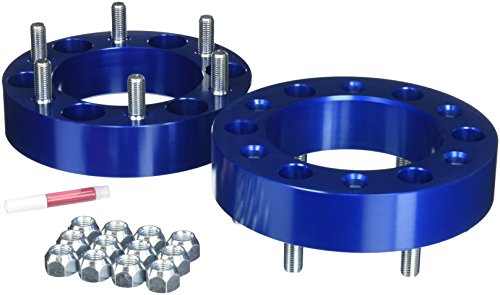








Spidertrax has maintained a strong reputation in the off-road community for well over a decade, and the WHS005 Blue Wheel Spacer Kit continues to justify that standing with its precision-machined construction and deliberately broad vehicle compatibility. The distinctive anodized blue finish is not merely cosmetic — it signals a hard-anodize process that protects the underlying aluminum against the salt, mud, and moisture that define serious trail use and northern-state winter driving. Spidertrax recommends contacting the seller with your specific year, make, and model before ordering, which reflects a commitment to accurate fitment rather than the overly optimistic compatibility claims that plague some competitors.
The kit's package dimensions — roughly 12 cm by 18 cm by 20 cm — suggest a compact, dense build that experienced off-roaders will immediately recognize as a sign of solid material thickness rather than an economy cut. Spidertrax spacers are consistently praised in owner reviews for their tight hub-to-spacer interface, which eliminates the micro-vibration that loosely toleranced spacers introduce at highway speed. The brand's decision to manufacture in China while maintaining tight internal quality standards has allowed them to hit a price point that undercuts domestic-only competitors without sacrificing the structural integrity that safety-conscious buyers demand.
If you run a lifted Jeep, a Toyota platform, or a domestic truck that needs a moderate width increase without committing to a full wheel swap, the WHS005 represents a proven, field-tested option that has earned its place on this list through years of consistent performance data rather than marketing copy alone.
Pros:
Cons:
Rough Country has built one of the most recognizable names in the domestic truck and SUV lift market, and their 1.5-inch wheel spacer pair for Chevy and GMC 1500 platforms extends that expertise directly into the wheel fitment category. Machined from 6061-T6 aluminum — the same aircraft-grade alloy used across premium suspension and steering components — these spacers deliver a hardness and tensile strength rating that far exceeds the cast alternatives you will encounter in the budget tier. The 6x5.5 bolt pattern covers the Silverado 1500, Sierra 1500, Suburban, Tahoe, and Yukon across a massive model year span from 1988 through 2021, making this one of the most broadly applicable truck-specific spacers currently on the market.
The 1.5-inch offset is a particularly well-chosen measurement for lifted Chevy and GMC trucks running aftermarket wheels and aggressive all-terrain tires: it creates enough additional track width to clear inner fender rubbing without pushing the wheel so far outboard that you introduce stress on wheel bearings and ball joints under heavy tow loads. Rough Country cites measurable improvements in cornering stability and rollover resistance, claims that align with the physics of a wider track — a lower center-of-gravity moment arm means less body lean in hard corners and more predictable handling on uneven off-road terrain. Each pair arrives silver-finished from the factory, which coordinates cleanly with unpainted aluminum wheels and bare-metal brake components.
For Chevy and GMC 1500 owners who want a direct-fit solution backed by a brand with deep aftermarket roots and a documented warranty program, the Rough Country 1.5-inch spacers represent the most straightforward path to a wider, more aggressive stance without any guesswork about compatibility.
Pros:
Cons:
KSP's 1.25-inch forged wheel spacers for the Toyota 6x139.7 bolt pattern family represent some of the most technically precise fitment hardware available for Tacoma, 4Runner, Tundra, and FJ Cruiser owners in 2026, and the use of real forged — not cast — 6061-T6 aluminum is the single most important differentiator that elevates this set above the crowded midrange. Forging compresses the aluminum's grain structure during manufacturing, producing a material that is measurably denser and more resistant to cracking under cyclical load than a cast part with identical external dimensions. KSP's in-house engineering team CNC-machines these to exact standards, and the 106mm hub bore with a centering lip locks directly onto the Toyota hub without the shimmy that lug-centric designs allow during torque cycling.
The hardware package includes heat-treated, hardened Grade 10.9 geomet-coated bolts — a fastener specification that exceeds the Grade 8 studs you will find in many competing kits and resists the galling and corrosion that standard zinc-plated hardware develops after a single wet season. At 32mm (1.25 inches), the spacer thickness sits in a sweet spot that provides genuine visual stance improvement and enough room to run 285-series all-terrain tires without inner fender interference, while keeping bearing load increases within the tolerance range that Toyota engineers built into the stock hub assemblies. Laser-engraved sizing and part number information on each spacer face makes torque-spec verification and future replacement ordering straightforward, a detail that signals careful product stewardship rather than a disposable afterthought. When you are done with the install, a quick check with one of the best digital tire pressure gauges ensures your wider rubber is seated and inflated correctly before the first drive.
One important caveat: some Tacoma and FJ Cruiser front axle configurations with locking hubs may not accommodate these spacers on the front, and the included open lug nuts may not engage sufficient thread depth on certain build years — KSP supplies ET-style lug nuts (part B07DLX519N) as a separate remedy, and including thread-locker in the kit shows they have anticipated the issue rather than leaving buyers to discover it roadside.
Pros:
Cons:
The Orion Motor Tech hub-centric spacer kit targets one of the most popular bolt patterns in the Japanese import segment — 5x114.3 — and covers an impressively broad Honda and Acura lineup that includes the Accord, Civic, CR-V, Acura RSX, and Acura TL, platforms that collectively account for millions of vehicles on North American roads. These 1-inch blue-anodized spacers add two full inches to the vehicle's axle track measurement when installed front and rear, a change that delivers a noticeably wider, more planted appearance and a measurable reduction in understeer in tight corners where the stock Honda suspension geometry tends to push wide under load. The T6 aircraft-grade aluminum construction keeps the unsprung weight addition minimal, which matters on a front-wheel-drive platform where excessive unsprung mass amplifies steering feedback disturbances.
The hub-centric design centers on the 64.1mm bore specification, which corresponds directly to Honda's OEM hub bore diameter and ensures the spacer self-aligns on the hub before the lug hardware is torqued, eliminating the small but cumulative centering errors that lug-centric spacers accumulate over hundreds of thermal expansion and contraction cycles. Orion includes 20 Dacromet-coated M12x1.5 bolts — a coating chemistry that the manufacturer claims provides seven to ten times the corrosion resistance of standard electroplated hardware, a claim consistent with Dacromet's documented performance against salt spray in ISO 9227 testing protocols. The rear face incorporates unique relief slots that ease removal after long-term installation, when corrosion and fretting can fuse an aluminum spacer to a steel hub with surprising tenacity.
Honda owners upgrading to aftermarket wheels or simply seeking the aggressive flushed-out look that the stock offset denies will find Orion's execution here to be genuinely purpose-built rather than a generic spacer relabeled for a popular application.
Pros:
Cons:

Eibach is a name that carries genuine credibility earned across decades of motorsport suspension development, and the Pro-Spacer System 4 represents the German manufacturer's application of that engineering discipline to the wheel spacer category — a segment where brand heritage is often invoked but rarely backed by actual performance pedigree. The S90-4-15-002 specification translates to a 30mm thickness with a 5/114.3 bolt pattern and a 67.0mm center bore, a configuration that spans a wide range of Japanese and Korean platforms including various Toyota, Lexus, Nissan, Infiniti, Hyundai, and Kia applications. At 30mm, this is among the more aggressive offsets in the non-adapter class, and the handling improvement it delivers on a sport-tuned platform is immediately perceptible through the steering column.
High-tensile-strength aluminum alloy is Eibach's stated material choice here, and the Pro-Spacer line is manufactured to the same dimensional tolerances that Eibach holds for its coilover and anti-roll bar products — tolerances that are considerably tighter than the aftermarket norm. Where some competitors treat spacers as a commodity product, Eibach's quality-control documentation and consistent owner satisfaction scores across automotive enthusiast forums suggest a production standard that justifies the premium price. The 30mm width increase materially improves both the visual stance and the physical handling dynamics of cars with narrow OEM track widths relative to their wheel well openings, producing the flush wheel look that enthusiasts associate with OEM-plus builds and tuner-spec show cars.
If you drive a performance-oriented sedan, sport utility, or coupe on a 5x114.3 pattern and want a spacer that reflects the same engineering values as your springs and dampers, the Eibach Pro-Spacer is the credible, documented choice that stands apart from the commodity alternatives cluttering the search results.
Pros:
Cons:
The Jeep Wrangler JK and JKU occupy a unique position in the wheel spacer market — their aggressive use cases, high center of gravity, and dedicated enthusiast owners demand hardware that prioritizes structural integrity and precise fitment above all other attributes, which is exactly where the GRIMM OFFROAD 1.75-inch kit distinguishes itself from the generic 5x5 spacers that flood the JK-compatible listings. The 1.75-inch thickness creates meaningful additional clearance for larger tire fitment, reducing or eliminating the fender and suspension rubbing that plagues JK owners running 35-inch or larger tires on stock or mildly lifted setups — a very specific pain point that GRIMM has clearly engineered against rather than just listing compatible bolt patterns and moving on.
The CNC-machined 6061-T6 aluminum construction is hub-centric, meaning it self-centers on the Wrangler JK's hub bore rather than relying on lug torque alone to maintain concentricity under load — a critical distinction when you are running the Wrangler through rocky terrain where wheel impacts generate lateral shocks that a lug-centric spacer simply cannot resist as reliably. GRIMM specifies 1/2-20 Grade 8 studs, which are a direct-fit match for the JK's factory lug hardware, and the black anodized coating on both the spacer body and studs provides the corrosion barrier that constant exposure to mud, water crossings, and trail debris demands from hardware you cannot easily inspect between trail runs. If you are also researching protective accessories for your Wrangler build, our guide to the best Jeep soft tops covers the complementary category of weather protection for open-top trail rigs.
For JK and JKU owners who have already invested in the lift, the tires, and the suspension, GRIMM OFFROAD's 1.75-inch spacer kit is the purpose-specific, precisely engineered finishing piece that the Wrangler community has needed at a price point that does not treat Jeep owners as a captive audience for margin extraction.
Pros:
Cons:
Steel wheel spacers occupy a specific and legitimate niche in the full-size truck market that aluminum-focused products simply cannot address: applications where maximum shear strength and resistance to deformation under load outweigh the weight savings that aluminum provides. These 1/4-inch steel spacers for the 10-lug commercial truck and heavy-duty SUV bolt pattern — 10x225mm metric or 10x8.75-inch imperial — represent the correct tool for owners of heavy-duty Chevy, GMC, Dodge, and Ford platforms where the loads imposed on wheel-mounting hardware regularly exceed what aluminum can endure without risk of creep deformation over time.
At only 1/4 inch of offset, these spacers are not attempting to dramatically alter your truck's stance — they are solving precise fitment problems such as clearing brake caliper brackets after an aftermarket rotor upgrade, correcting slight wheel-to-fender contact from a tire upsizing, or adapting OEM wheels to a platform with a slightly different hub face depth. The 10-lug configuration identifies the buyer demographic immediately: this is commercial-grade hardware for full-size 3/4-ton and 1-ton trucks, platforms that haul, tow, and work under sustained stress that would quickly expose any compromises in spacer construction. Steel's higher density relative to aluminum means a modest weight penalty, but on a vehicle that already weighs five-plus tons loaded, that tradeoff is irrelevant compared to the confidence of knowing the spacer will not yield under maximum trailer tongue weight. Before finalizing your truck accessory list, it is worth checking that your locking lug nuts are spec-matched to your new hardware configuration.
For buyers who prioritize raw material strength over minimizing unsprung weight — and who operate their trucks in the genuine heavy-duty application range those trucks were engineered for — this steel spacer pair delivers the no-compromise solution that the commercial truck segment demands.
Pros:
Cons:
The single most consequential decision you will make when selecting wheel spacers is whether to choose a hub-centric or lug-centric design, and the evidence overwhelmingly favors hub-centric construction for any vehicle driven at highway speeds or subjected to sustained lateral loads. A hub-centric spacer incorporates a precisely machined center bore that seats directly onto the vehicle's hub register, centering the spacer — and by extension the wheel — on the hub itself rather than relying on the lug studs to carry the centering load. When a lug-centric spacer is installed, the centering function falls entirely to the lug torque, which is adequate at constant load but can allow micro-movement during thermal cycling and impact events, producing the characteristic shimmy that many owners report after installing budget lug-centric spacers. For any application beyond static display, you should verify that the center bore specification of your chosen spacer matches your vehicle's hub register diameter exactly — even 0.5mm of mismatch in a lug-centric design creates the conditions for vibration that becomes progressively worse at speed.
Among the aluminum alloy options available in the 2026 market, 6061-T6 stands as the standard that reputable manufacturers converge on because its yield strength of approximately 276 MPa and tensile strength of 310 MPa provide the structural margins needed for wheel-mounting duty without imposing excessive unsprung weight. Within the 6061-T6 category, the manufacturing method matters significantly: forged spacers — where heated aluminum billet is compressed under hydraulic dies — produce a denser grain structure and measurably higher fatigue resistance compared to cast spacers that are poured into molds and may contain microscopic porosity voids. When evaluating any spacer listing in 2026, look specifically for the word "forged" backed by documentation rather than "CNC machined," which describes a finishing step that can be applied to both forged and cast blanks. Cast 6061-T6 is still structurally adequate for most street applications, but forged hardware is the appropriate choice for off-road, track, and towing use cases where cyclical loads are sustained and high.
Wheel spacer thickness determines how far your wheel moves outboard, and selecting the correct measurement requires balancing three competing factors: the visual stance improvement you want, the tire clearance you need, and the bearing stress increase you can accept given your vehicle's intended use. Thin spacers in the 1/4-inch to 1/2-inch range are appropriate for precise fitment corrections — clearing brake caliper brackets, addressing minor inner fender contact — where you want the minimum additional offset required to solve a specific interference problem. Spacers in the 1-inch to 1.5-inch range represent the most common choice for lifted trucks and SUVs seeking a wider stance and accommodation for plus-sized tires, providing visible track width improvement without dramatically altering the hub bearing's moment arm load. Spacers above 1.5 inches — the 1.75-inch GRIMM OFFROAD Jeep kit is a good example — are appropriate when you are running tires significantly larger than stock and need clearance from fenders and suspension components, but they impose a proportionally higher bearing load that your service interval schedule should account for with more frequent hub bearing inspection.
Bolt pattern compatibility is the most fundamental fitment check before any wheel spacer purchase, and getting it wrong means the spacer either will not mount to the hub or will not accept your wheels — both outcomes that require a return and reorder. Your vehicle's bolt pattern is expressed as a number of lugs times the diameter of the bolt circle in millimeters: common domestic truck patterns include 6x139.7 (Toyota, some GM), 6x135 (Ford F-150), and 10x225mm (heavy-duty commercial platforms). The stud specification on the spacer's outboard face must match your wheel's lug bore diameter and thread pitch exactly — mismatched thread pitches are the most common installation error, and forcing metric hardware onto imperial thread or vice versa will strip both the stud and the lug nut before generating any useful clamping force. When in doubt, contact the manufacturer with your specific year, make, model, and trim before ordering rather than relying on generic fitment tables, which is exactly the guidance Spidertrax provides with the WHS005 kit. After installation, always torque your lug hardware to the manufacturer's specified value — the KSP spacers, for example, specify 72–80 ft-lbs — and re-torque after the first 50 miles of driving, which allows the mating surfaces to fully seat.
Hub-centric wheel spacers made from quality 6061-T6 aluminum, installed to the manufacturer's torque specification and re-torqued after the first 50 miles, are safe for daily driving when properly matched to your vehicle's hub bore diameter and bolt pattern. Lug-centric spacers are generally adequate for low-speed and parking applications but carry a higher vibration risk at highway speeds due to their reliance on lug torque for centering rather than a precision-machined hub interface. The key safety variables are material quality, hub-centric fit, correct torque values, and periodic re-inspection — not the spacer concept itself.
Yes, wheel spacers increase the moment arm load on your wheel bearings by moving the wheel's contact patch outboard relative to the bearing centerline, which means the bearing experiences a slightly higher cantilever load under lateral cornering forces. For moderate spacer thicknesses — 1 to 1.5 inches — on a street-driven vehicle, the increased bearing stress is within the safety margins engineered into OEM hub assemblies, and most owners report no premature bearing failure when spacers are properly installed. Spacers above 1.5 inches on vehicles that see frequent heavy towing or sustained off-road lateral loads warrant more frequent hub bearing inspection as a precautionary measure.
A wheel spacer maintains the same bolt pattern on both its hub-mounting face and its wheel-mounting face, pushing the wheel outboard while preserving full compatibility with your existing wheels. A wheel adapter changes the bolt pattern between the two faces, allowing a wheel with a different bolt circle — such as a 5x4.5 wheel on a 5x5 hub — to be used on your vehicle. Adapters are significantly thicker than spacers to accommodate both bolt circles and the hardware to engage each, and they introduce more complexity into the fitment equation; spacers are the appropriate choice when you are keeping your existing wheels and simply want to move them outward.
The fuel economy impact of wheel spacers is measurable but small in most real-world applications, typically within 1 to 3 percent, primarily attributable to the increased frontal area created by wheels that now extend slightly beyond the original body envelope and, to a lesser extent, the added unsprung weight. For drivers using spacers to accommodate wider tires — a common pairing — the rolling resistance increase from the larger contact patch is generally a more significant fuel economy factor than the spacer itself. Aluminum spacers minimize the weight contribution, and moderate thicknesses under 1.5 inches produce effects that most owners describe as imperceptible in normal driving conditions.
Wheel spacers can cause vibration when they are lug-centric rather than hub-centric, when the center bore diameter does not precisely match the vehicle's hub register, or when they are installed without proper torque specification and re-torque procedures. Hub-centric spacers that are correctly sized to the vehicle's hub bore and torqued to specification are extremely unlikely to introduce vibration, because the centering function is performed mechanically by the precision bore rather than by the lug hardware alone. If you experience vibration after installing spacers, the first diagnostic step is verifying that the center bore specification matches your hub register and that all lug nuts are at the correct torque value.
Installing wheel spacers does not mechanically alter your suspension geometry, toe angle, or camber settings, so a four-wheel alignment is not technically required after spacer installation alone. However, if you are installing spacers as part of a broader wheel and tire change — particularly if the new tires are wider or have a different diameter — an alignment check is advisable to confirm that the tire contact patch is squarely centered and that any wear patterns from the previous setup are corrected. Many professional installers recommend an alignment any time significant wheel configuration changes are made, simply as a quality-control step to document the vehicle's pre-change baseline and verify post-installation geometry.
The right wheel spacer for your vehicle in 2026 comes down to three non-negotiable factors: a hub-centric bore that matches your hub register exactly, a 6061-T6 aluminum or high-tensile steel construction matched to your use case, and a thickness that solves your specific clearance or stance goal without overloading your hub bearings. Use the product breakdowns and buying guide above to identify the kit engineered for your exact platform, order with confidence, and torque to specification — your wider, more planted stance is one installation away.
 |
 |
 |
 |

About Marcus Chen
Marcus Chen has over twelve years of hands-on experience modifying cars across a range of platforms — from commuter builds to track-focused setups — with deep expertise in suspension tuning, wheel and tire fitment, and performance upgrades that improve driving dynamics without sacrificing day-to-day reliability. He has worked with both bolt-on and engineered modifications and brings a methodical, results-focused approach to evaluating performance parts. At CarCareTotal, he covers performance upgrades, suspension and handling, and wheel, tire, and drivetrain modifications.
Get some FREE car parts & gear.. Or check out the latest free automotive manuals and build guides here.
Disable your ad blocker to unlock all the hidden deals. Hit the button below 🚗
| | | |
