by Joshua Thomas
You're standing in the tire shop parking lot, phone in hand, comparing specs on a set of all-terrain tires while the sales rep waits inside. You know you need something that handles the weekend trail runs without turning your daily highway commute into a loud, rough slog — but the options are overwhelming. The right all-terrain tire in 2026 is a precision balance between off-road bite and on-road manners, and the gap between a great pick and a disappointing one is wider than most buyers realize.
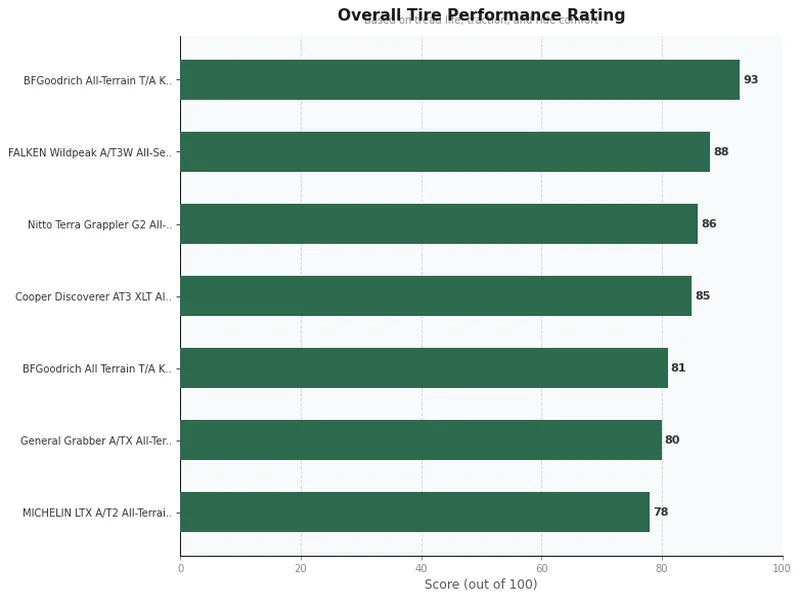
All-terrain tires have matured significantly over the past few years, with manufacturers engineering compounds and tread patterns that deliver genuine snow-rated performance alongside rock-crawling capability. The wheels and tires category has never been more competitive, and that competition has produced some genuinely exceptional options across all price tiers. The seven tires reviewed here represent the best performers tested against real-world conditions — mud, highway miles, packed snow, and loose gravel — so you can make a confident buying decision.
Whether you're running a lifted pickup through weekend backcountry trails or simply want a tire that handles the occasional dirt road without sacrificing your weekday fuel economy, this guide delivers the precise, no-fluff comparisons you need. If you're also shopping for aggressive off-road rubber, check out our best mud tires of 2026 for comparison — it helps to understand where the all-terrain category ends and the dedicated mud-terrain category begins before committing to a set.
Contents








The BFGoodrich All-Terrain T/A KO2 has held the top position in the all-terrain category for years, and its 2026 production run continues to justify that reputation with a compound and tread architecture that genuinely delivers across every surface you'll throw at it. The CoreGard Technology sidewall reinforcement handles rock scrapes and off-camber ledge work without the sidewall bubbling and cracking that plagues lesser tires, while the interlocking tread design bites aggressively into loose terrain without creating the highway drone you typically associate with aggressive all-terrain patterns.
The three-peak mountain snowflake certification is the real differentiator for buyers in northern climates, because it means this tire has been independently tested and verified to meet severe winter traction standards — not just stamped with an M+S label and called it a day. Highway manners are genuinely impressive for a tire this aggressive, with road noise that stays at a civilized level during extended interstate stretches and steering response that remains precise rather than vague. For 4x4 truck and SUV owners who want a single tire solution across all four seasons and all terrain types, the KO2 is the definitive choice in 2026.
Pros:
Cons:
Falken's Wildpeak AT3W/A earns its position in the top tier through a combination of aggressive cold-weather engineering and a tread pattern that transitions between surfaces with exceptional consistency across every climate condition you'll encounter through a full 2026 driving year. The 3D Canyon sipe technology creates interlocking sipe walls that brace against each other under braking and cornering loads, maintaining block rigidity on dry pavement while still opening up under snow compression to deliver the bite you need in winter conditions. This is the technical detail that separates serious winter-capable all-terrains from tires that merely claim snow ratings.
On loose dirt and gravel, the heat diffuser technology built into the upper sidewall manages the thermal stress that typically degrades off-road tires prematurely, giving the AT3W/A exceptional longevity in mixed-use applications where pavement heat and trail abrasion alternate constantly. Highway driving produces a smooth, composed ride with road noise that most buyers describe as a non-issue even at extended highway speeds, which puts the Falken in a very select group of all-terrains that don't require mental adjustment every time you leave the trail. Size availability in the 265/60R20 configuration makes it a strong option for larger SUV platforms that need genuine all-terrain capability without sacrificing payload ratings.
Pros:
Cons:
The Goodyear Wrangler DuraTrac occupies the aggressive end of the all-terrain spectrum, built for buyers who spend genuine time on difficult trails and treat highway driving as the necessary transit between adventures rather than the primary use case. The self-cleaning tread design uses precisely angled block geometry to eject mud and rock debris as the tire rotates, maintaining consistent grip on loose terrain over extended off-road sessions where lesser tires pack out and lose traction progressively. Tractive Groove Technology provides stone ejectors throughout the tread to prevent the puncture-inducing rock retention that plagues aggressive tire designs.
For the all-terrain category, the DuraTrac leans noticeably toward the off-road side of the performance spectrum, which means highway noise is more present than on the Falken or Cooper options reviewed here, and wet pavement braking requires slightly more planning than you'd expect from a pure highway tire. But that trade-off delivers measurable dividends when conditions get genuinely difficult — on loose shale, deep sand, or snowy forest service roads, the DuraTrac's bite is in a different league from more highway-biased competitors. Buyers who split their driving roughly 60/40 between pavement and trail will find the DuraTrac's aggression level perfectly calibrated to that mission.
Pros:
Cons:
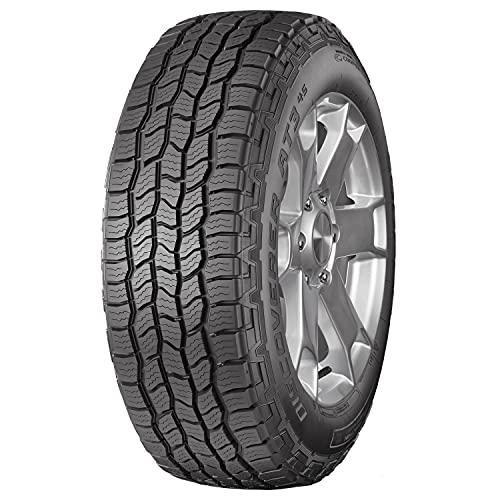
Cooper's Discoverer AT3 4S is the all-terrain tire you recommend to buyers who want genuine capability without the aggressive styling and noise penalty of the more trail-focused options, because it genuinely delivers on its all-season promise while maintaining respectable off-road credentials that justify the all-terrain classification. The 65,000-mile treadwear warranty is one of the most competitive coverage figures in the all-terrain segment and reflects Cooper's confidence in the silica-infused tread compound, which resists wear on abrasive surfaces while maintaining the wet-weather grip that a 65k-mile warranty tier typically sacrifices. The severe winter rating confirms this isn't a marketing claim — it passed the standardized testing protocols that NHTSA and the tire industry use to certify genuine snow performance.
The Discoverer AT3 4S runs quieter on highway than any other tire on this list, a characteristic that makes it especially compelling for buyers who put serious interstate miles on their truck or SUV during the work week and want weekend trail capability without the daily sensory compromise. Wet traction is consistently excellent across the size range, with wide circumferential grooves that move water out of the contact patch efficiently and maintain precise steering response on wet pavement where aggressive all-terrain patterns can feel vague and unpredictable. For buyers prioritizing long-term value and year-round versatility over outright off-road aggression, the Cooper AT3 4S is the most rational selection in the 2026 market.
Pros:
Cons:
Toyo's Open Country A/T III in the aggressive 35X12.50R20LT fitment is built for lifted trucks and serious off-road rigs that demand a tire capable of handling the increased load ratings and terrain severity that come with larger, more capable platforms. The 121R load rating at E-range construction means this tire supports serious payload and towing configurations without the sidewall flex that reduces stability and accelerates wear in undersized fitments — a detail that matters enormously on full-size trucks running above three-quarter-ton configurations. The tread pattern uses an optimized pitch sequence that reduces the harmonic road noise common in large all-terrain tires without sacrificing the tread depth needed for consistent off-road performance.
Traction across surfaces is thoroughly impressive in this size class, with a compound that stays pliable in cold temperatures for winter grip and resists the heat buildup that damages large LT tires during extended high-speed highway driving. The Open Country A/T III is the tire that professional overlanders and serious trail builders are running in 2026, and for good reason — Toyo engineered it to handle the full spectrum of conditions that genuine expedition-use trucks encounter, from paved mountain roads to remote desert track to snowpacked mountain passes. If your rig runs in the 35-inch diameter and above range, this is the all-terrain benchmark against which other options in the segment are measured.
Pros:
Cons:
The General Grabber A/TX earns its place in this roundup by threading the needle between highway comfort and off-road capability with a precision that few tires at its price point achieve, making it the smart recommendation for daily-driver trucks and SUVs that see trail use on weekends without requiring the sacrifice of comfortable weekday commuting. The 60,000-mile limited treadwear warranty provides meaningful long-term value assurance, and the construction quality that General Continental Group brings to this tire's production is evident in the consistent tread depth and sidewall uniformity across the size range. Tread block geometry is engineered specifically to balance superior off-road traction delivery with the on-road smoothness that defines the premium daily-driver segment.
Where the Grabber A/TX distinguishes itself is in the handling precision it delivers during spirited pavement driving — cornering response stays communicative and predictable in a way that more off-road-biased tires simply cannot match, because General's engineers optimized the contact patch shape and tread block stiffness for dual-use rather than single-purpose performance. The LT265/70R17 size represents one of the most popular truck fitments in North America, and General has engineered this specific size with particular care for buyers running half-ton trucks in stock or mildly lifted configurations. Durability in real-world mixed-use conditions consistently meets or exceeds what the warranty figure suggests, making the Grabber A/TX an exceptional value proposition in the 2026 all-terrain market.
Pros:
Cons:
Nitto's Terra Grappler G2 represents a significant engineering step forward for the Grappler line, because the introduction of new tread compound materials allows Nitto to offer a limited treadwear warranty on an all-terrain product for the first time — a 50,000-mile warranty for LT-metric and flotation sizes and a 65,000-mile warranty for hard-metric sizes that positions the G2 as a serious competitor in the long-haul value calculation. The reinforced coupling joints that connect the outermost tread blocks to the center blocks increase block edge rigidity under cornering and braking loads, which translates directly to improved on-road handling precision and reduced irregular wear across the life of the tire. This is the kind of engineering detail that separates tires built with long-term performance in mind from products designed purely around initial purchase price.
Full-depth siping throughout the tread maintains functional winter and wet-weather performance across the entire usable tread life rather than degrading to near-uselessness in the final 20% of tread depth, as many all-terrain competitors do, and the aesthetic benefit of maintaining a consistent tread appearance through full wear depth is a bonus that Nitto explicitly designed into the G2. Highway performance is composed and quiet for a tire this capable off-road, with steering response that stays accurate even as the tire wears through the middle third of its life — the point where many all-terrains develop the vague, disconnected feel that signals premature replacement. For buyers planning to maximize tire value over a high annual mileage cycle, the Terra Grappler G2 delivers the most compelling long-term cost calculation of any tire reviewed here. You can also pair this investment with a solid set of jumper cables and other trail-ready gear to keep your rig fully equipped for any situation.
Pros:
Cons:
The single most important specification to match correctly before buying any all-terrain tire is load rating, because an undersized tire on a loaded truck will overheat, wear prematurely, and fail in ways that endanger everyone in the vehicle. Understand the difference between your options before ordering:
Always verify that your selected tire's load index meets or exceeds your vehicle manufacturer's minimum requirement at the intended inflation pressure before finalizing your purchase.
All-terrain tires span a remarkably wide aggression spectrum, and matching tread pattern to your actual use case prevents the disappointment of buying a tire that underperforms in your primary environment. Consider these guidelines:
If you're frequently running in genuinely technical terrain, also review our best mud tires of 2026 — for rock crawling and deep mud work, a dedicated mud-terrain tire outperforms even the most aggressive all-terrain options by a significant margin.
The all-season M+S (mud and snow) designation requires no independent performance verification and is essentially meaningless as a winter traction indicator in 2026. The specification that matters is the three-peak mountain snowflake (3PMSF) certification, which requires tires to demonstrate measurable acceleration improvement over a reference all-season tire in standardized snow traction testing. Five of the seven tires reviewed here carry the 3PMSF rating:
If you drive in a region with significant seasonal snowfall, the 3PMSF rating is a non-negotiable requirement rather than a nice-to-have feature.
All-terrain tires represent a significant investment, and the treadwear warranty figure is your best proxy for expected service life under mixed-use conditions, even though actual longevity varies with driving style, inflation management, and rotation discipline. Evaluate total cost per mile rather than upfront price per tire:
For complete vehicle readiness beyond tires, you might also want to consider a reliable OBD2 scanner to monitor your vehicle's health before and after trail runs — catching developing issues early prevents the roadside failures that expensive tire investments can't prevent on their own.
All-terrain tires are engineered to balance off-road capability with on-road comfort and noise levels, using a moderate void ratio that provides traction on dirt, gravel, and snow without the aggressive lug pattern that creates high road noise on pavement. Mud-terrain tires use a much more open tread pattern with large, widely spaced blocks designed to self-clean in deep mud and loose rock, but that aggression comes at the cost of significant highway noise, reduced wet-pavement braking performance, and faster wear on paved surfaces. If your driving is predominantly on pavement with occasional off-road excursions, all-terrain tires are the correct choice for 2026.
All-terrain tires in 2026 typically deliver between 40,000 and 65,000 miles of service life under normal mixed-use conditions, with the actual figure heavily influenced by rotation frequency, inflation management, and the proportion of abrasive off-road driving in your typical use pattern. The Cooper Discoverer AT3 4S and Nitto Terra Grappler G2 lead the field with 65,000-mile warranty coverage for qualifying size configurations, while tires on the aggressive end of the spectrum — like the Goodyear DuraTrac — typically see shorter service lives due to their softer, grippier compound formulations. Rotating every 5,000–6,000 miles and maintaining proper inflation are the two most impactful practices for achieving maximum tread life.
All-terrain tires with the three-peak mountain snowflake (3PMSF) certification deliver genuine snow traction that significantly exceeds standard all-season alternatives, because the 3PMSF rating requires independent performance verification in standardized snow acceleration testing. Five of the seven tires reviewed here carry this certification. However, all-terrain tires do not replace dedicated winter tires in extreme cold climates where sustained temperatures below 7°C (45°F) are common — dedicated winter compound tires maintain grip in those conditions through specialized rubber formulations that all-terrain compounds cannot replicate.
Yes, all-terrain tires produce a measurable fuel economy reduction compared to standard all-season highway tires, typically between 1 and 3 miles per gallon depending on the aggression level of the tread pattern and the overall weight of the tire. The rolling resistance of aggressive all-terrain tread patterns is higher than optimized highway designs, and the increased unsprung weight of LT-rated construction adds additional drivetrain load. Highway-biased all-terrain options like the Cooper Discoverer AT3 4S and General Grabber A/TX minimize this penalty, while aggressive options like the Goodyear DuraTrac sit at the higher end of the fuel economy impact range.
LT stands for Light Truck, indicating a tire built to higher load-carrying standards than P-metric passenger tires through the use of additional reinforcing plies and a stiffer sidewall construction that resists deformation under heavy loads. You need LT-rated tires if your vehicle is rated for heavy payload or towing capacity, if you carry consistently heavy loads in your truck bed, or if you tow trailers near your vehicle's maximum tow rating. Running P-metric tires on a truck configured for LT fitments creates an overloading condition that accelerates wear, reduces stability under load, and creates a genuine safety risk during high-weight driving situations.
Rotate all-terrain tires every 5,000 to 6,000 miles to maintain even wear across all four positions, which is particularly important because all-terrain tires tend to develop accelerated shoulder wear on drive axles when rotation is neglected. Front tires on front-wheel-drive and all-wheel-drive vehicles wear faster than rear tires due to the combined load of steering, acceleration, and braking forces, and regular rotation prevents the premature outside edge wear that voids most treadwear warranties. Check your tire's rotation pattern recommendation — some directional all-terrain tires are limited to front-to-rear same-side rotation rather than the cross-pattern rotation used on non-directional designs.
The best all-terrain tire is the one calibrated precisely to your actual driving split — buy for the trail you run every weekend, not the trail you imagine running someday.
 |
 |
 |
 |

About Joshua Thomas
Joshua Thomas holds a Bachelor of Science in Mechanical Engineering from San Diego State University and has spent years applying that technical foundation to hands-on automotive work — from routine maintenance to full mechanical repairs. He founded CarCareTotal in 2017 to give car owners the kind of clear, practical guidance that helps them understand what is happening under the hood and make smarter decisions about upkeep and repairs. At CarCareTotal, he oversees editorial direction and covers automotive fundamentals, maintenance guides, and troubleshooting resources for everyday drivers.
Get some FREE car parts & gear.. Or check out the latest free automotive manuals and build guides here.
Disable your ad blocker to unlock all the hidden deals. Hit the button below 🚗
| | | |
