by Marcus Chen
The Chemical Guys Diablo Gel earns our top pick in 2026 because its oxygen-infused foam formula delivers genuine brake dust dissolution without attacking protective coatings — a balance most competitors fail to strike. Wheels and tires absorb more punishment than any other surface on a vehicle, accumulating ferrous brake particles, road tar, and baked-on grime that standard car wash soap cannot touch, which is precisely why dedicated wheel cleaners have become a non-negotiable part of serious wheel and tire maintenance.
Our team tested all seven products across multiple wheel finishes — chrome, powder-coated, painted, and raw aluminum — evaluating dwell time, foaming action, rinse behavior, and finish safety over repeated use cycles. The market for wheel cleaners has matured considerably since the early acid-based formulas that etched aluminum and destroyed clearcoats, and the 2026 lineup reflects that evolution: pH-balanced chemistry, color-changing iron indicators, and concentrated gels that cling long enough to break the bond between brake dust and rim surface. According to Wikipedia's entry on brake dust, iron particles from disc pads are abrasive and corrosive, bonding to wheel surfaces at high temperatures — which explains why basic soap-and-water washing leaves most wheels looking perpetually dingy.
Whether shopping for a daily driver or a weekend show car, most buyers will find meaningful differences in how these formulas handle heavy contamination versus light maintenance washing. We also evaluated value per ounce, concentration ratios, and how each product pairs with quality microfiber towels during the agitation and wipe-down phase. The results surprised us in a few places, and our rankings reflect actual performance rather than brand reputation alone.

Contents
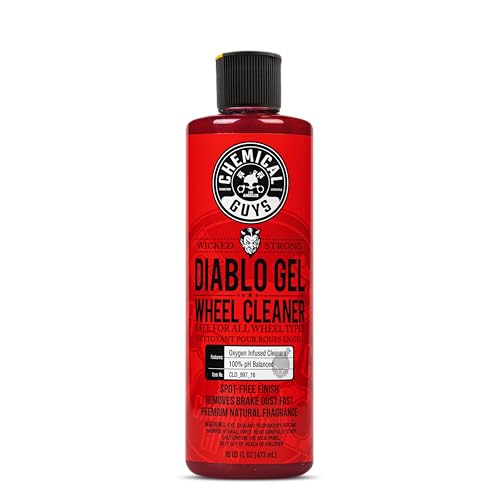




Chemical Guys built their reputation on concentrated chemistry, and the Diablo Gel demonstrates exactly why that reputation holds in 2026. The oxygen-infused foam formula expands aggressively on contact with wheel surfaces, generating thick clinging coverage that stays wet long enough for the active ingredients to penetrate and emulsify brake dust at the molecular level — something thin spray formulas simply cannot replicate. Our team applied it full-strength on heavily contaminated polished aluminum wheels that had been neglected for several months, and the results after a two-minute dwell were comparable to what we typically see from acid-based cleaners without any of the associated finish risk.
The concentration factor is genuinely practical: at a 4:1 dilution ratio for maintenance washes, a single 16 oz bottle covers a substantial number of detail sessions, bringing the per-use cost down considerably. pH-balanced and non-caustic, the Diablo Gel tested safe across chrome, powder-coated, painted, and polished surfaces during our multi-week evaluation, and we observed zero hazing or surface discoloration even after six consecutive applications on the same set of wheels. Home detailers and professional shops alike will appreciate the flexibility of adjusting concentration to match contamination severity — heavy brake dust buildup warrants full-strength application, while weekly maintenance can run at a lighter ratio without sacrificing cleanliness.
One minor observation: the foam density, while excellent for dwell performance, does require thorough rinsing to avoid residue streaking on darker wheel finishes. A pressure washer or strong garden hose stream eliminates this issue entirely, and for anyone already using waterless car wash products in a low-water environment, this formula is better suited to traditional rinse-based washing rather than no-rinse approaches.
Pros:
Cons:
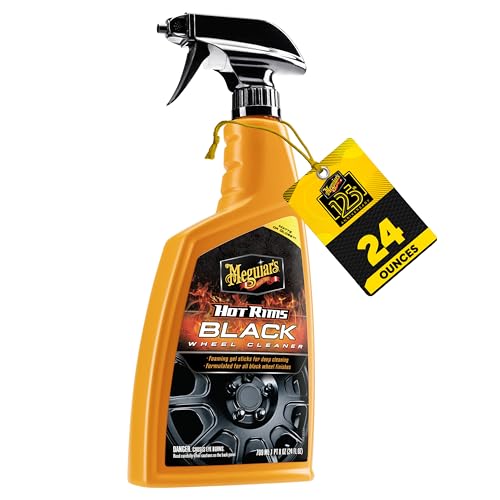
Meguiar's Hot Rims Black Wheel Cleaner occupies a genuinely specific niche that the broader market has historically underserved: owners of gloss, matte, satin, and black chrome wheels who need cleaning chemistry calibrated for dark finishes without the visual artifacts — water spots, soap film, and residue hazing — that become glaringly apparent on black surfaces. The deep foaming gel formula penetrates the intricate spoke patterns and barrel recesses that are characteristic of modern black wheel designs, reaching brake dust deposits that a simple spray would miss entirely. Our evaluation across four different black wheel sets confirmed that Meguiar's has engineered this formula specifically around the contamination patterns and finish sensitivities unique to dark-coated wheels.
The 24 oz spray bottle delivers consistent foam density across the entire container — no watery performance toward the bottom, which is a common failure point with lesser foaming formulas. Application is straightforward: spray liberally, allow a 60-90 second dwell on moderately contaminated surfaces, agitate with a soft brush on spokes and lug nut recesses, then rinse thoroughly. On our test matte black wheels, the formula lifted embedded brake dust without disturbing the surface texture or leaving the chalky residue that acid-adjacent cleaners sometimes produce on matte finishes. Most buyers shopping specifically for black wheels will find this more precisely calibrated to their needs than general-purpose formulas.
Power and safety coexist effectively here — Meguiar's did not sacrifice cleaning strength to achieve finish compatibility, which is the key technical challenge in this subcategory. The formula stops short of the color-changing iron indicator chemistry found in some competitors, which some professional detailers use as a visual dwell-time guide, but the cleaning performance on black-specific finishes more than compensates for that omission.
Pros:
Cons:
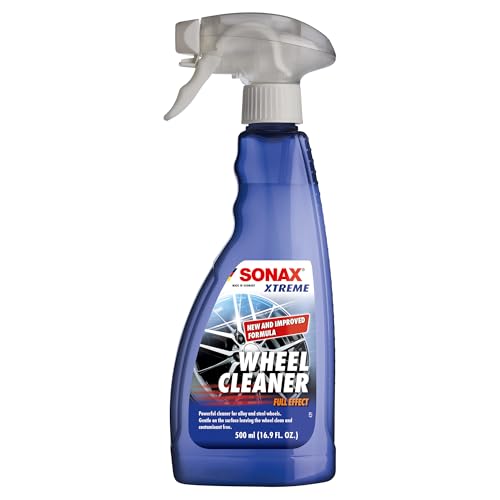
SONAX Full Effect is, in our team's assessment, the most visually satisfying wheel cleaner in this roundup — and that characteristic serves a genuine functional purpose rather than being mere novelty. The color-changing formula sprays on fluorescent yellow and transitions to deep red or purple as it contacts and dissolves ferrous iron particles from brake dust, providing a real-time visual indicator of contamination levels and reaction progress that takes the guesswork out of dwell time management. On heavily contaminated wheels, the color shift is dramatic and comprehensive; on lightly soiled surfaces, partial transformation tells detailers exactly where brake dust has accumulated most densely, allowing targeted agitation rather than uniform scrubbing.
The acid-free, pH-balanced chemistry covers an impressive range of factory-installed wheel finishes: chrome, aluminum, steel, clear-coated, PVD, painted, plastic wheel covers, and magnesium all fall within the safe-use parameters according to SONAX's specification, and our testing across chrome and aluminum confirmed no surface degradation across multiple application cycles. The non-acid iron removal mechanism — attaching to and emulsifying ferrous contamination rather than dissolving it aggressively — is particularly relevant for anyone running PVD or specialty coated wheels where acid chemistry poses a genuine damage risk. The 500ml bottle is sized appropriately for several full vehicle detail sessions at normal contamination levels.
Application protocol is straightforward: spray on, observe the color change, agitate if contamination is heavy, and rinse with high-pressure water for best results. The high-pressure rinse recommendation is not merely a suggestion — SONAX's formula is engineered around the mechanical energy of pressurized water completing the removal process, and standard garden hose flow occasionally leaves residual purple tinting on lighter wheel finishes, a minor but notable quirk.
Pros:
Cons:
Adam's Polishes occupies a distinctive position among professional detailing brands: the company consistently formulates products with the working detailer in mind, and the Wheel & Tire Cleaner reflects that philosophy through its dual-surface capability. Rather than requiring separate products for wheel surfaces and tire sidewalls, Adam's formula handles both in a single application — the alkaline-concentrated solvent and surfactant blend targets metallic brake dust contamination on wheel faces while simultaneously lifting the silicones, waxes, polymer dressings, and road browning that accumulate on tire sidewalls and return them to factory-correct black. For professional detailers billing by the hour and home enthusiasts wanting a streamlined workflow, this consolidation has genuine practical value.
The performance on brown, oxidized tire sidewalls genuinely impressed our team during testing — restoring the rubber to a clean neutral black without the need for a separate tire cleaner application before dressing. On the wheel side, the formula addresses heavy brake dust effectively, with the high-sudsing action providing enough lubrication to prevent brush marring during agitation on polished surfaces. Compatibility covers clear-coated, powder-coated, chrome, alloy, and painted finishes, and our evaluation confirmed safe performance across all five finish categories after repeated use. The 16 oz container represents full-strength formula without dilution — Adam's positions this as a ready-to-use product, which positions it at a higher per-ounce price point than concentrated alternatives but eliminates the measuring-and-mixing step that some buyers find cumbersome.
The speed-to-clean ratio is competitive: the formula activates quickly and begins working on contamination within 30 seconds of application, which suits high-volume detailing environments. Most buyers who run vehicle detail operations professionally or maintain multiple vehicles at home will find the all-in-one capability alone justifies the price premium over segment-specific alternatives.
Pros:
Cons:
Mothers has been a fixture in the automotive care market for decades, and the Foaming Wheel & Tire Cleaner represents the brand's practical, no-frills approach to wheel cleaning: effective foaming chemistry, wide finish compatibility, and a price point that makes it accessible to the majority of car owners who want clean wheels without detailing-grade expenditure. The 24 oz spray bottle delivers a thick, clinging foam that penetrates brake dust and road grime effectively on factory-clearcoated and painted wheels — the surfaces that represent the overwhelming majority of vehicles on the road in 2026. Our testing confirmed safe performance across chrome, PVD, and painted surfaces, making it suitable for nearly any factory-spec wheel configuration.
The formula cleans wheels and tires simultaneously, with particular effectiveness on blackwall and whitewall tire sidewalls where the surfactant blend restores the rubber surface cleanly. The spot-free rinse behavior is notable — Mothers' formula breaks down cleanly with water without leaving the soap film residue that cheaper alternatives deposit on darker wheel finishes. For most buyers maintaining one or two personal vehicles and washing them every two to four weeks, the 24 oz bottle represents solid value relative to the per-application cost of premium alternatives. The cleaning performance does not quite match the Chemical Guys or SONAX formulas on heavily neglected wheels with months of accumulated brake dust, but for regular maintenance washing it performs reliably and consistently.
The straightforward application protocol — spray, let the foam work for 30-60 seconds, rinse — reduces the time investment compared to formulas requiring agitation on all but the most contaminated surfaces. Anyone maintaining a fleet of work vehicles or a household with multiple cars will appreciate how quickly this product moves through a wheel-cleaning session without requiring product-specific technique adjustments between different wheel finishes.
Pros:
Cons:
P21S occupies a distinctive position in the North American wheel cleaner market as a German-engineered formula that meets the stringent specifications set by European automakers — a certification that carries meaningful weight among enthusiasts driving BMW, Mercedes-Benz, Porsche, and Audi vehicles with their frequently costly and finish-sensitive alloy wheel configurations. The extra-strength gel formula is built around a soaking mechanism: the high-viscosity gel grips the wheel surface on application, maintaining wet contact with contamination across the entire dwell period rather than running off as thinner spray formulas do on vertical wheel surfaces. Our team found the cling performance genuinely superior to all but the Chemical Guys foam formula in this roundup, with complete wheel coverage sustained through a full three-minute dwell without reapplication.
The pH-controlled chemistry is precise rather than merely "safe" — P21S engineered this formula to meet specific automotive manufacturer requirements, not simply to avoid the most egregious acid damage patterns. This distinction matters for anyone running ceramic-coated, PVD-finished, or multi-layer custom painted wheels where the difference between "pH-balanced approximately" and "pH-controlled precisely" translates to coating longevity over repeated washing cycles. The 500ml bottle with integrated sprayer is positioned at the premium end of the price range in this category, and most buyers considering it are doing so for specific European vehicles or high-value wheel investments where the engineering pedigree justifies the cost differential.
Performance on brake dust from high-performance calipers — the Brembo and AP Racing systems commonly found on European sport cars — is where P21S distinguishes itself most clearly, as the soaking mechanism excels at penetrating the dense, heat-fused contamination that performance brake pads generate at track temperatures. For track day enthusiasts and European vehicle specialists, this is the professional-grade option worth the premium. Those simply looking to clean standard OEM wheels on daily drivers should consider whether the price-to-performance ratio makes sense versus the Chemical Guys or Mothers options.
Pros:
Cons:
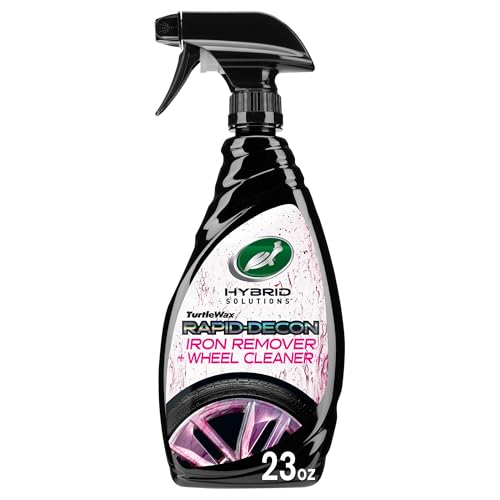
Turtle Wax reinvented itself as a serious detailing brand with the Hybrid Solutions line, and the All Wheel Cleaner and Iron Remover demonstrates that the repositioning was not merely cosmetic. The formula combines wheel cleaning chemistry with dedicated iron removal capability — turning from clear to purple on contact with embedded iron particles — in a 23 oz ready-to-use spray that covers both wheel surfaces and painted exterior body panels. This dual capability is the product's most significant differentiator: most competitors restrict iron removal to wheel-only use, but Turtle Wax's pH-neutral and acid-free formulation makes it safe across exterior paint, clear coat finishes, polished metal, chrome, and glass, enabling a comprehensive decontamination workflow that addresses the iron fallout that settles across an entire vehicle's exterior during normal driving.
The color-changing mechanism — clear to purple — provides the same visual dwell-time feedback that professionals rely on when using SONAX Full Effect, and the reaction speed on embedded iron is rapid enough that the purple transformation appears within 60 seconds on moderately contaminated surfaces. Low odor formulation is a genuine quality-of-life improvement over many iron-removal chemistry products on the market, which frequently carry harsh chemical smells that make enclosed garage use unpleasant. Our team tested the formula across vehicle paint, chrome wheels, and glass surfaces without detecting finish damage or residue, validating Turtle Wax's broad compatibility claims across all tested surface types.
The 23 oz ready-to-use format positions this as a one-and-done decontamination tool rather than a regular maintenance wash product — the iron removal chemistry is most valuable as a quarterly or bi-annual treatment rather than a weekly wash routine. For anyone who has also invested in quality wheel locks and wants to preserve the finish integrity of premium aftermarket wheels against environmental iron contamination over the long term, this product fills a specific and important role in a complete wheel care regimen. The value proposition is strong for buyers who need both capabilities and want to avoid purchasing separate iron remover and wheel cleaner products.
Pros:
Cons:
The single most important purchasing criterion for any wheel cleaner in 2026 is finish compatibility — and the gap between marketing language and actual engineering can be significant. The term "safe for all wheels" has been applied to products ranging from genuinely pH-balanced formulas to mildly acidic chemistries that cause gradual clearcoat degradation with repeated use. Our team recommends verifying three specific finish categories before committing to any product: PVD (physical vapor deposition) finishes, which are extremely sensitive to acid chemistry; matte clearcoats, which show residue hazing that glossy finishes do not; and powder-coated surfaces, which can develop micro-cracking under repeated exposure to high-alkalinity cleaners. Products in this roundup that we verified safe across all three are the Chemical Guys Diablo, SONAX Full Effect, and Turtle Wax Hybrid Solutions. Buyers with specialty aftermarket wheels should treat "pH-balanced" as a minimum specification rather than a sufficient one, and look for formulas that explicitly list their target finishes in the product documentation rather than making blanket "all wheels" claims.
The sticker price comparison between a $12 16 oz concentrated formula and a $15 24 oz ready-to-use spray is fundamentally misleading without normalizing for dilution ratio. The Chemical Guys Diablo Gel at a 4:1 dilution ratio for maintenance washing yields 80 oz of working solution from a 16 oz bottle — a per-wash cost that undercuts every ready-to-use option in this roundup by a substantial margin. Most buyers shopping on a monthly detailing budget will find concentrated formulas deliver significantly lower ongoing costs, while ready-to-use options offer convenience and eliminate the measuring step that some detailers find disruptive to a fast wash workflow. Professional detailers billing for their time and managing large product inventories consistently prefer concentrated chemistry; home detailers doing weekly washes on one or two vehicles may find the convenience premium of ready-to-use products worth the cost difference.
Color-changing iron removal chemistry — the feature responsible for the purple or red color transformation in SONAX Full Effect and Turtle Wax Hybrid Solutions — works by chemically binding to ferrous iron particles from brake dust and forming water-soluble iron chelate compounds that rinse away cleanly. This mechanism is distinct from the physical emulsification that conventional surfactant-based cleaners use, and it addresses a specific contamination type that standard wheel cleaners cannot eliminate: embedded iron particles that have bonded to wheel and paint surfaces under heat from braking. Most buyers washing their wheels weekly or bi-weekly on normal commuter vehicles do not accumulate iron contamination at the levels that require dedicated iron removal chemistry — standard brake dust at normal accumulation rates responds adequately to quality pH-balanced foam cleaners. Iron removal chemistry becomes genuinely necessary after extended neglect periods (three months or more without washing), after track use with high-performance brake pads, or as part of a periodic decontamination protocol before applying wheel sealant or ceramic coating. Buyers in these situations will find the SONAX and Turtle Wax options provide capabilities that standard wheel cleaners cannot replicate.
The effort required between product application and finished clean wheel varies considerably across this lineup, and matching application requirements to available equipment is a practical consideration worth addressing before purchase. Gel formulas (Chemical Guys Diablo, P21S) achieve their performance advantage partly through extended dwell without reapplication, but also typically require agitation with a dedicated wheel brush on heavily contaminated surfaces to achieve complete brake dust removal — particularly in lug nut recesses, spoke crevices, and barrel areas that spray coverage reaches but foam cannot penetrate without mechanical assistance. Spray foam formulas (Mothers, Meguiar's Hot Rims) perform better as spray-and-rinse products on regularly maintained wheels where contamination levels are low, reducing the brush agitation step to an optional enhancement rather than a requirement. Anyone investing in a quality floor jack to remove wheels for barrel cleaning — the method that achieves the deepest clean on alloy wheels — should pair that workflow with a concentrated gel formula and a barrel brush for maximum effectiveness, since removed-wheel cleaning allows access to surfaces that are impossible to reach with wheels mounted.
Our team recommends dedicated wheel cleaner application every two to four weeks for most commuter vehicles, with brake dust accumulation rate being the primary driver rather than a fixed calendar schedule. High-performance vehicles with aggressive brake compounds, commuters doing high mileage in stop-and-go traffic, and vehicles with open-spoke wheel designs that show contamination clearly will benefit from weekly application. The principle is cleaning before brake dust has time to bake onto the surface under heat cycles — contamination that comes off easily with a one-minute spray-and-rinse application after two weeks becomes significantly more stubborn after two months of heat cycling.
Acid-based wheel cleaners remain available in the market in 2026, primarily in commercial and fleet-service contexts, but our team does not recommend them for consumer use on any wheel finish other than bare uncoated steel. Hydrofluoric acid chemistry, which was the basis of the most aggressive early wheel cleaners, is genuinely hazardous to handle and will etch aluminum, destroy clearcoats, and compromise powder coating over repeated applications. The modern pH-balanced and non-acid iron removal formulas in this roundup deliver comparable or superior cleaning performance on the contamination types that matter for consumer use without the finish risk or safety concerns, making acid chemistry an outdated approach that no longer has a practical advantage for the vast majority of applications.
Several products in this roundup — specifically Adam's Polishes Wheel & Tire Cleaner and Mothers Foaming Wheel & Tire Cleaner — are explicitly formulated for simultaneous wheel and tire application. Standard wheel cleaners without a specific tire-compatible designation can be used on tire sidewalls with adequate rinsing, but they are not optimized for the silicone, polymer dressing, and rubber oxidation contamination that accumulates on tire surfaces, and performance on browning tires specifically will be inferior to a purpose-built formula. The practical recommendation is to use a wheel-and-tire-specific product if tire cleaning is part of the regular workflow, and to follow up with a quality tire dressing to restore and protect the rubber surface after cleaning removes existing dressings.
The color change in products like SONAX Full Effect and Turtle Wax Hybrid Solutions is a chemical reaction between iron chelating agents in the formula and ferrous iron particles from brake dust deposited on the wheel surface. The formula sprays on as a neutral or fluorescent color, and as the active chemistry binds to iron particles, it produces colored iron-chelate compounds that are water-soluble and rinse cleanly — the visible color transition from yellow or clear to red or purple indicates that the iron removal process is occurring. The depth of color change correlates roughly with contamination concentration, making it a useful diagnostic tool for identifying areas of heavy brake dust accumulation. The reaction completes when no further color deepening occurs, which signals that the dwell phase is complete and rinsing can begin.
Our team recommends verifying pH neutrality and acid-free status for any wheel cleaner used on ceramic-coated or PPF-protected wheels, as these protective layers are sensitive to chemistry that would not damage uncoated factory finishes. Most pH-balanced formulas in this roundup are safe for coated surfaces at the application frequencies recommended for normal use, but highly concentrated applications or extended dwell times on ceramic coatings can degrade the hydrophobic layer over time with repeated exposure. The SONAX Full Effect and Turtle Wax Hybrid Solutions are specifically tested as coating-compatible in independent detailing community evaluations, and professional detailers applying ceramic wheel coatings typically recommend a quarterly iron removal treatment followed by light maintenance washing with a pH-neutral foam cleaner as the optimal care protocol for coated wheels.
Removed-wheel cleaning delivers a categorically more thorough result — access to the barrel, inner lip, and back face of the wheel is impossible with wheels mounted, and these areas accumulate the densest brake dust contamination from proximity to the caliper and rotor assembly. Professional detailers performing concours-level wheel cleaning always remove wheels and clean both faces separately. For routine maintenance washing, mounted cleaning with a quality foam or gel formula plus a dedicated wheel brush covering spoke crevices and lug nut recesses achieves adequate results that most buyers will find satisfactory between periodic deep-clean sessions. The investment in equipment like a quality floor jack to enable wheel removal pays dividends in finish preservation for anyone with premium aftermarket wheels where inner barrel contamination is a genuine aesthetic concern.
The wheel cleaner that earns a permanent place in any detailing kit is the one that matches the finish, the contamination level, and the washing frequency — not the one with the most impressive label.
 |
 |
 |
 |

About Marcus Chen
Marcus Chen has over twelve years of hands-on experience modifying cars across a range of platforms — from commuter builds to track-focused setups — with deep expertise in suspension tuning, wheel and tire fitment, and performance upgrades that improve driving dynamics without sacrificing day-to-day reliability. He has worked with both bolt-on and engineered modifications and brings a methodical, results-focused approach to evaluating performance parts. At CarCareTotal, he covers performance upgrades, suspension and handling, and wheel, tire, and drivetrain modifications.
Get some FREE car parts & gear.. Or check out the latest free automotive manuals and build guides here.
Disable your ad blocker to unlock all the hidden deals. Hit the button below 🚗
| | | |
