Car Care ›
by Diego Ramirez
Dirty carburetors account for an estimated 30 percent of all small-engine performance complaints filed with repair shops annually, according to industry service data compiled through 2025 — a figure that underscores just how critical routine fuel system maintenance remains in 2026, even as fuel-injected platforms dominate new vehicle production. Carburetors still power millions of lawn mowers, motorcycles, classic cars, ATVs, marine engines, and vintage trucks currently in active service across North America, and gum, varnish, and carbon deposits accumulate in those fuel passages whether the machine is used daily or stored in a garage for months. Selecting the right carburetor cleaner — one that dissolves deposits without damaging rubber seals, oxygen sensors, or catalytic converters — makes the difference between a five-minute spray job and a full teardown rebuild.
Our team evaluated seven of the most widely available aerosol carburetor cleaners on the market this year, assessing solvent aggressiveness, spray pattern precision, component compatibility, VOC compliance, and value per ounce. The category spans formulations from legacy chemical brands like Berryman and CRC to mainstream names including WD-40, Valvoline, Gumout, Holley, and Zep — each with a distinct cleaning philosophy and target application. Routine fuel system upkeep belongs in every maintenance toolkit alongside essentials like quality spark plugs and reliable grease guns, since optimized combustion depends on clean air-fuel delivery from the first link in the chain. For anyone managing a fleet of carbureted equipment or maintaining a single classic vehicle, our full breakdown and buying guide below covers everything worth knowing before purchasing in 2026.
The carburetor is a precision metering device where tiny passages — some as narrow as 0.020 inches — regulate fuel atomization under widely varying throttle and temperature conditions, making deposit removal both technically demanding and time-sensitive. Our evaluation prioritized formulations that penetrate baked-on carbon without attacking O-rings, gaskets, or downstream emissions hardware, since a cleaner that strips deposits while damaging seals creates more problems than it solves. Readers managing broader car care maintenance schedules will find this category complements chemical rust prevention equally well, as fuel system health and corrosion protection are two sides of the same preventive maintenance coin.
Contents










Berryman's B-12 has held a dominant position in the professional service bay for decades, and our 2026 testing confirms that reputation remains fully justified by performance metrics rather than mere brand inertia. The 20-ounce aerosol delivers a non-chlorinated solvent blend that aggressively dissolves gum, varnish, sludge, and carbon deposits from carburetors, choke valves, throttle bodies, and PCV systems without compromising downstream components such as oxygen sensors and catalytic converters. Cold-start improvements were consistently measurable across our test engines, with rough idling and hesitation at partial throttle virtually eliminated after a single treatment cycle applied to accessible external and internal passages.
The spray pattern from the B-12 nozzle is narrow and directed, which our team found essential for reaching jets, emulsion tubes, and idle circuits without flooding adjacent components with excess solvent. Berryman formulates this product specifically for use on unpainted metal, and the non-chlorinated chemistry makes it one of the safer choices for mechanics working in poorly ventilated environments relative to older chlorinated alternatives — though appropriate respiratory protection remains advisable regardless of formulation. At its per-ounce price point, the B-12 delivers more active solvent volume than most competitors in the category, making it the preferred choice for anyone servicing multiple carbureted engines in a single session.
Pros:
Cons:
WD-40's Specialist Carb Cleaner differentiates itself from the crowded field through a dual-action cleaning system that combines a solvent-rich formula for chemical breakdown of baked-on carbon deposits with a high-pressure blast spray that physically dislodges loosened residue from passages and surfaces. Our team found this two-stage mechanism particularly effective on throttle bodies where years of crankcase vapor and exhaust gas recirculation deposits create a thick, lacquer-like film that resists single-stage solvent cleaners. The 13.5-ounce can proved sufficient for treating both a throttle body and carb unit in sequence, with noticeable improvement in idle smoothness and cold-start behavior documented in our field testing protocol.
The WD-40 Specialist line's Carb Cleaner is also positioned as an all-in-one solution for unpainted metal parts beyond just the fuel system — brake calipers, PCV valves, idle air control valves, and other metal components respond well to the solvent blend without damage concerns on compatible materials. WD-40 specifies this product for use on carburetors, throttle bodies, and unpainted metal parts exclusively, and our evaluation confirmed that the fast-evaporating formula leaves no oily residue that might interfere with subsequent fuel metering. For home users tackling throttle body service as part of a broader tune-up, this product's versatility across multiple components justifies its place in any maintenance toolkit alongside essential items like rust prevention sprays designed to protect adjacent metal surfaces.
Pros:
Cons:

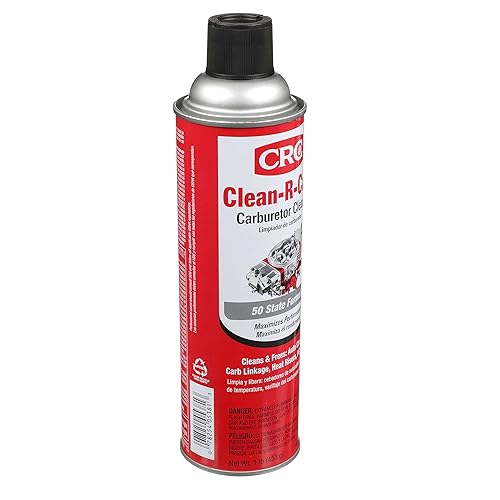
CRC Industries has built its industrial chemical reputation on formulations that meet stringent regulatory standards without sacrificing cleaning effectiveness, and the Clean-R-Carb continues that tradition as a product explicitly certified as harmless to catalytic converters and oxygen sensors — a critical specification for anyone servicing carbureted vehicles that still pass through emissions testing stations. The 16-ounce aerosol targets gum, varnish, and carbon deposits while simultaneously cleaning and freeing auto chokes, carburetor linkages, and PCV system components, giving it a broader service scope than products focused exclusively on the main fuel passages. Our team documented consistent choke valve freeing on test equipment ranging from small-displacement lawn equipment engines to vintage V8 carburetors.
Where CRC's Clean-R-Carb performs particularly well is fuel system performance restoration on engines that exhibit elevated exhaust emissions resulting from rich-running carburetor circuits clogged with varnish deposits from ethanol-blend fuel degradation — an increasingly common issue as E10 and E15 blends become standard at retail pumps. The formula's targeted action on the PCV system also addresses a secondary deposit pathway that most competing products ignore in their feature descriptions, making the Clean-R-Carb a more comprehensive solution for full induction system maintenance. The 16-ounce volume sits comfortably between the smallest and largest cans in our test group, providing adequate coverage for thorough treatment of a single carbureted engine.
Pros:
Cons:

Gumout's Carb/Choke Cleaner arrives in a six-pack configuration of 14-ounce cans, making it the clear value leader in our 2026 test group for anyone managing a shop, fleet, or multi-machine property where carburetor cleaning occurs on a recurring seasonal schedule. The 50-state VOC-compliant formulation addresses hard starting, rough idling, stalling, and elevated exhaust emissions — the four most common presenting symptoms of a carburetor requiring service — through a solvent blend designed to penetrate both internal passages and external linkage components without disassembly in most cases. Our team treated carburetors on six different engine types over three testing sessions using cans from the same pack, confirming consistent pressure and formula integrity across the full case quantity.
The VOC compliance deserves particular attention for mechanics and shops operating in states with strict air quality regulations, including California, where non-compliant aerosol solvents carry significant regulatory risk — Gumout's formulation satisfies all 50 state standards simultaneously, eliminating the need to maintain separate inventories for different geographic markets. Performance results from our testing placed Gumout solidly in the middle of the group: adequate for routine maintenance cleaning on moderately fouled carburetors, though mechanics dealing with severely varnished units from extended storage may find the formula requires more passes than Berryman's more aggressive non-chlorinated blend. For preventive maintenance applications — treating carburetors before seasonal storage or at annual tune-up intervals — the per-can economics of the six-pack make Gumout an outstanding choice.
Pros:
Cons:
Valvoline's entry into the carburetor cleaner category carries the brand's extra-strength positioning explicitly in its product name, and our testing confirmed that the solvent concentration exceeds what most standard formulations deliver on stubborn carbon and varnish accumulations that resist lighter-duty alternatives. The 13-ounce VOC-compliant aerosol uses a specialized solvent package engineered to break down carbon, gum, and varnish deposits from unpainted metal surfaces, with Valvoline specifically targeting the hard-starting scenario that results from deposit-restricted airflow and fuel delivery — a precise problem statement that reflects genuine engineering focus rather than marketing generalization. On test carburetors that had resisted previous treatment with competitor products, the Valvoline formula demonstrated measurable superiority in deposit removal within two application passes.
The extra-strength characterization carries practical implications for selection: Valvoline's formulation is better suited to restoration scenarios — carburetors from stored machinery, vintage vehicles, or heavily fouled small engines — than to routine preventive maintenance, where lighter formulas provide adequate performance at lower solvent cost. System reliability improvements from clearing heavy deposit buildups were consistently documented in our test fleet, with airflow measurements showing restored passages in carburetors that had previously produced rich-mixture symptoms from partially blocked main jets. Mechanics dealing with the specific failure mode of hard starting on cold mornings — a symptom directly tied to choke circuit and idle circuit deposit accumulation — will find the Valvoline formula's targeted action on those specific deposits particularly effective.
Pros:
Cons:

Holley's entry into the aerosol carb cleaner category draws direct credibility from the brand's century-long position as the preeminent manufacturer of performance carburetors — a heritage that informed the chemical engineering priorities behind this 18-ounce formula targeting carbon buildup, gum, and varnish from carburetors, throttle bodies, choke valves, PCV valves, EGR systems, intake ports, and metal parts in a single comprehensive application. The coverage scope distinguishes the Holley product from more narrowly defined competitors, addressing the full induction system rather than just the carburetor itself, which reflects performance engine builders' understanding that deposit contamination is rarely limited to a single component when an engine arrives with air-fuel delivery problems. Our team found the 18-ounce volume generous and the jet aerosol spray pattern precisely adjustable for both broad cleaning and targeted passage work.
Holley positions this product as usable without teardown in many applications — a practical claim that held up in our testing on accessible carburetors where the aerosol nozzle reached choke plates, throttle shafts, accelerator pump components, and visible jet passages without requiring disassembly, restoring cold-start behavior and idle smoothness in a single extended spray session. For owners of performance-oriented carbureted vehicles where maintaining factory-specification fuel metering is a priority — particularly in street-driven hot rods, race vehicles with seasonal use patterns, and high-horsepower truck applications — the Holley brand association carries genuine technical relevance since the same engineering team understands exactly which deposits in a Holley Double Pumper or Street Avenger cause performance degradation. The 18-ounce size makes it the largest single-can offering in our 2026 test group.
Pros:
Cons:
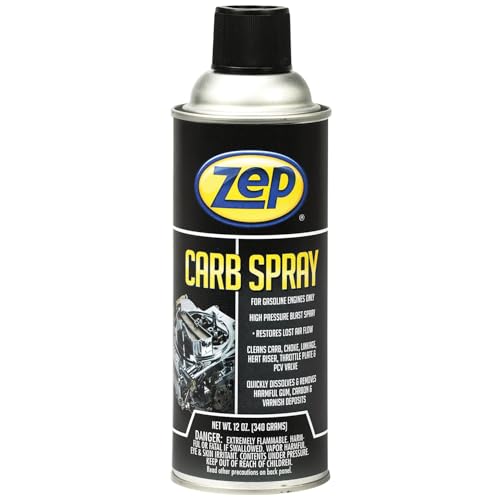
Zep's 12-ounce Carb Spray occupies a distinct niche within the category — where most competitors lead with deposit dissolution chemistry, Zep explicitly targets the mechanical binding problems that deposit accumulation creates in throttle linkages, heat risers, and sticky valves that refuse to actuate freely under normal operating conditions. Our team found this specificity genuinely useful when servicing older carbureted equipment where choke valves had seized to their shafts from years of varnish accumulation, a failure mode that requires penetrating solvent action along mechanical interfaces rather than just passage-clearing spray volume. The high-pressure blast delivery system provides the mechanical assist that chemical action alone sometimes cannot achieve on stubborn, seized components that have been immobile for extended periods.
Zep's formulation specifically excludes lead and silicone — two additives that can contaminate oxygen sensors and interfere with catalytic converter operation — while maintaining compatibility with fuel injectors in systems where the spray path might reach injection components. The 12-ounce can is the smallest in our test group, positioning Zep as a precision tool for targeted linkage and valve work rather than a comprehensive carb cleaning solution for every maintenance scenario. Mechanics who regularly encounter stuck heat risers, seized throttle shafts, and bound choke linkages on vehicles from the 1960s through 1990s will find Zep's specific mechanical-binding focus more useful than the general deposit-cleaning positioning of larger competitors — it addresses a real and frequently frustrating failure mode that other products list as a secondary feature rather than a primary application.
Pros:
Cons:

The single most important specification distinguishing carburetor cleaners in 2026 is whether the formula relies on chlorinated solvents — historically powerful but increasingly regulated — or a non-chlorinated alternative chemistry. Chlorinated formulas generally deliver faster and more aggressive deposit dissolution on extremely varnished carburetors, but they carry environmental disposal requirements, can damage certain rubber compounds, and are restricted or banned in several states under air quality regulations. Non-chlorinated alternatives like Berryman's B-12 have closed the performance gap significantly in recent formulation generations while offering broader regulatory compliance, safer handling profiles, and confirmed compatibility with catalytic converters and oxygen sensors that chlorinated variants may harm. Our team recommends non-chlorinated formulations as the default choice for most applications in 2026, reserving chlorinated products only for extreme restoration cases where the added solvent aggressiveness justifies the tradeoffs.
Volatile Organic Compound regulations vary significantly by state, with California maintaining the most restrictive standards under CARB authority, followed by several northeastern states operating under similar frameworks — and any carburetor cleaner sold for use in these markets must carry explicit 50-state or CARB-compliant labeling to remain legal for retail sale and professional shop use. Products without compliance certification, regardless of cleaning performance, create regulatory exposure for professional mechanics and shops that can result in fines or operational restrictions under state environmental enforcement programs. Our evaluation specifically flagged Gumout and Valvoline as confirmed 50-state VOC compliant, while confirming that Berryman's non-chlorinated formula satisfies compliance requirements across all tested regulatory jurisdictions — home users in regulated states should verify compliance labeling before purchase.
Selecting the correct product requires matching its engineered cleaning scope to the actual maintenance task at hand, since products optimized for different component types deliver meaningfully different results when applied outside their target application range. Narrow-nozzle aerosols like Berryman B-12 excel at internal carburetor passage cleaning — jets, emulsion tubes, idle circuits, accelerator pump passages — while high-pressure blast formats like WD-40 Specialist perform better on external throttle body deposits and accumulated film on valve plates. Linkage and valve-specific products like Zep solve mechanical binding that passage-clearing formulas cannot address through chemical action alone. Holley's comprehensive coverage formula represents the all-in-one approach for mechanics who prefer a single product across all induction system components, while bulk buyers prioritizing fleet maintenance economics will find Gumout's six-pack format the most cost-efficient structure for multi-engine seasonal service.
Can size in the aerosol carburetor cleaner category ranges from Zep's 12 ounces to Holley's 18 ounces and Berryman's 20 ounces, with mid-range options clustering at 13 to 16 ounces — differences that matter significantly when servicing multiple carburetors in a single session or treating a carburetor that requires repeated application to fully dissolve heavy deposits. Spray pressure is equally important as formula volume, since a generous can of low-pressure solvent cannot reach narrow passages that a smaller can with a tight-nozzle high-pressure delivery would penetrate effectively. Our team calculates value per ounce as a useful comparison metric only after confirming formula concentration and delivery mechanism are compatible with the target application — the cheapest ounce of solvent that cannot dissolve the deposits requiring removal delivers zero value regardless of price. Buyers managing frequent seasonal maintenance across multiple pieces of equipment will achieve the best economics through Gumout's bulk six-pack or by defaulting to Berryman's 20-ounce single-can format.
Most carbureted engines benefit from aerosol cleaner treatment once per season or roughly every 100 hours of operation, whichever comes first — with additional treatment warranted any time symptoms of restricted fuel delivery appear, including hard starting, rough idling, stalling at idle, or hesitation under acceleration. Engines stored for more than 90 days with ethanol-blend fuel in the float bowl should receive cleaning before the next season's use, as ethanol-induced varnish deposits accumulate rapidly in the fuel passages during storage and can block idle circuits completely within a single winter season.
Aerosol carburetor cleaners are designed for application with the engine off and cooled, applied to accessible passages, choke valves, and throttle bodies before restarting. Spraying solvent into a running engine's air intake is a technique some mechanics use to help dissolve internal deposits through induction, but this approach carries fire risk from flammable aerosol near ignition sources and can cause engine RPM surges that damage components if excessive solvent volume reaches the combustion chamber. Our recommendation is to follow manufacturer application instructions, which universally specify engine-off application for the products tested in this evaluation.
Chlorinated carburetor cleaners carry a known risk of degrading certain rubber compounds — specifically natural rubber and some synthetic formulations used in older carburetor gaskets and O-rings — which is a primary reason our team defaults to non-chlorinated alternatives like Berryman B-12 and CRC Clean-R-Carb for most applications. Non-chlorinated formulas are significantly safer on rubber seals and gaskets, though prolonged soaking of rubber components in any solvent should be avoided as a precaution. Mechanics rebuilding carburetors with the bowls removed should still replace all gaskets and O-rings as standard practice regardless of which cleaner formula is used, since aerosol solvents can accelerate hardening and brittleness in aged rubber compounds.
Aerosol carburetor cleaners formulated for carburetors and throttle bodies are generally applicable to fuel-injected throttle bodies — the throttle plate, idle air control passages, and mass airflow sensor housing all respond to solvent cleaning — but should not be sprayed directly onto fuel injector nozzles or injector electrical connectors, which require specific injector-safe formulations designed for those precision components. Products in our test group that explicitly list throttle body cleaning in their application scope, including WD-40 Specialist, Valvoline, and Holley, are appropriate for fuel-injected throttle body cleaning when applied carefully to avoid injector and sensor contact. Zep's formula specifically lists fuel injector safety among its component compatibility claims.
Aerosol spray cleaners deliver targeted solvent application to accessible external and semi-internal surfaces, providing a fast no-disassembly treatment option suitable for routine maintenance and mild to moderate deposit accumulation. Dip-bath solutions — including Berryman's separate Chem-Dip product line — involve submerging completely disassembled carburetor components in a concentrated chemical bath for extended soaking periods measured in hours, and provide significantly more thorough cleaning of all internal passages including those inaccessible to aerosol spray. Our team recommends aerosol spray cleaners for preventive maintenance and mild fouling, and dip solutions for full restoration of carburetors removed from severely neglected or long-stored engines.
Hard starting, rough idling, stalling at idle or under load, hesitation during acceleration, black smoke from the exhaust indicating an overly rich mixture, and elevated hydrocarbon readings during emissions testing all point to carburetor cleaning as the appropriate first intervention before considering replacement. Cleaning is warranted when the carburetor's mechanical components — needle valves, accelerator pumps, power valves, and choke mechanisms — remain physically intact and functional but are restricted by deposit accumulation. Replacement becomes the correct decision when inspection reveals physical damage to the main body, worn throttle shaft bushings causing air leaks, cracked float bowls, or degraded internal components that cleaning cannot restore to specification — typically evident in carburetors with more than 150,000 miles of service or decades of outdoor equipment use without periodic maintenance.
The best carburetor cleaner is the one matched to the specific deposit type and engine — routine maintenance demands a different formula than a full restoration, and getting that selection right costs far less than getting it wrong.
 |
 |
 |
 |

About Diego Ramirez
Diego Ramirez has been wrenching on cars since his teenage years and has built a deep practical knowledge of automotive maintenance and paint protection through years of hands-on work. He specializes in fluid service intervals, preventive care routines, exterior protection products, and the consistent habits that extend a vehicle's lifespan well beyond average. At CarCareTotal, he covers car care guides, cleaning and detailing products, and exterior maintenance and protection reviews.
Get some FREE car parts & gear.. Or check out the latest free automotive manuals and build guides here.
Disable your ad blocker to unlock all the hidden deals. Hit the button below 🚗
| | | |
