by Liam O'Brien
Which RV inverter truly delivers clean, reliable AC power without draining the house battery bank? After testing seven of the most popular models on the market in 2026, the Victron Energy MultiPlus Compact 2000VA stands as the clear frontrunner — its integrated charger, PowerAssist technology, and sub-20ms transfer switch set it apart from every competitor in this roundup.
An RV inverter converts 12V DC battery power into 120V AC household current, enabling travelers to run everything from CPAP machines and laptops to microwaves and coffee makers while off-grid. The difference between a modified sine wave and a pure sine wave inverter is not trivial: sensitive electronics, variable-speed motors, and medical devices demand clean power with minimal total harmonic distortion. Every unit reviewed here outputs pure sine wave AC, but they differ significantly in surge capacity, efficiency, build quality, and ancillary features like integrated charging and transfer switching.
RV electrical systems have grown considerably more complex as lithium battery adoption accelerates and solar installations become standard. Buyers upgrading from older RV batteries to lithium iron phosphate packs need inverters that support configurable charge profiles. Meanwhile, those running robust shore power setups should consider pairing their inverter with a quality RV surge protector to safeguard the entire system. This guide breaks down the seven best RV inverters available in 2026, covering specs, real-world performance, and the critical buying criteria that separate adequate units from exceptional ones.

Contents



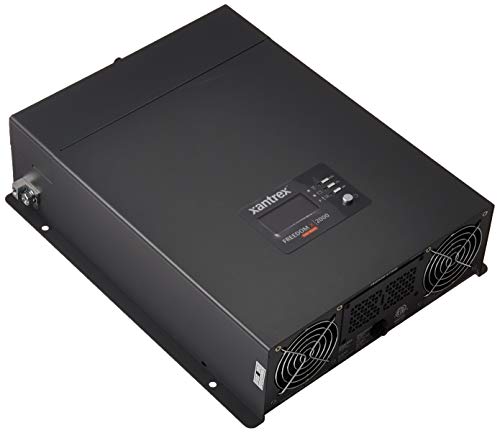


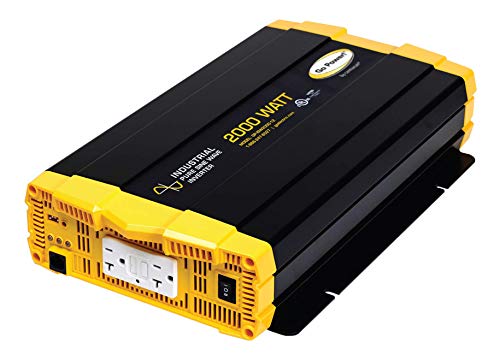


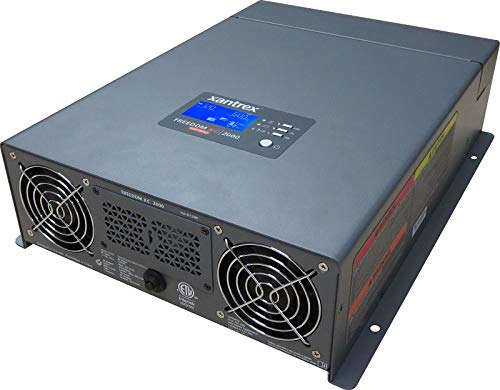

The Renogy Inverter P2 2000W delivers a compelling combination of performance and affordability that makes it the go-to option for budget-conscious RV owners. With 2000W continuous output and 4000W peak surge capacity, it handles most common RV appliances — including small microwaves, blenders, and power tools — without hesitation. Conversion efficiency exceeds 90%, which translates directly into less wasted battery capacity during boondocking sessions.
Build quality is solid for the price point. The aluminum housing dissipates heat effectively, and the dual cooling fans activate only under load, keeping noise levels manageable during light-duty operation. The built-in 5V/2.1A USB port is a convenient touch for charging phones and tablets without occupying an AC outlet. Renogy includes a wired remote controller that allows mounting the inverter in a compartment while retaining on/off control from the living space — a thoughtful design decision for RV installations.
Protection circuitry covers all the essentials: under-voltage and over-voltage shutdown, over-temperature protection, overload protection, and short circuit indication via LED indicators. The GFCI-protected outlets add an important layer of safety for outdoor and wet-area use. Where the Renogy falls short is the lack of an integrated transfer switch or battery charger — it is a standalone inverter only, requiring additional components for a complete shore power setup.
Pros:
Cons:
The Xantrex Freedom X 2000 has earned a reputation among serious RVers for its robust surge handling and true sine wave output. The extended surge rating — sustaining 2X continuous power (4000W) for a full two seconds — gives it a decisive advantage when starting high-inrush loads such as air conditioner compressors, residential refrigerators, and sump pumps. Many competing inverters can only hold peak surge for milliseconds, making the Freedom X the superior choice for motor-heavy RV setups.
The ignition control feature deserves particular attention. When wired to a 12VDC ignition signal, the inverter automatically powers down when the vehicle engine shuts off, preventing parasitic battery drain during storage or overnight stops. This is a practical feature for Class B and Class C motorhomes where the inverter sits in the engine compartment or a chassis-mounted bay. Build quality reflects the Xantrex professional-grade pedigree — the conformal-coated circuit boards resist moisture and vibration damage common in mobile installations.
On the downside, the Freedom X is an inverter-only unit without integrated charging capability. At its price point, competing products from Victron and Magnum include built-in chargers and transfer switches. For buyers who already have a standalone converter/charger, however, the Freedom X remains one of the most reliable pure inverters on the market.
Pros:
Cons:
The Victron Energy MultiPlus Compact is the most capable inverter/charger in this roundup and earns the top overall recommendation for 2026. It combines a pure sine wave inverter, an 80A adaptive multi-stage battery charger, and a 50A automatic transfer switch in a single UL-certified package. The sub-20ms transfer time means connected loads experience virtually no interruption when switching between shore power and inverter mode — critical for maintaining uptime on networking equipment, CPAP machines, and desktop computers.
The PowerAssist feature is what truly separates the MultiPlus from the competition. When connected to a limited AC source — whether a 15A campground pedestal or a small portable generator — PowerAssist supplements the incoming power with battery energy to prevent tripping the breaker. This allows running a 13,500 BTU air conditioner on a 15A outlet that would normally be insufficient, a game-changing capability for RVers who frequently encounter underpowered hookups. The adaptive charge technology automatically adjusts charging parameters based on battery condition and usage patterns, optimizing charge cycles for both lithium and lead-acid chemistries.
Victron's ecosystem integration adds long-term value. The MultiPlus communicates natively with Victron's GX monitoring devices, MPPT solar charge controllers, and the VRM online portal for remote system monitoring. For buyers building a comprehensive off-grid power system, no other inverter/charger at this price point offers comparable integration. The only significant drawback is the learning curve — configuring the MultiPlus via VEConfigure software requires more technical knowledge than plug-and-play competitors.
Pros:
Cons:
Space constraints are a persistent challenge in RV electrical compartments, and the Go Power GP-ISW2000-12 addresses this directly with its slim-profile chassis. Despite the compact form factor, it delivers the full 2000W continuous and 4000W surge that buyers expect from a premium pure sine wave inverter. The dual 20A GFCI-protected outlets provide safe, code-compliant power delivery, and the clean sine wave output handles sensitive electronics without the harmonic distortion issues associated with modified sine wave units.
Go Power has positioned this as an industrial-grade inverter suitable for both RV and commercial applications. The internal components reflect that ambition — heavy-gauge transformer windings, high-quality MOSFETs, and thermal management designed for sustained full-load operation in enclosed spaces. The two-year coverage provides reasonable assurance, though it falls short of the longer warranties offered by Victron and Magnum Energy. Installation is straightforward with clearly labeled DC input terminals and standard mounting provisions.
The primary limitation is the lack of any integrated charging or transfer switching capability. Buyers seeking a complete power management solution will need to pair this with a separate converter/charger and transfer switch, adding cost and complexity. However, for those who already have charging infrastructure in place or are building a custom system with separate components, the Go Power offers excellent power density in a space-efficient package.
Pros:
Cons:
The Magnum Energy MS2012 is a battle-tested inverter/charger that has earned loyal followers among full-time RVers and off-grid enthusiasts. It pairs a 2000W pure sine wave inverter with a powerful 100A battery charger — one of the highest charge rates in the 2000W class. For buyers with large battery banks (400Ah+), the 100A charge rate dramatically reduces recharge times compared to the 50-80A chargers found in competing units. The integrated 30A transfer switch handles automatic switching between shore power and inverter mode seamlessly.
Magnum's ME-RC50 remote panel (sold separately) transforms the MS2012 into a fully configurable power management system. The remote allows adjustment of charge profiles, input current limits, search mode sensitivity, and fault history review — all from a panel-mounted display in the RV living space. The inverter supports parallel and series stacking for users who need 4000W or 240V split-phase output, making it a scalable foundation for ambitious off-grid systems. Build quality is robust, with a steel chassis and potted transformer designed for the vibration and temperature extremes of mobile installations.
The MS2012 does run warmer than some competitors under sustained load, and the cooling fans produce noticeable noise at higher output levels. The separate remote panel adds to the total system cost but is effectively mandatory for accessing the full configuration capabilities. Despite these considerations, the combination of a 100A charger, proven reliability, and stacking capability makes the MS2012 the strongest choice for full-time RVers with demanding power requirements. Pairing it with a properly rated fire extinguisher in the electrical compartment is always recommended for any high-current installation.
Pros:
Cons:
The Xantrex Freedom XC 2000 represents a significant evolution from the Freedom X line, adding an integrated multi-stage battery charger and automatic transfer switch to the proven pure sine wave inverter platform. The result is a true all-in-one power management solution that competes directly with the Victron MultiPlus and Magnum MS2012. Xantrex has focused on ease of installation and configuration, making the Freedom XC particularly appealing for buyers who want inverter/charger capability without the steep learning curve of more complex systems.
The Freedom XC supports multiple battery chemistries including lithium, AGM, and flooded lead-acid, with selectable charge profiles accessible without external software. The integrated transfer switch handles automatic switching between shore power and battery, and the charger delivers efficient multi-stage charging that extends battery lifespan. True sine wave output remains clean under all load conditions, and the surge capacity handles common RV motor loads without difficulty.
Compared to the Victron MultiPlus, the Freedom XC lacks the PowerAssist feature and the deep ecosystem integration that make the Victron so compelling for power users. However, it offers a simpler installation and configuration process that many RV owners will appreciate. The Xantrex dealer network and North American warranty support are additional strengths for buyers who value accessible service. For those building out a complete RV electrical system, investing in quality RV leveling blocks is equally important for protecting the entire rig at each campsite.
Pros:
Cons:
For RV owners whose power demands exceed the 2000W tier, the Renogy Inverter P2 3000W provides 50% more continuous capacity while maintaining the same proven platform and value proposition. The 3000W continuous output with 6000W peak surge comfortably handles simultaneous operation of multiple appliances — running a microwave, charging a laptop, and powering an entertainment system concurrently poses no challenge. Conversion efficiency remains above 90%, though the higher power draw does demand a robust battery bank and appropriately sized cabling (2/0 AWG minimum recommended).
The 3000W model shares the same protection suite as its 2000W sibling: GFCI-protected outlets, over-voltage and under-voltage shutdown, thermal protection, overload detection, and short circuit indication. Battery compatibility spans lithium (Li), AGM, sealed lead-acid (SLD), gel, and flooded (FLD) chemistries, making it versatile across different RV battery configurations. The included wired remote controller provides convenient on/off switching and status monitoring from a distance.
The trade-off for higher power is increased current draw on the 12V side. At full 3000W load, the inverter pulls approximately 275A from the battery bank — a figure that demands serious attention to cable sizing, fuse ratings, and battery bank capacity. This is not an inverter for a single Group 24 battery; it pairs best with 400Ah+ lithium banks. The additional weight and larger footprint also require more installation space. For those who need the extra headroom, however, the Renogy 3000W delivers it at a price that undercuts most competitors in this wattage class. A full catalog of vehicle accessories and automotive tools is available for buyers outfitting their rigs comprehensively.
Pros:
Cons:
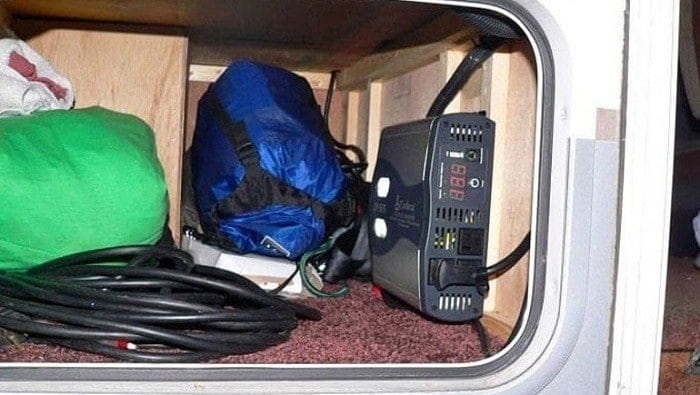
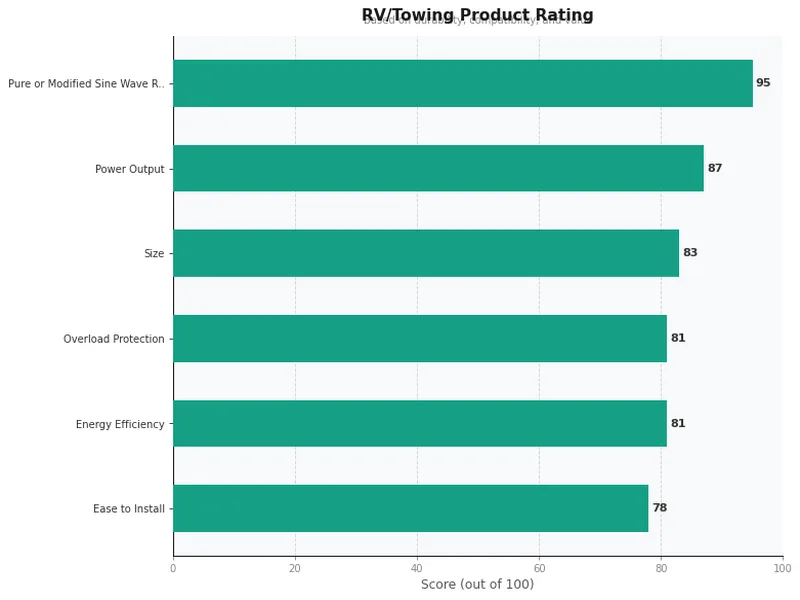
The continuous wattage rating determines the maximum sustained load the inverter can support indefinitely. Start by adding up the wattage of all devices that will run simultaneously — not the total of everything owned, but the realistic peak concurrent draw. Surge capacity matters equally: motors in air conditioners, refrigerators, and power tools draw 2-6X their rated wattage during startup. An inverter rated at 2000W continuous with 4000W surge handles most RV scenarios, but buyers running residential air conditioners or multiple high-draw appliances simultaneously should consider the 3000W class.
The most consequential decision in this category is whether to purchase a standalone inverter or an inverter/charger with an integrated transfer switch. Standalone inverters cost less upfront but require a separate converter/charger and transfer switch — adding complexity, weight, and often equal or greater total expense. Inverter/chargers like the Victron MultiPlus, Magnum MS2012, and Xantrex Freedom XC consolidate these functions into a single unit, simplifying wiring and reducing potential failure points. Full-time RVers and those with solar installations almost universally benefit from the integrated approach.
All seven inverters in this roundup produce pure sine wave output, but the quality of that sine wave varies. Total harmonic distortion (THD) below 3% is the benchmark for powering sensitive electronics without risk. Higher THD can cause buzzing in audio equipment, overheating in motor windings, and erratic behavior in digital devices. Efficiency — the ratio of AC output power to DC input power — typically ranges from 85-93% in this class. Every percentage point of efficiency translates directly into battery runtime: a 93% efficient inverter delivers roughly 10% more usable energy from the same battery bank than an 85% efficient unit. The pure sine wave standard ensures compatibility with all AC equipment without the compromises inherent in modified sine wave output.
Modern RV battery banks span multiple chemistries: lithium iron phosphate (LiFePO4), AGM, gel, and flooded lead-acid. Each chemistry demands different charge voltage setpoints, absorption times, and float parameters. An inverter/charger with configurable charge profiles protects the battery investment and maximizes cycle life. Lithium batteries in particular require precise charge cutoff voltages and the elimination of equalization charges that can damage cells. Buyers upgrading to lithium should verify that their chosen inverter/charger includes a validated lithium charge profile — not merely a user-adjustable voltage setting.
The required inverter size depends on the total wattage of simultaneously operating appliances. A 2000W inverter handles most common RV loads including microwaves (900-1100W), coffee makers (800-1200W), laptops, TVs, and small appliances. Buyers running residential air conditioners, hair dryers, or multiple high-draw devices simultaneously should consider 3000W or higher. Calculate the total concurrent draw and add a 20% safety margin to determine the minimum continuous rating.
Modified sine wave inverters can cause operational issues and potential damage to certain electronics. Sensitive devices including CPAP machines, variable-speed tools, laser printers, and audio equipment may overheat, produce audible buzzing, or malfunction entirely. Motor-driven appliances run less efficiently and at higher temperatures on modified sine wave power. All inverters reviewed in this guide produce pure sine wave output, eliminating these risks entirely.
Runtime depends on battery capacity, inverter efficiency, and load. The formula is: Runtime (hours) = Battery capacity (Ah) × Battery voltage (12V) × Depth of discharge (0.5 for lead-acid, 0.8 for lithium) × Inverter efficiency (0.90) ÷ Load (watts). A 200Ah lithium bank running a 500W load through a 90% efficient inverter delivers approximately 3.5 hours of runtime. Larger battery banks and lower loads extend runtime proportionally.
Running an inverter while driving is safe and common practice, provided the installation follows proper wiring standards. The alternator recharges the battery bank during transit, offsetting the inverter draw. However, extended high-load operation while driving can stress the alternator and charging system. Most RV owners use inverters during transit for light loads — charging devices, running a residential refrigerator, or powering entertainment systems — without issue.
DC wiring gauge depends on the inverter's maximum current draw and cable run length. A 2000W/12V inverter draws approximately 185A at full load, requiring 2/0 AWG copper cable for runs up to 5 feet. A 3000W unit draws approximately 275A, demanding 4/0 AWG cable. Undersized wiring creates voltage drop, reduces efficiency, and poses a fire hazard. Always install an appropriately rated Class T or ANL fuse within 18 inches of the battery positive terminal.
All inverters consume some standby power when turned on but not actively supplying a load. This parasitic draw typically ranges from 0.5A to 2A depending on the model. Over 24 hours, that represents 12-48Ah of battery capacity — a meaningful drain on smaller battery banks. Most quality inverters include a search mode or eco mode that reduces standby consumption by periodically pulsing the output to detect connected loads. Turning the inverter off entirely when not needed remains the most effective way to eliminate parasitic draw.
 |
 |
 |
 |

About Liam O'Brien
Liam O'Brien has spent over a decade buying, field-testing, and evaluating automotive tools with a focus on what actually performs in a real DIY garage rather than what markets well on a spec sheet. His hands-on experience spans hand tools, diagnostic equipment, floor jacks, socket sets, and specialty automotive gear across a wide range of brands and price points. At CarCareTotal, he covers automotive tool and equipment reviews, garage setup guides, and buying advice for home mechanics.
Get some FREE car parts & gear.. Or check out the latest free automotive manuals and build guides here.
Disable your ad blocker to unlock all the hidden deals. Hit the button below 🚗
| | | |
