by Marcus Chen
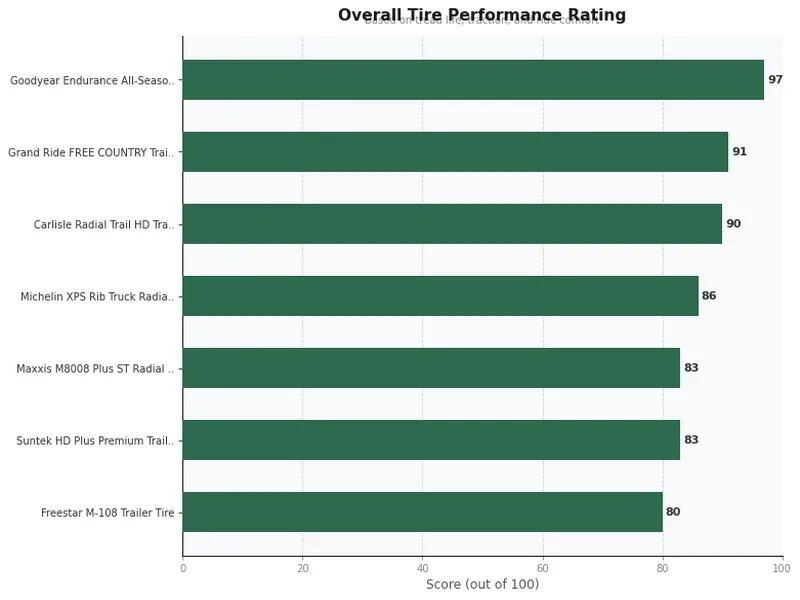
The Goodyear Endurance ST235/80R16 is our top pick for 2026 — it's the gold standard in trailer tires and the one name every serious RV owner trusts for long hauls. Choosing the wrong RV tire isn't just an inconvenience; it's a safety risk that can strand you on the side of the highway or, worse, cause a blowout at speed.
RV tires carry a different kind of burden than passenger car tires. They sit under heavy static loads for months at a time, bake in direct sunlight, and then get put through highway speeds without much warm-up time. That combination destroys tires that aren't purpose-built for trailer duty. The good news? The market for ST (Special Trailer) tires has improved dramatically, and 2026 brings solid options across every budget and rig size.
Whether you're running a towable toy hauler, a fifth wheel, or a bumper-pull travel trailer, the tires on your rig are the only thing between you and the pavement. Getting this decision right matters. We've researched the top options — from industry veterans like Goodyear and Carlisle to high-value challengers from Maxxis and Transeagle — to give you a no-nonsense breakdown of the best RV tires available right now. For a broader look at your wheels and tires setup, check out our full category coverage too.
Contents









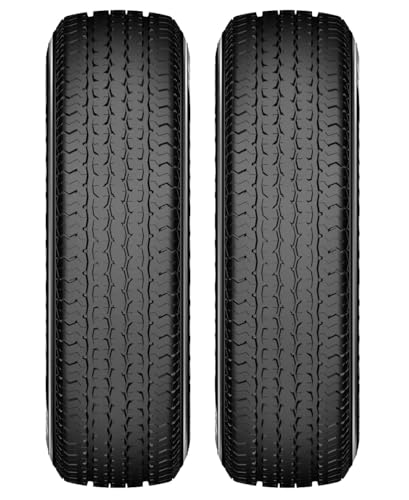
Goodyear's Endurance line has earned its reputation the hard way — through millions of miles of real-world trailer use. This 2-pack gives you ST235/80R16 tires with a Load Range E rating, meaning each tire is engineered to carry up to 2,830 lbs at 80 PSI. That's serious capacity for a serious rig. The 30.79-inch overall diameter fits most full-size trailer applications, and the all-season compound handles heat, rain, and highway grime without complaint.
What separates the Endurance from cheaper alternatives is Goodyear's polyester cord body and high-tensile steel belts. Together, they resist the flexing and heat buildup that kills budget tires on long hauls. You'll notice the difference after a 500-mile pull in July heat — the Endurance runs cool and maintains its shape where other tires start showing sidewall stress. The 2-pack pricing makes the per-tire cost competitive for a brand that costs more at retail.
Buying tires in pairs also solves the mismatched-age problem. Running two tires from the same production batch means uniform wear rates and consistent load-sharing on dual-axle setups. If you're replacing all four tires on a tandem-axle trailer, buy two 2-packs. If you're comparing RV tire options alongside other trailer tire picks, the Endurance consistently lands at or near the top of that list too.
Pros:
Cons:
Carlisle built its reputation in the trailer tire space, and the Radial Trail HD is one of their most versatile offerings. Sized at 225/75R15 with a 113M load rating and a 9/32" tread depth, this tire is purpose-built for short- and long-distance hauling across a wide range of trailer types. It's rated for 81 mph, which covers virtually every legal highway speed in the US. The radial construction gives you a smoother ride and better heat dissipation than bias-ply alternatives.
What makes this tire stand out for multi-use trailer owners is its broad compatibility list. Carlisle specifically names boat trailer brands including Alumacraft, Lund, Ranger, Sea Ray, and Tracker — but the tire works just as well on cargo trailers, utility trailers, horse trailers, and towable RVs. If you pull different trailers throughout the year, having a proven tire that transitions across applications without complaint is genuinely useful.
The 225/75R15 sizing is one of the most common trailer tire dimensions on the market, which means you won't struggle to find spares at truck stops or tire shops across the country. That availability matters when you're on a long road trip and need a replacement fast. This tire sits at a mid-range price point that balances quality with value — not the cheapest option, but far from overpriced for what you get.
Pros:
Cons:
Maxxis doesn't get enough credit in the trailer tire segment, but the M8008 Plus makes a compelling case for their engineering. The standout feature here is the upgraded inner liner compound — thicker than standard, specifically designed to minimize air loss rate and maintain optimal inflation across longer service intervals. For RV owners who store their rig between trips, this matters enormously. A tire that holds pressure through months of storage is a tire you can trust on the first haul of the season without a pressure check panic.
The M8008 Plus also targets rolling resistance directly. Better rolling resistance translates to real-world fuel savings on your tow vehicle — not a dramatic difference per trip, but over thousands of miles across a season, it adds up. The tire's construction improvements over the base M8008 include an optimized compound that enhances durability without sacrificing ride quality. At the 205/75R15 sizing with a 107/102N load rating, it fits smaller trailers and lighter towable RVs that don't need the maximum-duty Load Range E construction.
If you're running a smaller travel trailer or a lightweight toy hauler, this is the tire that gets the engineering right without over-building for your application. The 107/102N rating (single/dual) means it's designed for dual-axle configurations as well. Maxxis backs this tire with consistent quality control — you won't find the production variance issues that plague some budget brands.
Pros:
Cons:
The Provider Radial ST gives you Load Range E, 10-ply construction, and ST235/80R16 sizing at a price that significantly undercuts the name-brand competition. For budget-conscious RV owners who still need serious load capacity, this tire fills a real gap in the market. The semi-steel radial construction delivers a smoother ride than bias-ply tires while maintaining the structural integrity that ST tires need to handle sustained highway loads.
All-season capability and highway performance ratings mean you're not giving anything up on paper compared to pricier options. The Load Range E rating with a 10-ply (DC) designation handles the same gross loads as competing tires from Goodyear or Transeagle in this size. What you're trading is brand heritage and some degree of long-term wear data — Provider is a newer brand, and owners don't have the same decade-long track record to draw on.
That said, for a spare tire, a secondary rig, or an owner on a tight budget who needs four highway-capable ST tires right now, the Provider Radial ST is a legitimate choice. Buy from a reputable dealer, check the DOT date code for fresh production, and run them at proper inflation. If you want to understand how proper tire inflation affects blowout risk, the NHTSA's tire safety resources cover the fundamentals clearly.
Pros:
Cons:
TASKMASTER takes a no-excuses approach to trailer tires. The ST225/75R15 10-ply Load Range E is built for heavy loads and punishing conditions — not as a marketing claim, but as a specification that's been torture-tested in independent labs. That independent lab certification matters: it means the durability specs aren't just factory claims, they're third-party verified. If you haul at or near max capacity regularly, that distinction is worth paying for.
The Dura-Lock Inner Lining is the engineering highlight here. Standard trailer tires lose pressure gradually through micro-permeation in the inner liner — a slow creep that goes unnoticed until you're running under-inflated and generating dangerous heat. TASKMASTER's Dura-Lock addresses that directly by preventing creeping pressure loss. For seasonal RV owners who might go weeks between pressure checks, this feature provides genuine peace of mind.
The ST225/75R15 sizing hits the sweet spot for mid-size travel trailers and fifth wheels. Load Range E at this size gives you the capacity headroom to handle a fully loaded rig without stressing the sidewalls. Pair this tire with a good set of towing mirrors and you've got a safer, more controlled towing setup overall. The TASKMASTER earns its place as the go-to choice for owners who push their trailers hard.
Pros:
Cons:
The Transeagle ST Radial II has built a loyal following among RV owners who want Load Range E performance without premium-brand pricing. At ST235/80R16 with a 124/120L load rating and 10-ply construction, this tire delivers maximum-duty specs in the most common full-size trailer tire sizing. The 124/120L rating (single/dual load index) puts it at the high end of the load-carrying spectrum for this size category.
All-season, highway-rated performance is standard on the ST Radial II. The BSW (Black Side Wall) finish looks clean and professional on any rig. Transeagle has been building trailer tires long enough to understand the specific failure modes that plague this category — heat buildup, sidewall flex, and pressure retention. Their construction addresses all three without charging you a premium for the privilege.
The value proposition here is straightforward: you get heavy-duty specs at a mid-range price. If you're outfitting a tandem-axle fifth wheel or large travel trailer and need four tires, the savings per tire add up fast compared to name-brand equivalents. Transeagle's track record on Amazon backs this up with thousands of positive reviews from real RV owners. If you're also shopping for broader all-season tire options for your tow vehicle, we've covered that category separately.
Pros:
Cons:
The HORSESHOE LIPIZZAN ST-KING I stands out for one specific engineering choice that most competing tires skip: a full nylon overlay cap that spans the entire tread area — not just the shoulder strips you'll find on most other trailer tires. That full-width nylon overlay adds structural integrity and stability under heavy loads, reducing the risk of deformation at speed. It's a meaningful upgrade, especially for owners who push close to maximum GVWR regularly.
The Rim-Guard ring on the sidewall is another practical differentiator. Curb contact and tight maneuvering in campgrounds can scuff and damage the rim/wheel interface — the Rim-Guard ring absorbs that contact before it reaches your wheels. The tire's steel belt construction uses high-strength multiple layers for structural integrity, and the 10-ply Load Range E rating handles up to 2,830 lbs single / 2,470 lbs dual at 80 PSI cold. The ST225/75R15 sizing with an overall diameter of 28.31 inches fits a wide range of trailer applications.
The 2-pack format and a 2-year manufacturer warranty round out the value case. For an RV owner who wants maximum sidewall and rim protection — particularly one who navigates tight campground spaces or gravel roads regularly — the LIPIZZAN ST-KING I is the most thoughtfully engineered option at this price point. If you want to round out your road safety prep, our car emergency kit guide covers the roadside essentials you should carry on every trip.
Pros:
Cons:
Picking the right RV tire involves more than matching a size to your rim. Here are the factors that actually matter when you're making this decision.
Load Range is the single most important spec to get right. It determines how much weight the tire can safely carry at its maximum inflation pressure. For most towable RVs and travel trailers, you'll want:
Never run a Load Range that puts you at or above the tire's maximum load rating. Calculate your trailer's actual loaded weight — not just its empty weight — and match your tires with a comfortable margin above that number. Under-loading a tire slightly is fine. Over-loading is how blowouts happen.
Always use ST (Special Trailer) tires on your trailer — never passenger (P) or light truck (LT) tires. Here's why this matters:
Running LT or P tires on your trailer is a safety risk and can void your trailer's warranty. Stick with ST-rated tires across the board.
Your trailer's owner manual specifies an approved tire size. That spec isn't a suggestion — it's an engineering requirement that accounts for load capacity, fender clearance, and hub fitment. The most common RV trailer tire sizes in 2026 are:
If you want to upsize, confirm the new tire's overall diameter fits your fender wells with adequate clearance and that your wheel hubs are rated for the new size's load capacity.
Rubber degrades with time, regardless of tread depth. UV exposure, ozone, and temperature cycling break down the tire compound from the inside out. For RV tires specifically:
Tire age is the leading cause of RV blowouts. A tire with excellent tread but 6 years of heat cycling is far more dangerous than a tire with moderate tread that's 2 years old.
ST (Special Trailer) tires are engineered specifically for trailer applications — they have stiffer sidewalls that resist trailer sway and are built to carry heavy static loads at sustained highway speeds. LT (Light Truck) tires are optimized for driven wheels and prioritize traction and steering response over load-bearing stability. Never substitute LT or P-metric tires on a trailer. The sidewall ratings, construction, and safety margins are completely different.
Replace ST trailer tires every 5 years from the DOT manufacture date — regardless of how much tread remains. UV exposure, ozone, and temperature cycling degrade the rubber compound from the inside, creating invisible structural weakness that can cause sudden blowouts. Many RV owners follow a 3-year replacement schedule as an extra safety margin. Check your DOT code (the last four digits on the sidewall) and track your tire age proactively.
Inflate to the maximum PSI stamped on the tire sidewall — not the pressure listed on your tow vehicle's door jamb. ST tires are designed to run at maximum rated inflation. Under-inflation is the primary cause of trailer tire failure because it causes excessive sidewall flexing and heat buildup. Always check cold inflation pressure before a trip, not after the tires have been driven on. For Load Range E tires, that maximum is typically 80 PSI.
No. Your truck runs LT or P-metric tires optimized for traction and steering on a driven axle. Your trailer needs ST-rated tires with the stiffer sidewall construction and load ratings specific to trailer duty. Running truck tires on a trailer compromises load capacity calculations, increases sway risk, and can void your trailer warranty. Always use ST tires on any towable RV or trailer, sized to match the manufacturer's specifications.
Three causes account for the vast majority of trailer tire blowouts: age degradation (tires over 5 years old with invisible internal cracking), chronic under-inflation (sidewall flexing generates heat that destroys the tire from the inside), and overloading (running above the tire's rated load capacity). The fix is straightforward — replace tires on a 5-year schedule, run maximum rated inflation, and never exceed your trailer's GVWR. A quality TPMS (Tire Pressure Monitoring System) is a worthwhile investment for any RV owner.
Most travel trailers and fifth wheels in the 5,000–14,000 lb GVWR range require Load Range E (10-ply) tires. Calculate your trailer's actual loaded weight — add water, gear, food, and passengers — then divide by the number of tires. Each tire needs a load rating comfortably above that per-tire number. Load Range D works for lighter rigs under 8,000 lbs, but Load Range E is the safer default for any rig you load to near capacity. When in doubt, refer to your trailer manufacturer's specifications.
 |
 |
 |
 |

About Marcus Chen
Marcus Chen has over twelve years of hands-on experience modifying cars across a range of platforms — from commuter builds to track-focused setups — with deep expertise in suspension tuning, wheel and tire fitment, and performance upgrades that improve driving dynamics without sacrificing day-to-day reliability. He has worked with both bolt-on and engineered modifications and brings a methodical, results-focused approach to evaluating performance parts. At CarCareTotal, he covers performance upgrades, suspension and handling, and wheel, tire, and drivetrain modifications.
Get some FREE car parts & gear.. Or check out the latest free automotive manuals and build guides here.
Disable your ad blocker to unlock all the hidden deals. Hit the button below 🚗
| | | |
