by Marcus Chen
You're standing in the auto parts aisle, staring at a wall of tire pressure gauges, and you have no idea which one is actually worth your money. A colleague swears by the analog stick gauge he's had for a decade, but your mechanic just told you your tires were 8 PSI under-inflated at your last oil change — and you checked them yourself the week before. That gap between what you think your tires are running and what they're actually running is exactly why a reliable digital tire pressure gauge matters more than most drivers realize.
According to the National Highway Traffic Safety Administration, under-inflated tires are a leading contributor to tire failure and blowouts, costing drivers billions in premature tire replacement each year. A quality digital gauge eliminates guesswork with precise 0.1 PSI readout resolution, backlit displays for low-light use, and ANSI-certified accuracy that holds up over time. Whether you're maintaining a commuter sedan, managing a fleet of trucks, or keeping your RV's tires in shape for a long haul, the right gauge is a tool you'll reach for again and again. If you're also thinking about your tires themselves, our guide to the wheels and tires category covers everything from installation tips to upgrades.
For this 2026 edition, the editorial team at CarCareTotal tested and evaluated seven of the most popular digital tire pressure gauges available on the market. The picks below span the full range — from compact, budget-friendly pocket gauges to heavy-duty industrial units calibrated to professional ANSI standards. Here's what you need to know before you buy.

Contents






CRAFTSMAN has built its reputation on tools that work shift after shift without drama, and the CMMT14134 digital tire pressure gauge carries that tradition into the garage bay and the driveway. The gauge delivers a quick, accurate pressure reading the moment you seat the chuck on the valve stem — no waiting, no second-guessing. It's the kind of tool you keep in the glove box and forget about until you need it, at which point it performs exactly as expected.
Two features set the CMMT14134 apart from basic pocket gauges at this price point. First, the backlit digital display gives you a clear reading even when you're crouched in a dim parking garage or checking tire pressure by the light of a phone screen at night. Second, the lighted nozzle illuminates the valve stem area directly, so you're not fumbling around trying to make contact. The 30-second automatic shutoff keeps the battery alive through years of intermittent use. Build quality is consistent with what CRAFTSMAN delivers across its hand tool line — solid enough to handle being tossed in a toolbox or dropped on pavement without the display going haywire.
For the average driver maintaining a personal vehicle or a household fleet of cars, this gauge hits the practical sweet spot. It won't challenge a professional ANSI-calibrated unit for raw accuracy, but for confirming that your tires are within the manufacturer's recommended range before a road trip or a seasonal check, it delivers reliable results every time you use it.
Pros:
Cons:
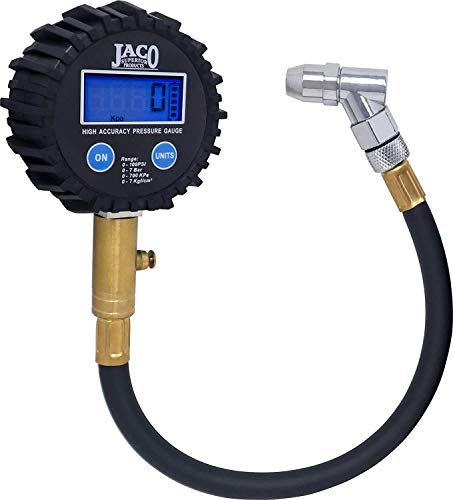
The JACO ElitePro is the gauge mechanics reach for when accuracy is non-negotiable. Certified to professional ANSI 2A standards, it runs dual pressure sensors calibrated to ±0.50% full scale — that translates to a tolerance of 0.50 PSI across its 100 PSI range, with readout resolution down to 0.10 PSI. That level of precision matters when you're dialing in tire pressure for performance driving, track use, or maintaining a commercial vehicle where even a 2 PSI variance affects load rating and fuel economy meaningfully.
Construction is all business. Every structural component is solid brass or steel, and the entire assembly is enclosed in a shock-resistant gear-style protective guard that absorbs drops and impacts without cracking. The 10-inch HybridFlex air hose is fully rotational and fitted with a 360-degree swivel angled air chuck, letting you reach rear inner duals on trucks and tight valve stem positions on performance wheels without contorting yourself. The chuck accepts standard 1/4-inch NPT fittings, so it's field-swappable if your preferred chuck style differs. An integrated air bleeder valve allows real-time pressure adjustment without resetting the display — a practical feature that saves time when you need to bleed air from an over-inflated tire. Readings lock on the display until you press the ON button to reset, meaning you can stand up and read the gauge at eye level rather than crouching at wheel height.
If you're building out a tire maintenance toolkit and want a single gauge that covers everything from motorcycles to RVs and trailers, the ElitePro earns its place as the reference-grade instrument in the group. Pair it with our roundup of the best locking lug nuts of 2026 if you're building out a complete wheel-security and maintenance setup.
Pros:
Cons:
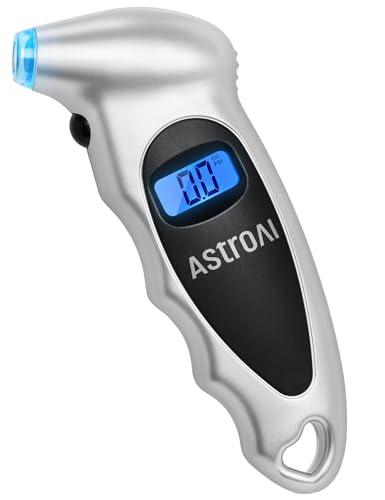
The AstroAI gauge proves that budget-friendly doesn't have to mean imprecise. Calibrated to ANSI B40.7 with a ±1 PSI accuracy rating and 0.1 PSI readout resolution, it covers the full range of passenger vehicles, light trucks, and bicycles in a single compact package. AstroAI individually calibrates each unit with professional-grade tools before it ships — a manufacturing process step that's more often associated with gauges costing twice as much. For drivers who want a dependable backup gauge or a reliable primary tool without paying for features they won't use, this is the clear pick.
The unit supports four pressure units — PSI, Bar, kgf/cm², and kPa — switchable with a single button press. That flexibility matters if you're working on imported vehicles with metric placard values or checking bicycle tire pressures on a different scale than your car tires. The illuminated nozzle solves the perennial problem of locating a valve stem in the dark, forming a clean seal that delivers consistent readings without air loss. The backlit LCD is large enough to read at arm's length in poor lighting conditions. At a range of 0–150 PSI, it handles passenger cars, SUVs, motorcycles, and standard truck tires with room to spare.
Durability is appropriately modest for the price category — the housing is plastic rather than metal, and it won't survive the kind of daily professional abuse that a JACO or ETENWOLF would shrug off. But for the driver who checks tire pressure a few times per month and needs a gauge that gives accurate results consistently, the AstroAI delivers exactly that without overcomplicating the experience.
Pros:
Cons:
Accutire has been a fixture in the tire pressure gauge category for years, and the MS-4021B demonstrates why the brand retains a loyal following. The gauge is built with a heavier-duty construction than most units at its price point, featuring an angled head and a rubber-coated handle that make it noticeably easier to grip, especially when your hands are cold or the valve stem is positioned awkwardly. The angled head design addresses a practical frustration with straight-barrel gauges — reaching rear tires and inner-rim valve stems without bending the chuck at an uncomfortable angle. It reads across the full range from 5 to 150 PSI and supports four pressure units: PSI, Bar, kPa, and kg/cm².
The large backlit LCD is one of the clearest displays in this roundup. Characters are well-sized and the backlight activates automatically, making readings effortless in dim conditions. The unit ships with four valve caps, a small but practical addition that costs nothing extra and saves you the inconvenience of missing or damaged caps on your wheels. Construction feels appropriately heavy-duty — this is not a gauge that flexes or rattles when you press it onto a stem under pressure.
Where the MS-4021B doesn't compete with the JACO or ETENWOLF is on certified calibration documentation. It delivers accurate and consistent readings in real-world use, but it doesn't ship with ANSI certification paperwork or dual-sensor precision. For the driver who wants a sturdy, reliable gauge with a practical angled design and valve caps thrown in, this is a strong all-around choice that punches above its weight class.
Pros:
Cons:
When standard passenger-car gauges top out at 100 or 150 PSI and you're running heavy-duty truck tires, commercial vehicle tires, or industrial equipment that operates at higher inflation pressures, you need a unit built for that range. The MotCertified gauge handles pressures up to 200 PSI with an ANSI B40.1 Grade B calibration (±2% accuracy) and steel construction that holds up to the physical demands of commercial use. The extended 5mm chuck tip creates a secure seal on valve stems without air leakage — a detail that matters when you're trying to get a stable reading rather than bleeding air while you're measuring.
The flexible rubber hose with a 360-degree angled rotating nozzle is the standout feature for practical use. Reaching tire valves on dual rear wheels, trailer axles, or industrial equipment often requires awkward positioning — the rotating nozzle eliminates that problem by letting you approach the stem from any angle and still get a clean seal. A rubber protective cover over the steel body absorbs drops and protects the display from impact, and the reinforced rubber hose resists cracking under repeated flexing at temperature extremes. An integrated air release valve allows real-time pressure adjustment, and the hold function locks the reading on-screen so you can read it at eye level after stepping back from the wheel.
The ±2% accuracy under ANSI B40.1 Grade B is less precise than the JACO's ANSI 2A certification, but for truck and commercial vehicle maintenance where the goal is confirming tires are in a safe operating range rather than dialing in 0.1 PSI precision, this gauge delivers everything you actually need. If you also use your truck for towing or camping, check out our review of the best tire chains of 2026 for winter driving readiness.
Pros:
Cons:
The ETENWOLF T300 occupies a genuinely distinct position in this roundup: it's the only gauge here calibrated to ANSI B40.7 Grade 2A (±0.5%) across the full range of 3 to 200 PSI, and it's the only unit engineered to maintain that accuracy in temperature extremes from -4°F to 130°F (-20°C to 54°C). That combination of precision and environmental resilience makes it the right tool for professional mechanics, fleet managers, and serious enthusiasts who need reliable readings whether they're checking pressures on a January morning in Minnesota or a July afternoon in Phoenix. The built-in AI thermal compensation chip adjusts sensor output in real time to compensate for temperature-induced drift — a feature that separates industrial-grade instruments from consumer-grade ones.
The T300 covers both the low end of the pressure scale (from 3 PSI, which captures bicycle and specialty tires accurately) and the high end (200 PSI for commercial truck and heavy equipment applications) without compromising accuracy at either extreme. That's a meaningful claim verified by the ANSI 2A certification. Physical design reflects industrial intent: the vivid orange housing is high-visibility in low-light shop environments, and the gauge runs on standard AAA batteries that are user-replaceable — no proprietary cells or charging cables required. Note that a Presta valve adapter is not included; if you're using this gauge for road bikes with Presta valves, you'll need to source one separately.
For anyone who needs a gauge that performs as precisely in the middle of winter as it does in summer heat — and who needs that precision across a 3–200 PSI operating range — the T300 stands alone in this group. It's the instrument that eliminates the question of whether the gauge or the environment is affecting your reading.
Pros:
Cons:
The Rhino USA gauge redefines the product category for drivers who connect to an air compressor regularly. Rather than a standalone measurement tool, it's a complete 3-in-1 unit that combines an inflator, a straight locking chuck, a calibrated pressure gauge, a stainless braided hose, and an integrated bleed valve into a single tool. It connects to any standard 1/4-inch NPT air compressor fitting, covers the full 0–200 PSI range, and handles everything from passenger car tires to truck, motorcycle, SUV, RV, and trailer tires without any adapter changes. For RV owners who already rely on a portable compressor, this gauge pairs naturally with the kind of tire maintenance routine our best tire repair kits guide is designed to support.
Construction is the calling card here. Rhino USA builds this tool from durable stainless steel and solid brass hardware — no plastic fittings on the pressure-bearing components. The stainless braided hose resists kinking and abrasion, and the large 2-inch dial provides at-a-glance readability even when you're crouched at wheel height without your reading glasses. The locking chuck engages securely on the valve stem and holds pressure without leaking while you read and adjust. Rhino USA is an American-owned family operation with US-based live phone support — a meaningful differentiator if something goes wrong and you want to talk to an actual person rather than submit a warranty claim form online.
For drivers who already own a portable compressor or have shop air available, this gauge eliminates the back-and-forth between a standalone gauge and a separate inflation chuck. Inflate, check pressure, bleed if needed — all through one tool without swapping connections. It's the most functionally capable unit in this roundup for active tire inflation management, and the 200 PSI ceiling ensures it grows with your vehicle needs. RV owners will also find it useful alongside our RV portable waste tanks guide as part of a broader pre-trip inspection routine.
Pros:
Cons:
The most important specification on any tire pressure gauge is its certified accuracy — and not all gauges are equal on this front. The ANSI calibration hierarchy goes from Grade B (±2%, the minimum) through Grade A (±1%) to Grade 2A (±0.5%, the most precise for digital instruments). For passenger vehicle maintenance where your manufacturer's recommended PSI falls between 30 and 50 PSI, a Grade A or B gauge is entirely adequate. For performance applications, commercial vehicles, or any situation where precise pressure matters — think track days, payload-sensitive truck setups, or RV tire management where a few PSI affects handling and load distribution — you want a Grade 2A certified instrument like the JACO ElitePro or the ETENWOLF T300.
PSI range determines which vehicles your gauge can serve. A 100 PSI gauge covers passenger cars, SUVs, motorcycles, and most light trucks. If you're maintaining commercial trucks, heavy equipment, or any high-pressure tire application, you need a gauge rated to at least 150 PSI — and ideally 200 PSI for true versatility. The gauges in this roundup top out at either 100, 150, or 200 PSI, so match your selection to the highest-pressure application you'll actually encounter.
The physical construction of a tire pressure gauge tells you a lot about how long it will survive real-world use. Brass and steel components handle pressure cycling without fatigue failure over years of use. Plastic housings are acceptable for infrequent consumer use, but in a shop environment or a heavy-use toolbox, they crack and break at chuck joints and display bezels. Look for rubber-overmolded handles for grip and drop protection, reinforced air hoses on extended-hose models, and protective guards around the gauge body on premium units like the JACO ElitePro.
Chuck quality is where many budget gauges fail first. A worn or loose chuck bleeds air during the measurement, which throws off readings and requires multiple attempts to get a stable number. Metal chucks with tight tolerances and swivel joints hold up far longer than pressed plastic fittings. If the gauge has an air hose, check that it's reinforced rather than plain rubber — a kinked or cracked hose on a compressor-connected gauge is a maintenance problem you'll encounter at the worst possible time.
Digital displays have made tire pressure gauges dramatically easier to use in real-world conditions, but display quality still varies meaningfully across the price range. A backlit display is essential for low-light use — and more often than not, you're checking tire pressure in a dark garage, a dim parking structure, or alongside a road at night. Some gauges, like the CRAFTSMAN CMMT14134 and the AstroAI, add an illuminated nozzle tip that solves the separate problem of locating the valve stem in the dark.
Readout resolution matters for precision. A 1 PSI resolution gauge tells you that your tire is somewhere between 31 and 33 PSI. A 0.1 PSI resolution gauge tells you it's 32.4 PSI. For casual consumer use, 1 PSI resolution is fine. For performance tuning or any application where you're chasing specific pressure targets, 0.1 PSI resolution is worth paying for. Auto-lock displays that hold the last reading until you reset are a genuine usability improvement over gauges that display a live reading only while the chuck is seated — they let you read the measurement at eye level after stepping back from the wheel.
Most passenger vehicles and light trucks use standard Schrader valve stems, which all the gauges in this roundup support natively. If you're also maintaining bicycles with Presta valves or specialty vehicles with non-standard stems, check whether your preferred gauge includes or supports adapter fittings. The ETENWOLF T300 explicitly does not include a Presta adapter. Multiple pressure unit support (PSI, Bar, kPa, kgf/cm²) matters if you reference metric placards on imported vehicles or work with international specifications.
For compressor-connected gauges like the Rhino USA, confirm that the chuck fitting is standard 1/4-inch NPT, which is the universal standard for portable and shop air compressors in the US and compatible with the full range of aftermarket air chucks. The JACO ElitePro's HybridFlex hose with 360-degree swivel chuck is the benchmark for reach and flexibility in handheld gauge design — worth the premium if you regularly deal with difficult-to-access valve stems on dual rear wheels, trailer axles, or staggered-fitment performance wheels.
Your vehicle's recommended tire pressure is printed on a sticker inside the driver's door jamb, not on the tire sidewall. The number on the tire sidewall is the maximum pressure the tire is rated to handle — not the recommended operating pressure. Most passenger cars fall between 30 and 36 PSI, while trucks and SUVs often run 35 to 45 PSI. Always reference the door jamb placard for your specific vehicle and load.
For everyday passenger vehicle maintenance, a gauge accurate to ±1 PSI (ANSI Grade A) is more than adequate. At 32 PSI, a 1 PSI margin of error represents about 3% variance — well within the range where your tires will perform safely and efficiently. For performance driving, payload-sensitive truck applications, or professional shop use, a Grade 2A gauge accurate to ±0.5% is the standard mechanics rely on. The JACO ElitePro and ETENWOLF T300 both meet that benchmark.
Tire pressure should be checked at minimum once per month and before any long trip. Tires lose approximately 1 PSI per month under normal conditions, and temperature changes affect pressure measurably — for every 10°F drop in ambient temperature, tire pressure decreases by roughly 1 PSI. In 2026, with seasonal temperature swings affecting tire pressure more dramatically than many drivers realize, monthly checks remain the recommended standard from manufacturers and safety organizations.
ANSI calibration refers to accuracy certification under the American National Standards Institute's instrument standards — specifically B40.1 and B40.7 for pressure gauges. A gauge certified to ANSI standards has been tested and verified to read within a specified tolerance across its rated pressure range. Grade B allows ±2% error, Grade A allows ±1%, and Grade 2A (the professional standard) allows ±0.5%. An uncertified gauge may give consistent readings but provides no documented basis for trusting its accuracy across the full pressure range or over time.
Yes, provided the gauge's PSI range covers all your applications. A gauge rated to 150 PSI handles passenger cars, motorcycles, bicycles, and most light trucks. If you also maintain heavy-duty trucks or commercial vehicles operating above 100 PSI, you need a 200 PSI gauge like the MotCertified or the ETENWOLF T300. For bicycles with Presta valves, confirm your gauge includes or supports a Presta adapter, as most automotive gauges are configured for Schrader valves only.
Replace your gauge if it gives readings that consistently differ from a verified reference gauge by more than 2 PSI, if the chuck no longer seats cleanly on the valve stem without air leaking, if the display fails to activate reliably, or if the housing or hose shows cracks that compromise the pressure seal. Digital gauges with lithium or alkaline batteries should be replaced or have their batteries swapped before the low-battery indicator affects display stability. A gauge that costs less than a single tire replacement is worth refreshing every few years to ensure you're getting accurate readings.
 |
 |
 |
 |

About Marcus Chen
Marcus Chen has over twelve years of hands-on experience modifying cars across a range of platforms — from commuter builds to track-focused setups — with deep expertise in suspension tuning, wheel and tire fitment, and performance upgrades that improve driving dynamics without sacrificing day-to-day reliability. He has worked with both bolt-on and engineered modifications and brings a methodical, results-focused approach to evaluating performance parts. At CarCareTotal, he covers performance upgrades, suspension and handling, and wheel, tire, and drivetrain modifications.
Get some FREE car parts & gear.. Or check out the latest free automotive manuals and build guides here.
Disable your ad blocker to unlock all the hidden deals. Hit the button below 🚗
| | | |
