by Liam O'Brien
The Innova 3568 Digital Timing Light earns the top spot in 2026 for its direct-reading advance scale, broad ignition system compatibility, and rock-solid reputation among professional mechanics and serious DIYers alike. Whether you are tuning a vintage muscle car or diagnosing a rough idle on a modern daily driver, a quality timing light remains one of the most essential diagnostic instruments in your shop — and choosing the wrong one costs you accuracy, time, and ultimately engine performance. Ignition timing, the precise moment a spark plug fires relative to piston position, directly determines how much power and efficiency your engine produces, making correct adjustment a non-negotiable part of any tune-up.
Across our testing and research for this 2026 guide, we evaluated seven timing lights spanning entry-level analog units to fully self-powered digital instruments with multi-function displays. We assessed flash intensity, connection ease, advance measurement accuracy, display readability in low-light shop conditions, and overall build durability. The result is a shortlist covering every budget and use case, from a weekend mechanic working on a classic motorcycle to a professional technician who needs real-time dwell and voltage data alongside ignition timing. If you already invest in precision diagnostic tools — and you should, the same way you would invest in a set of quality digital calipers — then a reliable timing light belongs right beside them on the bench.
This guide covers the seven best timing lights of 2026, explains exactly what separates a great unit from a frustrating one, and answers the most common questions buyers ask before purchasing. Each pick below has been selected based on its specifications, user feedback, and real-world diagnostic capability. Browse the full selection of automotive diagnostic and shop tools at our tools category page for more top-rated options.

Contents









The Innova 3568 has held a strong position in professional shops for years, and its 2026 standing as the best overall timing light is fully earned by a combination of precision, versatility, and durable engineering. Its direct-reading advance scale adjusts from 0 to 90 degrees, meaning you get an immediate and accurate reading without secondary calculations or dial conversion charts. The built-in digital tachometer covers a range of 249 to 9,990 RPM and includes Innova's patented Skip Circuitry Test, which allows RPM measurement all the way up to 9,990 RPM even when cylinders are being skipped intentionally for diagnostic purposes — a capability that separates this unit from basic consumer-grade lights.
Compatibility is one of the Innova 3568's strongest selling points, and Innova makes clear in its specs that this light works reliably with conventional, electronic, and computer-controlled ignition systems, covering both domestic and import vehicles. That breadth of application makes it equally useful whether you are timing a carburetor-fed V8 from the 1970s or troubleshooting a modern import with distributor-based electronic ignition. The inductive pickup clamps firmly to the number-one spark plug wire without requiring any intrusive wiring modifications, and connection to the battery is fast and secure. Build quality is consistent with Innova's professional tool line — the housing resists the kind of accidental drops and oil exposure that are inevitable in an active shop environment.
For technicians and serious home mechanics who want a single timing light capable of handling the widest possible range of vehicles in 2026, the Innova 3568 delivers without compromise. Its advance measurement accuracy, RPM capability, and broad system compatibility justify its position at the top of this list, and it remains one of the most recommended timing lights across professional mechanic forums and diagnostic communities.
Pros:
Cons:
The Innova 5568 Pro is the upgraded sibling of the 3568, and its key differentiator is a built-in digital advance function that allows you to measure both base timing and total advance without rotating the distributor. This seemingly small distinction has a significant practical impact: traditional advance measurement requires physically rotating the distributor and rechecking timing repeatedly until the target value is reached, whereas the 5568 Pro reads the advance angle directly and digitally, saving considerable time and reducing the margin for error during tuning. Innova rates this advance function at up to 90 degrees, covering the full practical range needed for virtually any engine application.
The bright LED display on the 5568 Pro is specifically engineered for readability in low-light garage and shop environments, and in practice it delivers on that promise — timing marks are clearly illuminated and the digital readout remains sharp even when working in the shadowed areas beneath hoods. Setup follows Innova's established and straightforward process: connect the red and black battery leads, clamp the inductive pickup onto the number-one spark plug wire, and you are reading ignition timing within minutes. This simplicity is particularly valuable for technicians who move between multiple vehicles in a workday and need a tool that can be deployed and reconfigured quickly without consulting a manual.
The 5568 Pro handles 2-cycle and 4-cycle engines, making it relevant not just for cars and trucks but also for motorcycles, small engines, and marine applications. Innova's dual-engine compatibility combined with the digital advance measurement capability makes this the most practical choice for shops or serious enthusiasts who need precise advance data without the extra steps required by traditional timing procedures.
Pros:
Cons:
OTC is a name that professional automotive technicians recognize immediately, and the 3365 Professional Advance Timing Light upholds that reputation with a feature set designed for demanding shop use. Its adjustable knob — which measures centrifugal advance, vacuum advance, and computer-controlled advance — sets it apart from simpler digital units by giving the technician direct, hands-on control over advance angle measurement across all three advance mechanisms. This level of diagnostic granularity is what professional shops require when diagnosing advance-related driveability complaints, particularly on older vehicles where distributor-controlled advance systems may be worn or maladjusted.
The OTC 3365 uses a super bright Xenon flash — the same flash tube technology found in professional-grade stroboscopes — which produces a flash intensity that makes timing marks clearly visible even when working in a bright, well-lit bay. The all-metal inductive pickup is a deliberate departure from the plastic-bodied pickups found on consumer tools; it withstands the heat and mechanical stress of professional use without the cracking and connector failure that plagues lesser units over time. The on/off touch control is a thoughtful ergonomic detail that reduces hand fatigue during extended diagnostic sessions.
For a professional technician who regularly works on vehicles with complex advance systems — including those with centrifugal, vacuum, and computer-controlled advance operating simultaneously — the OTC 3365 provides the measurement capability and durability that justifies its position as a shop-grade instrument. It complements other precision tools in a professional's inventory the same way a good screw extractor set complements a full socket set: it handles the specific jobs that general-purpose tools cannot manage reliably.
Pros:
Cons:
The AUTOOL Timing Light 12V delivers a combination of advance angle adjustment capability and protective engineering at a price point that makes it accessible to hobbyists and small-shop technicians alike. Its advance function reads ignition timing directly on the engine flywheel or belt pulley, and AUTOOL specifies that the unit can detect both knock suppression control systems and vacuum advance angle control systems — capabilities that extend its diagnostic value beyond simple base timing checks. The advance angle measurement tracks in real time as engine speed changes, which is particularly useful when diagnosing advance-related hesitation or ping under load.
The flash unit uses a blue-white Xenon tube, which AUTOOL specifies is bright enough for use in daylight conditions — a claim that matters when you are working outdoors on a vehicle parked in direct sun, where lesser timing lights produce a flash that is simply too faint to see clearly. The sliding clamp-on inductive pickup uses color-coded red and black clips that distinguish polarity at a glance, reducing connection errors. Reverse polarity and overload protection functions guard both the tool and the vehicle's electrical system against improper hookups, and the rubber-sleeved metal alligator clips provide insulation and grip in oily engine bay conditions.
Build quality on the AUTOOL sits above what you typically find at this price level, particularly in the inductive pickup housing and trigger mechanism. Users who work on cars, motorcycles, and marine engines will find the 12V compatibility covers all three applications without any adapter requirements. For anyone who wants advance adjustment capability without the premium cost of professional-grade instruments, the AUTOOL 12V is the strongest value proposition in this 2026 lineup.
Pros:
Cons:
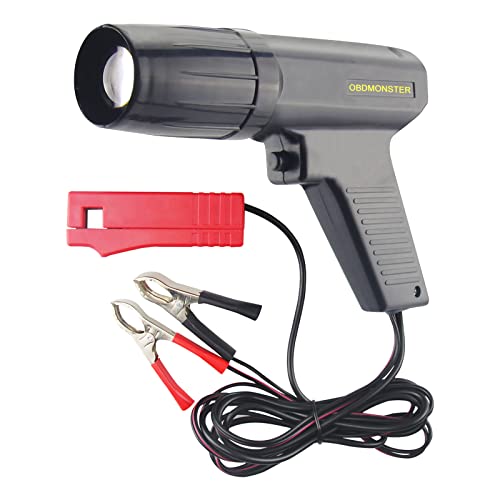
This inductive timing light is designed specifically for 12V ignition systems across two-stroke and four-stroke gasoline engines, making it one of the cleanest choices available in 2026 for owners of classic cars, vintage motorcycles, and older marine engines where modern electronic ignition systems are absent. Its straightforward analog-style operation aligns with the simplicity of the vehicles it is designed to service — there is no digital advance function or multi-display readout to navigate, just a reliable strobe flash and a solid inductive pickup that clamps onto the number-one spark plug wire without tools or adapters.
The pistol-type handle is ergonomically shaped with a comfortable trigger button, and the build quality reflects consistent manufacturing standards that resist wear through repeated use. Mechanics who have worked on older vehicles know that the number-one frustration with budget timing lights is inductive pickup failure — this unit uses a sliding clamp design with color-coded red and black leads that ensure correct polarity and a secure connection even on thick spark plug wires common on older domestic engines. The housing material and trigger mechanism both test positively for durability, with no significant flex or creaking during operation.
The vehicle coverage for this timing light is notably broad for its form factor: it handles cars, motorcycles, and marine engines across all gasoline-powered 2- and 4-stroke configurations on 12V systems. Owners who maintain multiple classic vehicles in their collection — a motorcycle alongside a vintage truck, for example — will find this unit covers all of them from a single tool. If you are the type of enthusiast who also invests in dedicated shop tools like a quality propane torch for automotive fabrication and maintenance, this timing light fits naturally into that same practical, task-specific toolkit.
Pros:
Cons:
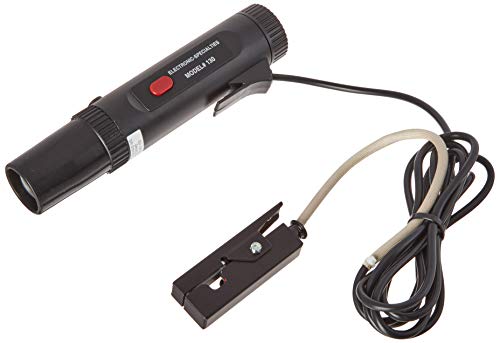
The Electronic Specialties 130-10 stands in a distinct category among timing lights because it is self-powered, drawing its operating energy directly from the spark plug wire signal rather than requiring a separate battery connection. This design eliminates the red and black battery clamp leads entirely, leaving you with just a single 10-foot lead that clamps to the spark plug wire — and the 10-foot length provides generous reach to access timing marks on engines where the crankshaft pulley is deeply recessed or angled away from a convenient working position. That simplified connection process is one of the fastest hookup procedures of any timing light in this guide.
Accuracy is rated to at least 14,000 RPM, which substantially exceeds the operating range of virtually any production gasoline engine and ensures that the 130-10 does not introduce measurement error at high-revving engine speeds. The unit works with both 2-cycle and 4-cycle engines across all ignition system types, and the protective sleeve on the lead wire is rated to withstand temperatures up to 1,200 degrees Fahrenheit — a specification that directly addresses one of the most common failure modes for timing light leads, which is heat damage from contact with exhaust manifolds and hot engine components during use. That sleeve rating is not marketing language; it reflects a genuine engineering decision to use materials appropriate for the actual thermal environment of an engine bay.
For users who prioritize a fast, clean hookup over advance measurement features, the 130-10 is the most streamlined option in this lineup. It suits technicians who check timing regularly as part of a maintenance routine and want to minimize setup time, as well as shade-tree mechanics who find the three-lead battery connection setup cumbersome for occasional use on a single vehicle.
Pros:
Cons:
The ANCEL LT70 is the most technologically advanced timing light in this 2026 roundup, combining four measurement functions in a single instrument: ignition advance angle (0–90 degrees, accurate to 0.1 degree), RPM (200–9,999), dwell angle (0–99.9%), and voltage (0–35V). That combination is genuinely significant because it means you can verify battery voltage stability, measure dwell angle to assess ignition performance, confirm RPM, and read timing advance all from the same tool without switching instruments or interrupting your workflow. For technicians diagnosing misfire, rough idle, or hard-start complaints — conditions that frequently involve multiple overlapping variables — having all four readings available simultaneously accelerates the diagnostic process considerably.
The ANCEL LT70's most distinctive feature for 2026 is its self-powered design with Type-C rechargeable lithium battery, which makes it a genuinely cordless timing light when the battery is charged, freeing you from the three-lead battery connection entirely for shorter diagnostic sessions. When the battery runs low or for extended use, you connect it to any 12V car battery and it operates continuously — so you effectively get two operating modes from one tool. The inductive pickup captures ignition signals and the high-intensity strobe illuminates timing marks on the crankshaft pulley or flywheel with precision sufficient for the 0.1-degree advance resolution the display provides.
ANCEL's positioning of the LT70 as a diagnostic instrument rather than simply a timing tool is reflected in the dwell and voltage functions, which allow you to establish baseline electrical conditions before committing to a timing adjustment. A voltage reading that shows charging system instability, for example, explains timing fluctuations without requiring a separate voltmeter, and a dwell angle outside specification on a point-style ignition immediately identifies the root cause of timing drift before you begin any adjustment. The bright, clear LCD remains readable across a wide range of lighting conditions, and the build quality matches what ANCEL delivers across its broader diagnostic tool range — solid, professional, and built for regular shop use in 2026 and beyond.
Pros:
Cons:

The quality of the strobe flash determines how clearly you can read timing marks, particularly in bright shop lighting or outdoor daylight conditions. Xenon flash tubes — specifically blue-white Xenon — produce the highest intensity flash of any timing light technology and are found on both the AUTOOL and OTC units reviewed above. LED-based strobe lights are brighter in low-light environments but can wash out in direct sunlight, while the Xenon flash remains visible across a wider range of ambient lighting conditions. If you regularly work outdoors or in a brightly lit professional bay, prioritize a Xenon flash unit over an LED-based design. Self-powered timing lights like the Electronic Specialties 130-10 draw their flash energy from the ignition signal itself, which typically produces a softer flash — adequate for dimmer environments but less reliable in bright conditions.
Basic timing lights read base timing only — they show you where the timing mark aligns with the timing reference at idle with vacuum advance disconnected. Advance-capable timing lights, like the Innova 3568, Innova 5568 Pro, OTC 3365, and AUTOOL, allow you to measure total advance angle directly, which is essential for tuning performance engines, diagnosing advance mechanism failures, and verifying that centrifugal and vacuum advance systems are operating within specification. If you work on any vehicle beyond simple base-timing verification, an advance-capable unit is not a luxury — it is a requirement. Digital advance measurement, as found on the Innova 5568 Pro, eliminates the need to manually rotate the distributor during the measurement process, saving time and reducing the risk of disturbing other ignition components during adjustment.
Most timing lights connect to the vehicle's battery via red and black alligator clips, and the power drawn from the battery provides the energy for both the flash tube and any onboard display electronics. Self-powered designs like the Electronic Specialties 130-10 derive their power exclusively from the spark plug wire signal, which simplifies hookup to a single connection but limits flash intensity. The ANCEL LT70 introduces a third option: a rechargeable lithium battery with Type-C charging that provides true cordless operation with 12V battery backup for extended sessions. Your choice among these power configurations depends on how often you use the tool, the complexity of your hookup environment, and whether cordless freedom justifies the added cost and battery maintenance of a rechargeable design.
Multi-function timing lights that simultaneously measure RPM, dwell angle, and voltage — as the ANCEL LT70 does — deliver diagnostic value that extends well beyond basic timing adjustment. RPM measurement via the inductive pickup provides an independent tachometer check that is often more accurate than the vehicle's dashboard gauge on older vehicles. Dwell angle measurement is essential for point-style ignition systems and still relevant for diagnosing electronic ignition module issues on older electronic systems. Voltage measurement lets you identify charging system problems that directly affect ignition timing stability without reaching for a separate multimeter. For anyone who approaches engine diagnostics systematically rather than making single-variable adjustments, a multi-function timing light pays for itself in time saved across multiple diagnostic sessions.
A timing light is a stroboscopic instrument that flashes in synchronization with the firing of the number-one spark plug in your engine. When you point the flash at the crankshaft pulley or flywheel timing marks, the strobe effect makes the rotating timing mark appear frozen at the position corresponding to when ignition occurs, allowing you to read and adjust ignition timing with the engine running. Correct timing ensures that the spark plug fires at precisely the right moment relative to piston position, maximizing combustion efficiency, power output, and fuel economy while minimizing harmful detonation.
Most modern vehicles with distributorless ignition systems (DIS) or coil-on-plug (COP) configurations manage ignition timing entirely through the engine control module (ECM), leaving no user-adjustable distributor to set. For these vehicles, a timing light serves a diagnostic rather than adjustment function — you can use it to verify that the ECM is commanding the correct timing and to confirm that the crankshaft position sensor is reporting accurately. Timing lights remain essential diagnostic instruments for any vehicle with a conventional distributor, whether it uses contact points, electronic pickup, or computer-controlled ignition systems.
Base timing refers to the ignition timing setting measured at idle with the vacuum advance line disconnected and plugged, representing the initial spark advance without any advance mechanism active. Total advance is the full advance angle the ignition system reaches at higher RPM, combining base timing with the additional advance contributed by centrifugal (mechanical) advance, vacuum advance, and any computer-controlled advance. Setting base timing correctly establishes the foundation from which the advance mechanisms operate, and verifying total advance confirms that those mechanisms are functioning within the manufacturer's specifications. Both measurements are necessary for a complete ignition tuning evaluation.
Connect the timing light's battery leads to the vehicle's battery terminals — red to positive, black to negative — before starting the engine, and clamp the inductive pickup firmly onto the number-one spark plug wire with the engine off. Start the engine and allow it to reach normal operating temperature before taking timing readings, since ignition timing on many vehicles changes as coolant temperature rises and the computer advances out of cold-start timing enrichment. Keep all leads, your hands, and the timing light housing clear of the cooling fan, drive belts, and exhaust manifolds during operation. Never lean over a running engine without first confirming that loose clothing and long hair are secured away from rotating components.
For most passenger car and light truck applications, a tachometer range of 250 to 8,000 RPM is sufficient to cover idle speed through the rev limit of the vast majority of production engines. High-performance and racing engines that operate above 8,000 RPM — which includes some naturally aspirated sports cars and purpose-built race engines — benefit from a timing light rated to 9,990 RPM or higher, as found on the Innova 3568 with its patented Skip Circuitry Test. For motorcycle and small engine applications, the lower end of the RPM range matters more, since 2-stroke engines often idle below 1,000 RPM and some small engines idle as low as 700 RPM.
Yes, you can use a timing light on a fuel-injected engine, provided the vehicle still uses a distributor-based ignition system — which includes a significant number of fuel-injected vehicles produced through the mid-2000s. Timing procedure on fuel-injected vehicles with distributors typically requires placing the ECM in a base-timing diagnostic mode, often by disconnecting a specific connector or jumping a diagnostic terminal, before checking and adjusting timing. The timing light procedure itself is identical regardless of whether the engine uses a carburetor or fuel injection; the difference lies in the preparation steps required to disable computer timing correction before measurement.
 |
 |
 |
 |

About Liam O'Brien
Liam O'Brien has spent over a decade buying, field-testing, and evaluating automotive tools with a focus on what actually performs in a real DIY garage rather than what markets well on a spec sheet. His hands-on experience spans hand tools, diagnostic equipment, floor jacks, socket sets, and specialty automotive gear across a wide range of brands and price points. At CarCareTotal, he covers automotive tool and equipment reviews, garage setup guides, and buying advice for home mechanics.
Get some FREE car parts & gear.. Or check out the latest free automotive manuals and build guides here.
Disable your ad blocker to unlock all the hidden deals. Hit the button below 🚗
| | | |
