Car Care ›
by Diego Ramirez
UV degradation accounts for more than 70 percent of all paint oxidation failures on vehicles driven in sun-intensive climates — a figure that makes selecting the right automotive clear coat one of the most consequential decisions in any refinishing or protection project. Clear coat is the transparent topmost layer that shields basecoat color from moisture, road chemicals, bird droppings, fuel splash, and relentless ultraviolet exposure, and when that layer fails, the entire paint system beneath it begins to deteriorate rapidly. Our team has spent considerable time evaluating the formulations, application behavior, and long-term durability of the leading products on the market to help anyone shopping for automotive clear coats in 2026 make a well-informed decision without wasting money on products that underperform.
The market splits broadly into two categories — aerosol cans designed for spot repairs and small projects, and gallon-kit urethane systems intended for professional-grade full-panel or whole-vehicle refinishing. Both categories have genuine merit depending on the scope of the project, and our list covers the full spectrum so that weekend detailers and professional body shop operators alike can find a product that matches their workflow. We also looked closely at VOC compliance, because several high-performance formulations carry regional restrictions that matter enormously in states like California, Delaware, and Maryland. For anyone who already keeps their vehicle's exterior protected with a quality carnauba wax, pairing that routine with a durable clear coat foundation produces results that last measurably longer than either product used in isolation.
Clear coat chemistry has advanced significantly since the shift from lacquer-based finishes to modern urethane and polyurethane systems, and the 2026 product lineup reflects that progress with improved UV inhibitor packages, faster cure windows, and better compatibility with waterborne basecoat systems. Whether the goal is a flawless show-car finish or a tough workhorse coating for a daily driver, the right product exists — and our testing helps narrow that field considerably. We also recommend reviewing our guide on swirl removers before applying clear coat over any freshly sanded or compounded surface, because surface preparation quality directly determines how well any clear coat bonds and performs over time.
Contents






The Spray Max USC 2K High Gloss Clearcoat stands apart from conventional aerosol clear coats because it delivers genuine two-component chemistry in a self-contained can — the kind of polyurethane formulation that professional body shops typically apply with spray guns and dedicated mixing equipment. When the activator cartridge at the base of the can is pressed to initiate the two-part reaction, the resulting coating cures to a hard, chemically resistant film that standard single-stage aerosols simply cannot replicate. Our team found the fan nozzle particularly effective for achieving even film builds across curved panel sections without streaking or uneven layering, and the gloss depth the formula produces is genuinely comparable to gun-applied professional finishes at a fraction of the equipment investment.
Durability testing confirmed outstanding resistance to gasoline, brake fluid, and prolonged UV exposure — critical performance markers for anyone using this product on a daily-driven vehicle rather than a show car that lives in a climate-controlled garage. The two-pack format makes economic sense for projects that require more than one can, because running out mid-panel and blending a new can into a fresh coat often causes visible lap marks with lesser aerosol products. The Spray Max formula's extended pot life after activation — roughly 48 hours under normal conditions — gives enough working time to complete door-sized panel repairs without feeling rushed. This is our team's top aerosol recommendation for 2026 for anyone who needs professional chemistry without professional equipment.
The primary limitation is cost relative to single-stage aerosol alternatives, and the activation process is one-way — once the two components mix, the clock starts regardless of how much product remains in the can. That means careful planning before activation is essential to avoid wasting product. Despite that constraint, the performance gap between this product and conventional lacquer-based aerosol clear coats is wide enough that the premium is easy to justify for quality-conscious refinishing work.
Pros:
Cons:
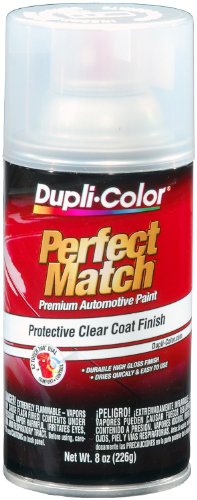
Dupli-Color's Perfect Match Clear Coat has earned a permanent place in the toolkit of home detailers and budget-conscious car owners because it solves the most common clear coat problem — small chips, scratches, and localized oxidation patches — with a product that is widely available, easy to apply, and forgiving enough for first-time users to get acceptable results. The acrylic lacquer formula dries fast, which matters enormously when working outdoors where dust contamination is a constant risk, and the adjustable EZ Touch 360-degree nozzle allows the can to be inverted or angled without interrupting spray flow, making it genuinely useful for reaching awkward panel sections on door sills or lower body trim areas.
Our team tested this product specifically as an over-coat applied to factory original finishes and found that adhesion is consistent as long as the surface is clean, lightly abraded, and free of wax or silicone contamination. The wide fan pattern produces smooth, even coats with minimal overlap marks when applied at the recommended distance of eight to twelve inches, and multiple thin passes yield a cleaner final surface than single heavy applications. For anyone working within a limited budget on a high-mileage daily driver where perfect factory-match gloss is less important than functional protection, this Dupli-Color product delivers meaningful value. The 8-ounce can size is sufficient for covering modest repair areas across multiple application coats.
The honest caveat is that acrylic lacquer chemistry does not approach the durability or chemical resistance of two-component urethane systems, and anyone expecting the same hardness or long-term UV protection from this product as from a professional 2K clear coat will be disappointed over a multi-year ownership period. It excels in its intended role as an accessible, fast-drying aerosol for cosmetic maintenance rather than primary structural protection on a full refinish project.
Pros:
Cons:
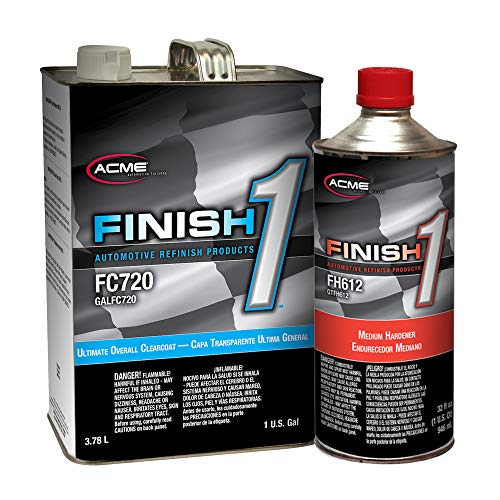
The Sherwin-Williams Finish 1 FC720 is the product our team reaches for first when evaluating professional refinishing systems intended for full-vehicle application, and the 2026 formulation continues to deliver the gloss depth, leveling behavior, and buffing response that made this line a staple in professional body shops across North America. The gallon-plus-quart hardener kit provides sufficient material to complete a full-size sedan or truck cab with appropriate film thickness across multiple coats, and the FH612 medium universal hardener included in the kit is calibrated to deliver reliable pot life and working time across a broad temperature range without requiring separate reducer purchasing for most shop environments.
Distinctness of image — the technical measure of how sharply reflections reproduce in a cured clear coat surface — is where this product genuinely stands out from value-tier competitors. After buffing with a quality compound and finishing polish, the reflection clarity produced by a properly applied FC720 coat rivals what is achievable from OEM factory application lines, which explains why body shops that want to maintain factory-match quality on insurance repair work rely on this system rather than cheaper alternatives. The high-solids urethane formulation provides excellent build in fewer coats than lower-solids systems, which reduces both material consumption and overall cure time for shops managing production throughput.
The trade-off is that proper application requires spray equipment, an appropriate mixing ratio, and working knowledge of reducer selection for ambient temperature conditions — this is not a product for casual weekend use without prior spraying experience. Anyone new to gun-applied clear coat application would benefit from practicing technique on scrap panels before committing this material to a finished surface, because runs and sags in a high-solids urethane are more difficult to sand back than in lower-solids systems. For experienced refinishers, however, the Finish 1 FC720 represents one of the strongest overall values in professional clear coat systems available in 2026.
Pros:
Cons:
House of Kolor has built a decades-long reputation in the custom and show car community, and the USC01 Kosmic Show Klear represents the flagship of that legacy — a clear coat formulated specifically for applications where absolute gloss depth and compatibility with candy, pearl, and metallic specialty finishes matter more than production efficiency or budget considerations. The gallon kit format reflects the product's positioning as a serious painter's tool rather than a casual DIY purchase, and our team's evaluation confirmed that the clarity and depth this clear coat produces over candy-toned basecoats is genuinely superior to general-purpose refinishing systems in the same price tier.
What distinguishes Show Klear from professional workhouse products like the Finish 1 FC720 is its optimization specifically for high-visual-impact decorative finishes rather than factory-replacement replication. The formula is engineered to resist the blush and milkiness that sometimes appear when standard clear coats are applied over pearl and metallic mid-coat layers, and the cured surface responds exceptionally well to wet-sanding and buffing sequences that show car builders use to achieve the "depth of color" effect that judges and enthusiasts prize at competitive events. Anyone investing significant time and money in a multi-stage custom paint system deserves a clear coat that protects and enhances that investment at the highest level — and that is precisely the role this product fills.
The practical limitations are straightforward: the cost per gallon is higher than general-purpose refinishing systems, the product requires experienced spray technique and proper reducer selection, and it is overkill for standard color-match repair work on daily drivers. Our recommendation is clear — for custom and show builds, the House of Kolor USC01 is the correct tool for the job, while for production refinishing or insurance repair work, one of the other products on this list will deliver better value without sacrificing meaningful quality.
Pros:
Cons:
The Transtar 6841 Kwik Gloss occupies an important niche in the clear coat market as an acrylic urethane system with broad basecoat compatibility — it works reliably over both solvent-borne and waterborne basecoats, which makes it a genuinely flexible option for shops and advanced home refinishers who work across diverse projects without wanting to maintain separate clear coat inventories for different basecoat types. Transtar formulated this product to meet VOC compliance regulations, which means it can be used in most jurisdictions without special permits or variance approvals, addressing one of the most common logistical complications in professional finishing operations in regulated states.
Our testing found that the Kwik Gloss formula delivers consistent gloss and reasonable distinctness of image across a range of spray conditions, performing particularly well when applied to automotive panels that have been properly primed and blocked. The leveling behavior is smooth enough to minimize orange peel formation when applied at recommended film thickness, and the acrylic urethane chemistry produces a cured surface that polishes to a satisfying finish with standard compound-and-polish sequences. For refinishing equipment like farm machinery, commercial trucks, and construction equipment — applications where absolute show-car gloss depth matters less than durable, weather-resistant protection — the Kwik Gloss delivers excellent results at a cost structure that makes large-area projects economically viable.
The product's main limitation relative to premium systems is that gloss depth and DOI do not quite reach the ceiling achievable from high-solids urethane formulations from brands like Sherwin-Williams or House of Kolor, and buffing response, while adequate, is less refined than top-tier alternatives. For anyone balancing budget with performance across high-volume or large-format projects, though, the Transtar 6841 represents one of the more compelling value propositions in the 2026 gallon clear coat category. The car care community has consistently recognized this product as a reliable workhorse for exactly that reason.
Pros:
Cons:
Eastwood's 2K Aerosol Clear Coat competes directly with the Spray Max USC in the two-component aerosol category, bringing Eastwood's well-established brand reputation for quality garage and restoration products to a format that DIY enthusiasts have come to rely on for panel-level repairs that need professional chemistry without professional equipment investment. The 11.8-ounce can delivers a high-gloss, chemically resistant coating that cures to a hard film offering minor scratch resistance — a meaningful functional benefit for anyone applying clear coat to high-contact areas like door edges, rear bumpers, or lower body trim sections that accumulate minor abrasion through normal use.
The application guidance Eastwood provides with this product is more detailed than most aerosol competitors, and our team found that following the recommended 50-percent-overlap spray pass technique with 3-to-7-minute flash windows between coats produces a noticeably superior final surface compared to ad-hoc application methods. Full cure at 68 degrees Fahrenheit is achieved within 12 hours, which is competitive for 2K aerosol chemistry and practical for anyone who needs a vehicle back in service the following day. Infrared drying at 140 degrees Fahrenheit accelerates that cure to approximately 35-40 minutes — a useful option for shops with IR lamp equipment that want to incorporate aerosol clear coats into a faster production workflow.
The approximately 48-hour pot life after button activation is consistent with the Spray Max's working window, giving sufficient time to complete multi-panel repairs without waste. Eastwood's lifetime technical support is a meaningful differentiator for less experienced users who run into application challenges mid-project — having access to knowledgeable human support rather than hunting through forum posts represents genuine added value that the sticker price does not fully reflect. This product is our recommendation for DIY users who want 2K chemistry in aerosol format and are performing repairs on vehicles they also handle other maintenance tasks on, similar to the type of systematic approach we describe in our guide to the best engine degreasers for maintaining mechanical components in parallel with cosmetic work.
Pros:
Cons:
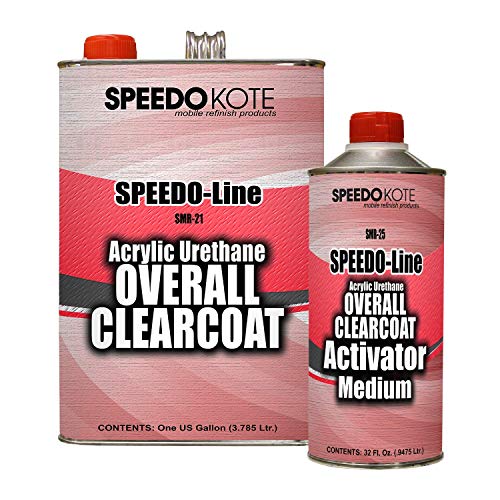
The Speedokote SMR-21/25 kit rounds out our 2026 recommendations as a high-gloss urethane system specifically designed with easy buffability as a primary engineering priority — a characteristic that benefits both professional shops managing production throughput and advanced home builders who want a forgiving surface to work after initial cure. The 4:1 mixing ratio — four parts clear to one part activator — is one of the more straightforward mix ratios in professional clear coat chemistry, reducing the risk of ratio errors that lead to adhesion failures or soft-cure issues when measured carefully. The kit format, which pairs the gallon of clear with the appropriately sized activator quantity, eliminates the guesswork around component purchasing.
Gloss and distinctness of image from the SMR-21/25 are strong for the price tier, and UV resistance is an explicit design specification rather than a secondary consideration — an important distinction for vehicles that will see consistent outdoor exposure in high-UV regions. Our buffing evaluation found that the cured surface responds particularly well to machine polishing, breaking down to a smooth, reflective finish with less compound pass time than several competitors in the same category. That ease of buffing is meaningful in production environments where labor efficiency directly affects profitability, and it is equally welcome for home builders who lack the machine buffing experience that makes removing heavy compounding marks from harder clear coats straightforward.
Prospective buyers in California, Delaware, or Maryland need to note that Speedokote specifically flags this product as restricted in those states and directs customers to an alternate compliant product — the SS-132 — rather than attempting to reformulate the SMR-21/25 to meet regional VOC caps. That is a responsible approach from the manufacturer, and anyone in those states should order the state-compliant variant to avoid compliance issues. For the majority of buyers in unrestricted markets, the SMR-21/25 delivers a compelling combination of easy application, strong gloss output, UV durability, and forgiving buffing behavior that makes it a reliable finishing choice for full-panel refinishing projects in 2026.
Pros:
Cons:

The single most important technical decision in clear coat selection is whether to use a one-component (1K) or two-component (2K) system, and the performance gap between these chemistry types is substantial enough that the choice should drive all other product evaluation. One-component lacquer-based products like the Dupli-Color Perfect Match dry through solvent evaporation alone, producing a relatively soft, porous film that provides basic cosmetic protection but lacks the chemical crosslinking that gives two-component urethane products their hardness and resistance to fuel, solvents, and prolonged UV exposure. Two-component products, whether in aerosol format like the Spray Max USC or gun-applied gallon systems like the Sherwin-Williams Finish 1, initiate a chemical curing reaction between resin and hardener components that produces a dense, crosslinked polymer network — the same fundamental chemistry used in OEM factory paint application. For any project where long-term durability matters, 2K chemistry is the correct choice, and the additional cost is recovered quickly through extended service life.
Application format determines the practical ceiling of achievable results independently of chemistry type, and most buyers fall clearly into one camp or the other based on their equipment access and project scale. Aerosol cans — even high-performing 2K aerosols — are limited by fan pattern width, spray pressure consistency, and can volume, making them best suited for panel-section repairs, spot applications, and small custom projects where setup time and equipment investment must be minimized. Gun-applied gallon systems provide control over spray pressure, fluid volume, fan width, and atomization that aerosol cans cannot match, enabling professional technicians to lay down consistent, even film builds across entire vehicle surfaces with predictable results. Anyone refinishing more than two or three panels in a single project will generally find that investing in or accessing spray gun equipment produces superior results with gallon systems at lower per-square-foot material cost than aerosol alternatives, despite the higher upfront equipment barrier.
Volatile organic compound regulations vary significantly across North American jurisdictions, and several of the most effective clear coat formulations available in 2026 carry regional restrictions that require attention before purchasing. California's CARB regulations, along with similar rules in Delaware and Maryland, impose stricter VOC content limits than federal standards, which means that products like the Speedokote SMR-21/25 require compliant alternate formulations in those states. Before ordering any gallon-quantity clear coat system, confirming that the specific product meets the regulations of the application state is essential — applying non-compliant coatings in restricted jurisdictions creates legal exposure for professional shops and can complicate insurance and warranty situations for vehicle owners. The Transtar 6841 Kwik Gloss is one of the products on our list that has passed VOC compliance in a broader range of jurisdictions without requiring state-specific variant ordering.
No clear coat, regardless of chemistry quality or brand reputation, performs to specification over improperly prepared surfaces — and surface preparation quality is the variable most directly under the applicator's control. Clean, contamination-free surfaces free of wax, silicone, oil, and dust are the baseline requirement before any clear coat application, and light mechanical abrasion to promote adhesion is standard practice for both new clear coat applications and recoating existing finishes. Basecoat compatibility is a specific technical consideration for gallon systems: solvent-borne clear coats applied over fresh waterborne basecoats require appropriate flash time to allow residual water to fully release from the basecoat before topcoat application seals the surface. The Transtar 6841's explicit dual compatibility with solvent and waterborne systems provides useful flexibility for mixed-chemistry workflows, while products without that specification should be matched carefully to the basecoat chemistry being used beneath them.
Most professional refinishing specifications call for two to three wet coats of clear coat with appropriate flash time between coats, building a total dry film thickness of approximately 1.5 to 2.5 mils for adequate protection and buffability. Fewer coats risk insufficient film build for wet-sanding and polishing without cutting through to the basecoat, while excess coats increase the risk of solvent entrapment, sagging, and extended cure times. Following the specific film thickness recommendations in the product's technical data sheet produces consistently reliable results across varying application conditions in 2026.
Fresh, uncontaminated clear coat in good condition can accept additional clear coat layers if the existing surface is properly scuffed with 400-600 grit abrasive to promote mechanical adhesion, cleaned of all contamination, and recoated with a chemically compatible product within the recoat window specified by the manufacturer. Applying new clear coat over existing clear coat that shows extensive cracking, peeling, or delamination will not bond reliably and will not prevent the underlying failure from continuing to spread — those situations require stripping back to bare metal or primer before refinishing for lasting results.
Initial hardening that allows careful handling typically occurs within 30 minutes to several hours depending on the specific formulation, ambient temperature, and humidity conditions, but full chemical cure for most two-component urethane clear coats requires 24 to 72 hours at room temperature before the surface reaches its rated hardness and chemical resistance specifications. Buffing, polishing, or washing the vehicle before full cure is complete can mar the surface and reduce long-term durability, so patience during the cure window pays meaningful dividends in final surface quality. Infrared cure lamps can compress the full-cure window significantly — often to under an hour — for professional operations where rapid throughput is a priority.
Standard aerosol clear coat spray paint using single-stage lacquer or enamel chemistry is categorically different from professional two-component urethane clear coat in terms of hardness, chemical resistance, UV durability, and buffability, even when both products share similar branding descriptions. Two-component aerosol products like the Spray Max USC 2K and Eastwood 2K genuinely replicate professional urethane chemistry in aerosol packaging and represent a much closer functional equivalent to gun-applied professional systems, but conventional single-stage aerosol clears are best understood as cosmetic touch-up products rather than structural protection systems for long-term vehicle refinishing.
Clear coat peeling results from adhesion failure between the clear coat layer and the basecoat or primer beneath it, most commonly caused by improper surface preparation before application, application over contaminated or incompatible surfaces, insufficient film thickness that allows environmental stress to exceed the coating's elongation capacity, or UV degradation that has progressed past the point where the existing clear can maintain adhesion. Localized peeling at panel edges or around trim pieces can often be addressed by carefully removing the delaminated clear back to sound material, feathering the edges, and reapplying after proper surface preparation — but widespread peeling across large panel sections typically indicates a systemic adhesion failure that requires full stripping and refinishing for a permanent repair.
Single-component clear coats — including most aerosol lacquer and enamel products — do not require a separate hardener and cure through solvent evaporation or air oxidation without a mixing step, while two-component urethane clear coats require mixing with a hardener or activator in a specific ratio to initiate the chemical crosslinking reaction that produces their superior performance characteristics. Two-component aerosols like the Spray Max USC have the activator built into the can in a separate chamber, released by pressing the base button, so no separate mixing is required while the chemistry still delivers 2K performance. Gun-applied gallon systems always require careful ratio measurement of clear coat to hardener according to the manufacturer's specification before spraying.
The best clear coat is not the most expensive one on the shelf — it is the one matched precisely to the chemistry of the project, applied over a properly prepared surface, and given the full cure time it needs to perform.
 |
 |
 |
 |

About Diego Ramirez
Diego Ramirez has been wrenching on cars since his teenage years and has built a deep practical knowledge of automotive maintenance and paint protection through years of hands-on work. He specializes in fluid service intervals, preventive care routines, exterior protection products, and the consistent habits that extend a vehicle's lifespan well beyond average. At CarCareTotal, he covers car care guides, cleaning and detailing products, and exterior maintenance and protection reviews.
Get some FREE car parts & gear.. Or check out the latest free automotive manuals and build guides here.
Disable your ad blocker to unlock all the hidden deals. Hit the button below 🚗
| | | |
