Car Care ›
by Diego Ramirez
Standing in the detailing aisle, staring at a shelf of car waxes all promising "deep gloss" and "mirror shine," the owner of a black sedan faces a uniquely frustrating dilemma. Black paint reveals every swirl mark, every water spot, and every shortcut in surface preparation, which means the wrong wax does more harm than good. The right product, however, transforms that unforgiving finish into something that looks freshly rolled off the showroom floor.
The 2026 market for black-car waxes has matured considerably, with ceramic-infused sprays sitting alongside traditional carnauba pastes and synthetic polymer liquids. Each chemistry brings distinct trade-offs in depth of color, durability, ease of application, and swirl-hiding capability. For owners who have already invested in proper car care fundamentals — clay barring, paint correction, and quality wash mitts — the wax layer is the final seal that locks in all that effort.
After evaluating formulations across carnauba, synthetic polymer, ceramic hybrid, and glaze-sealant categories, the following seven products represent the strongest options for dark and black finishes in 2026. Each was assessed on gloss depth, durability, ease of application and removal, swirl-masking ability, and value relative to coverage area. Buyers who start with a thorough wash using a quality car wash soap before waxing will see dramatically better results from any product on this list.





Meguiar's has long been the default recommendation in the consumer detailing space, and the improved Ultimate Liquid Wax formula justifies that reputation with measurable gains in water beading and gloss retention over the previous generation. The pure synthetic polymer base delivers a wet-look finish that complements black paint particularly well, amplifying depth without the slightly hazy undertone that some natural carnauba products can leave on darker colors. The 16-ounce bottle ships with both an applicator pad and a premium microfiber towel, which means first-time users can achieve presentable results without sourcing additional supplies.
Application behavior is where this product genuinely separates itself from competitors at its price point. The liquid spreads thinly and evenly without grabbing or streaking, and it remains workable even in direct sunlight — a claim that many waxes make but few actually deliver on. Removal requires minimal pressure, leaving behind a slick surface that causes water to sheet off in tight beads for roughly six to eight weeks under normal driving conditions. On black paint, the finish reads as deep and reflective rather than merely shiny, which is the critical distinction experienced detailers look for.
The synthetic chemistry does mean the product lacks the warm, organic glow that high-end carnauba waxes produce, and durability falls short of dedicated ceramic coatings. However, for buyers seeking a reliable all-season protectant that delivers consistent results on black finishes without a steep learning curve, this remains the benchmark product in the under-twenty-dollar segment.
Pros:
Cons:
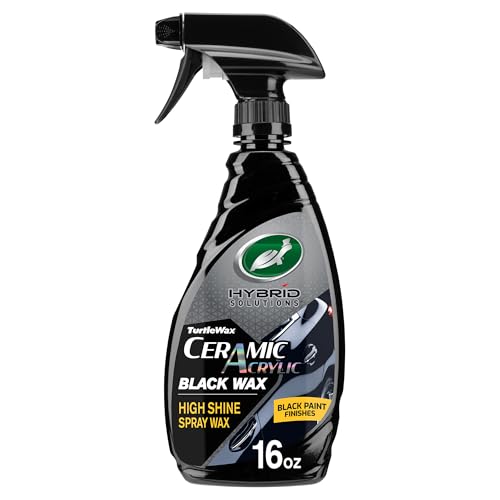
Turtle Wax's Hybrid Solutions line merges ceramic polymer technology with black-pigmented carnauba in a spray format that cuts application time to a fraction of what traditional paste or liquid waxes demand. The black pigment infusion is the defining feature here: it physically deposits color-matched material into light scratches and swirl marks, effectively masking imperfections that would otherwise catch light and appear gray on a black finish. The result is an immediately noticeable improvement in color depth and perceived "jetness" that goes beyond what a clear wax can achieve.
The ceramic polymer component provides water beading that holds up significantly longer than carnauba alone, with most users reporting effective hydrophobic behavior for ten to twelve weeks in moderate climates. Road contaminants and industrial fallout release more easily during subsequent washes, which reduces the mechanical contact needed to clean the surface and thereby lowers the risk of introducing new swirl marks. For owners of black vehicles who wash regularly but want to minimize the time spent on dedicated waxing sessions, this spray-and-wipe approach represents a compelling middle ground between a quick detailer and a full wax.
The trade-off is that spray waxes inherently deposit a thinner layer of protection than hand-applied liquids or pastes, and the black pigment can leave faint residue on white or light-colored trim pieces if not buffed carefully. Masking tape over trim or a steady hand during application eliminates this concern, but it is worth noting for buyers accustomed to more forgiving clear formulas.
Pros:
Cons:
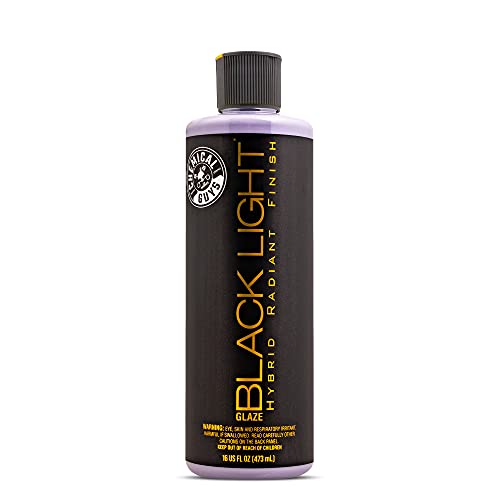
Chemical Guys positions the Black Light Hybrid Radiant Finish as a combination glaze and sealant, which places it in a slightly different category than pure waxes. The advanced micro-polish formula smooths minor surface imperfections at the microscopic level, filling light swirls and hazing with optical-grade polymers that create a genuinely mirror-like wet finish. On black and dark-colored paint, this translates to a depth of reflection that approaches what multi-step paint correction achieves, without the time investment or risk of removing clear coat.
The hybrid chemistry delivers both immediate visual gratification and ongoing protection against environmental contaminants, UV exposure, and acid rain. As a glaze, it enhances paint clarity by leveling the surface optically; as a sealant, it bonds to the clear coat and provides a durable barrier that typically lasts eight to ten weeks. Many experienced detailers use Black Light as a pre-wax layer, applying it after clay bar treatment and before a dedicated carnauba or synthetic wax, which creates a multi-layer system with exceptional depth and longevity.
The main limitation is that the glaze component, while excellent at masking imperfections, does not correct them permanently. Once the product wears off, any underlying swirls or scratches return to visibility. Additionally, the 16-ounce bottle yields fewer applications than comparably sized pure waxes because the glaze portion of the formula requires slightly more product per panel to achieve full coverage and optical filling.
Pros:
Cons:
P21S occupies a respected position in the enthusiast detailing community, and the 12700W Carnauba Wax demonstrates exactly why. This German-engineered paste wax delivers what the manufacturer describes as a "mirror image" shine with remarkable "jetness" — and on black paint, those claims hold up under scrutiny. The high-concentration carnauba formula produces a warm, organic glow with a three-dimensional depth that synthetic polymers struggle to replicate, creating the illusion that the viewer is looking into the paint rather than at it.
Application and removal rank among the easiest in the paste wax category, which is notable given that many premium carnauba products are notoriously difficult to work with. The wax spreads in a thin, even film by hand or dual-action polisher and wipes off cleanly without the chalky residue or excessive buffing effort that plagues lesser formulations. This ease of use makes P21S accessible to casual detailers who want the carnauba experience without the labor-intensive process typically associated with show-car-grade products.
Durability is the expected compromise with a carnauba-dominant formula. Most users report three to five weeks of meaningful protection before water beading degrades noticeably, which means monthly reapplication is the practical reality for daily drivers. The price per ounce also sits well above mass-market alternatives, positioning P21S firmly as a premium choice for enthusiasts who prioritize visual depth over longevity and cost efficiency. According to the carnauba wax entry on Wikipedia, this Brazilian palm derivative remains the hardest known natural wax, which explains its superior gloss properties when properly formulated.
Pros:
Cons:
Pinnacle's Souveran Wax has earned a devoted following among concours-level detailers, and its prime ingredient — Brazilian Ivory Carnauba — represents the highest grade of natural carnauba available on the commercial market. The hand-poured construction ensures a consistent blend throughout the tin, and the resulting paste has a distinctively buttery texture that spreads across paint with almost no resistance. On black surfaces, Souveran produces a rich, three-dimensional shine with stunning gloss characteristics that photograph exceptionally well under both natural and artificial lighting.
The application experience itself is a significant part of Souveran's appeal. The wax wipes off with virtually any clean microfiber towel — even lower-grade towels that would streak or smear with other products produce clean results here. This forgiving removal behavior means less time spent buffing and less risk of accidentally marring the surface during the final wipe-down, which is particularly important on swirl-prone black paint. The 8-ounce tin provides enough product for roughly eight to twelve applications on a mid-size sedan, depending on how thin the user applies each layer.
The 8-ounce size does place Souveran at a higher cost per application than most competitors, and its carnauba-dominant chemistry means durability tops out around four to six weeks in typical conditions. Buyers should also note that this product excels at enhancing already-corrected paint but lacks the filling or masking agents found in hybrid glaze products, which means existing swirl marks will remain visible through the wax layer on uncorrected surfaces.
Pros:
Cons:
BLACKFIRE's BlackICE Hybrid Liquid Wax takes a distinctive approach by blending Montan wax — a fossil wax derived from lignite coal — with proprietary Wet Diamond polymers to create a finish specifically engineered for dark paint colors. The 32-ounce bottle provides substantially more product than most competitors at this tier, which offsets the higher purchase price and makes it a practical choice for owners of larger vehicles or those who prefer to wax frequently. The resulting finish on black paint is what detailers describe as "mile-deep," with a wet-look reflective quality that accentuates body lines and curves.
Heat resistance is where BlackICE distinguishes itself most meaningfully from the competition. The Montan wax and polymer blend is engineered to withstand high temperatures without flaking, streaking, or degrading — a critical advantage for black vehicles that absorb significantly more solar radiation than lighter colors and routinely reach surface temperatures exceeding 170 degrees Fahrenheit in summer conditions. This thermal stability translates to longer effective protection periods in hot climates, where traditional carnauba waxes often soften and lose their hydrophobic properties within weeks.
The liquid formula applies cleanly by hand or machine and wipes off without staining plastic trim, rubber seals, or textured surfaces — a welcome departure from many dark-vehicle-specific products that leave white residue in crevices. Protection against UV rays, acid rain, bird droppings, and mineral deposits is robust, and the combination of Montan and synthetic polymers typically delivers ten to fourteen weeks of functional water beading. Buyers who park outdoors in warm climates and struggle with wax durability will find BlackICE particularly well-suited to their conditions.
Pros:
Cons:
The paste counterpart to Turtle Wax's ceramic spray entry on this list, the Hybrid Solutions Ceramic Black Polish and Wax combines an effective polishing compound with black-pigmented carnauba and ceramic polymer protection in a single-step product. The polishing compound is more aggressive than what the spray version offers, making this the stronger choice for black vehicles with moderate swirl marks, light scratches, or oxidation that needs more than optical filling to address. The abrasive action physically levels imperfections while the black pigment fills whatever remains, producing a noticeably improved finish after a single pass.
The ceramic polymer layer deposited during application provides durable hydrophobic protection that outperforms traditional polish-and-wax combinations, with water beading typically persisting for eight to ten weeks. The product is formulated specifically for black, dark blue, and charcoal finishes, and the color-matched pigment ensures that repaired areas blend seamlessly into the surrounding paint rather than appearing as lighter spots under direct light. For owners whose black vehicles show accumulated wash marring or light surface damage, this product addresses both the cosmetic concern and the ongoing protection need in a single application step.
The polishing compound does add a step of effort that pure waxes avoid — the product requires moderate pressure during application to activate the abrasives, and buffing to a clean finish takes more time than non-abrasive alternatives. Buyers with freshly corrected or new paint that does not need polishing would be better served by a pure wax or sealant, as the abrasive component provides no benefit on already-perfect surfaces and introduces unnecessary mechanical contact. Pairing this product with a quality plastic restorer for surrounding trim pieces completes the exterior refresh.
Pros:
Cons:
The foundational decision when selecting a wax for black paint is the base chemistry, as each type produces a visually and functionally distinct result. Natural carnauba waxes — represented on this list by P21S and Pinnacle Souveran — deliver the warmest, most organic-looking gloss with three-dimensional depth that enthusiasts describe as looking "into" the paint. Synthetic polymer waxes like Meguiar's Ultimate Liquid prioritize durability and ease of application, producing a clean, sharp reflection that lasts roughly twice as long as carnauba alone. Ceramic hybrids from Turtle Wax and BLACKFIRE split the difference, layering SiO2 or ceramic polymer bonds over traditional wax bases for extended water beading and contaminant resistance without fully sacrificing the visual warmth of wax.
For black paint specifically, the choice often comes down to whether the owner values depth of reflection or longevity of protection more highly. Carnauba produces the most visually striking result on dark colors but demands reapplication every three to five weeks, while synthetic and ceramic options stretch that interval to eight to fourteen weeks at the cost of a slightly less dimensional finish. Many detailers ultimately adopt a layered approach — glaze underneath, wax on top — to capture both benefits simultaneously.
Black paint is uniquely punishing when it comes to revealing surface imperfections, which makes swirl-masking ability a critical evaluation criterion that rarely matters as much on lighter colors. Products fall into three categories here: pure waxes that add protection without addressing imperfections, glazes and fillers that optically mask swirls by depositing transparent polymers into surface valleys, and polish-wax combinations that physically abrade the clear coat to level imperfections before sealing. Chemical Guys Black Light exemplifies the glaze approach, while Turtle Wax's ceramic paste polish represents the abrasive correction approach.
Buyers should honestly assess their paint's current condition before selecting a product category. Freshly corrected or new paint benefits most from a pure wax or sealant that preserves the existing finish, while neglected daily drivers with accumulated wash marring gain more from a glaze or polish-wax that addresses the visible damage. Applying a pure wax over heavily swirled black paint simply seals in the imperfections and can actually make them more visible under certain lighting conditions by increasing overall surface reflectivity.
The practical experience of applying and removing a wax matters more than many buyers initially realize, particularly because black paint shows application errors — streaks, high spots, uneven coverage — far more readily than lighter colors. Spray waxes like Turtle Wax's ceramic spray offer the lowest barrier to entry and the fastest completion time, typically covering an entire vehicle in fifteen to twenty minutes. Liquid waxes occupy the middle ground, providing more control over product placement and thickness while still spreading and removing relatively easily. Paste waxes demand the most technique but also reward skill with the thickest, most controlled layer of protection.
Temperature sensitivity during application varies significantly between products and directly affects the working experience. Synthetic formulas generally tolerate a wider temperature range and remain workable in direct sunlight, while pure carnauba pastes can become difficult to remove if they cure too quickly in heat. Buyers who primarily wax outdoors in warm conditions should weight this factor heavily, as fighting a product that has baked onto the surface is both exhausting and risks introducing swirl marks during aggressive buffing.
Durability claims from manufacturers should be interpreted cautiously, as real-world longevity depends heavily on environmental exposure, washing frequency, wash method, and parking conditions. A garage-kept weekend car will hold a wax layer dramatically longer than a daily-driven vehicle parked outdoors under trees. The most practical indicator of remaining wax protection is water behavior: when water stops beading into tight droplets and begins sheeting or sitting flat on the surface, the wax layer has effectively expired and reapplication is needed.
Maintaining wax protection between full applications is best accomplished with a wax-safe car wash soap — harsh detergents and dish soaps strip wax rapidly — and an occasional spray-wax boost after each wash. This maintenance approach can extend the effective life of any base wax layer by two to four weeks and keeps the surface hydrophobic enough to repel most road contaminants. Buyers who find themselves reapplying wax more often than they prefer should consider stepping up to a ceramic hybrid formula or exploring a dedicated ceramic coating, which offers months to years of protection at a higher upfront cost.
Black-specific car waxes typically differ in two ways: some contain dark pigments that fill and mask light scratches and swirl marks that are highly visible on black paint, and many are formulated to maximize depth of reflection rather than simple surface gloss. A quality clear wax still works on black paint, but purpose-formulated products like Turtle Wax's black ceramic line or Chemical Guys Black Light deliver more visually dramatic results on dark finishes because their chemistry is optimized for depth enhancement and imperfection concealment.
Black cars do not inherently degrade wax faster than lighter colors, but they reveal the loss of wax protection sooner because water spots, diminished gloss, and surface contamination become visible much earlier on dark paint. Most detailers recommend waxing black vehicles every four to eight weeks with carnauba products or every eight to twelve weeks with synthetic or ceramic hybrid formulas, roughly the same intervals as lighter vehicles but with less margin for delay before the finish begins to look neglected.
Wax can be applied over a cured ceramic coating, and many owners of ceramic-coated black vehicles do exactly this to add an extra layer of visual depth and sacrificial protection. The wax sits on top of the ceramic layer and wears away first, shielding the coating from minor contamination and adding the warm glow that pure ceramic coatings sometimes lack. However, the wax does not bond to the ceramic surface as durably as it bonds to bare clear coat, so reapplication intervals will be shorter — typically two to four weeks rather than the six to twelve weeks expected on uncoated paint.
Clay barring before waxing is strongly recommended for black vehicles because it removes embedded contaminants — industrial fallout, rail dust, tree sap residue, and brake dust — that create a rough texture beneath the wax layer. On black paint, this roughness scatters light and reduces the depth and clarity of the wax finish substantially. Running a hand over the paint after washing will reveal whether clay barring is needed: if the surface feels gritty or rough rather than glass-smooth, contaminants are present and should be removed before any wax or sealant is applied.
Car wax, whether natural carnauba or synthetic, sits on top of the clear coat as a sacrificial protective layer that enhances gloss and repels water. Paint sealants use synthetic polymer chemistry to bond more aggressively to the clear coat surface, creating a longer-lasting but typically thinner protective barrier. On black paint, waxes generally produce a warmer, deeper-looking finish with more visual dimension, while sealants deliver a sharper, more reflective shine with superior durability. Products like Chemical Guys Black Light and BLACKFIRE BlackICE blur this distinction by combining both technologies in a single formula.
Multiple coats can improve depth of shine on black paint, but the returns diminish rapidly after the second layer. The first coat bonds to the clear coat and provides the majority of the protection and gloss enhancement, while a second coat fills any thin spots and can add a marginal increase in depth and water beading performance. Third and subsequent coats typically do not bond effectively to the existing wax surface and may actually create a hazy or cloudy appearance as the excess product sits unbonded on the surface. Two thin coats applied twenty to thirty minutes apart generally represent the optimal approach for maximizing visual depth on black finishes.
The best wax for a black car is the one that matches the owner's patience — carnauba for those who enjoy the ritual, ceramic hybrid for those who want results that last, and a good wash routine underneath either one.
 |
 |
 |
 |

About Diego Ramirez
Diego Ramirez has been wrenching on cars since his teenage years and has built a deep practical knowledge of automotive maintenance and paint protection through years of hands-on work. He specializes in fluid service intervals, preventive care routines, exterior protection products, and the consistent habits that extend a vehicle's lifespan well beyond average. At CarCareTotal, he covers car care guides, cleaning and detailing products, and exterior maintenance and protection reviews.
Get some FREE car parts & gear.. Or check out the latest free automotive manuals and build guides here.
Disable your ad blocker to unlock all the hidden deals. Hit the button below 🚗
| | | |
