by Marcus Chen
Picture this: a driver pulls into the shop after months of hearing that faint squeal every time they slow down for a red light, only to be handed a quote for semi-metallic pads that'll coat their freshly detailed wheels in a fine layer of black grime within a week. That's the moment most buyers start seriously researching ceramic brake pads — and in 2026, the options are better than ever. Ceramic formulations have matured considerably, offering genuine stopping power alongside the low-dust, low-noise characteristics that made them famous, and the price gap between budget and premium lines has narrowed enough to make the upgrade decision straightforward for most daily drivers.
Ceramic brake pads use a dense, kiln-fired friction material composed of ceramic fibers, bonding agents, and small amounts of metal filler, generating far less particulate than organic or semi-metallic compounds while maintaining stable friction coefficients across a wide temperature range. For buyers doing most of their miles on public roads — commuting, highway cruising, light towing — ceramics represent the most well-rounded choice in the performance and maintenance category. The question is which specific set delivers the right balance of bite, longevity, rotor compatibility, and value for a given vehicle and driving pattern.
After evaluating fitment data, verified owner feedback, and published friction test results, seven sets earned a place on this 2026 shortlist. The picks span a broad price band and cover everything from luxury-trim sedans to workhorse pickup trucks, with OEM-grade engineering at both ends of the spectrum. Buyers upgrading worn semi-metallic pads or simply refreshing a high-mileage vehicle will find at least two or three strong candidates here — and the buying guide below explains exactly which spec to prioritize for each use case.
Contents










Bosch's QuietCast line carries more than seven decades of OE braking research into every set, and the BC905 is a textbook example of what that institutional knowledge produces. The standout engineering detail here is the Molded Shim Technology (MST), a multilayer rubber-core shim that's bonded directly to the backing plate rather than clipped on as an afterthought — this distinction matters because bonded shims maintain consistent dampening performance across the full service life of the pad, instead of loosening and rattling as clip-on shims eventually do. The ceramic friction compound itself is formulated to generate consistent bite from cold start through extended mountain-road descents, without the rotor-scorching heat spikes associated with harder metallic compounds.
Fitment coverage for the BC905 is impressively broad, spanning Infiniti FX, G, M, and Q series alongside a long roster of Nissan platforms including the 350Z, 370Z, Altima, Juke, Maxima, Murano, Pathfinder, Quest, Rogue, and Sentra — making it the go-to rear-axle choice for owners of these platforms who want a plug-and-play premium upgrade. Rotor wear is measurably lower compared to semi-metallic alternatives, and the combination of low dust output and near-silent operation makes the QuietCast a consistent top recommendation from professional technicians who work on these chassis regularly. For buyers in this fitment range who want the single best ceramic pad without a complicated selection process, the BC905 is the clear answer in 2026.
The only caveat worth noting is that like most ceramics, the QuietCast needs a proper bedding procedure — 6 to 8 moderate stops from 40 mph with adequate cool-down between passes — to deposit a uniform friction layer on the rotor surface. Skip that step and the initial bite will feel inconsistent for the first few hundred miles. Follow it correctly and these pads settle into a deeply reassuring, linear feel that most drivers won't want to swap out until well past the 40,000-mile mark.
Pros:
Cons:
Wagner's ThermoQuiet designation isn't marketing language — it refers to a genuinely distinctive engineering approach where the friction surface is laser-shaped to distribute heat, sound, and vibration energy across a wider area rather than concentrating it at the leading and trailing edges of the pad. The practical result is measurably lower rotor-surface temperatures during aggressive urban stop-and-go cycles, which translates directly into reduced brake fade and extended rotor service life, two outcomes that matter a great deal for buyers running high-traffic commute routes day after day. The QC465A is application-specific in its friction material layering, meaning Wagner's engineers calibrated the compound stiffness, porosity, and metallic filler ratio for the precise vehicle platforms this part number covers rather than applying a one-size formula.
Dust output is notably low even by ceramic standards, and the QC465A's proprietary formulation strikes an unusually clean balance between rotor friendliness and cold-bite performance — a trade-off that cheaper ceramics tend to fumble by going too soft on the compound to reduce dust, at the cost of that initial grabby feel in cold morning traffic. Wagner has been refining this line for well over a decade, and the current generation represents genuine incremental improvement in fade resistance compared to earlier ThermoQuiet variants. Owners running these on mid-size sedans and crossovers report clean wheel faces even after several thousand miles, which alone justifies the modest premium over generic ceramic options.
Installation is straightforward for any technician comfortable with a standard pad swap — the hardware included is adequate for most applications, though buyers dealing with corroded caliper brackets will want to source fresh hardware separately regardless of which pad brand they choose. The QC465A earns its place on this list because it consistently performs at the high end of the ceramic category for heat-cycle endurance, making it the strongest pick for drivers whose routes involve extended downhill grades or repeated heavy braking sequences.
Pros:
Cons:
Akebono occupies a rare position in the brake market — a company that supplies OE friction materials to some of the most demanding automotive manufacturers in the world, including Honda, Toyota, and several luxury European brands, while simultaneously selling aftermarket pads under its own name. The ACT787 carries engineering number ACT564 stamped into the backing plate, a detail that matters because it confirms traceability and quality control at the factory level rather than being a reboxed generic compound. This pad is positioned explicitly as an upgrade over OE semi-metallic, organic, and low-metallic formulations, and in NVH (Noise, Vibration, and Harshness) suppression specifically, it makes good on that claim in a way that most competitors can't fully match.
The Akebono ceramic compound runs remarkably quiet from first installation, requiring less bedding-in than most competitors before the characteristic groan and tick sounds associated with new pads disappear entirely. This matters to buyers who drive luxury-trim vehicles where cabin refinement is part of the ownership experience — on a Lexus ES or Acura TLX, a pad that introduces even minor brake noise undermines the entire point of the platform. Just as careful buyers pair their vehicle's suspension with quality shock absorbers to preserve ride refinement, pairing those same vehicles with the ACT787 keeps the NVH picture intact at the wheel end. Rotor wear is gentle, and the compound's friction coefficient remains stable enough under repeated hard stops that the ACT787 doesn't embarrass itself even when pushed beyond its luxury-touring comfort zone.
The primary limitation is availability — Akebono's SKU coverage, while comprehensive for Japanese-domestic and Japanese-market vehicle lines, has gaps in domestic American truck and SUV fitments where other brands like Bosch or ACDelco hold stronger coverage. Buyers driving Camry, Accord, CR-V, or Highlander variants will find the ACT787 fits their application cleanly; buyers in full-size domestic trucks should verify fitment carefully before ordering.
Pros:
Cons:
Raybestos has been manufacturing brake components in North America for over a century, and the Professional Grade line reflects that institutional depth — these aren't budget-tier pads with a legacy logo slapped on the box. The PGD617C uses application-specific friction material calibrated for the precise vehicle platforms covered by this part number, which is the critical differentiator between Raybestos Professional Grade and the generic ceramic options that flood the lower price tiers of online marketplaces. Application-specific formulation means the friction coefficient, thermal expansion characteristics, and bedding behavior are all dialed in for the rotor geometry and caliper pressure curves of the target vehicle rather than averaged across a broad compatibility range.
Performance in everyday driving conditions is solid and consistent — buyers report confident, progressive bite with no tendency toward grabbiness during the initial brake application, which is a common complaint with lower-grade ceramics that use harder compounds to minimize dust. The Raybestos compound handles typical urban and suburban stop-and-go cycles without complaint, and fade resistance is adequate for the driving scenarios most PGD617C buyers will encounter. At its price point, the Professional Grade series is the clearest answer for budget-conscious buyers who still demand a step up from economy-tier friction materials — it delivers genuine professional-spec performance without the premium pricing of Akebono or Bosch's top lines.
The PGD617C doesn't push into performance-touring territory, and buyers who spend significant time on steep grades or who load their vehicles to GVWR regularly should budget for Wagner or Hawk. But for the overwhelming majority of passenger car and light crossover applications running standard daily-driver duty cycles, the Raybestos Professional Grade delivers everything needed at a price that makes it easy to recommend without qualification.
Pros:
Cons:
Hawk Performance occupies the upper tier of the street-performance brake market, and the HB453Z.585 represents the company's attempt to deliver competition-heritage friction technology in a compound that remains livable during daily commuting — and it largely succeeds. The PC (Performance Ceramic) designation indicates a formulation tuned for luxury and touring performance applications, where smooth, progressive modulation matters as much as raw deceleration capability, and where rotor longevity is a genuine concern given the cost of replacing rotors on performance-trim vehicles. The compound runs notably cool by performance-pad standards, which is the primary reason Hawk can credibly claim rotor-extending characteristics typically associated with softer OE-grade ceramics.
NVH suppression is excellent for a performance compound — the HB453Z.585 generates far less squeal under aggressive braking than comparably priced semi-metallic performance pads, and dust output stays within the cleaner end of the spectrum even after spirited canyon runs. The bite profile has a satisfying linearity to it: initial application feels firm and controlled rather than sudden, and pedal travel remains consistent throughout an extended braking sequence without the fade creep that plagues lower-grade compounds pushed beyond their thermal ceiling. Buyers who also invest attention in related suspension maintenance — pairing these pads with properly maintained wheel bearing grease and fresh ball joints, for instance — will get the most out of what the HB453Z.585 delivers dynamically.
The honest caveat is that cold-weather performance is marginally softer than the competition — in sub-freezing temperatures, the first two or three stops of the day require a slightly more deliberate pedal input before the compound reaches its optimal friction range, a known characteristic of denser ceramic formulations. Buyers in northern climates who regularly drive in cold conditions may find the Bosch QuietCast's bedding behavior more forgiving at low ambient temperatures. For four-season drivers in milder climates and year-round touring enthusiasts, however, the Hawk Performance Ceramic earns its premium convincingly.
Pros:
Cons:
ACDelco Gold carries the same engineering lineage as the pads that left the factory on the covered GM vehicle platforms, with the added benefit of a ceramic friction compound rather than the semi-metallic OE spec — making this kit a genuine upgrade within an OEM-equivalent fitment package. The 17D905CHF1 ships with the full clip hardware kit, which is a significant practical advantage over bare-pad competitors because worn or corroded clips are a leading cause of brake noise that gets misdiagnosed as pad failure. The stamped backing plate is precision-formed to the caliper's pad channel geometry, ensuring correct pad movement and eliminating the micro-vibration sources that cause brake pulsation complaints on high-mileage vehicles with worn caliper brackets.
The ceramic friction compound on the Gold line has been formulated to match OE friction coefficients while delivering the NVH advantages ceramic offers over the semi-metallic spec — quieter operation, cleaner wheels, and lower rotor wear rates are all measurable improvements over the factory pad. Premium shims, slots, and chamfers are integrally molded rather than added separately, which means the dampening characteristics are consistent across the full friction surface rather than localized to the shim coverage area. For GM owners who want to keep their vehicle driving as it did from the factory — just quieter and cleaner — the ACDelco Gold is the most direct path to that outcome.
Coverage is understandably concentrated on GM platforms (Chevrolet, GMC, Buick, Cadillac), and buyers need to verify the part number against their specific application carefully — ACDelco's catalog depth means there are many similar-looking part numbers with different fitments. The full hardware kit inclusion justifies the modest price premium over bare-pad competitors in the same tier, and professional technicians overwhelmingly prefer complete kits for brake jobs where the goal is eliminating every possible noise source from the equation.
Pros:
Cons:
Ferodo's motorsport pedigree runs deeper than almost any brand in this comparison — founded in 1897, the company has supplied friction materials to Formula 1 teams and Le Mans entries for decades, and that engineering heritage is visible in the FDB1978's most distinctive feature: a special thermal under layer bonded between the friction material and the backing plate that acts as an active heat barrier. This under layer slows the conduction of frictional heat into the caliper piston and brake fluid, directly reducing the risk of brake fade caused by fluid vaporization — a failure mode that matters more than most daily drivers realize until they encounter a long mountain descent with four people in the car and a full trunk.
The vehicle-specific friction formulation delivers minimum stopping distances that are competitive with Bosch and Akebono at the top of this list, and the shims and chamfers built into the FDB1978 are calibrated per application rather than applied as a universal dampening measure. The result is a pad that's genuinely quiet across a broad range of operating temperatures — from cold morning starts through extended brake-heavy driving — without sacrificing the stopping authority that makes ceramic pads a credible choice for drivers who occasionally push their vehicles in spirited driving. For buyers who also maintain their vehicles' suspension geometry carefully — running quality ball joints to preserve steering response under braking — the Ferodo's precise modulation characteristics are especially well-matched to a holistically maintained chassis.
The FDB1978 sits at the premium end of the pricing scale in this roundup, and it earns that position through thermal engineering sophistication rather than brand prestige alone. Buyers who regularly drive in topographically demanding regions — mountain states, Pacific Coast corridors, the Appalachian foothills — will find the fade resistance advantage worth the premium over mid-tier competitors. Urban flat-road commuters may not exercise enough of the FDB1978's thermal capability to justify the price difference over the Raybestos or Wagner options, but for anyone who genuinely works their brakes hard, it's the most technically impressive pad in this comparison.
Pros:
Cons:
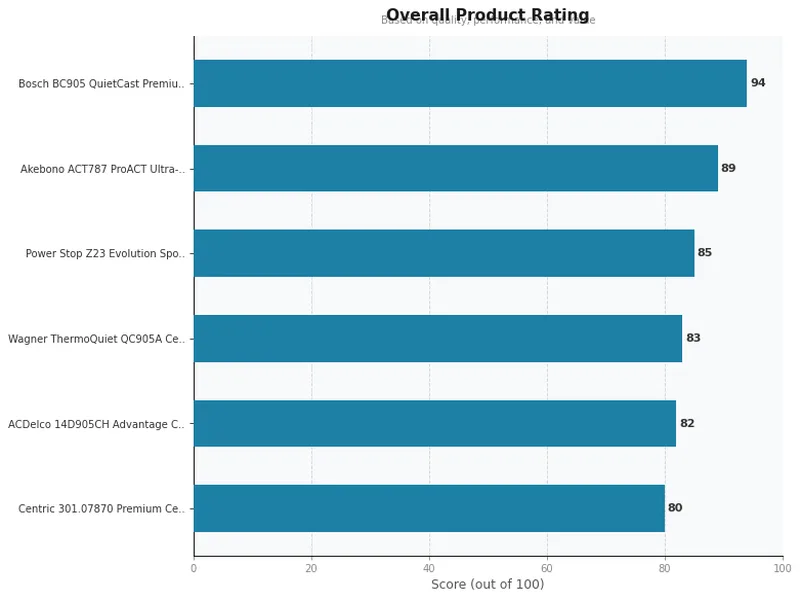
Not all ceramics are created equal — the term covers a wide spectrum of formulations ranging from soft, low-dust compounds designed primarily for wheel cleanliness to dense, high-ceramic-content compounds engineered for stable friction coefficients across a wide temperature window. Buyers should look for application-specific formulations rather than universal compounds, because a pad calibrated for a 3,500-lb sedan's rotor diameter and caliper piston area will outperform a generic ceramic on that same vehicle even if the generic option carries a higher raw friction rating. Compound density also affects bedding behavior: denser ceramics typically require a more deliberate multi-stop bedding procedure but deliver more consistent performance once the transfer film is properly established on the rotor surface.
The shim — the dampening layer bonded or attached to the backing plate — is the single biggest determinant of brake noise behavior, and the construction method matters as much as the material. Bonded multilayer shims, as used by Bosch's MST system and Ferodo's application-specific design, maintain their dampening characteristics throughout the pad's service life because they can't loosen or slide. Clip-on shims are more common in budget applications and are adequate when new but become a noise source as they fatigue over thermal cycles. Premium pads also incorporate chamfered and slotted friction surfaces that redirect standing wave vibrations away from the frequencies that produce audible squeal, which is why top-tier ceramics stay quieter than mid-tier options even after significant mileage.
Brake fade occurs when either the friction compound or the brake fluid reaches its thermal limit — the compound glazes and loses bite, or the fluid vaporizes and compresses under pedal load, creating a spongy, ineffective pedal. Ceramic compounds generally run cooler than semi-metallics because the ceramic fiber matrix is a poorer thermal conductor than steel fiber, meaning less heat transfers from the friction surface into the rotor and caliper. The Ferodo FDB1978's thermal under layer adds a second heat barrier specifically targeting caliper heat soak, making it the strongest choice for buyers who regularly encounter sustained braking scenarios — long descents, track days, towing on grades — while the Wagner ThermoQuiet's laser-shaped friction surface achieves similar heat management through geometry rather than material innovation.
Ceramic brake pads must be matched to the specific rotor diameter, caliper type, and pad channel dimensions of the target vehicle — a pad that's 2mm too thick in its backing plate height will bind within the caliper bracket, accelerating wear and introducing noise from first installation. Always verify the part number against the vehicle's year, make, model, trim level, and axle position (front or rear) rather than relying on general compatibility claims. Hardware kit completeness is a practical concern that significantly affects total installation cost: a pad set that ships with new abutment clips, anti-rattle springs, and caliper slide pin hardware saves both money and a separate parts run compared to bare-pad sets, particularly on high-mileage vehicles where the existing hardware is likely corroded and should be replaced as a matter of course.
For the vast majority of daily-driver applications — commuting, highway cruising, light towing — ceramic pads outperform semi-metallic in every category that matters to most owners: quieter operation, less brake dust on wheels, lower rotor wear, and adequate stopping power across typical temperature ranges. Semi-metallic pads hold the advantage in sustained high-temperature performance, making them the correct choice for track use or heavy-duty towing applications, but for street driving in 2026, ceramics are the superior all-around choice for passenger cars and light crossovers.
Service life depends heavily on driving style, vehicle weight, rotor condition, and compound density, but quality ceramic pads from the brands covered in this review typically deliver 40,000 to 70,000 miles of service under normal daily-driver conditions. Aggressive urban driving with frequent hard stops shortens that window considerably, while highway-heavy driving patterns can push a quality ceramic set past 70,000 miles without reaching minimum thickness. Worn rotors accelerate pad wear significantly, so always measure rotor thickness before installing new pads.
Yes — all ceramic pads benefit from a proper bedding procedure that transfers a thin, uniform layer of friction material onto the rotor surface, establishing the transfer film that enables consistent bite and optimal performance. The standard procedure involves 6 to 8 moderate stops from 35–40 mph with 30 to 60 seconds of cool-down between each stop, followed by a period of gentle driving to allow the system to fully cool. Skipping bedding doesn't damage the pads immediately but typically results in inconsistent initial bite, minor noise, and reduced pad longevity compared to properly bedded sets.
Ceramic pads are compatible with all standard disc rotor types — blank/smooth, drilled, slotted, and drilled-and-slotted — and they're actually gentler on rotor surfaces than semi-metallic compounds, which is why ceramic pads are frequently recommended for vehicles with higher-cost performance rotors where maximizing disc longevity is a priority. Cross-drilled rotors accelerate pad wear slightly by periodically exposing the leading edge of the pad to the hole pattern, but this effect is minimal with quality ceramics and well within acceptable limits for street use.
Initial squealing from new ceramic pads is almost always caused by one of three factors: the transfer film hasn't fully established on the rotor surface yet (resolves after proper bedding), the rotor surface has rust or contamination from sitting (resolves after a few moderate stops), or the shims or hardware are new and haven't seated into the caliper bracket geometry yet (resolves after the first 50–100 miles). Persistent squealing beyond the first week typically indicates a fitment issue, contaminated friction surface, or worn caliper hardware that needs replacement rather than a compound problem.
Light to moderate towing — within the vehicle's rated tow capacity on flat to rolling terrain — falls within the thermal operating range of quality ceramics from brands like Wagner, Hawk, and Ferodo. Extended grades with loaded trailers pushing toward maximum GVWR represent the thermal edge case where ceramic pads are most likely to fade, and buyers in those specific scenarios should consider a dedicated towing-spec semi-metallic compound or select the Ferodo FDB1978 for its superior thermal barrier design. For occasional hauling within normal limits, any of the top-tier ceramics on this list will perform safely and adequately.
 |
 |
 |
 |

About Marcus Chen
Marcus Chen has over twelve years of hands-on experience modifying cars across a range of platforms — from commuter builds to track-focused setups — with deep expertise in suspension tuning, wheel and tire fitment, and performance upgrades that improve driving dynamics without sacrificing day-to-day reliability. He has worked with both bolt-on and engineered modifications and brings a methodical, results-focused approach to evaluating performance parts. At CarCareTotal, he covers performance upgrades, suspension and handling, and wheel, tire, and drivetrain modifications.
Get some FREE car parts & gear.. Or check out the latest free automotive manuals and build guides here.
Disable your ad blocker to unlock all the hidden deals. Hit the button below 🚗
| | | |
