Car Care ›
by Diego Ramirez
According to the NACE International corrosion cost study, rust and corrosion cost the U.S. economy more than $270 billion annually, and a significant portion of that damage hits everyday vehicles, tools, and household metal objects that you rely on every day. Whether you are dealing with a rusted brake caliper, a corroded garden tool, or oxidized cast iron cookware, the right rust remover can save you hundreds of dollars in replacement costs without any sanding or heavy scrubbing. The 2026 market offers a wide range of formulas — soaks, sprays, gels, and jellies — each designed for a specific scale of corrosion and a specific type of metal surface.
Choosing the wrong product, however, can damage your metal, strip paint, or simply fail to penetrate deep rust. Understanding the chemistry behind these products — whether they rely on chelation agents, phosphoric acid, or oxalic acid — helps you match the formula to your exact problem. Some products are reusable and biodegradable, while others are single-use sprays designed for quick touch-ups before painting. Your budget, the severity of the rust, and whether you need the product for automotive work or household repairs all factor into the decision.
This guide covers seven of the most-reviewed and best-performing rust removers available in 2026, with detailed breakdowns of each product's strengths, limitations, and ideal use cases. You will also find a car care buying guide section covering the key criteria to evaluate before purchasing, along with a FAQ section that addresses the most common questions buyers ask. If you also maintain your vehicle's engine components, pairing a rust remover with one of the best engine degreasers of 2026 can make pre-treatment and cleanup significantly more effective.

Contents







Evapo-Rust ER012 is a water-based, chelation-formula rust remover that has earned a strong reputation among automotive restorers and hobbyists who deal with heavily rusted parts on a regular basis. The 128-ounce jug provides enough volume to fully submerge large components like brake calipers, fuel tanks, and hand tools, and the solution works without any scrubbing, sanding, or mechanical abrasion. Because it contains no acids, solvents, or caustic bases, you can handle it without heavy protective gear, and it produces no harmful fumes even when used indoors.
The chelation mechanism selectively targets iron oxide — meaning it removes rust without attacking surrounding bare metal, painted surfaces, or plastic components that may be in contact with the solution. For automotive and industrial applications where preserving the underlying metal integrity is critical, this selectivity makes Evapo-Rust a notably safer choice than acid-based alternatives. The solution can be reused until it turns very dark, and the manufacturer confirms it is biodegradable and safe for disposal down standard drains after exhaustion.
Independent user testing consistently reports that light rust dissolves within 30 minutes, while heavily corroded parts may require an overnight soak of 8 to 12 hours for complete removal. The product is particularly effective on cast iron cookware, antiques, and classic car hardware, where aggressive chemical treatments could permanently damage the base material and render parts unusable.
Pros:
Cons:
WD-40 Specialist Rust Remover Soak is positioned as the industrial-strength entry in WD-40's Specialist line, and the one-gallon volume makes it particularly well suited for high-volume restoration projects where you are cleaning multiple parts in sequence over an extended period. The formula is non-toxic, biodegradable, and certified 50-state VOC compliant, which means it meets the strictest air quality standards in states like California, New York, and Oregon — an increasingly important consideration for professional shops and serious home mechanics.
The soak works by dissolving existing rust and restoring metal surfaces to a near-original condition without the use of acids or caustic chemicals that could compromise the structural integrity of thinner metal components. NSF Category P1 certification confirms it is safe for incidental food contact, which makes it a viable option for restoring cast iron cookware or barbecue grates where residual chemical contamination is a concern. The solution does not require scraping, chipping, or physical abrasion — you submerge the part, allow adequate dwell time, and then rinse thoroughly with water.
Users working on vehicle restorations report effective results on moderately rusted suspension components, exhaust brackets, and chassis hardware when parts soak for 1 to 4 hours depending on corrosion severity. The gallon volume makes this product an economical choice when measured against per-use cost, particularly for shops that deal with rust removal on a weekly basis and can reuse the solution across multiple treatment cycles.
Pros:
Cons:
Rust-Oleum's Rust Dissolver Trigger Spray Gel addresses one of the fundamental limitations of soak-type rust removers — the inability to treat large, fixed, or irregularly shaped metal surfaces without removing the part entirely. The gel formula is thick enough to cling to iron, steel, bolts, car frames, bike frames, grills, and firearms without dripping or running off, which means you can treat vertical surfaces and undercarriage components in place without disassembly. The 6-pack configuration of 32-oz. bottles makes this a practical choice for contractors, auto body shops, and enthusiasts who work through product quickly.
The chemistry dissolves medium to light rust in as little as 10 to 30 minutes, and after dwell time has elapsed you simply rinse the treated area with water and wipe it clean — no scrubbing, chipping, or sanding required. The resulting bare metal surface is described by Rust-Oleum as an ideal substrate for priming and painting, which is a critical consideration when you are preparing a vehicle for a new coating and need a clean, rust-free base. If you are also planning to apply a clear coat after treatment, you might find it useful to review the best automotive clear coats of 2026 to choose a compatible top coat.
Heavier rust deposits may require a second application and slightly extended dwell time, and the manufacturer acknowledges this in their product documentation. The spray gel format is not designed for soaking individual parts the way jug-format products are, but it excels in field applications, underbody treatments, and any scenario where complete disassembly of the rusted assembly is impractical or impossible.
Pros:
Cons:

Workshop Hero Metal Rescue distinguishes itself in the 2026 market through a combination of no-scrub chemistry and an explicitly reusable formula that the manufacturer says can be used continuously until the solution turns completely black — an indicator that the chelation agents have been exhausted and the product can no longer absorb additional iron oxide. For workshops and mechanics who regularly treat multiple corroded parts, this reusability translates directly into lower per-use cost over the product's active lifespan compared to single-use alternatives.
The gallon jug format provides a practical working volume for most automotive and tool restoration tasks, and the formulation is water-based and free of acids, so it is safe to handle without acid-resistant gloves or a respirator. Submersion remains the primary application method — parts must be fully covered by the solution for the chelation process to work uniformly across all corroded surfaces. Users who have tested this product on rusted agricultural tools, classic car hardware, and firearms components report consistent results with no damage to the underlying metal or any adjacent plastic or rubber components.
One notable characteristic of Metal Rescue is the visual indicator built into the formula itself — the solution progressively darkens from a clear liquid to a dark brown-black as it absorbs more rust, giving you a reliable, observable cue for when replacement is necessary without requiring any test kits or chemical measurements. This transparency in product lifecycle makes Workshop Hero Metal Rescue especially practical for professional environments where cost tracking and inventory management matter.
Pros:
Cons:
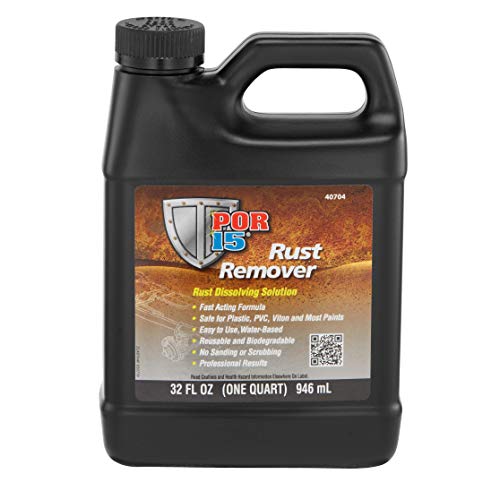
POR-15 is a brand that has built its reputation in the automotive restoration community through its coatings and surface treatment products, and the POR-15 Rust Remover is engineered to integrate directly into that ecosystem. The 32-oz. formula is water-based, odorless, and contains no VOCs, making it one of the more environmentally responsible options in this category while still delivering the performance levels required for heavy corrosion removal on automotive-grade metals. The manufacturer confirms that the product will not affect plastic, PVC, Viton, or most existing paint coatings — a critical specification when treating parts where these materials are in close contact with corroded steel.
Light rust typically responds within 20 minutes, while heavily corroded metal may require an extended overnight soak for complete treatment, and POR-15 recommends using their Cleaner Degreaser product as a pre-treatment step to maximize effectiveness. When planning a complete restoration workflow that includes surface cleaning, rust removal, and a final protective coating, pairing this product with a dedicated degreaser produces consistently cleaner results than rust removal alone. The noncorrosive formula means that even after the rust is removed, the product continues to sit harmlessly against bare metal without causing secondary oxidation or etching during extended soak times.
POR-15 Rust Remover is reusable and biodegradable, which positions it alongside Evapo-Rust and Workshop Hero as a cost-effective option for high-volume work. The 32-oz. size is smaller than the gallon formats offered by competitors, but for users who need a reliable backup supply or are treating smaller individual components in a dedicated POR-15 restoration workflow, this size provides good value within the brand's broader product ecosystem.
Pros:
Cons:

Rust-Oleum Rust Dissolver Jelly serves a slightly different purpose than its 6-pack spray counterpart — the 8-oz. jelly format is designed for targeted spot treatment on heavily rusted fasteners, brackets, tools, and small surface areas where a brush-on or hand-applied gel provides more precision than a trigger spray. The thick jelly consistency adheres firmly to iron and steel surfaces, including heavily corroded areas with uneven topography where a thinner product might not maintain consistent contact long enough to dissolve the rust effectively.
Like the Rust-Oleum spray gel, the jelly dissolves medium to light rust in 10 to 30 minutes and requires only a rinse and wipe for cleanup, with no mechanical scrubbing or abrasion required. Heavily corroded surfaces may require a second application, and for jobs of that scale, upgrading to the 6-pack spray format may be more economical — but the jelly's compact 8-oz. size makes it an ideal tool kit or glove compartment addition for quick field repairs. Its portability is a genuine advantage for users who work across multiple job sites or maintain vehicles and equipment in remote locations.
The jelly is well suited to bicycle chains, garden tool heads, firearms components, and small automotive fasteners — precisely the types of spot-rust applications where the compact format adds real practical value. For users who are already familiar with Rust-Oleum's spray gel and want a complementary product for precision application, this jelly provides a consistent chemical experience in a more controllable delivery format.
Pros:
Cons:
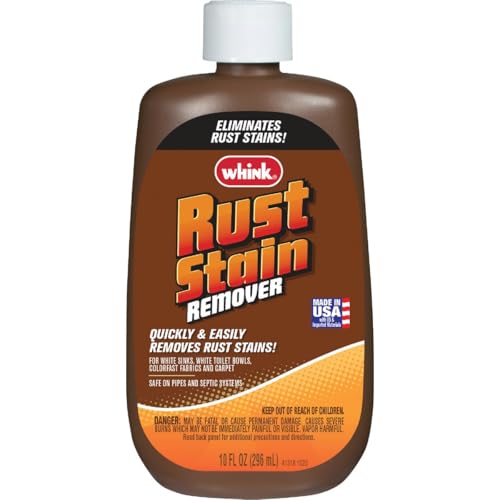
Whink Rust & Stain Remover occupies a distinct niche in this roundup because it is not primarily engineered for metalwork or automotive restoration — it is a household-grade rust stain remover formulated for fabrics, sinks, bathtubs, toilet bowls, and tile grout where iron deposits have left orange-brown staining from hard water exposure or corroded fixtures. If you are dealing with rust stains on laundry, concrete driveways, or bathroom fixtures rather than corroded metal parts, Whink addresses the problem at a price point that is substantially lower than the professional-grade soaks and gels reviewed above.
The 10-oz. bottle is sized for household use rather than volume application, and the formula relies on hydrofluoric acid-based chemistry — which is highly effective at dissolving rust stains on porous and non-porous surfaces but requires more careful handling than the water-based, acid-free products in this list. Protective gloves and eye protection are strongly recommended, and the product should not be used on painted surfaces, aluminum, chrome, stainless steel, or natural stone where the acid can cause etching or permanent damage.
For budget-conscious buyers who need an affordable solution for laundry rust stains or bathroom fixture discoloration, Whink delivers reliable results at a lower cost per application than any other product in this guide. It is not the right choice for automotive restoration or metal part derusting, but within its intended household application scope it remains one of the most recognized and widely used products in its category. Buyers who need a complementary product for broader vehicle maintenance might also explore our guide to the best swirl removers of 2026 for exterior paint care alongside this rust treatment solution.
Pros:
Cons:
The most fundamental choice you face when selecting a rust remover in 2026 is whether you need a soak-type formula, a spray gel, or a jelly — and each format matches a different set of working conditions. Soak formulas in gallon or 128-oz. jugs are designed for full submersion of individual parts and are the most effective option when you are restoring disassembled hardware, tools, and automotive components with complex internal geometries. Spray gels and jellies, on the other hand, are engineered for in-place application on installed components, vertical surfaces, and large fixed structures where disassembly is impractical. Matching the application method to your actual working scenario will determine whether you achieve full rust removal or only partial surface treatment.
Understanding the underlying chemistry of a rust remover helps you predict how it will interact with the surrounding materials on your project. Chelation-based products — including Evapo-Rust, Workshop Hero Metal Rescue, and POR-15 — use selective binding agents that target iron oxide specifically and leave bare metal, paint, plastic, and rubber unaffected, which makes them the safer choice for complex assemblies with mixed materials. Acid-based products, including phosphoric acid and hydrofluoric acid formulations like Whink, are more aggressive and effective on surface staining but carry a higher risk of etching, discoloration, or damage to adjacent materials if not applied carefully. If you are working on a vehicle with painted panels, factory plating, or rubber seals, a chelation formula is generally the more appropriate choice.
Not all rust removers are equally capable across the full spectrum of corrosion severity, and matching the product to the degree of rust on your parts will save you time and reduce product waste. Light surface rust typically responds in 10 to 30 minutes with most spray gels and soaks, while moderate corrosion may require 1 to 4 hours of submersion with a soak product. Heavy, deep-pitting rust — the kind found on long-neglected automotive parts or antique tools — often requires an overnight soak of 8 to 12 hours in a chelation-formula product to achieve complete removal. Products like POR-15 and Evapo-Rust explicitly address this spectrum in their documentation, and choosing a product rated for your actual rust severity prevents wasted applications and frustration.
For anyone who removes rust regularly as part of vehicle maintenance, workshop operations, or restoration projects, the reusability and per-use economics of a product matter as much as its raw performance. Chelation-based soak products — including Evapo-Rust, Workshop Hero, WD-40 Specialist Soak, and POR-15 — are all reusable until chemically exhausted, meaning a single gallon can treat dozens of individual parts before needing replacement. Spray gels and jellies are typically single-application products that are consumed per treatment, making them more expensive per use but more convenient for occasional spot treatment. Calculating the expected number of applications per container and dividing by price gives you a meaningful cost-per-use figure that is more informative than headline price alone when comparing products across different format sizes.
The safest rust removers for household and automotive use are water-based, chelation-formula products such as Evapo-Rust, Workshop Hero Metal Rescue, and POR-15 Rust Remover, because they contain no acids, solvents, or caustic chemicals and produce no fumes. These products can be handled with basic precautions, used indoors without ventilation equipment, and disposed of through standard household drain systems once chemically exhausted. Acid-based products like Whink are effective on stains but require more careful handling and are not safe on metal, painted, or plated surfaces.
Treatment time depends on both the product formula and the severity of the corrosion you are treating. Light surface rust typically responds in 10 to 30 minutes with fast-acting spray gels like Rust-Oleum Rust Dissolver, while moderate rust on soaked parts usually requires 1 to 4 hours. Heavily corroded parts with deep pitting may need an overnight soak of 8 to 12 hours in a chelation-based product like Evapo-Rust or POR-15 Rust Remover to achieve full removal. Always follow the manufacturer's dwell-time guidelines and inspect the part after the minimum recommended time before extending the soak further.
Chelation-based rust removers are specifically formulated to target iron oxide without attacking bare metal, paint, plastic, or rubber, making them the safest choice for parts with mixed materials or existing coatings. Acid-based formulas, by contrast, can etch bare metal and damage paint, chrome, aluminum, and stainless steel if applied incorrectly or left on too long. Always verify that the product you select is compatible with the specific metals and coatings present on your part before application, and rinse thoroughly with water after the recommended dwell time to neutralize residual chemistry.
Several of the soak-type rust removers reviewed here are explicitly designed to be reusable across multiple treatment cycles, including Evapo-Rust, Workshop Hero Metal Rescue, WD-40 Specialist Rust Remover Soak, and POR-15. These products progressively darken as they absorb iron oxide from treated parts, and they reach the end of their useful life when the solution turns very dark brown or black and can no longer remove rust at an acceptable rate. Spray gels and jellies like the Rust-Oleum Rust Dissolver products are consumed per application and are not designed for reuse between separate treatment jobs.
A rust remover dissolves and eliminates iron oxide from a metal surface, leaving behind bare metal that can then be primed, painted, or left exposed, whereas a rust converter chemically reacts with existing rust and transforms it into a stable compound — typically iron tannate — that serves as a primer-ready base coat. Rust removers like those reviewed in this guide are the appropriate choice when you want to fully eliminate rust and restore clean metal, while rust converters are better suited for large surface areas where complete rust removal is impractical and you need to stabilize the remaining corrosion before painting. The two products serve complementary but distinct purposes in a metal restoration workflow.
Yes — chelation-based rust removers including Evapo-Rust and Workshop Hero Metal Rescue are explicitly recommended for cast iron cookware restoration by their manufacturers, because the non-acidic formulas remove rust without damaging the cast iron substrate or leaving residual chemicals that could contaminate food surfaces after thorough rinsing. After treatment, cast iron should be rinsed thoroughly with clean water, dried immediately to prevent flash rust, and then re-seasoned with cooking oil to restore the protective polymerized coating. Products containing acids or hydrofluoric acid, such as Whink, should not be used on cast iron cookware intended for food preparation.
 |
 |
 |
 |

About Diego Ramirez
Diego Ramirez has been wrenching on cars since his teenage years and has built a deep practical knowledge of automotive maintenance and paint protection through years of hands-on work. He specializes in fluid service intervals, preventive care routines, exterior protection products, and the consistent habits that extend a vehicle's lifespan well beyond average. At CarCareTotal, he covers car care guides, cleaning and detailing products, and exterior maintenance and protection reviews.
Get some FREE car parts & gear.. Or check out the latest free automotive manuals and build guides here.
Disable your ad blocker to unlock all the hidden deals. Hit the button below 🚗
| | | |
