by Liam O'Brien
Nearly 40% of RV owners report shore power issues as their most common campground frustration — and a failing or undersized converter is the root cause more often than you'd think. Your converter is the nerve center of your RV's electrical system, converting 120V AC shore power into 12V DC to run your lights, fans, slides, and charge your house batteries. Get it wrong and you're dealing with sluggish battery recovery, fried components, or a dead rig at the worst possible moment.
In 2026, the market has matured considerably. Auto-detect lithium charging, multi-stage profiles, and low-voltage campground compensation are no longer premium features — they're baseline expectations. This guide cuts through the noise with hands-on analysis of the seven best RV power converters available right now, ranked by real-world performance, installation experience, and long-term reliability. Whether you're upgrading an aging unit or outfitting a new build, you'll find a clear recommendation here.

Before you commit to any unit, know your amp requirements, your battery chemistry, and whether you need an integrated power center or a standalone deck-mount charger. RV converters aren't one-size-fits-all — and the wrong amp rating costs you either performance or money. If you're also planning maintenance work on your rig, our guide to the best RV roof sealants of 2026 is worth a read alongside this one. Now, let's get into the picks.
Contents







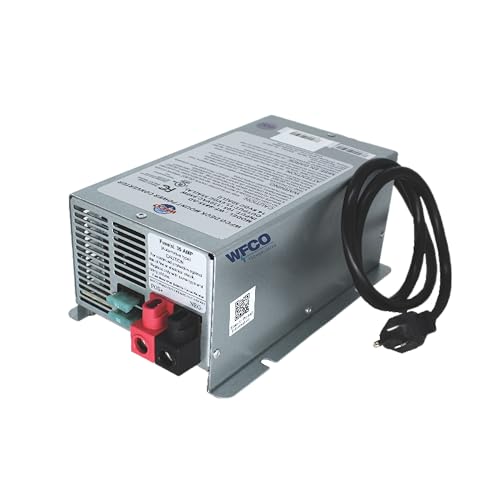
If there's a single unit that dominates the OEM-installed RV converter market, it's WFCO — and the WF-8945-AD is the model most frequently spec'd by major manufacturers. That preference exists for good reason. The 45-amp DC output matches the load profile of the vast majority of 30-amp travel trailers and fifth wheels, delivering enough headroom to run your DC loads while simultaneously pushing a solid charge to your house batteries. What separates the AD series from the previous generation is the patented Auto-Detect technology (Patent #12,113,377), which reads your connected battery bank on startup and automatically configures a lead-acid or LiFePO4 multi-stage charging profile. No dip switches. No manual configuration. It just works.
The low-voltage campground compensation is the feature that quietly earns this unit its reputation. Most converters throttle output when shore power dips below 105V — a frustratingly common scenario at packed campgrounds. The WF-8945-AD sustains full output power down to 100V AC input, meaning your batteries keep charging and your DC loads stay fed even when the campground's electrical infrastructure is struggling. For frequent full-hookup campers, this single feature justifies the purchase. The integrated power center form factor with breaker panel makes it a genuine drop-in replacement for aging WFCO units — the bolt pattern, wiring harness connections, and dimensions are designed for exactly that use case.
Build quality matches what you'd expect from a market leader. The housing is solid, the breaker panel accepts standard breakers for future circuit additions, and the unit runs cool under sustained load. The three-stage charging profile (bulk, absorption, float) is properly implemented — not the simplified pseudo-three-stage that cheaper converters fake. If you're replacing a factory-installed converter or building out a new 30-amp RV, this is your baseline recommendation.
Pros:
Cons:

Step up to the WF-8955-AD when your RV's DC load budget demands more than 45 amps. The 55-amp output is the right call for larger fifth wheels, motorhomes with expanded DC accessories, or any rig where you're running multiple slide-outs, a large residential refrigerator, or an aggressive lithium charging setup. The same Auto-Detect technology from the 8945 carries over here — your LiFePO4 or lead-acid bank is automatically identified and the correct multi-stage profile is applied. WFCO's implementation of this feature is genuinely superior to manual-configuration competitors; it removes the single most common installation error from the equation entirely.
The low-voltage performance story is identical to the 8945 — full output down to 100V AC. At a 55-amp draw, that's a meaningful difference. Competing units that begin throttling at 105V will be delivering 30-40% less charging current when the campground voltage sags, while this unit keeps pushing the full 55 amps. The WF-8955-AD is also a direct replacement for any existing WFCO 8900 series power center, so if your rig shipped with a WFCO unit from the factory, this is a plug-and-play upgrade path requiring minimal rewiring.
Thermally, the unit performs well under sustained high-current draw — the internal cooling design keeps operating temperatures in a safe range even during extended bulk charging sessions. The integrated breaker panel is well-built, and the overall fit and finish is exactly what you'd expect from a brand that supplies the major RV manufacturers. For 30-amp service rigs that are pushing toward the limits of a 45-amp converter, this is the smart move up.
Pros:
Cons:

IOTA Engineering has been building power conversion equipment since 1975, and the DLS-55 reflects five decades of refinement. This is not a consumer-grade unit dressed up with marketing specs — it's industrial-lineage hardware that happens to fit perfectly into RV electrical systems. The 55-amp output is the standout number, but the more important spec is the low transient AC line voltage tolerance. IOTA designed this unit specifically to withstand the voltage fluctuations that destroy lesser converters — extended periods of low or unstable shore power that degrade components over time. Your DLS-55 will outlast budget converters by years in demanding use environments.
The operating temperature profile is equally impressive. IOTA's thermal design keeps this unit running cool even under sustained full-load output, which translates directly to longevity. The unit delivers a consistent 13.4V DC output for battery maintenance with bulk charge capability that genuinely restores depleted banks quickly. Unlike some competitors that label themselves three-stage but deliver a simplified charging curve, the IOTA implementation is a proper multi-stage profile that respects battery chemistry. Installation is straightforward — the standalone form factor means you're adding this to your existing electrical system rather than replacing your panel.
The tradeoff is form factor simplicity. This is a standalone converter/charger, not an integrated power center. You'll need your existing distribution panel, or you'll be building one alongside this unit. That's actually an advantage for experienced builders who want precise control over their electrical layout — the IOTA becomes one dedicated, high-quality piece in a system you architect yourself. For full-time RVers and serious boondockers who demand durability above all else, the DLS-55 is the professional's choice.
Pros:
Cons:
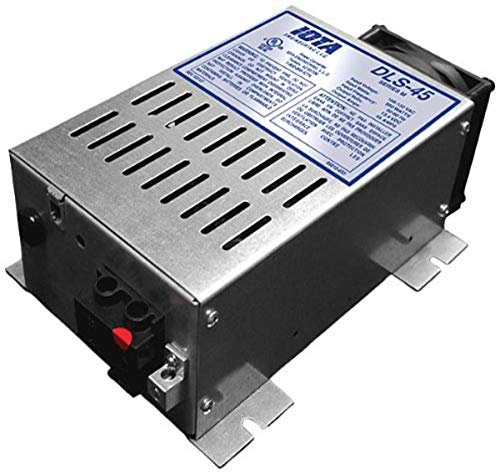
The DLS-45 is the 45-amp variant in IOTA's DLS series, and it occupies a specific sweet spot in the market: industrial build quality at a mid-tier price point, in a form factor that suits both retrofit installations and new builds. The same low transient voltage tolerance and low operating temperature signature that define the DLS-55 carry through to the DLS-45. At 45 amps, it's appropriately sized for the majority of 30-amp RV platforms — enough output to power your DC loads and charge your batteries simultaneously without pushing the unit into thermal stress.
The compact dimensions (9.7" L × 6.7" W × 3.4" H) make installation straightforward in tight compartments where larger units simply won't fit. IOTA's reputation for reliability is hard-earned, and the DLS-45 inherits it fully. The unit maintains stable DC output voltage across a wide range of AC input conditions — no flickering, no sag under load, just consistent power delivery. For RVers who are adding a converter to an existing system with its own distribution panel, or building a custom electrical layout, the DLS-45 gives you a rock-solid foundation without the panel replacement complexity of an integrated power center.
Like the DLS-55, this unit doesn't auto-detect lithium batteries. If you're running LiFePO4, you'll want to verify your charging voltage requirements and configure accordingly — or pair this with an external battery management system that handles the profile switching. For lead-acid and AGM users, the DLS-45 is straightforward and performs exactly as specified. The "Made in the USA" lineage of this unit also matters for those who prioritize domestic manufacturing quality standards.
Pros:
Cons:
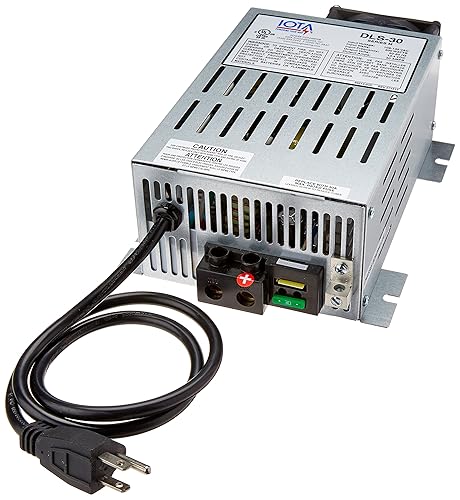
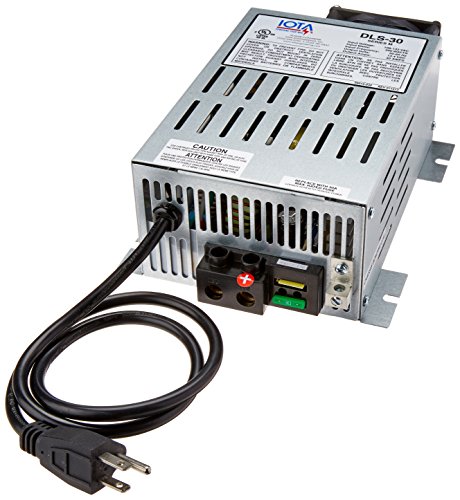
The DLS30 is IOTA's entry into the 30-amp segment, and it punches well above its price class. If your RV has modest DC loads — interior lighting, a single roof fan, basic water pump operation — and you're primarily plugged into shore power rather than draining your battery bank aggressively, the DLS30 delivers everything you need without paying for headroom you won't use. The unit handles 110/120V AC input and outputs a stable 13.4V DC, which keeps lead-acid batteries in a proper float maintenance state during extended hookup periods.
IOTA's build philosophy carries through to this budget tier — the DLS30 is not a flimsy plastic-bodied unit with overstated specs. The compact dimensions (32.4 cm L × 18.8 cm W × 10.8 cm H) make it adaptable to a variety of installation positions, and the standalone form factor keeps installation straightforward. You're not rewiring a full panel replacement — you're adding a competent charger/converter to an existing circuit. For owners of smaller travel trailers, pop-ups, or cargo conversions where the electrical demands are light, the DLS30 hits the spec requirements precisely without overbuilding.
The honest limitation here is amperage ceiling. If your camping style is evolving toward more boondocking, more battery cycling, or you're adding accessories that push your DC load — a residential fan, a 12V compressor cooler, additional lighting circuits — you'll outgrow the DLS30. But for its intended use case, it's the most reliable 30-amp unit available at this price. IOTA's track record in both marine and RV applications speaks for itself, and this unit reflects the same engineering discipline that makes their higher-amp models worth the money.
Pros:
Cons:

The PowerMax PM3-45 takes a different approach from the IOTA and WFCO units: adjustable output voltage modes and lithium compatibility out of the box, in a standalone package at a competitive price. The 45-amp capacity covers the standard 30-amp RV load profile with enough headroom for battery charging to run simultaneously. The three-stage smart charging mode — bulk, absorption, and float — is properly implemented here, not a marketing label applied to a single-stage unit. Your battery bank gets the right charging profile at each recovery stage, which directly extends battery life over repeated cycles.
The adjustable power supply modes are the differentiating feature in this segment. You can tune the output voltage for specific battery chemistries or accessory requirements — a flexibility that fixed-output converters simply don't offer. The built-in cooling fan is notably quiet for a 45-amp unit; fan noise at a shared campsite is a real consideration that PowerMax clearly addressed in the PM3 design. The LED indicator gives you immediate visual feedback on charge state, which is more useful than it sounds when you're doing a quick check at the campsite before bed.
At 11" × 8.5" × 4.2" dimensions and a compact weight profile, the PM3-45 installs in spaces where larger integrated units won't fit. The lithium compatibility makes it particularly well-suited to 2026 builds where LiFePO4 is the battery chemistry of choice — you're not buying a converter and immediately needing a workaround for lithium charging. Installation is direct: AC in, DC out, minimal configuration. For budget-conscious builders who need lithium compatibility and proper three-stage charging without spending WFCO power center money, this is the honest value pick on this list.
Pros:
Cons:


The WF-9855-AD-CB is WFCO's answer to the question: "What if I want WFCO quality and Auto-Detect technology, but I already have my own distribution panel?" The deck mount form factor breaks the converter/charger out of the integrated power center shell and delivers it as a standalone unit you can mount anywhere in your electrical bay. At 55 amps DC output, it's the highest-capacity unit in WFCO's standalone lineup — matched with the same Auto-Detect lithium/lead-acid recognition that defines the AD series, and the same full-output-to-100V-AC low voltage performance that makes WFCO the campground-voltage problem solver.
This is the unit to specify when you're upgrading an existing RV that already has a functional distribution panel, when you're doing a full custom build and want WFCO's charging intelligence without the integrated panel format, or when you're adding converter capacity to a system with its own established distribution architecture. The deck mount installation is clean — surface mount, standard wiring connections, no panel tearout required. You get all of WFCO's engineering and OEM-quality components in a package that respects your existing electrical layout.
The 55-amp output handles the most demanding 30-amp RV scenarios and is well-suited to 50-amp rigs running significant DC accessories alongside aggressive battery charging. The multi-stage charging profile treats your battery bank correctly regardless of chemistry — the Auto-Detect feature eliminates the guesswork that causes premature battery failure in systems where lead-acid chargers are inadvertently connected to lithium banks. If you're planning your 2026 RV electrical upgrade and want the WFCO name on your system without committing to a full power center replacement, this is the precise unit for that scenario. For complementary RV security, check out our roundup of the best trailer locks of 2026.
Pros:
Cons:

Choosing the right RV power converter comes down to four core factors: amperage requirements, battery chemistry compatibility, installation format, and low-voltage performance. Get all four right and your converter will run quietly in the background for years. Get one wrong and you'll either be back shopping within a season or dealing with a battery bank that never fully recovers. According to the Recreation.gov resource on campground infrastructure, shore power quality varies significantly across campground types — a practical consideration when evaluating low-voltage performance specs. Here's what matters most in 2026:
Your converter's amp rating must cover your total DC load demand with enough headroom for simultaneous battery charging. A useful rule: add up all your 12V DC loads (lighting, fans, water pump, slideouts, refrigerator fans) and add 10-15 amps for battery charging. For most 30-amp travel trailers with standard equipment, 45 amps covers the load budget comfortably. If you're running a large lithium bank, a 12V compressor refrigerator, heated bedding circuits, or multiple slide mechanisms, step up to 55 amps. Undersizing your converter costs you battery recovery speed and risks the unit running at sustained high percentages of rated load — which kills longevity.
This is the most critical spec to get right in 2026, as lithium battery adoption has accelerated dramatically across the RV market. Lead-acid and LiFePO4 batteries require different charging voltage profiles. Connecting a lead-acid charger profile to a lithium bank causes incomplete charging at best and potential damage at worst. The WFCO Auto-Detect units solve this automatically. IOTA units require manual configuration or an external BMS solution. The PowerMax PM3-45 offers adjustable modes that accommodate lithium natively. If your battery chemistry is fixed (all lead-acid or all lithium), any unit on this list can be configured correctly. If you anticipate a chemistry transition — upgrading from AGM to lithium in the next season — auto-detect functionality saves you a converter replacement.
Integrated power centers (WFCO 8900 series) combine the converter, battery charger, and distribution breaker panel into a single enclosure. They're the right choice for direct replacement of existing power centers or for new builds where a complete electrical center is needed. Standalone deck mount units (WFCO 9855, IOTA DLS series, PowerMax PM3-45) are the right choice when your distribution panel is already in place, when you're adding converter capacity to an existing system, or when you're building a custom layout and want component-level flexibility. Don't pay for an integrated panel you don't need, and don't spec a standalone unit when a full panel replacement is actually required. You might also find our guide on best wheel chocks of 2026 useful for complete RV safety preparedness.
Campground voltage is rarely a clean 120V. At popular campgrounds during peak summer weekends, shore power sags to 105V or below with regularity — a condition that causes converters without low-voltage compensation to throttle their output significantly. WFCO's full-output-to-100V-AC spec is a genuine engineering differentiator that pays dividends at real campgrounds. IOTA's low transient line voltage tolerance serves a similar function. Before purchasing any converter, verify what happens to its output when input voltage drops. A converter that delivers 55 amps at 120V but throttles to 35 amps at 105V is effectively a 35-amp converter in real campground conditions. The tools and information you need to evaluate your full RV setup are available through our RV tools section.
An RV power converter takes 120V AC power from shore power or a generator and converts it to 12V DC to run your RV's 12-volt electrical systems — lighting, fans, water pump, slideout motors — and to charge your house batteries. Without a functioning converter, your 12V systems only run off battery power, which depletes quickly. The converter is the primary power management component in your RV's electrical system when you're connected to shore power.
Add up the amp draw of all your active 12V DC loads (check your appliance specs or use a clamp meter on the DC bus). Add 10-15 amps to that total to account for simultaneous battery charging demand. The result is your minimum converter amp requirement. For most 30-amp travel trailers with standard equipment, 45 amps covers this comfortably. Larger rigs with expanded accessories, multiple slideouts, or large battery banks require 55 amps. Always size up rather than down — running a converter at 95% of rated capacity continuously degrades it faster than running at 70-75%.
A standard battery charger only charges your battery — it doesn't power your 12V DC loads simultaneously. Your RV converter functions as both a power supply (for your 12V systems) and a battery charger in one unit. Running only a battery charger means your lights, fans, and other DC accessories draw directly from the battery while the charger attempts to recover it, creating a cycle that often results in incomplete charging. A proper RV converter manages both functions simultaneously with a stable regulated output.
The WFCO AD series (WF-8945-AD, WF-8955-AD, WF-9855-AD-CB) feature patented Auto-Detect technology that automatically identifies whether you have lead-acid or LiFePO4 (lithium iron phosphate) batteries connected and adjusts the charging profile accordingly. Older WFCO units without the AD designation use a lead-acid profile only, which is not optimal for lithium. If you're running LiFePO4, ensure you're purchasing an AD-series unit or confirming lithium compatibility on any competing brand before purchase.
The three most common causes of premature converter failure are sustained operation at high percentages of rated amp capacity (chronic overloading), exposure to repeated low-voltage shore power without adequate input protection, and inadequate ventilation causing thermal stress. A correctly sized converter running at 60-75% of its rated capacity in a ventilated compartment will last 10-15 years or more. A borderline-sized unit running at 90%+ in a hot, poorly ventilated bay may fail within 3-5 years. Buy the right amp rating, ensure airflow clearance around the unit, and the converter will rarely be a maintenance concern.
Replacing an integrated power center (like WFCO 8900 series) with a direct same-brand replacement is one of the more accessible RV electrical projects — the wiring harness connections, mounting footprint, and breaker positions are standardized, making it a direct swap for experienced DIYers. Installing a standalone deck mount converter requires proper DC wiring gauge selection for the amp rating, appropriate fusing at the battery connection, and secure mounting. Neither job requires an electrician, but both require comfort with 12V wiring, appropriate tools, and reading the installation manual carefully. When in doubt, an RV service center installation is money well spent.

 |
 |
 |
 |

About Liam O'Brien
Liam O'Brien has spent over a decade buying, field-testing, and evaluating automotive tools with a focus on what actually performs in a real DIY garage rather than what markets well on a spec sheet. His hands-on experience spans hand tools, diagnostic equipment, floor jacks, socket sets, and specialty automotive gear across a wide range of brands and price points. At CarCareTotal, he covers automotive tool and equipment reviews, garage setup guides, and buying advice for home mechanics.
Get some FREE car parts & gear.. Or check out the latest free automotive manuals and build guides here.
Disable your ad blocker to unlock all the hidden deals. Hit the button below 🚗
| | | |
