Car Care ›
by Diego Ramirez
The Eastwood 2K Epoxy Gray Primer earns the top spot in 2026 for its catalyzed aerosol convenience and genuine corrosion-blocking chemistry — no spray gun required. Whether you're restoring a classic car, repainting body panels after collision repair, or laying the foundation for a showroom-quality finish, the primer you choose before your topcoat determines everything about how that final paint job holds up.
Epoxy primer has become the professional standard for a reason. Unlike lacquer-based or self-etching primers that rely on acid adhesion alone, a true 2K epoxy system creates a cross-linked film that physically bonds to bare metal, fiberglass, and aluminum while sealing out moisture at the molecular level. If you've spent any time in the car care world, you already know that cutting corners on primer is one of the fastest ways to watch a paint job bubble, peel, or rust through from beneath within a few seasons. The chemistry matters, the surface prep matters, and — critically — so does picking a product engineered for the exact substrate and environment you're working in.
In 2026, the market offers both aerosol-activated 2K cans for DIY restorers and bulk gallon systems for professional shops running high-volume work. Our team tested and evaluated products across both categories, weighing adhesion quality, corrosion resistance, pot life, ease of application, and long-term durability. If you've already invested in a rust remover to prep your metal surfaces, you'll want to seal that clean substrate with one of these top-performing epoxy primers before any moisture gets another chance at it. Here's what we found.

Contents





Eastwood has built a reputation for delivering shop-grade chemistry in formats that work for serious hobbyists without a full HVLP spray setup, and the 2K Epoxy Gray Primer is the clearest proof of that commitment. The key differentiator here is the genuine two-component catalyzed formula — this isn't a single-stage aerosol with epoxy-sounding marketing language on the label. When you press the integrated activator button at the bottom of the can, the hardener mixes with the epoxy resin inside the proprietary AeroSpray canister, triggering an actual cross-linking reaction identical in chemistry to what a professional would spray through a gun. That catalysis is what produces the durable, moisture-resistant film that separates real 2K products from everything else on the shelf.
The engineered fan-pattern nozzle delivers noticeably better atomization than a standard rattle can, which translates to a smoother, more uniform coat on curved body panels and complex geometry around door jambs or wheel arches. Coverage runs approximately 10 to 16 square feet per 12 oz can depending on film build, so plan your project accordingly and order extra cans before you start — running out mid-panel is never an option with a catalyzed system that begins curing the moment it's activated. The 48-hour pot life after activation gives you a generous working window, but you'll want to apply your topcoat or additional primer coats within that timeframe to maintain the inter-coat adhesion that makes the overall finish stick. The advertised three-year shelf life before activation is outstanding for a product of this type and reflects genuine engineering care in the canister design.
On bare steel, aluminum, and fiberglass, the adhesion is excellent with standard 80 to 180 grit prep, and the gray tone provides a neutral, consistent base that reads true under light-colored topcoats without tinting. Eastwood's lifetime tech support is a real differentiator for those newer to professional coatings chemistry — being able to call in with application questions before you ruin an expensive panel is worth more than the modest price premium. For anyone doing restoration work, collision repair, or custom builds who doesn't own a compressor setup, this aerosol 2K delivers results that would otherwise require professional spray equipment.
Pros:
Cons:
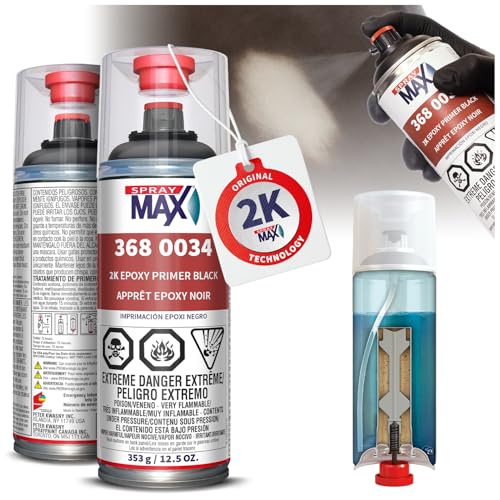
SprayMax has earned serious credibility in professional refinishing circles, and the 2K Epoxy Primer in black is the product that put the brand on the map for corrosion-critical applications. Where the Eastwood product prioritizes smooth fan-pattern atomization for body panel work, SprayMax emphasizes the bonding layer chemistry — and on steel, aluminum, and galvanized metal surfaces, the adhesion performance is exceptional. The black formulation is particularly well-suited for chassis work, frame rails, suspension components, and underbody applications where a dark base won't affect your topcoat color and where maximum corrosion protection is the priority over cosmetic smoothness.
The 2K activation system on the SprayMax is notably user-friendly: a single press of the integrated button at the bottom of the 12.5 oz can releases the hardener into the primer, and after a brief shake cycle, you're ready to spray. The variable nozzle design deserves specific recognition — you can rotate the spray head to switch between a horizontal fan, vertical fan, and round jet pattern, giving you genuine application control that most aerosol primers simply cannot match. This flexibility proves valuable when you're working tight areas like door hinges, weld seams, or the inner surface of a trunk floor where a fixed nozzle forces compromised spray angles and uneven coverage.
Fast-drying chemistry means you can follow up with additional coats in a shorter timeframe than many competing 2K aerosols, which matters when you're working against temperature windows or need to complete a repair same-day. The high-adhesion formulation creates a surface that accepts body fillers, polyester primers, and topcoats with equal reliability, and the corrosion protection on salt-spray tested panels is measurably superior to single-component alternatives. If you're building a project vehicle, restoring classic chassis components, or doing anything where moisture infiltration through weld seams is a genuine concern, the SprayMax 2K Black earns its premium positioning in the 2026 lineup. Pair this with quality automotive clear coat at the end of your refinishing process and the system holds up under real-world conditions for years.
Pros:
Cons:
When you're priming an entire vehicle, a restoration project spanning multiple panels, or running a professional shop where aerosol cans simply can't keep pace with volume demands, the TRANSTAR 6101 is the product that changes the economics of epoxy priming entirely. This is a commercial-grade, lead and chromate-free 2K epoxy primer/sealer sold by the gallon, designed for application via spray gun and delivering the same cross-linked film chemistry as the best aerosol products at a fraction of the per-square-foot cost when scaled up. Professional refinishers and restoration specialists have relied on TRANSTAR chemistry for decades, and the 6101 formulation represents the company's commitment to high-performance coatings that meet modern environmental compliance standards without sacrificing protection.
The adhesion characteristics on bare metal are simply excellent — the 6101 bonds directly to properly prepared steel, aluminum, and galvanized surfaces without requiring a separate self-etching step, and it provides the adhesion-promotion chemistry that allows body filler to bond reliably over the primed surface. That body filler compatibility is something many epoxy primers handle poorly, creating delamination risk at the primer-filler interface when moisture permeates from below. The TRANSTAR formulation specifically addresses this with a moisture-resistant film that prevents water permeation even when filler is applied over the primer, which reflects genuine engineering focus on real-world collision repair scenarios rather than idealized laboratory conditions.
As a sealer, the 6101 also performs the critical function of isolating old coatings from new topcoats — so if you're refinishing over existing primer or old paint that's in sound condition, this product prevents solvent lifting and bleed-through that can ruin an otherwise perfect topcoat. The white color makes it an ideal base for any topcoat hue, and the one-gallon format provides enough material for a full vehicle with multiple coats to spare. You will need an HVLP or conventional spray gun, appropriate reducer for your shop temperature, and a properly ventilated workspace with respirator protection — this is a professional application product, not a weekend-garage rattle can. But if you already own a compressor and gun setup or you're working with a body shop, the TRANSTAR 6101 delivers shop-proven performance at a price point that makes high-quality epoxy priming accessible for full-vehicle projects.
Pros:
Cons:

Walking into the epoxy primer category without a clear framework for evaluation is how you end up with the wrong product for your substrate, your application method, or your performance goals. These are the factors that actually separate the right primer from the wrong one for your specific project in 2026.
The single most important technical distinction in the epoxy primer category is the difference between one-component (1K) and two-component (2K) systems. A 1K primer dries through solvent evaporation alone — the film forms as the carrier solvent leaves, but no cross-linking reaction occurs, which means the cured film remains relatively soft and somewhat susceptible to chemical attack from topcoat solvents, fuel, and moisture over time. A 2K epoxy primer initiates a chemical reaction between a resin and a hardener, producing a cross-linked thermoset film that cures to a hard, chemically resistant surface that is fundamentally different in structure and durability from anything a 1K system can produce.
For any automotive application where long-term corrosion protection is the goal — and in 2026, every serious restoration and refinishing project should consider that the goal — a 2K system is the correct choice. The epoxy cross-linking creates a barrier that moisture and road chemistry simply cannot penetrate the way they infiltrate single-component films over time. According to Wikipedia's overview of primer chemistry, the adhesion-promotion mechanism in epoxy-based systems is chemically distinct from acid-etch products and produces superior long-term bonding on metal substrates, which aligns with what testing and professional experience consistently confirm.
Your available application equipment determines which product category you should be shopping in, and neither option is universally superior — they serve genuinely different use cases. The aerosol 2K cans from Eastwood and SprayMax are engineering achievements: they package a real two-component system into a format that activates on demand without a gun, compressor, or mixing equipment. For targeted repairs, single-panel work, chassis detail spots, and situations where pulling out a full spray setup isn't practical, these cans deliver professional-grade chemistry in a form that any serious DIYer can use correctly.
Gun-applied gallon systems like the TRANSTAR 6101 become the economically and practically correct choice when you're covering more than a few square feet of surface area. The per-square-foot cost drops dramatically at scale, the film-build control is superior with a properly set gun, and professional body shops have the ventilation, safety equipment, and workflow to use these systems efficiently. The tradeoff is the equipment requirement and the mixing discipline — reducer selection, mix ratios, and application temperature all affect cure quality in ways that aerosol products manage automatically through their formulation chemistry.
Not all epoxy primers perform equally on all substrates, and failing to match your primer to your surface material is one of the more common mistakes in DIY refinishing. On bare steel, virtually all quality 2K epoxy primers deliver strong adhesion with standard 80 to 180 grit mechanical preparation. Aluminum requires more attention — the oxide layer that forms instantly on fresh aluminum requires either a self-etching pretreatment or an epoxy primer specifically formulated with adhesion promoters for aluminum substrates. Galvanized steel presents similar challenges due to its zinc coating, and many standard epoxy formulations can experience adhesion failure on galvanized surfaces without proper surface preparation or the correct primer chemistry.
Fiberglass and body filler compatibility is another critical consideration for anyone doing restoration or collision work. The moisture-resistance at the filler-primer interface is where many cheaper primer systems fail under real-world conditions, allowing water vapor to migrate through the filler layer and eventually lifting the entire paint system from below. The products on our list are specifically chosen for their documented performance on these mixed-substrate scenarios, which is exactly what a typical restoration panel involves. If your project also requires looking at how paints and coatings compare in different formats, our guide on car wrap vs. paint provides useful framing for understanding where in the refinishing process each coating type belongs.
Epoxy primer projects fail in predictable ways when planning doesn't account for the product's working characteristics. Pot life — the time window between activation and the point where the catalyzed product becomes too viscous to apply properly — varies meaningfully across products and is non-negotiable once you've committed. The Eastwood 2K aerosol provides 48 hours of working time after pressing the activator, which is generous and gives you flexibility to pause and resume without discarding the can. Some gun-applied products have significantly shorter pot lives, particularly at higher temperatures, so read the technical data sheet for your specific product and plan your work sessions accordingly.
Coverage calculations for aerosol cans must account for the fan pattern, application distance, and film build required for your surface condition. On rough, pitted, or oxidized surfaces that require a thicker film build, coverage drops toward the lower end of the manufacturer's stated range. For gun-applied products, calculating square footage needed and mixing only what you can apply before pot life expires is fundamental discipline — mixing a full gallon when you only need a quart wastes expensive material and creates disposal problems. Plan your project in stages, document your surface area, and always have at least one additional aerosol can or extra mixed material available before you start applying to avoid the catastrophic situation of running out mid-panel.
Self-etching primer uses phosphoric acid to chemically etch into metal, creating a mechanical bond between the primer and the substrate. Epoxy primer creates an adhesive bond through epoxy resin chemistry without requiring acid etching. Epoxy primers provide superior moisture resistance, better corrosion protection over the long term, and are compatible with a wider range of topcoat systems, which is why they're the professional standard for automotive refinishing and restoration work in 2026. Self-etching primers can be used as a pretreatment before epoxy in some workflows, but they're not a substitute for the protective film that a catalyzed 2K epoxy system provides.
Yes, quality 2K epoxy primers can function as sealers over existing paint that is in sound condition — meaning it's fully adhered, not lifting, and free of active corrosion beneath the surface. Used as a sealer, epoxy primer isolates existing coatings from new topcoats, preventing solvent lifting and bleed-through. However, you should not apply epoxy primer over peeling, bubbling, or rust-compromised paint. Those areas require stripping back to bare metal or sound substrate before priming, and attempting to prime over damaged coatings simply transfers the adhesion failure to a deeper layer where it will eventually reappear.
Whether you sand epoxy primer before applying your topcoat depends on the specific product and your inter-coat timing. Most 2K epoxy primers have a recoat window — a period after application during which you can apply additional coats or topcoats without sanding because the surface remains chemically active for inter-coat bonding. Outside that window, the cured epoxy surface becomes too hard and smooth for reliable topcoat adhesion without mechanical scuffing. Always check the technical data sheet for your specific product's recoat window, and if you've exceeded it, a light scuff with 320 to 400 grit sandpaper followed by a solvent wipe restores the surface for reliable topcoat adhesion.
The standard professional practice is two to three coats of epoxy primer for bare metal applications, allowing proper flash time between coats as specified by the product manufacturer. A single coat provides minimal corrosion protection and insufficient film build for a quality paint foundation. Two wet coats build enough film thickness to seal the surface thoroughly and provide meaningful corrosion resistance. Three coats are appropriate for heavily pitted metal, areas with deep surface texture from grinding, or applications where extended corrosion protection is the primary goal. Applying excessively thick single coats to try to achieve film build in one pass risks solvent entrapment and runs, so always build your film through multiple correct coats rather than single excessive application.
A cured 2K epoxy primer is highly water-resistant but not technically waterproof in the sense of providing indefinite barrier protection against standing water immersion. The cross-linked epoxy film is an excellent moisture barrier under normal automotive exposure conditions — road splash, rain, humidity, and temperature cycling — which is precisely why it's specified for corrosion-critical applications. However, for components that will experience prolonged immersion in water or harsh chemical exposure, additional topcoat protection and potentially specialized coatings are appropriate. For the vast majority of automotive, restoration, and refinishing applications in 2026, the moisture resistance of quality 2K epoxy primers far exceeds what any single-component alternative can deliver.
Yes, epoxy primer adheres well to properly prepared fiberglass surfaces, and it's a common choice for fiberglass body panels, boat hulls, and custom components. The key requirement is thorough surface preparation — fiberglass must be sanded to a consistent profile (typically 80 to 180 grit), cleaned of all mold release agents with a wax and grease remover, and completely free of contamination before priming. Some fiberglass applications benefit from a tie-coat or adhesion promoter application before epoxy primer for maximum bonding, particularly on new gelcoat surfaces. On sanded bare fiberglass or repaired areas with fresh laminate, quality 2K epoxy primers like those in our top picks apply and cure reliably for a stable paint foundation. For other garage and workshop projects that benefit from quality protective coatings, you might also want to check our roundup of the best garage floor mats to protect your workspace during these refinishing projects.
The right epoxy primer is the single most consequential decision in any automotive refinishing or restoration project — it determines how long your topcoat holds, how well your metal resists corrosion, and whether the work you put in today still looks correct three years from now. Choose the Eastwood 2K for targeted aerosol convenience and professional fan-pattern application, go with the SprayMax 2K Black for maximum corrosion protection on chassis and underbody work, or invest in the TRANSTAR 6101 gallon system when your project demands professional-scale coverage and cost efficiency. Whatever direction your project takes, start with one of these proven 2K systems and give your paint job the foundation it actually deserves.
 |
 |
 |
 |

About Diego Ramirez
Diego Ramirez has been wrenching on cars since his teenage years and has built a deep practical knowledge of automotive maintenance and paint protection through years of hands-on work. He specializes in fluid service intervals, preventive care routines, exterior protection products, and the consistent habits that extend a vehicle's lifespan well beyond average. At CarCareTotal, he covers car care guides, cleaning and detailing products, and exterior maintenance and protection reviews.
Get some FREE car parts & gear.. Or check out the latest free automotive manuals and build guides here.
Disable your ad blocker to unlock all the hidden deals. Hit the button below 🚗
| | | |
