by Liam O'Brien
Picture this: you're three hours into a road trip when your laptop battery hits 5%, your kid's tablet dies in the back seat, and the nearest outlet is a rest stop you passed forty miles ago. If you had a quality car power inverter plugged in, none of that would be a crisis — it would just be Tuesday. The right inverter turns your vehicle's 12V DC battery into a reliable 110V AC power source, letting you run laptops, CPAP machines, power tools, and small appliances wherever the road takes you.
In 2026, the market is flooded with options ranging from palm-sized cigarette lighter adapters to serious hardwired units that can power a mini-fridge. The difference between a great inverter and a disappointing one comes down to wattage rating, sine wave quality, protection circuitry, and build consistency — factors that aren't obvious from a product photo alone. Whether you're a weekend camper, a work-truck driver, or someone building out an RV setup (and if you're in that last category, our guide to the best RV portable waste tanks is worth a look too), your inverter choice shapes how comfortably you operate away from shore power.
We tested and analyzed the top-performing car power inverters available right now, cross-referencing real-world performance data, safety certifications, and thousands of verified buyer reviews. Below you'll find six standout picks across every power tier, from ultra-compact 150W plug-in units to capable 2000W pure sine wave inverters built for demanding loads. Use the tools category for more vehicle accessory guides as you build out your setup.
Contents
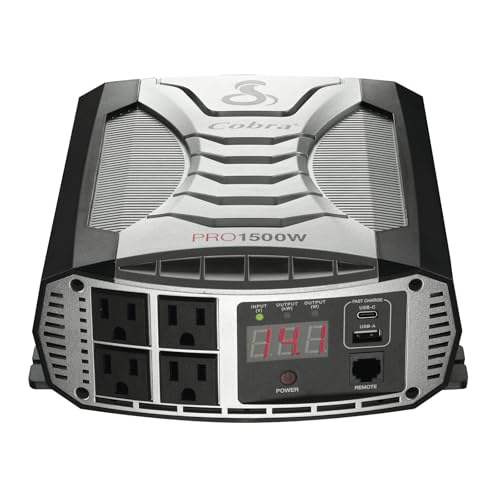







The Cobra PRO 1500W is the inverter you buy when you're serious about mobile power and you want a unit that communicates with you while it works. Delivering 1500 watts of continuous modified sine wave power with a 3000W peak surge capacity, this inverter handles four grounded AC outlets simultaneously, making it a genuine workhorse for contractors, truckers, and road warriors who need to run laptops, power tools, gaming systems, or kitchen appliances from the vehicle. The build quality is immediately apparent — Cobra has been designing mobile power products for decades, and the CPI1500W reflects that institutional knowledge in its heat management, connector quality, and firmware reliability.
What genuinely separates this unit from competitors in the same wattage class is the remote controller system. You get a remote that includes both a 3.0A USB-A port and a USB-C port, so you can manage device charging from anywhere in the cab without reaching back to the inverter itself. A seven-color LED indicator on the remote displays real-time battery voltage and current consumption, which means you're not flying blind about your vehicle's battery state — a critical feature if you're running the inverter for extended periods with the engine off. The two fast-charge USB ports integrated into the inverter body itself add additional charging capacity for smartphones and tablets on top of the AC outlets.
For professional drivers and campers who need reliable power delivery across multiple device types, the Cobra PRO 1500W is the clear choice at this wattage tier. Keep in mind that modified sine wave power is fine for most resistive and capacitive loads, but if you're running CPAP machines, high-end audio equipment, or certain variable-speed motors, you'll want to step up to a pure sine wave unit. At 1500 watts continuous, this inverter also requires a proper wiring connection directly to your battery rather than a cigarette lighter socket — plan your installation accordingly.
Pros:
Cons:
Krieger occupies a smart position in the inverter market — enough power to handle real workloads, priced accessibly enough that it makes sense for drivers who need reliable mobile power without paying a premium for features they'll never use. The KR1100 delivers 1100 watts continuous and 2200 watts peak, converting 12V DC to 120V AC through two grounded outlets, and it arrives with everything you need for a proper installation already in the box. The included ANL fuse kit and three-foot battery cables mean you're not hunting for parts before you can get to work — a thoughtful detail that reflects Krieger's understanding of its customers.
The LCD display on this unit is genuinely informative, showing input voltage, output wattage, and battery level in real time so you always know exactly what's happening with your vehicle's electrical system. A wired remote control is also included, giving you convenient on/off access without reaching back to the inverter. The protection suite covers overload, temperature, and short circuit conditions — all clearly displayed on the LCD when triggered — which gives you the kind of confidence you need when leaving the unit running unattended in a work truck or RV. ETL approval under UL STD 458 means this unit has been independently certified for safety, not just self-certified by the manufacturer.
If you're powering shop vacuums, blenders, small power tools, or office equipment from your vehicle on job sites, the Krieger 1100W hits a practical sweet spot. It's powerful enough to handle the startup surge of most portable tools without tripping protections, yet the price point keeps it realistic for tradespeople who need inverters as working tools rather than luxury accessories. Like all modified sine wave inverters, it's not the best choice for motor-speed-sensitive devices or high-quality audio, but for the vast majority of everyday power needs, it performs consistently and durably.
Pros:
Cons:
When you need clean power in volume — for an RV, a solar backup system, or a truck-based workstation running sensitive equipment — the Ampeak 2000W pure sine wave inverter stands as the most capable unit in this roundup. It delivers a genuine 2000 watts continuous with a 6000W surge capacity, meaning it doesn't just claim high numbers on a spec sheet — it sustains 2200W for over 25 minutes and 2400W for over 15 minutes, which far exceeds what most competitors offer at this power class. That sustained output matters if you're starting double-door refrigerators, RV water pumps, or power tools with heavy inductive loads that draw hard on startup.
The pure sine wave output quality is where this inverter truly earns its position. With total harmonic distortion (THD) of only 3–4%, the AC power it produces is cleaner than what most wall outlets deliver — safe for CPAP machines, variable-speed motors, high-end audio amplifiers, and other electronics that modified sine wave power can damage over time. The voltage regulation is equally impressive: output stabilizes at 118–120V when dynamic input exceeds 11V, and even at 10–11V input, output stays above 110V, protecting voltage-sensitive equipment like mini-fridges and computers from the kind of undervoltage damage that ruins expensive hardware. The conversion efficiency rating above 93% also means less of your battery's energy is wasted as heat during operation.
This unit includes dual AC outlets, a 20A outlet for higher-draw appliances, a hardwire port for permanent installation, a 5V 3.1A USB port, and a remote control — covering essentially every connection scenario you're likely to encounter. For anyone building a serious solar charging system for their vehicle or managing power-hungry RV loads, the Ampeak 2000W is the inverter to anchor that setup around. It's a significant investment compared to the modified sine wave units here, but the protection it offers for your connected equipment more than justifies the price differential over time.
Pros:
Cons:

Not everyone needs 2000 watts of mobile power, and for the driver who wants clean pure sine wave output at a more modest power level, the Ampeak 1000W ETL-certified inverter delivers exactly that without the installation complexity or price tag of its larger sibling. With ETL certification — meaning it's been independently tested against established safety standards rather than self-certified — this unit earns real trust for use around medical equipment, laptops, and other electronics where power quality directly affects both device performance and longevity. Three AC outlets give you flexibility to run multiple devices simultaneously, and the 4.8A dual USB output handles fast charging for phones and tablets alongside AC-powered equipment.
Ampeak's 17-point safety protection system is the headline feature of this unit, covering protections that most competitors in this price range simply don't offer. You get overload protection, over-temperature cutoff, under-voltage and over-voltage shutdown, short-circuit protection, soft start functionality to prevent startup surges from tripping the protection system, and more — all working together to protect both your connected devices and the inverter itself. The enhanced output voltage stability at 115V ±5V keeps your electronics in their designed operating range even when your vehicle battery fluctuates, which matters most for CPAP machines, medical devices, and variable-speed appliances that can malfunction when voltage strays too far from nominal.
The precision LCD display on this unit reports input voltage, output voltage, current draw, and power consumption in real time, giving you a complete picture of your electrical situation at a glance. If you're powering sensitive equipment on a work vehicle or using a CPAP while camping, pure sine wave output at 1000W is genuinely the minimum spec you should consider — and the Ampeak 1000W delivers it with a safety certification and protection suite that justifies the modest premium over cheaper unrated alternatives. It's also an excellent companion for home EV charging discussions, as understanding power quality matters across all your charging applications.
Pros:
Cons:
Stanley's PI500S occupies a clever design space that most inverter brands miss: a unit powerful enough to handle real loads but flexible enough to operate two different ways depending on your situation. You can connect it directly to your vehicle's battery with the included battery clamps for 500 watts of continuous power, or plug it into your car's 12V DC socket for a more limited 120-watt output when you just need to top off a laptop or power a small device without dealing with clamps. That dual-connection design makes the PI500S genuinely versatile across different vehicles and use cases in a way that fixed-connection inverters simply can't match.
The lightweight, ergonomic build is genuinely appreciated on a unit you're likely to move between vehicles or carry into job sites. Stanley's brand reputation in the tool space carries over here — this isn't a cheaply assembled no-name unit that makes big claims on packaging and underdelivers in practice. The dual 120V AC outlets and dual 3.1A USB ports give you four simultaneous connection points, covering the realistic charging needs of most users who need power for a worksite tool, a laptop, and a couple of phones at the same time. At 500 watts continuous, it handles small power tools, fans, televisions, and most consumer electronics without strain.
Where the PI500S makes trade-offs is in output cleanliness — like the Cobra and Krieger units, it produces modified sine wave power, which limits its suitability for sensitive electronics. For everyday portable power needs, though, the combination of Stanley's build quality, the dual connection options, and the practical 500W power rating makes this one of the most sensibly designed mid-range inverters in the 2026 market. If you're also looking for quality portable automotive tools to complement your mobile power setup, our review of the best low-profile floor jacks covers another essential for anyone working roadside or in the field.
Pros:
Cons:
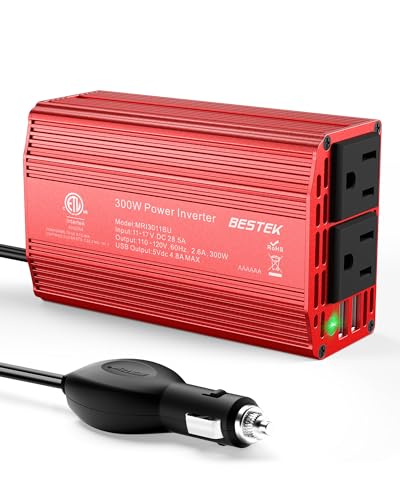
BESTEK is the name in compact cigarette lighter inverters, holding power inverter patents and leading the American market in this specific category — and the 300W model demonstrates exactly why. Sized roughly like an iPhone, this unit plugs directly into your vehicle's 12V cigarette lighter socket and immediately gives you two 110V AC outlets and two 4.8A USB ports for fast charging, all in a package light enough that you'll forget it's plugged in. The aluminum housing manages heat dissipation effectively for a unit this compact, which directly translates to longer service life compared to plastic-bodied competitors at similar price points. The 32-inch cord between the plug and the unit body gives you genuine placement flexibility inside the cab.
The 2026 version of this unit has been upgraded to support 11–17V compatibility, which means it works correctly with Tesla vehicles and other EVs that operate at slightly different DC voltage ranges than traditional combustion engine cars — a thoughtful update that extends its usefulness as the automotive market shifts. With 300 watts continuous and 700 watts instantaneous surge capacity, it handles laptop charging, tablet charging, small LED lighting, and other light consumer electronics without any issues. The dual 4.8A USB ports deliver fast charging for virtually any USB-powered device on the market today, making the combination of AC and USB outputs comprehensive for typical travel and commuting use cases.
The honest limitation here is the 300W ceiling — this is a convenience inverter, not a workhorse. You're not running power tools, microwaves, or hair dryers from this unit. What you are doing is keeping your laptop charged during a long drive, powering a portable speaker, running a small CPAP travel unit (though modified sine wave limits this for some models), or charging multiple devices simultaneously from a single outlet that every modern vehicle already has. For that role, the BESTEK 300W is essentially the gold standard in terms of build quality, brand reliability, and practical design within the cigarette lighter inverter category.
Pros:
Cons:
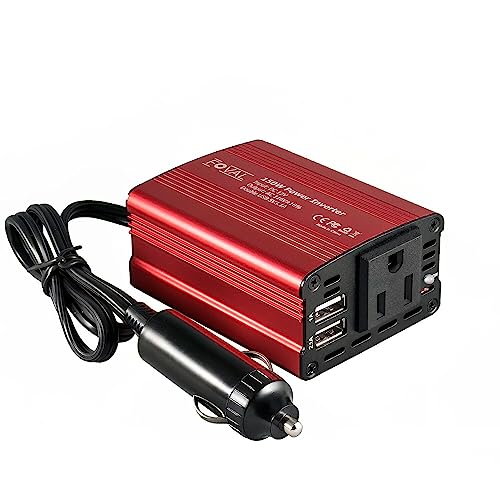
When you need a compact, plug-and-go inverter for light-duty daily use and you don't want to spend much to get there, the FOVAL 150W delivers reliable basic functionality in a genuinely pocketable package. At 3.2 by 2.5 by 1.5 inches and just over 8 ounces, this is the inverter you toss in your glove box or laptop bag as a backup power solution — one AC outlet for laptops and small appliances, plus dual USB ports delivering up to 3.1A total for simultaneous phone and tablet charging. The aluminum shell construction punches above its price point in terms of heat management and durability, and the classic red colorway has made this one of the most recognizable budget inverters on the market since its introduction.
The 150W output ceiling is genuinely useful for the scenarios this inverter is designed for — charging a laptop while you navigate, powering a breast pump during a long commute, running a CPAP travel adapter, or keeping a gaming console alive during a road trip. The dual USB ports handle fast charging for most modern smartphones even while the AC outlet is in use, which is a more capable simultaneous-use scenario than many buyers expect from a unit at this price point. The cigarette lighter plug design means zero installation — you pull it out of the box, plug it in, and you have power within seconds.
The practical limitations are exactly what you'd expect at 150W: no power tools, no kitchen appliances, nothing with a significant motor load. You also get one AC outlet rather than two, which means if you need to run two AC devices simultaneously, you'll want to step up to the BESTEK 300W or one of the higher-wattage units in this guide. But as an entry-level mobile power solution for everyday light loads, the FOVAL 150W earns its reputation through consistent performance, reliable protection circuitry, and a price point that makes it easy to keep one in every vehicle you own. For more on understanding how power inverters convert DC to AC electricity, the technical fundamentals are well-documented.
Pros:
Cons:
The single most important spec on any inverter is its continuous wattage rating — the power it can sustain indefinitely, not just for a few seconds during a surge. Before you buy, add up the wattage of every device you plan to run simultaneously, then add a 20–25% buffer to give the inverter room to operate without constantly running near its limit. A laptop draws roughly 45–90W, a small CPAP machine uses 30–60W, and a portable power tool can draw 300–600W on startup. Running an inverter at or near its rated maximum for extended periods shortens its lifespan and increases the risk of thermal protection shutdowns during critical moments.
The peak or surge wattage rating — typically double the continuous rating — matters for devices with motors or compressors, which pull significantly more current during startup than during steady-state operation. A refrigerator compressor, for example, might draw 600W continuously but spike to 1800W at startup, meaning you need an inverter with enough surge capacity to absorb that spike without tripping. Always check the startup wattage of your highest-draw device before sizing your inverter, and don't assume continuous ratings alone tell the whole story.
Modified sine wave inverters produce AC power that approximates the smooth sine wave of grid electricity using a stepped waveform — functional for most resistive loads like incandescent lights, simple battery chargers, and heating elements, but potentially problematic for sensitive electronics. Pure sine wave inverters produce AC power with total harmonic distortion below 5% — indistinguishable from utility grid power — making them safe for CPAP machines, variable-speed motor tools, high-end audio equipment, medical devices, and any electronics with switching power supplies that are sensitive to waveform quality. The price premium for pure sine wave is real, but so is the protection it provides for your expensive connected devices.
Your vehicle's cigarette lighter socket is fused at 10–20 amps, which limits it to powering inverters up to about 150–300W safely. Beyond that threshold, you need to wire directly to the battery using heavy-gauge cables — typically included with higher-wattage units. Direct battery connection gives you access to your battery's full current capacity but requires a proper installation with correctly sized cables and an inline fuse to protect your vehicle's electrical system from a short circuit. If you're considering a permanent installation in a work truck or RV, factor in the cost and effort of proper wiring when comparing inverter options at different wattage tiers.
A quality inverter protects itself and your devices from overload, over-temperature, under-voltage, over-voltage, and short circuits through automatic shutdown systems that prevent damage rather than requiring a trip to a repair shop. Look for units with comprehensive protection suites — the Ampeak 1000W's 17-point protection system is an example of thorough coverage — and pay attention to safety certifications like ETL approval under UL STD 458, which indicates independent laboratory testing rather than manufacturer self-certification. An inverter that lacks proper protection circuitry is a liability in a vehicle where electrical fires have catastrophic consequences.
You can run a car power inverter with the engine off, but doing so will drain your vehicle's battery depending on the load and duration. A 100W load running for one hour draws approximately 8–9 amp-hours from a 12V battery, and most vehicle batteries have 40–70 amp-hours of usable capacity before you risk not being able to start the engine. For anything beyond light phone charging with the engine off, start the engine periodically to recharge, or invest in a deep-cycle auxiliary battery specifically for inverter use.
Most laptops draw between 45 and 90 watts continuously, so a 150W or 300W inverter is sufficient for charging a single laptop comfortably. If you're also charging phones via USB ports on the inverter and running another small device simultaneously, step up to a 300–500W unit to keep yourself well within the inverter's continuous rating. Always check your laptop's power adapter label for its actual watt rating, as gaming laptops can draw significantly more than ultrabooks.
For CPAP machines, medical devices, variable-speed power tools, high-end audio equipment, and any electronics with sensitive switching power supplies, a pure sine wave inverter is worth every dollar of the premium. Modified sine wave power can cause these devices to run hot, produce audible buzz, charge inefficiently, or fail prematurely. For simple loads like phone chargers, LED lights, and basic laptop adapters, modified sine wave works adequately — so the justification depends entirely on what you're powering.
Most quality inverters with LCD displays show real-time input voltage from your battery — a reading below 11.5V under load indicates the battery is being stressed, and below 10.5V most inverters will automatically shut down to prevent battery damage. If your engine is running, your alternator should maintain 13.5–14.5V at the battery terminals, meaning you can run modest loads indefinitely. Without the engine running, watch your battery voltage display carefully and recharge before it drops below 12V under load.
A 1000W inverter drawing from a 12V battery requires approximately 83 amps of current, which means you need 4 AWG wire at minimum for runs up to six feet, and 2 AWG for longer runs to manage voltage drop and heat. A 2000W inverter at full load draws around 167 amps, requiring 1/0 AWG or 2/0 AWG cable for safe operation. Always include an appropriately sized inline fuse as close to the battery positive terminal as possible — the fuse protects the wire, not the inverter, and must be rated for the wire gauge you're using rather than the inverter's output wattage.
Running a small window air conditioner requires a minimum of 1000–1500W continuous capacity with adequate surge headroom for compressor startup — achievable with the Ampeak 2000W pure sine wave unit, though you'll need a running engine and direct battery wiring. A standard microwave oven draws 800–1500W depending on its rated output, placing it within reach of higher-wattage inverters as well. Neither application is practical with any cigarette lighter inverter. For RV cooling needs specifically, our guide to the best RV air conditioners of 2026 covers purpose-built solutions that integrate more cleanly with vehicle electrical systems.
 |
 |
 |
 |

About Liam O'Brien
Liam O'Brien has spent over a decade buying, field-testing, and evaluating automotive tools with a focus on what actually performs in a real DIY garage rather than what markets well on a spec sheet. His hands-on experience spans hand tools, diagnostic equipment, floor jacks, socket sets, and specialty automotive gear across a wide range of brands and price points. At CarCareTotal, he covers automotive tool and equipment reviews, garage setup guides, and buying advice for home mechanics.
Get some FREE car parts & gear.. Or check out the latest free automotive manuals and build guides here.
Disable your ad blocker to unlock all the hidden deals. Hit the button below 🚗
| | | |
